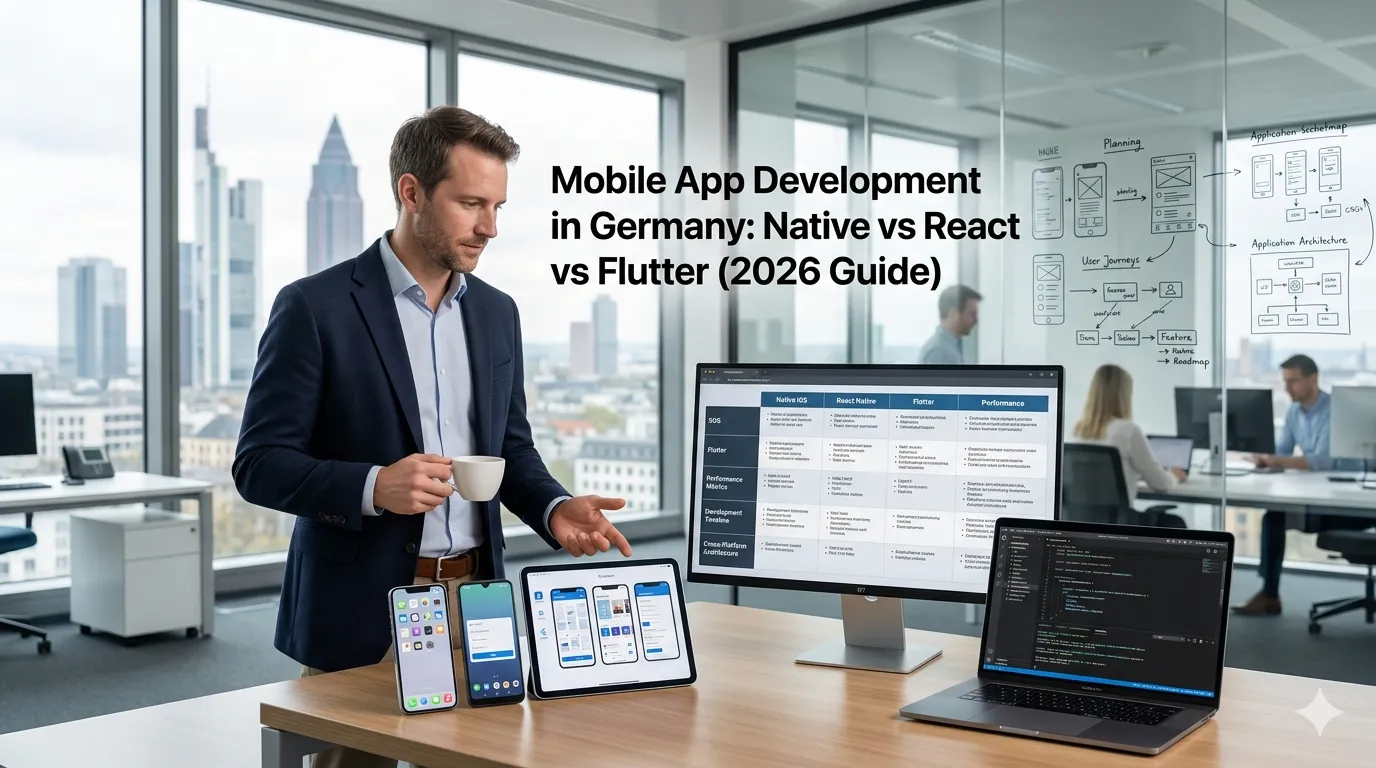
Mobile app development for the German market in 2026 is more diverse than ever. The choice between native iOS/Android, React Native, Flutter, and PWA isn’t a religious decision — it’s a trade-off between time-to-market, performance, team familiarity, and long-term maintenance cost. Get the trade-off wrong and you’ll spend €80,000+ rebuilding by year two.
This guide walks through what mobile app development Germany actually looks like in 2026: realistic EUR build costs by stack, the German-specific build essentials (DSGVO consent flows on mobile, payment integrations, German App Store / Play Store legal pages), and the agency-vetting questions that separate teams shipping production apps from those shipping prototypes.
What types of mobile apps do German businesses build in 2026?
Five common categories:
- Companion app to existing web product — extends a SaaS or e-commerce experience to mobile.
- Mobile-first product — the primary product experience is the app (Tinder-style, Strava-style).
- Internal employee / field-service app — Mittelstand workforce tooling.
- DiGA (prescription digital health app) — see our healthcare web development guide.
- B2C content or community app — branded content, community access, loyalty.
Each category has different performance requirements, App Store/Play Store scrutiny, and DSGVO complexity.
What are the realistic stack choices in 2026?
Four serious options:
Native iOS (Swift / SwiftUI) + Native Android (Kotlin / Jetpack Compose)
Best performance, best access to platform APIs, best long-term maintenance for performance-critical apps.
Pros: native feel, full platform-API access, best on platform-specific features (widgets, complications, Live Activities, Material You). Cons: 2x development cost (build twice), 2x maintenance, harder hiring for both stacks. Best for: performance-critical apps, apps using cutting-edge platform features, apps with serious budget.
React Native (with Expo)
Most popular cross-platform choice in 2026. Single codebase compiles to iOS + Android.
Pros: ~80% code sharing, React/TypeScript fluency reuses web team skills, mature ecosystem, Expo dev experience is excellent. Cons: performance gap vs. native (closing each year but still real), platform-specific bridges occasionally needed. Best for: SaaS companion apps, content + community apps, most B2C apps where 90% performance is fine.
Flutter (Dart)
Google’s cross-platform framework, very strong on UI consistency.
Pros: pixel-perfect rendering across platforms, strong performance, single codebase, expanding to web + desktop. Cons: Dart is less common than TypeScript in the German developer pool, smaller library ecosystem than RN. Best for: brand-driven UI apps where consistency matters, teams with strong Dart depth.
PWA (Progressive Web App)
Web app installable on a device. No app store distribution.
Pros: lowest cost, fastest iteration, no app store gatekeeping. Cons: limited native API access, less discoverable, iOS support has caught up but still has gaps. Best for: internal tools, low-touch B2B, content-heavy products. See our PWA development guide.
Most German SaaS companion apps in 2026 are best built with React Native and Expo.
DiGA and regulated healthcare apps usually require Native development or carefully architected React Native setups.
Brand-focused apps often work best with Flutter or fully Native development.
What does mobile app development cost in Germany in 2026?
Realistic EUR ranges.
Native iOS or Android only
- Simple companion app: €25,000–€60,000
- Mid-complexity app: €60,000–€180,000
- Complex app with backend integration: €180,000–€500,000+
Native iOS + Android (both)
- Add ~70–90% over single-platform native cost (some shared backend work).
- Total: €45,000–€900,000+
React Native (iOS + Android shared codebase)
- Simple companion: €25,000–€55,000
- Mid-complexity: €55,000–€150,000
- Complex: €150,000–€400,000+
Flutter (iOS + Android shared codebase)
- Similar ranges to React Native (often slightly higher due to smaller talent pool in Germany).
PWA
- See our PWA development guide — typically 40–60% of native or RN equivalent.
Add 20–30% for first-year maintenance (OS updates, store policy changes, bug fixes).
For broader context see our web development cost in Germany guide.
How do you choose between the stacks?
A 5-question filter that resolves most cases:
Do you need cutting-edge platform features?
(Apple Watch complications, iOS Live Activities, Android Material You theming, advanced ARKit/ARCore.)
- Yes → Native.
- No → RN, Flutter, or PWA all work.
Does your team already use React/TypeScript?
- Yes → React Native maximizes code/skill reuse.
- No (Dart team, or fresh hire) → Flutter is competitive.
Is performance per-screen critical?
Streaming video editing, games, AR — yes. CRUD-style apps — no.
- Critical → Native.
- Standard → RN, Flutter, PWA.
Do you need App Store presence?
- Yes → Native, RN, or Flutter.
- No (internal tool, B2B) → PWA may be cheapest.
What’s your hiring market?
- Larger React Native pool in Germany than Flutter
- Native iOS (Swift) pool is large; native Android (Kotlin) pool is large but smaller than iOS
What’s special about App Store / Play Store launch in Germany?
Five things German publishers must handle that US-default workflows often miss:
German metadata and screenshots
App name, description, keywords, screenshots in German. Both stores have German storefronts. Skipping German metadata reduces conversion 30–60% with German users.
Impressum + Datenschutzerklärung in app stores
App Store and Play Store metadata require Impressum / privacy policy links. Both must be German-language for German users.
DSGVO consent on first launch
Before any analytics SDK fires (Firebase Analytics, Sentry, Adjust, Branch, Meta SDK), explicit consent. Gate ATT (App Tracking Transparency) properly on iOS.
German trial and subscription disclosure
If you offer trials and subscriptions, German consumer law requires specific disclosures around auto-renewal, cancellation, and price changes.
App-Tracking-Transparency (ATT) defaults
iOS ATT — most German users decline. Plan attribution and analytics around the assumption that the majority of users won’t grant tracking permission.
How does DSGVO shape mobile apps in Germany?
Six architectural decisions:
Consent before tracking SDKs fire
Initialize tracking SDKs only after consent. Common pitfall: Firebase Analytics fires before user makes a choice.
EU data residency
Backend data, push tokens, user profile data — all EU regions. See our B2B SaaS development guide for backend architecture.
Granular consent in-app
Separate toggles for analytics, marketing, crash reporting. Easy to revoke from settings.
Data export and erasure
User-initiated export and account deletion flows in-app. Both Apple and Google now require “Account Deletion” flows; do it well.
Encryption in transit and at rest
TLS for all network calls. iOS Keychain / Android Keystore for sensitive client-side data.
Third-party SDK disclosure
Every SDK that processes user data must be disclosed in Datenschutzerklärung. App Store “App Privacy” labels and Play Store “Data Safety” sections must be accurate.
For more DSGVO context see our GDPR compliance guide.
What German integrations does a mobile app typically need?
Six categories:
Payments (in-app + external)
- Apple In-App Purchase (mandatory for digital goods on iOS)
- Google Play Billing (mandatory for digital goods on Android)
- Stripe SDK for physical goods or services outside app store rules. See our Stripe SEPA integration guide.
- PayPal mobile SDK
- Klarna mobile SDK
Push notifications
Firebase Cloud Messaging (FCM) with explicit consent. APNs handled via FCM or directly.
Auth
Apple Sign In (mandatory on iOS if you offer third-party login), Google Sign In, Microsoft 365, Auth.js / Clerk EU for backend.
Analytics
Plausible mobile (very limited), self-hosted PostHog EU, Mixpanel EU region, Firebase Analytics with DSGVO consent gating.
Crash reporting
Sentry (EU region), Crashlytics with DSGVO consent gating.
Backend
Most mobile apps need a backend — see our B2B SaaS development guide for backend stack choices.
What are the most common mobile app build mistakes German founders make?
Four patterns:
Picking stack without considering team
Hiring Flutter contractors when the team is React-fluent forces a 6-month learning curve. Pick the stack that matches your team’s depth.
Skipping ATT and DSGVO consent until app review
App Store rejections happen here. Build consent flows from week one.
Underestimating App Store submission overhead
First submission often takes 2–4 review iterations. Plan for it in the timeline.
Ignoring backend coupling
Mobile apps without a strong backend strategy hit limits fast. Plan the backend in parallel — see our B2B SaaS development guide.
When should you skip native app and ship a PWA?
PWA wins when:
- App is content-heavy, not interaction-heavy
- You don’t need camera, GPS at-high-rate, biometric auth
- Discoverability via App Store doesn’t matter (internal, B2B users)
- You want fastest iteration
See our PWA development guide for the full framework.
When does it make sense to hire vs. agency for mobile?
- Hire native iOS/Android developer when you have 12+ months of mobile work and need institutional knowledge.
- Hire React Native developer when your existing React team can manage one shared codebase.
- Hire an agency for fixed-scope mobile builds with handover to in-house team later.
For developer hiring see our hire React developer guide — React Native rates closely mirror React rates.
Frequently Asked Questions About Mobile App Development in Germany
€25,000–€60,000 simple; €55,000–€180,000 mid; €150,000–€500,000+ complex; +70–90% for both-platform native.
RN has larger German talent pool and ecosystem; Flutter has best UI consistency. Pick by team depth.
Native for performance/platform features; cross-platform for most SaaS+B2C; PWA for internal tools.
3–6 months simple; 6–12 mid; 9–18 complex with backend.
Yes for native; no for React Native or Flutter — one team ships both.
Consent-gated SDKs, EU data residency, in-app granular toggles, export and deletion flows, SDK disclosure.
Missing Account Deletion, bad ATT, wrong IAP usage, misleading metadata — read both stores’ guidelines.
Yes — Eastern Europe/Portugal RN+Flutter talent at 40–60% lower rates.
Need help scoping a mobile build?
If you’re planning a mobile app for German users and want a 30-minute scoping conversation about stack, integrations, and realistic EUR budget, book a meeting or send details via our contact page.
Need expert help? Gem Programmers provides custom website development for businesses in Germany, Austria and Switzerland. Request a free, no-obligation quote and get a clear plan with scope, timeline and price.