
If you’re trying to budget a project this year, the web development cost Germany 2026 market data is wildly inconsistent — quotes for the same scope can range from €3,000 to €60,000, and most “pricing guides” online either copy each other or are written by agencies pricing themselves into a corner. This guide gives you honest EUR ranges by tier, what’s actually included at each price point, and where founders consistently get burned.
Whether you run a GmbH in Berlin, a Mittelstand operation in NRW, or a SaaS startup in Munich, the goal is the same: a realistic number you can defend to a co-founder, board, or Steuerberater.
What does web development cost Germany 2026 actually include?
Before any number makes sense, you have to know what’s inside a quote. A €15,000 website in Germany typically covers:
- Discovery & scoping (1–2 weeks)
- UX & UI design (Figma)
- Frontend & backend development
- CMS setup (WordPress, Webflow, or custom)
- Basic SEO foundation (technical, meta, schema)
- GDPR / DSGVO compliance (cookie banner, AVV, Impressum)
- Mobile responsiveness & QA
- Launch & a short post-launch support window
What it doesn’t include — and where surprise invoices come from — are content writing, professional photography, ongoing maintenance, marketing integrations, paid stock assets, and multilingual translation. Make sure these are spelled out in your quote.
What are the honest EUR cost ranges by project tier in 2026?
These are real ranges based on the German market right now. Numbers are exclusive of VAT (19% Umsatzsteuer where applicable).
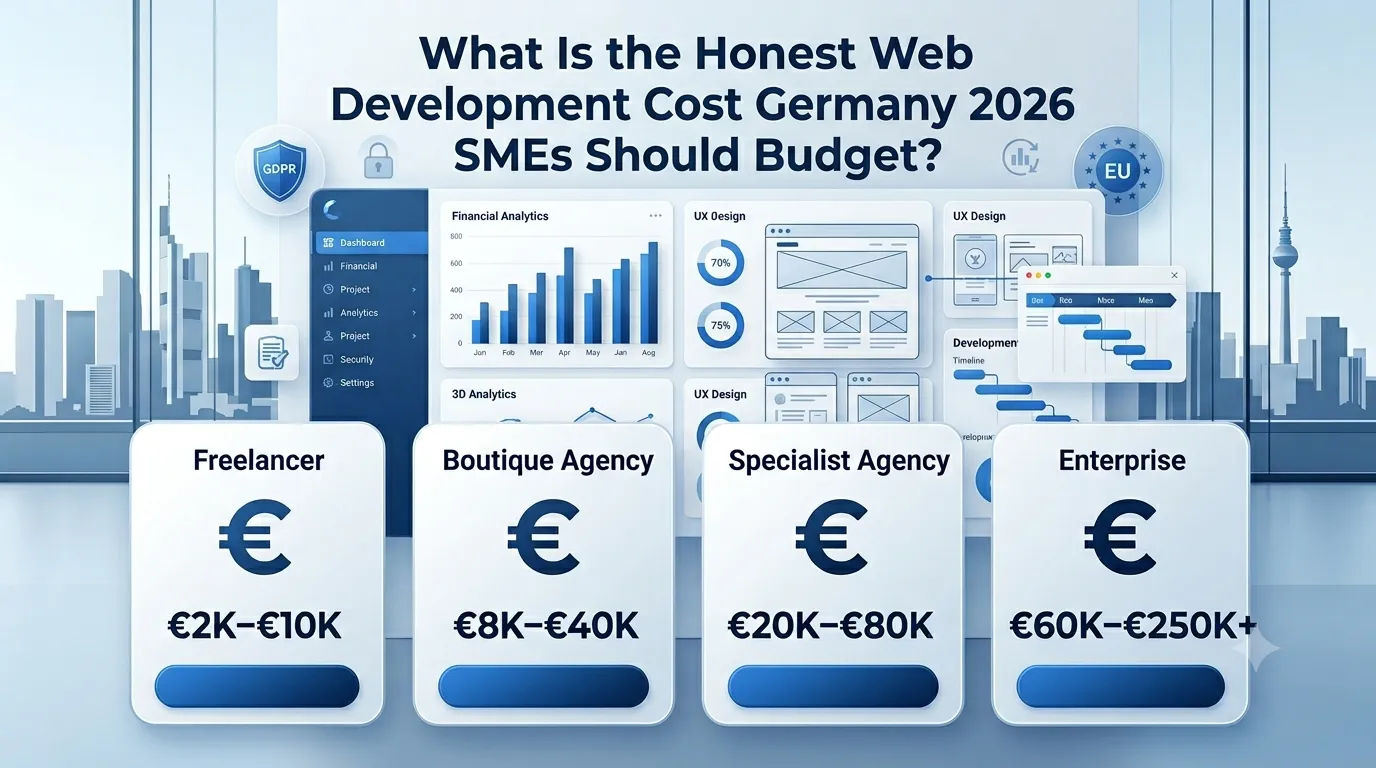
| Tier | Typical EUR cost | Who it fits | What’s inside |
|---|---|---|---|
| Solo freelancer | €2,000 – €10,000 | Small brochure, side project, MVP landing page | 3–8 pages, WordPress theme, basic SEO, single freelancer risk |
| Boutique agency | €8,000 – €40,000 | Established SME, GmbH, services business | Custom design, multilingual, GDPR done right, light integrations |
| Mid-tier specialist | €20,000 – €80,000 | Scale-ups, SaaS MVPs, complex shops | Bespoke UX, CRM/ERP integration, API work, dedicated team |
| Enterprise / Plus | €60,000 – €250,000+ | DAX suppliers, multi-region brands, Plus stores | Headless commerce, multi-country rollouts, SLAs, security audits |
A quick sanity rule: if a quote falls 30%+ below the bottom of its tier, something is missing from scope. The rework cost usually erases the “savings” within six months.
Why does the German vs UK and US rate comparison mislead?
Founders moving from US/UK markets often assume German agencies are cheap. The headline rate per hour is sometimes lower — €80–€150/hr for a boutique in Berlin vs. $150–$250 in NYC — but a few hidden factors flip the picture:
- German agencies invest more in compliance (GDPR, accessibility BFSG, AGB).
- Discovery phases are longer and more thorough.
- Mittelstand clients expect higher documentation standards.
- 19% VAT applies to most domestic invoices.
The total project cost often lands close to UK pricing once these are normalised. Expect roughly EU-average for quality, not a discount.
Where are the hidden costs in a German web project?
These are the line items that turn a €15k project into a €22k project if you don’t catch them early:
- Content writing & copy editing. Native-English or bilingual copywriting is rarely included by default. Budget €1,500–€5,000 for a small site.
- Translation / localization. A proper EN ↔ DE website with hreflang, native translation, and proofread copy adds 30–60% to a base build.
- Stock photography / illustrations. Licensing fees, custom illustrations, or AI-generated assets all carry real cost.
- Maintenance retainer. Plugin updates, backups, security patching: typically €60–€400/month depending on stack and traffic.
- Third-party tools. Hetzner / IONOS hosting (€10–€80/mo), email service (Brevo/CleverReach), analytics (GA4 server-side), CMP (Borlabs, Usercentrics).
- Compliance audits. BFSG accessibility audits, formal GDPR reviews, penetration tests — these are extras at every tier.
A clean way to read any quote is to ask: “What is not in this number?”
How do BAFA, Digital Jetzt, and public funding work for websites in Germany?
This is where many German SMEs leave money on the table.
- BAFA “Förderung von Unternehmensberatungen für KMU” can subsidise consulting around digital strategy — up to 50% of qualifying consulting fees, capped per year.
- Digital Jetzt (BMWK) historically supported digitisation investments for KMU with grants up to €50,000, dependent on regional rules and renewal.
- Länder-level programs. Regional bodies in Bayern, NRW, Baden-Württemberg, and others run their own digital-transformation grants.
Funding rules change year to year. Always check current eligibility on the official BAFA and BMWK sites, or work with an agency that has a BAFA-listed consulting partner.
What’s a realistic budget template for a German SME?
Here’s an honest “typical” budget for a mid-sized German service business (€2M–€20M annual revenue) building a serious new website in 2026:
- Discovery & strategy: €2,000 – €6,000
- UX/UI design: €4,000 – €12,000
- Development & CMS: €8,000 – €25,000
- Content & copy: €2,000 – €6,000
- Multilingual translation: €1,500 – €5,000
- GDPR / cookie / legal pages: €500 – €2,000
- QA & launch: €1,000 – €3,000
- Year-1 maintenance retainer: €2,000 – €5,000
Total range: roughly €21,000 – €64,000 for a polished, conversion-focused B2B website with proper compliance — without counting paid media or major integrations.
If this number surprises you, that’s the conversation worth having before you sign anything. If it doesn’t surprise you, you’ve probably been quoted before.
Which pricing model works: fixed price, time and materials, or retainer?
How an agency prices reveals a lot about how they work.
- Fixed price. Best for well-scoped projects. Protects you only if discovery is thorough and signed off in writing. Bad sign: a fixed price without a written scope document.
- Time & materials (T&M). Honest for ambiguous or evolving work. Risk: scope creep without strong project management.
- Retainer. Monthly engagement (€2,000–€15,000/mo typically). Best for ongoing optimisation, maintenance, growth marketing alongside dev.
For most German SMEs and GmbH founders, a fixed-price MVP build followed by a monthly retainer is the cleanest structure.
What are cheap quotes actually hiding?
Cheap proposals usually omit one or more of the following — and you discover it three weeks in:
- No real discovery phase (just “we’ll figure it out”)
- No GDPR / DSGVO compliance work
- No mobile QA across real devices
- No source code handover or IP transfer clause
- No staging environment
- No accessibility considerations (relevant under BFSG)
- No multilingual handling (no hreflang, no DE/EN parity)
If you’re seeing a quote 50% below the rest, ask the agency to point to where those items are in their proposal. They usually aren’t.
How do you evaluate a web development quote like a pro?
Use this rubric on every proposal before you sign:
- Is scope written line-item by line-item, in English, in EUR?
- Is there a discovery phase with a deliverable (a written scope document)?
- Is the timeline broken into milestones with payment tied to acceptance?
- Is GDPR / DSGVO explicitly named, with AVV (DPA) attached?
- Are change requests priced upfront (€/hr or €/change)?
- Is the source code yours, in your Git org, from day one?
- Is post-launch support clearly described (response times, scope, cost)?
A quote that fails three or more of these is not cheap — it’s risky.
What do German SMEs actually get for €25,000?
To make the abstract numbers concrete, here’s what a €25,000 (excl. VAT) project from a quality boutique agency typically delivers in Germany:
- Discovery workshop with a senior strategist
- 8–14 weeks delivery timeline
- Custom Figma design (homepage + 6–10 templates)
- WordPress or Webflow build, or lightweight headless setup
- Bilingual (DE/EN) with hreflang done right
- GDPR/DSGVO compliance package (banner, AVV, Impressum, AVV with hosting)
- Basic technical SEO foundation
- GA4 + server-side tagging (optional)
- 30-day post-launch support window
- Full source code, admin handover, training video
If your quote at €25k doesn’t include at least 8 of these, the gap is in scope, not price.
How do you compare agencies without wasting three weeks?
You don’t need to interview ten vendors. Three good ones is enough if you brief them identically. Send each:
- A short business summary and goal
- Top three pages / templates you need
- Integrations required (CRM, ERP, payments)
- Languages and accessibility requirements
- Realistic timeline and budget range (not a number)
You’ll see immediately which agency reads carefully, asks smart follow-up questions, and which one sends a templated PDF.
For a deeper, related read, our How to Hire a Web Developer in Germany If You Don’t Speak German guide walks through the English-first hiring angle.
Frequently asked questions about web development cost Germany 2026
For a serious B2B SME website expect €20,000–€50,000. Simple brochure sites land closer to €5,000–€12,000.
Scope hidden inside the price, compliance work included or not, and the experience of the team explain most of the gap.
Most German WordPress builds for SMEs land between €4,000 and €30,000 depending on customisation, integrations, and design complexity.
BAFA consulting subsidies, Digital Jetzt (current eligibility permitting), and Länder digital transformation grants can offset part of the cost.
Fixed price works when discovery produces a written scope. T&M is honest for evolving work. Most projects combine fixed build plus monthly retainer.
Reputable agencies show net plus 19% VAT separately for B2B. Cross-border EU B2B usually uses reverse charge.
Content writing and translation. Budget €2,000–€8,000 for native-quality bilingual copy.
Ready to plan your web development cost Germany 2026 budget?
The honest answer to “how much should this cost?” is: it depends on scope, but the floor for a serious German SME website is around €15,000 and the ceiling for a mid-market project is around €80,000. Anything substantially below the floor usually means scope, compliance, or quality is being cut.
Want a transparent EUR-denominated quote with scope written line-by-line in English? Our team specialises in working with English-first founders and German SMEs. You can request a free quote on our website development services page or book a 30-minute scoping call directly.