
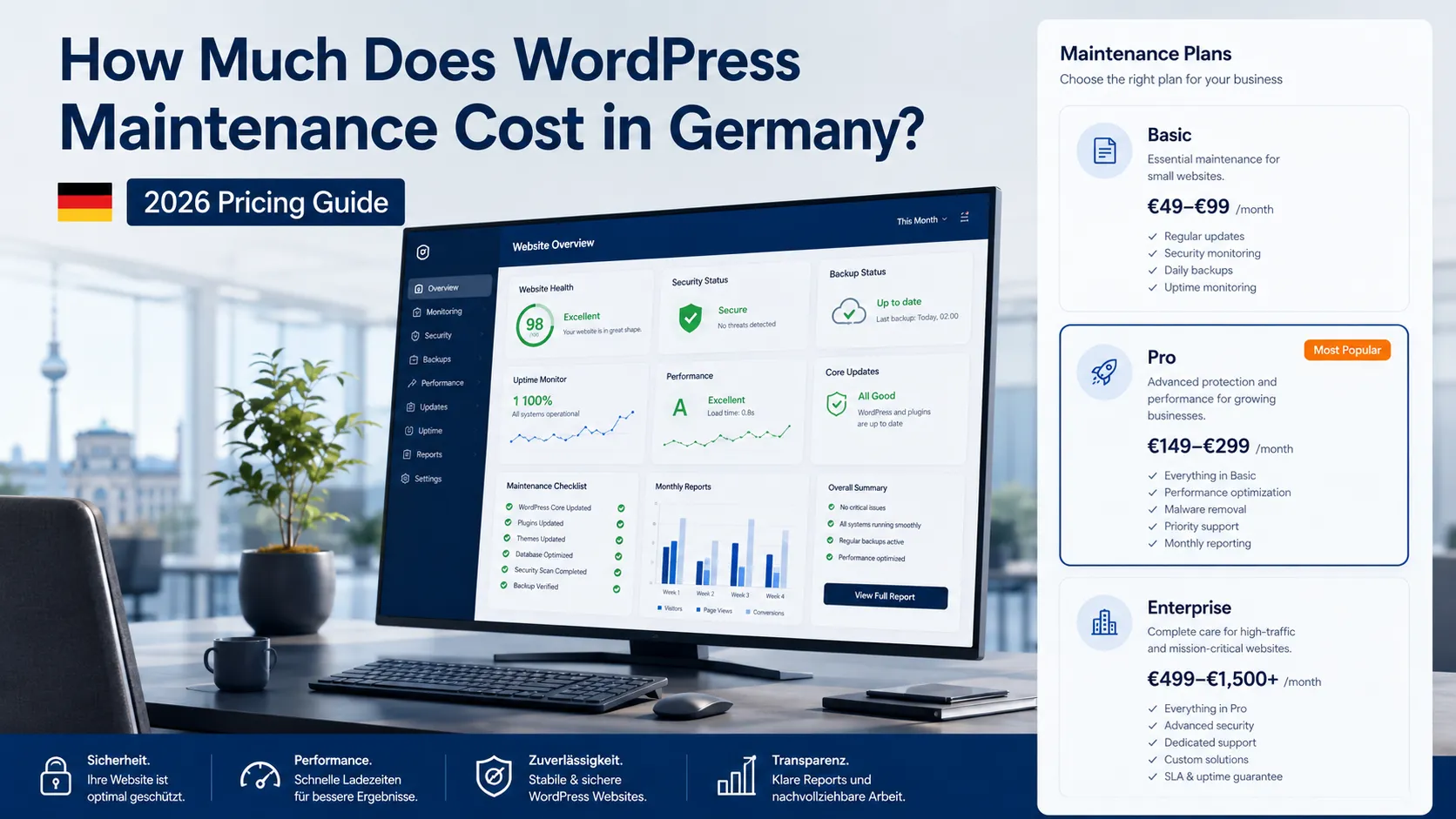
WordPress maintenance plan cost Germany is not a one-time purchase. It is a living piece of infrastructure that needs the same disciplined upkeep as a car or a piece of office equipment — small regular service costs a fraction of a single emergency repair.
German business owners rarely ask whether maintenance is necessary when they call us. They ask how much it should cost and what it should include — because the market is crowded with opaque retainers, fake “WordPress care plans” that deliver almost nothing, and surprise invoices when hackers force businesses into emergency recovery.
This guide gives you transparent EUR pricing for WordPress maintenance in Germany in 2026, breaks down what a real care plan actually includes at each tier, and explains how to choose between DIY, freelancer, and agency models for your specific situation.
Why does WordPress need ongoing maintenance at all?
WordPress powers roughly 43% of the web in 2026, which makes it the single most attractive target for opportunistic attackers. Each week, dozens of plugins and themes ship security patches. Each month, WordPress core releases at least one update. On a quarterly basis, PHP and database engines reach end-of-support windows.A WordPress site that does not receive structured maintenance for twelve months is not a site that has saved money — it has accumulated risk in the context of WordPress maintenance plan cost Germany.
Three concrete things go wrong with un-maintained WordPress sites.
Security incidents happen. Roughly 90% of compromised WordPress sites we have recovered ran on outdated plugin versions. We covered the recovery playbook in our WordPress hacked emergency guide; the work and cost of incident recovery is typically 5–20x the cost of the maintenance plan that would have prevented it.
Performance decays. Plugins accumulate, database tables bloat, image libraries balloon, caching plugins fall behind WordPress core changes. A site that loaded in 1.2 seconds at launch is loading in 4.5 seconds two years later — and a slower site is a worse-ranking, lower-converting site. We unpacked the diagnosis in our slow WordPress fix guide, in the context of WordPress maintenance plan cost Germany.
Compatibility breaks.
WordPress 6.x to 7.x transitions, PHP 8.2 to 8.4 upgrades, MariaDB engine changes, and Cloudflare API updates can each break plugins that developers no longer maintain or update.
The site goes from “fine” to “white screen of death” in one server reboot. Without a maintenance contract in place, the rebuild bill arrives during whichever hour you can least afford it.
What should a WordPress maintenance plan actually include?
The market is full of “WordPress care plans” that consist of an automated plugin updater and a quarterly email saying “everything looks fine.” That is not maintenance. A real maintenance plan covers seven categories of work; what changes between tiers is depth, frequency, and response speed.
Updates and patching
Core WordPress, all installed plugins, the active theme, and PHP are patched on a defined cadence. Critical security patches are applied within 24–48 hours of release. Non-critical updates are batched weekly and tested on a staging site before going to production. Plugin updates that introduce breaking changes are flagged for review rather than blindly applied.
Backups and restore testing
A proper backup strategy follows the 3-2-1 rule: three copies of the data, on two different media, with at least one off-site. For WordPress this typically means daily full backups, a copy stored on the same server (for fast restore), a second copy stored on independent infrastructure (Hetzner Storage Box, AWS S3, or Backblaze B2), and a documented retention policy in the context of WordPress maintenance plan cost Germany. Backups that have never been tested are not backups — once a quarter, a restore test should be run on a sandbox and signed off.
Uptime and performance monitoring
The site is pinged every minute from at least one external location. An incident triggers an alert to a defined response channel (email, Slack, or SMS for the highest tiers). Performance metrics — load time, Core Web Vitals, server response time — are tracked weekly and reported monthly.
Security hardening and scanning
Wordfence, Sucuri, or MalCare scan files and the database for known malware patterns. Brute-force login protection, two-factor authentication, login URL changes, and file integrity monitoring are configured. The Datenschutzbehörde 72-hour breach notification process is documented in advance so it is not improvised under stress.
Database optimisation
Post revisions, transient data, expired sessions, and orphaned metadata are cleaned monthly. Tables are optimised and indexed. Search functions are kept performant as content grows. This is often the single biggest win for old sites — a database that grew to 4 GB over five years compresses to 600 MB without losing any user-visible data.
Content edits and small fixes
Most plans include a defined monthly allowance of “small change” work — fixing a typo, adding a page, swapping a hero image, updating a phone number. This is the work that an in-house marketer should not have to ticket up and an agency should not bill hourly for. The threshold for “small” varies by tier.
Monthly reporting
A summary email or PDF lists what was updated, what incidents occurred and how they were resolved, current performance and uptime metrics, and any recommendations. This is the only document the business owner actually reads, so it matters.
What does WordPress maintenance cost in Germany in 2026?
Honest, transparent monthly EUR pricing for the three tiers you will see across the German market.
Basic tier: €49 to €99 per month
The right plan for a brochure-style Visitenkartenseite or a small landing page that is critical to lead generation but not transactional. Covers weekly plugin and core updates, daily backups with 14-day retention, basic uptime monitoring, monthly security scan, and roughly 30 minutes of small content edits per month. Response time for issues: next business day. Suits law firms, dental practices, small B2B service brands, and personal-brand sites for coaches or consultants.
Pro tier: €149 to €299 per month
The right plan for an active B2B marketing site, a content-driven blog, or a small WooCommerce shop. Covers daily plugin and core updates with staging-site testing, daily backups with 30-day retention, uptime monitoring with 5-minute checks, weekly malware scans, monthly database optimisation, monthly performance audit, Google Search Console error review, and roughly 2 hours of small edits per month. Response time: 4 business hours, with an emergency hotline for security incidents. Suits Mittelstand brands, growing SaaS companies, and any site doing meaningful organic traffic.
Enterprise tier: €499 to €1,500+ per month
The right plan for a high-traffic e-commerce site, a multilingual Mittelstand site, or a B2B SaaS marketing engine where downtime has measurable revenue impact. Covers same-day patching for security issues, real-time uptime monitoring with PagerDuty-style alerting, daily off-site backups with 90-day retention plus monthly cold backups, advanced security (Wordfence Premium, Cloudflare WAF, geo-blocking), monthly penetration scan, quarterly load testing, dedicated technical account manager, and 6+ hours of monthly development. Response time: 1 hour for emergencies, 24/7 on the highest tier. Suits sites where downtime costs €500+ per hour.
For reference: a site that generates €30,000 per month in revenue and runs on a Basic plan for €70 per month is spending 0.23% of revenue on hosting hygiene. A site on Enterprise at €800 per month is spending 2.7%. Industry benchmarks suggest 1–3% of revenue is the right band for a sensible site. Anything lower is technical debt accumulating quietly; anything higher should be questioned.
DIY versus freelancer versus agency: which model fits?
The three operating models all work, with very different tradeoffs.
DIY in-house WordPress maintenance
Works if you have a technical person on staff (or yourself if you are technical) who can dedicate a real 2–4 hours per month and is comfortable touching servers when something breaks at 22:00 on a Sunday. Total cost: roughly €30 per month in tooling (Wordfence Premium, UpdraftPlus Premium, ManageWP Mini, uptime monitor) plus internal time. Hidden cost: when the person leaves, the institutional knowledge leaves with them and the next emergency catches the business unprepared.
Freelancer maintenance retainer
Works if you have a long-term, trusted relationship with a single WordPress developer who is reliable, German-speaking (or English-fluent for your operations), and reachable when it matters. Cost: €80 to €250 per month typically. Risk: single point of failure. A freelancer on holiday, sick, or moving jobs leaves your site exposed for whatever window that lasts. Many German SMEs run on this model successfully for years until the day the freelancer disappears.
Agency maintenance retainer
Works if you want SLAs, multiple engineers covering your site, documented processes, and a real support channel during business hours. Cost: €150 to €1,500+ per month depending on tier. Trade-off: higher monthly bill, less direct personal relationship, but no single-point-of-failure risk. The right answer for sites where downtime materially affects revenue or where compliance (GDPR breach notification, BFSG accessibility maintenance, IT-Sicherheitsgesetz logging) matters.
We tend to recommend freelancer retainers for sites under €500k annual revenue and agency retainers above that line — the failure mode of single-developer dependence becomes too expensive to absorb at scale.
What questions should you ask a German WordPress maintenance provider?
Before signing any retainer, send these questions by email. The answers tell you more than any sales call.
What is your update cadence and do you test on staging before production? Where are the backups stored physically, and what is the AVV situation for that storage? What is your response time SLA in and outside business hours? What does the monthly report actually look like — can you send me a real example? Which plugins or themes are NOT supported by your plan? What happens if my site gets hacked despite your plan — is recovery included or billed separately? Can I cancel monthly, or is there a minimum term? What is the off-boarding process if I leave — full database and file export, in what format, at what cost?
Vendors who answer in one email round-trip with specifics are usually the ones worth signing. Vendors who push for a phone call before answering anything concrete are usually selling to your fear rather than offering a real product.
What is the real cost of skipping WordPress maintenance?
Three honest scenarios from our recovery work.
A Mittelstand engineering services company in Stuttgart ran a WordPress marketing site with no maintenance for three years. A plugin vulnerability was exploited, malware redirected visitors to a phishing site, Google flagged the domain “Deceptive site ahead,” organic traffic dropped 91% in 48 hours. Recovery + Google reconsideration + reputation cleanup took six weeks and cost €18,500. A three-year basic maintenance plan would have cost €2,500–€3,500.
A Berlin coaching business ran a WordPress site with email-list capture for two years without maintenance. The site got hit by a brute-force attack that locked admins out, then a database corruption left the email list inaccessible. Two months of lead capture were lost. Total impact (lost leads + recovery): €11,200. A two-year Pro plan would have cost €4,800.
A Hamburg SaaS marketing site ran with no monitoring. The site went down at 23:00 on a Friday after a PHP version auto-update broke a critical plugin. The team did not notice until Monday morning. Three days of organic traffic lost (~€8,000 of pipeline). Emergency restoration: €2,200. A €149/month Pro plan would have detected the outage in 5 minutes.
The pattern is consistent: maintenance avoided costs roughly 10–20% of incident costs. The maths almost always favours the plan.
Frequently Asked Questions About WordPress Maintenance Plan Cost in Germany
Partially — managed hosts cover updates, monitoring, backups, but skip staging tests, DB optimisation, and content edits.
Yes, fully — ordinary Betriebsausgaben for GmbH, UG, and Einzelunternehmer.
Strongly recommended — German-language breach handling and same-time-zone business-hours support.
A reputable provider inspects custom code at onboarding and either accepts it or carves it out explicitly.
Within 30 days — onboarding audit usually fixes 5–15 latent issues in week one.
Optional — bundled is simpler; separated is more flexible. Make sure AVV with the host is in place either way.
Maintenance is ongoing; a security audit is a one-time deep scan (€1,500–€8,000).
Yes — but require full handover documentation; resistance to clean handover is a red flag.
Want a WordPress maintenance plan that actually delivers?
A good maintenance plan is one of the highest-ROI subscriptions a German business can carry — €50 to €300 per month buys peace of mind, faster site, and an organised response when something goes wrong.
If you want an honest read on your current site’s risks, or a quote for a Basic, Pro, or Enterprise plan matched to your traffic and risk profile, our team actively manages WordPress sites for German SMEs every day.
Book a free 30-minute maintenance consultation, explore our website development services, or send us your site URL — we will reply with three current risks we spotted and a fixed-price plan recommendation within one business day.