If your website targets cookie banner compliance Germany TTDSG users — and almost every English-language SaaS, agency, e-commerce, or B2B site does — your cookie banner becomes one of the most legally exposed elements on the page.Get it right and nobody notices. Get it wrong and a single Datenschutz-aware visitor or competitor can trigger an Abmahnung that arrives with a four-figure invoice attached. Since 2021, the Telekommunikation-Telemedien-Datenschutz-Gesetz (TTDSG) — now folded into the TDDDG in 2024 — has set a strict bar for what consent actually means in Germany, and 2026 case law has only sharpened the teeth.
This guide explains exactly what a Germany-legal cookie banner needs in 2026, the most common compliance mistakes that turn into Abmahnungen, the consent management platforms (CMPs) German agencies actually use, and how to audit your own banner in under twenty minutes.
What is the TTDSG and why does it matter for cookie banners?
The TTDSG entered force on 1 December 2021 as Germany’s national implementation of the EU ePrivacy Directive. In 2024, it was renamed to the TDDDG (Telekommunikation-Digitale-Dienste-Datenschutz-Gesetz), but practitioners and most ongoing case law still reference TTDSG, so we use both names interchangeably in discussions around cookie banner. The law governs how websites and apps may store information on, or read information from, a user’s device — which covers cookies, localStorage, sessionStorage, fingerprinting scripts, and any tracking pixel that touches the browser.
The core rule, set out in §25 TTDSG, is simple: storage of, or access to, information on the end-user’s terminal equipment requires the user’s prior, informed, freely given, specific consent — unless the storage is strictly necessary to provide the service the user explicitly requested. That single sentence carries enormous weight. It means that any analytics, marketing, or personalisation cookie — Google Analytics, Meta Pixel, LinkedIn Insight Tag, Hotjar, Microsoft Clarity, even some A/B testing tools — needs an opt-in before it fires, not an opt-out after.
This is stricter than how many international SaaS websites still operate in 2026. A banner that drops third-party cookies on page load and offers a “Manage preferences” link is not compliant with cookie banner. A banner with a large green Accept button and a tiny grey “Decline” text link is not TTDSG-compliant either. The German Datenschutzbehörden — the federal and state data protection authorities — have published enforcement guidance year on year, and German courts have backed them up.
What makes a cookie banner legally compliant in Germany in 2026?
A Germany-legal banner in 2026 must meet seven non-negotiable criteria. Miss one and you are exposed to Abmahnung risk, even if the rest of your privacy posture is excellent.
Is consent genuinely opt-in?
The banner must obtain consent before setting any non-essential cookie or running any non-essential script. “Pre-ticked” checkboxes are illegal — the CJEU’s 2019 Planet49 ruling settled this and German courts have applied it ever since. The user must take a positive, deliberate action to grant consent.
Are Accept and Reject treated as equal choices?
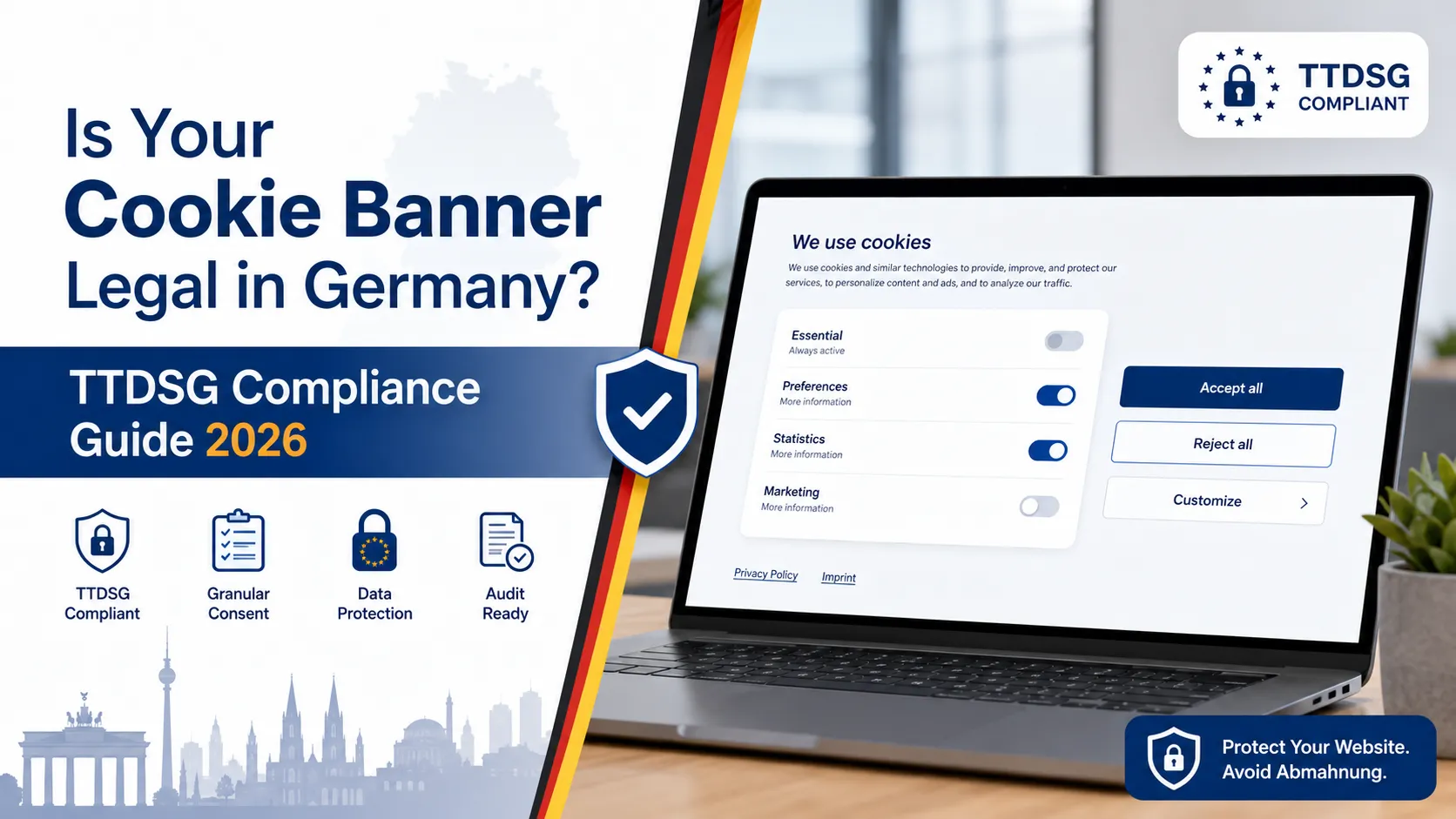
This is the single most-violated rule on the German web. If the banner shows a prominent “Accept all” button and only a hidden “Settings” or “More info” link to refuse, the consent is not freely given. The Datenschutzkonferenz (DSK) has been explicit since 2021: a Reject button must be visible on the same layer, with similar size, colour weight, and prominence as the Accept button. Hiding it behind a second click is treated as a dark pattern by both regulators and courts.
Is consent granular?
Bundling all cookie categories under a single Accept button — marketing, analytics, personalisation lumped together — fails the specificity requirement. The user must be able to consent to categories separately: necessary (no consent needed), preferences, statistics, marketing. Most modern CMPs offer this granular toggle out of the box; the burden is on you to actually enable the granular layer rather than hide it.
Can consent be withdrawn as easily as it was given?
Article 7(3) GDPR is unambiguous: withdrawing consent must be as easy as granting it. In practice, this means a permanent “Cookie settings” link in your footer or a floating fingerprint icon that re-opens the banner. A user who needs to email your DPO to retract consent is a user whose consent does not legally exist.
Are the purposes described in plain language?
Generic phrases like “we use cookies to improve your experience” do not meet the informed-consent bar. The banner must name the categories, list the relevant third parties (or at minimum link to a per-vendor list), explain retention periods, and clarify whether data leaves the EU. Plain German is preferred even on English sites if your audience is significantly German.
Are non-essential scripts genuinely blocked before consent?
A banner that says “we need consent for Google Analytics” while Google Analytics has already loaded in the background is worse than no banner at all — it documents the violation. Real compliance requires the CMP to block scripts at the source until consent fires, typically using script-tag rewriting or a tag manager gated by consent state.
Is consent properly logged?
You must be able to prove, per visitor, that consent was given, when, for what categories, and with what banner version. Most reputable CMPs handle this server-side automatically. If you ever face an Abmahnung or Datenschutzbehörde inquiry, the consent log is your defence.
Which cookie banners get site owners into trouble?
Working with German SMEs and Mittelstand brands every week, we repeatedly see the same compliance failures in cookie-banner audits under cookie banner compliance— and these are also top Abmahnung triggers.
The “Accept all” trap — one prominent Accept button with a hidden Reject option, making consent non-neutral.
The “Continue browsing equals consent” trap — closing the banner counts as acceptance, which German courts reject.
The “Cookie wall” trap — blocking access unless users accept cookies, only allowed in very limited cases.
The “Pre-loaded scripts” trap — tracking tools fire before consent is given, making the banner legally meaningless.
The “Outdated CMP” trap — old cookie plugins not updated for TTDSG/TDDDG compliance.
The “Google Fonts / Maps / YouTube embeds” trap — external requests sending data before consent; often requires self-hosting or blocking until approval.
Which cookie banner tools work for German websites?
You have three reasonable paths in 2026: a lawyer-backed German CMP, an international enterprise CMP configured for German rules, or a well-configured open-source/freemium option for small sites.
Borlabs Cookie
Borlabs Cookie is the WordPress-native CMP most widely deployed across German SMEs. It is German-built, German-maintained, includes a default configuration aligned with TTDSG, and integrates cleanly with Google Tag Manager, Matomo, and most WordPress themes. Licensing starts around €39 per year per site. For a single-site marketing website on WordPress, Borlabs is usually the right answer.
Real cookie banner
Real cookie banner compliance Germany is another German-built WordPress plugin that has grown rapidly because it includes a comprehensive service library (hundreds of pre-configured third parties) and walks the user through a guided setup. It is favoured by lawyer-supported agencies because the default texts are written by German Datenschutz lawyers. Pricing is similar to Borlabs.
Usercentrics
Usercentrics is the German enterprise CMP. It is what you use when you run a multi-domain operation, need server-side integration, want detailed consent analytics, or have a legal team that wants audit-ready logs. Usercentrics is integrated with Google Consent Mode v2, which is now mandatory for European users who want Google Ads attribution to work properly. Pricing scales with traffic and starts to make sense above mid-five-figure monthly visitors.
Cookiebot (Cybot)
Cookiebot is Danish but widely used across Germany. It auto-scans your site for cookies, generates the consent prompt, and offers a generous free tier (under 100 subpages and low traffic). For non-WordPress sites — Webflow, Shopify storefronts, custom JS apps — Cookiebot is often the easiest drop-in.
Klaro and Cookie Consent (open source)
Both are open-source consent managers with active maintainer communities. Klaro in particular is favoured by privacy-first developers because it is fully self-hostable and integrates well with Matomo. It requires more technical setup than Borlabs but costs nothing.
Native Shopify and Webflow tools
Shopify’s built-in consent banner and Webflow’s native Cookie Consent component have improved markedly since 2024 but still fall short of TTDSG compliance for sites with non-essential marketing scripts. For German Shopify shops, layering a dedicated CMP (Pandectes for Shopify is the common choice) is the safer route — we covered this in our Shopify GDPR Germany guide and recommend it for any shop accepting €100k+ annually.
How do you audit your existing cookie banner in 20 minutes?
You do not need a lawyer for the first pass. The following self-audit catches roughly 90% of the compliance issues we see in client engagements.
Open your site in a fresh incognito window. Watch the banner appear before clicking anything. Open browser DevTools, switch to the Network tab, and filter by “googletagmanager,” “google-analytics,” “facebook,” “linkedin,” “hotjar,” and “clarity.” If any of those requests fire before you click Accept, you have a script-blocking failure.
Look at the banner buttons. If Accept is one colour and Reject is grey, smaller, or hidden inside a settings dropdown, you fail the equal-choice test. The fix is usually a one-toggle change in your CMP.
Try to close the banner with the X or by clicking outside. If the banner disappears and the site treats you as “consented,” you fail the affirmative-consent test.
Scroll to your footer. Look for a permanent “Cookie settings” or “Privacy settings” link. If it is missing, you fail the withdraw-as-easily test.
Open your privacy policy and search for the names of the actual third parties firing on your site (Google Analytics, Meta, LinkedIn, HubSpot, Hotjar, Cloudflare). If the list is generic or out of date relative to the tags actually firing, you fail the transparency test.
Check the network tab one more time for any request to fonts.googleapis.com or fonts.gstatic.com. If those are loading on first page view, your Google Fonts are Abmahnung-vulnerable. Self-host them.
If everything passes, document the result with a screen recording or screenshots — this becomes part of your compliance defence file. If anything fails, fix the highest-risk items first: script blocking, equal Accept/Reject, and Google Fonts. The rest can follow within the same week.
What does Google Consent Mode v2 change for German websites?
Google Consent Mode v2 became mandatory in March 2024 for any European business sending audience or conversion data to Google Ads. It requires the website to send Google two specific consent signals — ad_storage and analytics_storage, plus the v2 additions ad_user_data and ad_personalization — before Google’s tags can attribute conversions for targeting.
In practice this means three things. First, your CMP must explicitly support Consent Mode v2 (Borlabs, Real cookie banner, Usercentrics, and Cookiebot all do as of 2026). Second, if a user refuses, Google Ads cannot use that user’s behaviour for personalisation but can still receive aggregated, anonymised modelled conversions — which is better than no signal. Third, if you skip Consent Mode v2 entirely, Google increasingly throttles or zeros out conversion data for European users, which silently breaks your paid-acquisition ROAS reporting.
The takeaway: TTDSG compliance and Google Ads measurement are no longer separate problems. The same CMP configuration solves both.
What does a cookie-banner Abmahnung actually cost?
The honest answer: it varies, but the floor is high enough to take seriously. A first-warning Abmahnung from a competitor’s lawyer typically demands an immediate signed Unterlassungserklärung (cease-and-desist undertaking) plus reimbursement of the lawyer’s fees, which sit between €600 and €2,500 depending on the alleged severity and the legal value (Streitwert) assigned. A Datenschutzbehörde notice can carry administrative fines up to €20 million or 4% of global revenue under GDPR Art. 83, although in practice fines for banner-only failures have ranged from €5,000 to €500,000 for German SMEs. Repeated or willful violations escalate quickly.
The legal-cost number is only half the bill. The hidden costs are larger: rushed remediation under deadline, lost paid-marketing data because consent was broken for months, internal engineering time, and the reputational damage of being on a published Abmahnung list. The cost of getting a CMP right the first time — typically €500 to €3,000 in setup plus €40 to €400 per year in licensing — is trivial compared with one settled Abmahnung.
Frequently Asked Questions About Cookie Banner Compliance in Germany Under TTDSG
No banner needed for strictly-necessary cookies; banner required as soon as you add any tracker or pixel.
Yes, after granular consent with IP anonymisation, EU routing, DPA, and Consent Mode v2.
Legally contested; EDPB critical in 2024. Not worth the SME risk — use equal-choice banner.
Address transfers in the AVV; prefer EU-hosted CMPs (Borlabs, Real Cookie Banner, EU options of Usercentrics/Cookiebot).
No — same banner with full functional parity in English; most CMPs handle multilingual.
Yes — under the 2024 DSA and German consumer-protection law.
Quarterly minimum and after every new marketing tool, CMS change, or GTM update.
TTDSG applies equally; tracking SDKs need prior consent. iOS ATT alone is not sufficient under German law.
Want a cookie banner compliance that actually survives an Abmahnung?
Cookie compliance is one of the few areas where doing it once, correctly, removes the problem permanently. Our team configures Borlabs Cookie, Real Cookie Banner, and Usercentrics every week for German clients — most setups are complete within a single working day, and we hand over a documented compliance report you can show your DPO or insurance provider.
If you would like an honest audit of your current banner, a fixed-price implementation of a new one, or guidance on how cookie compliance interacts with your paid-marketing stack, our team is happy to help. Book a free 30-minute compliance consultation, explore our website development services, or contact us with a quick description of your current banner and CMP — we will reply with a candid, vendor-neutral recommendation within one business day.