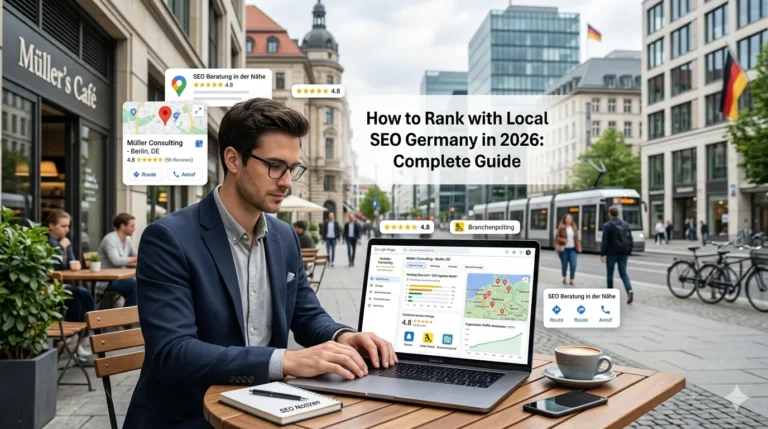
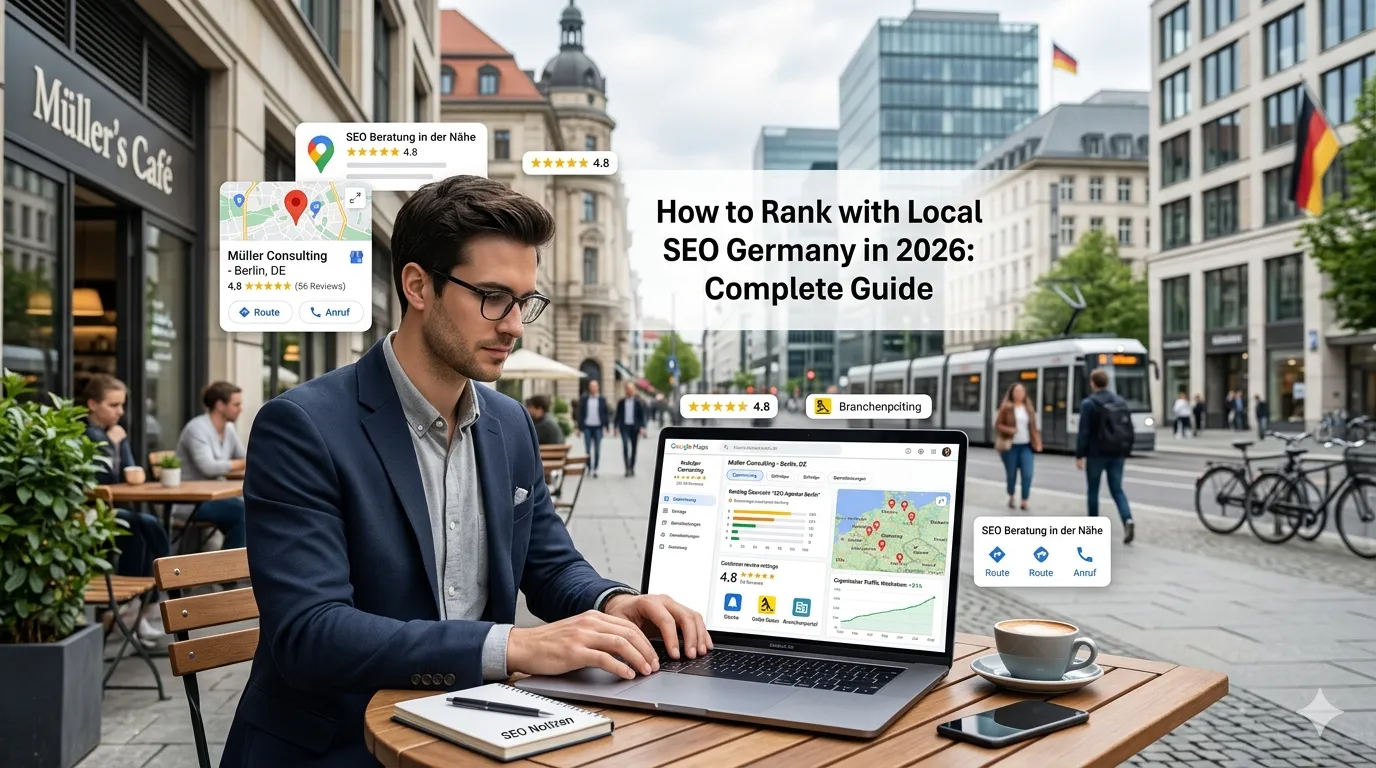
Local SEO Germany is the single most important SEO investment for Mittelstand service businesses — Steuerberater, Anwälte, Heilpraktiker, Bauunternehmer, Handwerker, restaurants, retail with physical locations. Showing up in Google’s local pack (“Steuerberater Berlin”) drives 40–60% of new client inquiries for typical German local businesses.
This guide walks through what local SEO Germany for businesses actually requires in 2026: Google Business Profile optimization, local citation building, location-specific page structure, review strategy, and the German-specific local ranking factors.
What is local SEO?
Optimization for queries with implicit or explicit location intent. Three query types:
Explicit local queries
“Steuerberater Berlin,” “Friseur Hamburg-Altona,” “Italiener München”
Near-me queries
“Steuerberater in der Nähe,” “Restaurant in meiner Nähe”
Implicit local
Google detects user’s location and applies local context. “Friseur” from Berlin shows Berlin results.
Why does local SEO matter for German businesses?
Four reasons:
Mittelstand service business dependency
Steuerberater, Anwälte, Heilpraktiker, Bauunternehmer, Handwerker — these all rely on local search visibility.
Strong commercial intent
Local searchers are typically ready to act. Conversion rates 5–15% vs. 1–3% for generic queries.
Lower competition than national
For most local terms, you compete with 20–100 local businesses, not millions of pages.
Free + sustained results
Google Business Profile + foundational local SEO is largely free + sustained.
What are local SEO ranking factors?
Five primary factors in 2026:
1. Google Business Profile completeness + activity
Most important factor. Complete profile, regular posts, photos, reviews, Q&A activity.
2. Proximity to searcher
Geographic distance from searcher to business. Limited control — depends on where searcher is.
3. Local citations + NAP consistency
Name, Address, Phone consistent across directories. Local citations on Gelbe Seiten, 11880, Branchenbuch.
4. Reviews + ratings
Number + quality of reviews on Google. Strong reviews drive both rankings + conversions.
5. On-site local signals
Location pages, local schema, address + hours + contact in footer, embedded Google Map.
For broader SEO context see our SEO services Germany guide.
How do you optimize Google Business Profile?
For German businesses:
Complete every field
- Business name (exact match to legal name)
- Address (precise German format)
- Phone (+49 with proper area code)
- Website URL
- Category (primary + secondary)
- Opening hours (including special hours for holidays)
- Service area (if applicable)
- Attributes (online appointments, accessibility, payment methods)
Add photos
- Logo, cover, interior, team, products/services
- 10–30+ photos. More photos = more profile views.
Write descriptions
- Short description (under 750 characters)
- Detailed description with German keywords + sevices
Set up Google Posts
- Weekly posts about offers, events, news, services
- Active Google Business Profile signals to Google that business is active
Enable messaging + booking
- Customers can message directly
- Booking integration (for hospitality, services)
Q&A section
- Pre-populate common questions with answers
- Monitor + answer customer questions promptly
For Google Business Profile depth see our Google Business Profile guide (forthcoming).
What are essential German local citations?
Important local citation sources in 2026:
National German directories
- Gelbe Seiten (gelbeseiten.de)
- 11880 (11880.com)
- Das Örtliche (dasoertliche.de)
- Yelp (less important in Germany but still listed)
- Branchenbuch.de
- TripAdvisor (hospitality)
- ImmoScout24 (real estate)
Industry-specific
- Steuerberater: Steuerberaterkammer directory
- Anwalt: Anwalt.de, Anwaltskammer directory
- Heilpraktiker: Heilpraktikerkammer
- Restaurants: TripAdvisor, OpenTable
- Hotels: Booking.com, HRS
Local German chamber + business directories
- IHK Mitgliederverzeichnis
- City-specific business directories
- Tourism boards for hospitality
For each: ensure NAP (Name, Address, Phone) consistent across all citations.
How do you build a local citation profile?
A 5-step approach:
Step 1: NAP standardization
Define exact NAP format. Use this everywhere.
Step 2: Big-6 first
Get listed on top 6 German directories (Gelbe Seiten, 11880, Das Örtliche, Yelp, Branchenbuch, industry-specific).
Step 3: Industry-specific expand
Find 5–15 industry-relevant directories.
Step 4: Local geographic citations
City-specific directories + chamber of commerce.
Step 5: Monitor + maintain
Use a citation management tool (Yext, BrightLocal, Moz Local) or manually audit annually.
Most German businesses get 80% of citation value from the top 10–20 citations.
How do you handle multi-location German businesses?
For businesses with 2+ physical locations:
Each location gets its own Google Business Profile
Separate profiles. Same brand, distinct location entities.
Each location gets its own location page
Dedicated page per location with unique content (200+ words), address, hours, photos, embedded map, local schema.
LocalBusiness schema per location
Schema markup specific to each location
Consistent NAP per location
Each location has unique NAP. Don’t confuse main HQ address with branch addresses.
Internal linking between locations
Each location page links to other locations (light cross-linking).
For multi-location depth see our multi-location local SEO guide (forthcoming).
What about reviews?
Critical for local SEO:
Quantity matters
More reviews = stronger local signal. Aim for 50+ for established business.
Quality matters more
5-star average dominates 4.5-star. 4.2 average looks worse than 4.7.
Review velocity matters
Steady stream of new reviews better than 100 reviews in one week then nothing.
Response matters
Respond to every review — positive + negative. Shows engagement.
Don’t pay for reviews
Google penalizes fake reviews. Also illegal under German UWG.
Encourage via legitimate means
After-service email asking for review. QR code on receipt. SMS with link.
What’s the location page structure?
For each German service location:
Hero / intro (200–400 words)
Location-specific intro. Address. Hours. Phone. Services offered at this location.
Services section
Bullet list of services. Link to detailed service pages.
Team / staff (if applicable)
Photos + bios of staff at this location.
Testimonials / reviews
Local-specific reviews highlighted.
FAQ section
Location-specific common questions.
Contact + map
Embedded Google Map. Contact form. Click-to-call phone number.
LocalBusiness schema
Schema markup specific to this location.
Each location page must be unique — no duplicate content across locations.
How do you measure local SEO performance?
Six KPIs:
Google Business Profile views
Available in GBP Insights dashboard.
Search queries that led to profile views
What people searched to find you. Insights dashboard.
Calls + directions + website clicks
Actions taken from GBP. Conversion proxies.
Map pack rankings for priority queries
Where you rank in the “3-pack” for “Steuerberater [Stadt]” etc.
Organic local query rankings
Rankings for local long-tail queries.
Review velocity + average rating
New reviews per month + ongoing rating.
What are common German local SEO mistakes?
Five patterns:
Incomplete Google Business Profile
Missing photos, no posts, partial information. Most common + most fixable.
Inconsistent NAP across citations
Slight differences in address format across directories. Confuses Google.
One generic page for multiple locations
Each location needs its own page. Generic “we have offices in Berlin and Munich” weak.
Ignoring reviews
Few reviews + slow response + 4.2 average rating. Lose to competitor with 100 reviews + 4.7.
No LocalBusiness schema
Free win ignored. Add schema markup per location.
How does local SEO interact with paid Google Ads?
Local Service Ads (LSA) + Google Ads Performance Max can complement organic local SEO. Reviews + GBP quality affect both organic + paid local visibility. Don’t treat as separate channels.
Frequently asked questions
Optimization for local-intent queries.
GBP, proximity, citations, reviews, on-site local signals.
Complete fields, photos, weekly posts, messaging, Q&A, reviews.
Big-6 German directories plus 10 to 20 industry and city sources.
Separate GBP, unique location pages, schema per location.
After-service email, QR codes, SMS link, in-person ask.
Yes, factually and respectfully; offer resolution.
Map pack in 4 to 12 weeks; solid visibility in 3 to 9 months.
Need help with local SEO?
If you’re scoping local SEO for your German business and want a 30-minute scoping conversation about GBP + citations + content strategy, book a meeting or send details via our contact page.
Need expert help? Gem Programmers provides full-service SEO for businesses in Germany, Austria and Switzerland. Request a free, no-obligation quote and get a clear plan with scope, timeline and price.