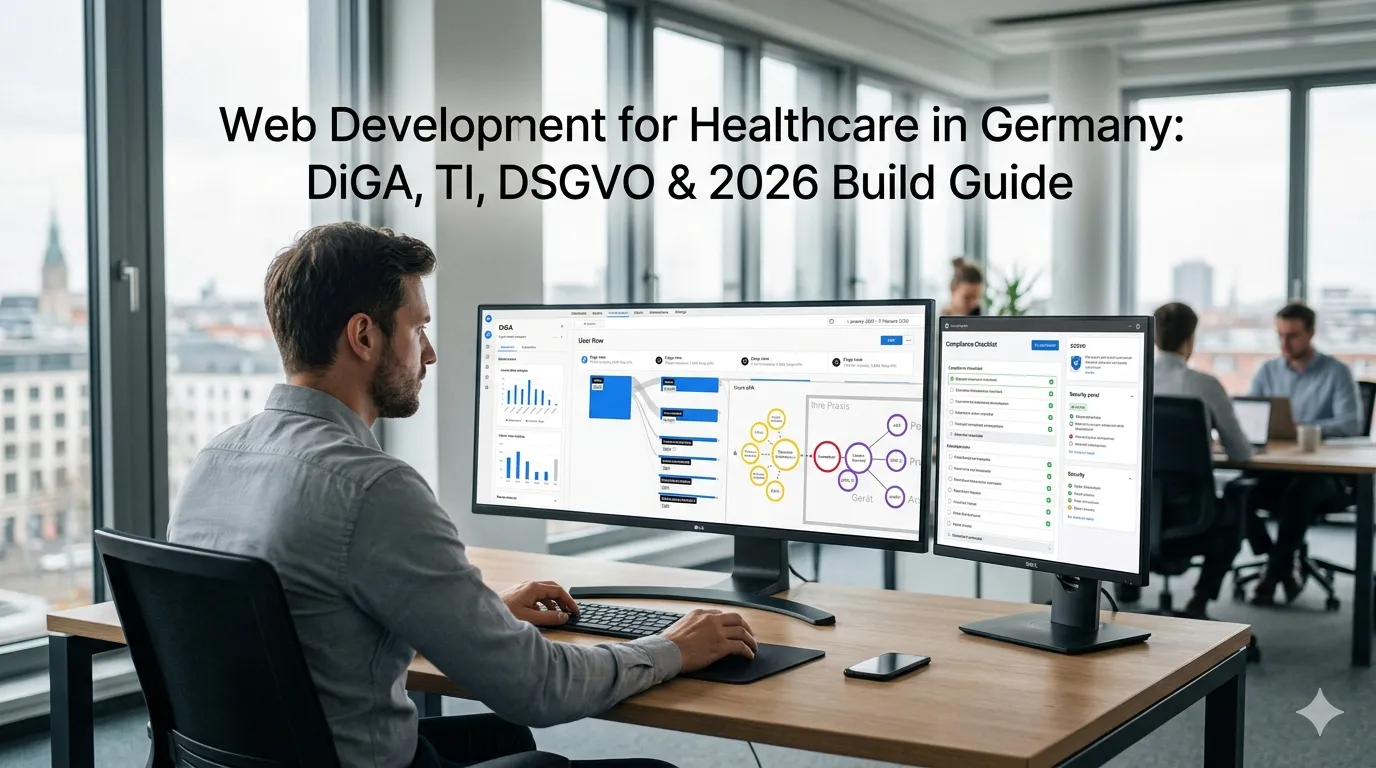
Healthcare web development in Germany is one of the most regulated and rewarding spaces in 2026. The German digital health market has matured rapidly — DiGA (Digitale Gesundheitsanwendungen, prescription digital health apps reimbursed by Krankenkassen), TI (Telematikinfrastruktur) integration, electronic patient record (ePA) flows, and the broader MDR (Medical Device Regulation) framework have created clear regulatory pathways for digital health products that didn’t exist five years ago. But the regulatory weight is significant: a wrong architectural choice early can mean a 12-month rebuild before you ever reach reimbursement.
This guide walks through what web development for healthcare in Germany actually looks like in 2026: DiGA pathway, MDR class implications, TI integration, EUR build costs, and the agency questions that separate teams who can ship reimbursable software from those who can’t.
What counts as “healthcare” web development in Germany in 2026?
Several distinct categories with different regulatory weight:
- DiGA (prescription digital health apps) — software reimbursed by German statutory health insurance. Highest regulatory bar, clearest reimbursement pathway.
- DiPA (Digitale Pflegeanwendungen) — equivalent for care/Pflege, growing market.
- Telematikinfrastruktur (TI) connectors and services — software interacting with the German health network (Gematik, ePA, e-prescription, KIM messaging).
- Patient-facing portals and self-service — practice management, appointment booking for clinics, telehealth platforms.
- B2B healthcare SaaS for providers — software for Praxen, hospitals, Pflegedienste, MVZ.
- Unregulated wellness / fitness adjacent — corporate wellness, mental health adjacent.
The first three carry significant regulatory weight (MDR, DiGA-V, KBV connector requirements). The fourth requires careful patient-data handling. The fifth and sixth are lighter regulatory load but still hit DSGVO + BDSG.
What German regulations and frameworks shape healthcare web development?
- DSGVO + BDSG — data protection. Patient data is Article 9 “besondere Kategorie.”
- DiGA-V — Digital Health Applications Ordinance.
- PDSG — Patient Data Protection Act.
- MDR — Medical Device Regulation (EU 2017/745). DiGA apps typically Class I or IIa.
- IVDR — In-Vitro Diagnostic Regulation.
- Gematik standards — German Telematikinfrastruktur specifications.
- ISO 13485 — medical device QMS.
- ISO 14971 — medical device risk management.
- IEC 62304 — medical device software lifecycle.
- BSI Grundschutz — German IT baseline protection.
- §203 StGB — German confidentiality of health professionals.
For early-stage healthcare founders: first questions are MDR class, DiGA viability, TI scope.
What does healthcare web development cost in Germany?
Unregulated wellness MVP
- German agency: €50,000–€150,000
- Nearshore with healthcare experience: €35,000–€100,000
DiGA Fast-Track candidate MVP (Class I or IIa)
- German agency: €180,000–€550,000
- Nearshore + regulatory consulting: €140,000–€400,000
- Plus BfArM application + MDR conformity: €60,000–€250,000+
TI-connected solution
- German agency: €250,000–€900,000
- Plus Gematik certification and ongoing operational costs
Enterprise hospital / MVZ software
- €500,000–€3,500,000+
For broader context see our B2B SaaS development guide and web development cost guide.
What is the DiGA pathway and how does it shape the build?
DiGA is the BfArM program for prescription digital health apps. Approved DiGA apps are reimbursed by all statutory health insurers in Germany.
Eligibility
- Class I or Class IIa medical device under MDR
- Primary purpose: detection, monitoring, treatment, mitigation of disease or compensation for disability
- CE-marked
- Demonstrated positive healthcare effect
Application pathway
- Fast-Track: provisional listing for 12 months with evidence still being gathered.
- Permanent listing: evidence ready at application.
Build implications
- ISO 13485 QMS in place
- IEC 62304 software lifecycle compliance
- ISO 14971 risk management documentation
- Penetration testing and security review
- Patient data handling per DSGVO + BDSG + PDSG
- Data residency in Germany (or strictly EU)
- Clinical evidence study (typically RCT)
This is why DiGA-ready MVPs cost €250,000+ and take 12–18 months minimum.
What is Telematikinfrastruktur (TI) and when does it matter?
TI is the German health network operated by Gematik. Your healthcare software needs TI integration if it:
- Sends/receives e-prescriptions (E-Rezept)
- Accesses or updates ePA (electronic patient record)
- Uses KIM (Kommunikation im Medizinwesen) secure messaging
- Acts as a primary practice management system (PVS)
TI integration is technically complex and requires Gematik certification. Most teams partner with TI specialists rather than building from scratch.
What does a typical German healthcare tech stack look like?
Stable, audit-friendly choices:
- Backend: Java + Spring Boot, Kotlin, or .NET Core. Less commonly Node.js or Python with strict typing.
- Frontend: React + Next.js, Angular for enterprise health software.
- Database: PostgreSQL with row-level encryption.
- Infrastructure: Hetzner Cloud Frankfurt, IONOS, AWS Frankfurt with HIPAA-style controls, BSI-Grundschutz DCs for TI workloads.
- Auth: Keycloak self-hosted, ForgeRock for enterprise. Patient ID via TI or video-ident services.
- Logging / SIEM: Self-hosted ELK or Splunk EU.
For non-DiGA / non-TI products, lighter stacks (Next.js + Node.js or Laravel) work — but design with awareness that medical-device classification can shift mid-project.
How does DSGVO + BDSG + PDSG shape healthcare web development?
Patient data is Article 9 “besondere Kategorie” — strongest protection.
Data residency in Germany (or strictly EU)
For DiGA: data must reside in Germany or EU with extra safeguards.
Encryption at rest with key management
AES-256 minimum. HSM-backed keys for highly sensitive data. Application-level encryption for diagnoses, prescriptions.
Granular consent
Specific, informed, freely given, withdrawable. Document consent text version and timestamp.
Audit logging
Every access to patient data logged. Append-only with hash chaining. Retention per German legal requirements (often 10+ years).
Pseudonymization
Separate identifying data from health data. Re-link only when necessary.
Right to deletion within legal constraints
§ 630f BGB requires 10-year retention of treatment documentation. Reconcile with DSGVO Article 17 via pseudonymization rather than deletion.
See our GDPR compliance guide.
What questions should you ask a healthcare web development agency?
“Have you shipped a DiGA-approved product?”
If yes, get the BfArM listing URL. If not, factor regulatory consulting time.
“Walk me through your ISO 13485 QMS.”
Real QMS has documented procedures, change control, supplier management, post-market surveillance.
“How do you handle IEC 62304 software lifecycle?”
Software safety classification (A/B/C), unit/integration testing per class, V&V documentation.
“Show me a risk management file (ISO 14971).”
Real document identifying hazards, harm sequences, risk control measures.
“How do you handle clinical evidence?”
For DiGA: clinical trials, statistical analysis plans, study registries. Most agencies partner with a clinical CRO.
“What’s your patient data audit architecture?”
Append-only logs, retention rules, tamper evidence.
For broader agency vetting see our how to choose a web development agency guide.
What are the most common healthcare build mistakes German founders make?
Building before MDR classification
Engage a regulatory consultant before significant build.
Underestimating clinical evidence requirements
DiGA requires demonstrable positive healthcare effect. RCTs cost €100k–€300k+.
Mixing patient and operational data
Creates DSGVO + § 203 StGB problems. Isolate from day one.
Treating TI as an afterthought
TI integration is its own discipline. Plan 4–9 months; partner with a specialist.
When is DiGA worth pursuing vs. private-pay or B2B?
- DiGA when: clinical evidence is achievable, addressable patient population is large (10,000+ German patients).
- Private-pay / cash-pay when: targeting early adopters, clinical evidence years away.
- B2B (sell to clinics / Praxen) when: software is for providers, not patients directly.
Most early-stage German digital health founders start B2B or private-pay, then pursue DiGA when product-market fit and clinical data mature.
Frequently Asked Questions About Healthcare Web Development in Germany
€50,000–€150,000 wellness MVP; €180,000–€550,000 DiGA candidate; €250,000–€900,000 TI-connected.
Yes if it has a medical purpose — get MDR classification from a Benannte Stelle.
DiGA is prescription + reimbursed by Krankenkassen; requires CE, MDR, ISO 13485, BfArM listing.
3 months processing + 12 months provisional + 6–12 months permanent = 18–30 months total.
Java + Spring Boot dominates; Kotlin/.NET Core common; modern startups use Next.js + NestJS.
No for DiGA; possibly for B2B healthcare with DPA; yes for wellness adjacent with DSGVO care.
DiGA case studies on bfarm.de; compliance-officer references; ISO 13485/IEC 62304/ISO 14971 experience.
Telematikinfrastruktur — needed for E-Rezept, ePA, KIM, or replacing primary practice system.
Need help scoping a healthcare build?
If you’re at the early stage of a German digital health product and want a 30-minute scoping conversation about MDR pathway, DiGA viability, stack choice, and realistic EUR budget, book a meeting or send details via our contact page.
Need expert help? Gem Programmers provides professional web design services for businesses in Germany, Austria and Switzerland. Request a free, no-obligation quote and get a clear plan with scope, timeline and price.