
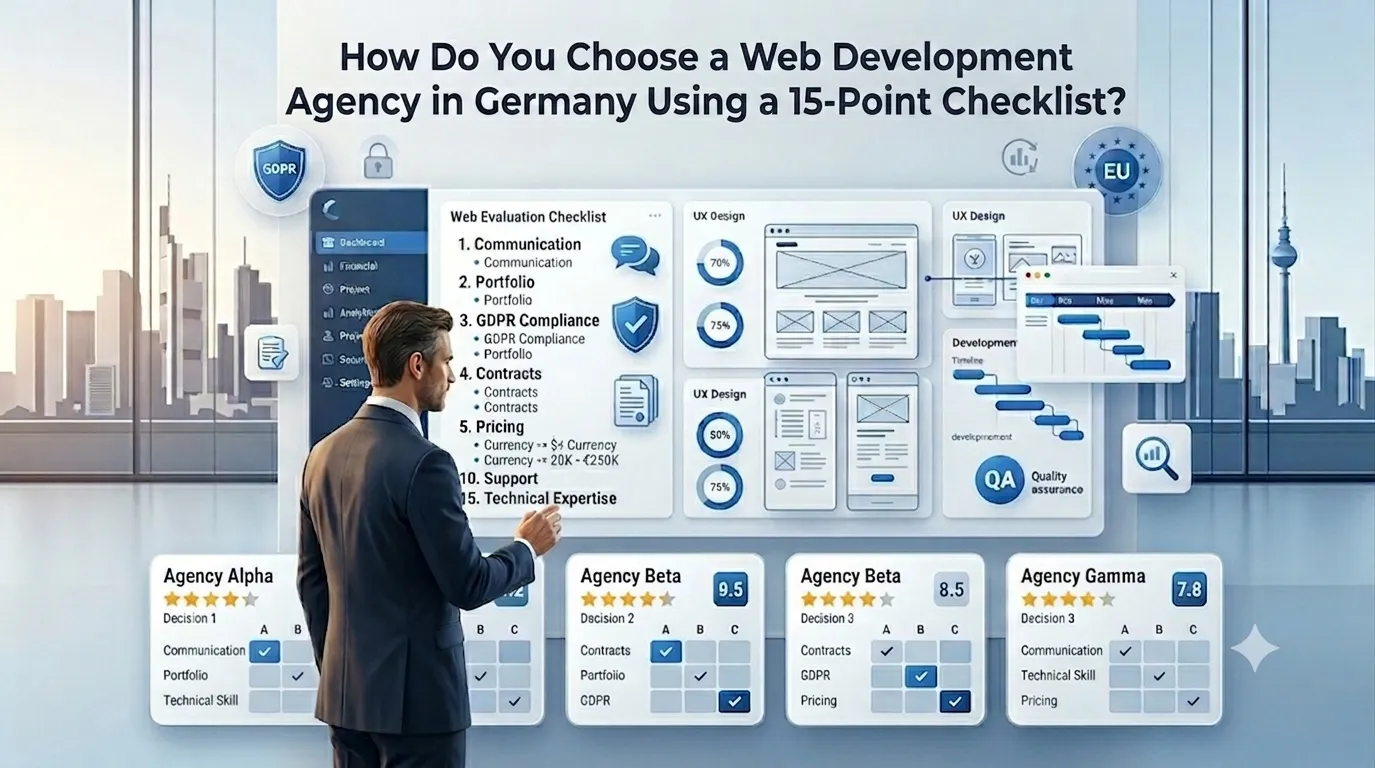
Knowing how to choose a web development agency in Germany is the difference between a project that ships on time and one that drags six months past budget. Most first-time buyers learn the hard way — by signing with a polished agency, watching scope dissolve, and switching vendors halfway through. This guide gives you a 15-point vetting checklist, the freelancer vs agency vs nearshore trade-off, and the contract clauses that actually protect a GmbH.
It’s written for founders, marketing leads, and operations directors who don’t want to spend three weekends reading legal forums to pick a vendor.
Why does choosing the right web development agency in Germany matter more than cost?
Founders often start the vendor search by comparing price. By the third project, they’ve learned to compare process. A €15,000 build with a wrong-fit agency burns three months of leadership attention and usually ends in a rebuild. A €25,000 build with the right team ships clean, becomes a real growth asset, and never demands a “rescue project” later.
The signal you’re optimising for isn’t cheapest — it’s predictable delivery with English-friendly communication, GDPR by default, and clean handover at the end.
What is the 15-point web agency selection checklist for Germany?
Use this checklist before you sign with anyone. It’s organised by the order the questions come up naturally during vetting.
Discovery & Communication
- English-first communication. Are kickoff calls, Slack channels, Notion docs, and tickets in English — or only sales decks?
- Single point of contact. Is there one named senior person owning your project, not a rotating account manager?
- Discovery phase included. Is there a paid or unpaid discovery sprint producing a written scope document?
Portfolio & References
- Verifiable live work. Can you visit three production websites the team built recently and inspect them yourself?
- Comparable references. Will the agency connect you with a past client at a similar company size or industry?
- Industry presence. Are they listed on Clutch, GoodFirms, Sortlist, or featured in BVDW / IHK communities?
Legal & Compliance
- English contracts available. Can you sign a contract you can read line-by-line without a translator?
- Explicit IP transfer. Does the contract assign all source code, design files, and copyright to your business on payment?
- AVV (DPA) standard. Does the agency sign an Auftragsverarbeitungsvertrag without friction?
- GDPR / DSGVO in process. Are cookie consent, TTDSG, AVV with hosting, and Google Fonts handled by default — not as optional extras?
Commercial & Risk
- EUR-denominated quotes with VAT clarity. Are net price and 19% VAT shown clearly, with reverse-charge mentioned where relevant?
- Milestone-based payments. Is payment tied to acceptance of deliverables, not a calendar?
- Change request transparency. Is the cost-per-change documented up front, not discovered mid-project?
Post-Launch & Handover
- Code & access handover. Will you receive Git access, hosting credentials, DNS control, and admin accounts at launch?
- Written support agreement. Is there a post-launch SLA (response times, scope, hourly rate for fixes)?
Score each candidate. Anything below 12 out of 15 is a risk you can avoid.
Freelancer vs agency vs nearshore: which fits a German project?
There’s no single “best” choice — it depends on your project size, in-house capability, and risk appetite.
| Option | Best for | Watch out for |
|---|---|---|
| Solo freelancer | Small, well-scoped projects under €10k | Single point of failure, slow during holidays/illness |
| Boutique German agency | Established SMEs with €15k+ budget | Higher pricing, sometimes German-only execution |
| EU + offshore hybrid | Mid-market €10k–€80k projects, English-first | Verify EU contracting structure is real |
| Pure offshore | Cost-sensitive, experienced buyer | Time zone, GDPR complexity, contract law mismatch |
| Nearshore (EU-East) | Mid-market projects with EU contract preference | Variable English fluency, fewer DACH-specific specialists |
For most first-time buyers running a GmbH or UG, an EU + offshore hybrid or a boutique agency with an English-fluent senior lead is the lowest-risk path. Our how to hire web developer Germany English speaking guide goes deeper on the English-first angle.
Where can you source web development agencies in Germany?
Don’t rely on a single directory. Use three to cross-reference:
- Clutch & GoodFirms — international review platforms, easy to filter by location and budget. Verified reviews from real clients.
- Sortlist — strong DACH coverage, more agency-side curation than Clutch.
- BVDW (Bundesverband Digitale Wirtschaft) — German digital industry body. Member directory is a quality signal.
- IHK directories — chamber-of-commerce listings. Useful for verifying agencies are real, registered businesses.
- LinkedIn — search for senior developers, look at their company, then evaluate the company.
- Word of mouth in your industry network — still the highest-converting source.
What five questions should you ask on every intro call?
Most intro calls waste time on features. These five questions actually predict project success:
- “Can you walk me through how you handled GDPR for a previous EU project — in detail?”
- “How do you price change requests after we’ve signed the SoW?”
- “Show me a sample invoice and contract from a recent German client (names redacted).”
- “What does month four of post-launch support look like with you?”
- “If we wanted to switch agencies after launch, what would the handover include?”
The vendors who answer specifically and unrehearsed are the ones who’ve actually done the work. Vendors who pivot to features or pricing are signalling they haven’t.
What are the contract and legal essentials for a German web project?
Three contract terms cause 80% of expensive disputes in Germany:
- Scope and acceptance criteria. Without a written scope and a defined “what does acceptance mean” clause, every change becomes a debate.
- IP transfer. Make explicit that all source code, design files, copy, and asset licences transfer to your business on full payment.
- Liability cap & SLA. German agencies usually cap liability at the project fee. Negotiate a realistic SLA for post-launch issues (response time, fix time).
A solid contract template from a German IT-Recht firm is a smart €500–€1,500 investment if you’re spending €20k+ on the project.
What red flags should end the conversation immediately?
Walk away if you see any of these:
- Quote without a written scope document
- No willingness to provide references
- Discovery treated as a freebie or skipped entirely
- Source code stored only on the agency’s GitHub (not yours)
- 50%+ upfront payment requested
- No mention of GDPR / DSGVO in the proposal
- Vague timeline language (“phases” without dates)
- Junior team running the project with no senior oversight
- Aggressive sales pressure with deadline tactics
Our deep-dive on red flags when hiring a web developer covers each of these with real-world examples.
How do you compare three final candidates side by side?
After shortlisting three agencies, run them through identical brief and evaluate on these dimensions:
- Brief comprehension. Did they ask smart, specific follow-up questions, or send a templated proposal?
- Process clarity. Can they describe their discovery → design → build → launch flow in detail?
- Risk handling. How do they describe handling scope creep, scope changes, and delays?
- Cultural fit. Will you enjoy working with this team for 4–6 months?
The “cultural fit” criterion is consistently underrated. A web project is a relationship. Pick the team you’d want a beer with at the launch party.
What is the cost vs quality trade-off in the German market?
Here’s the honest reality:
- Below €5,000: expect a templated build, limited custom design, basic GDPR
- €5,000–€15,000: solid solo freelancer or junior agency build, custom design starting to appear
- €15,000–€40,000: boutique agency sweet spot, proper compliance, custom UX
- €40,000+: dedicated team, complex integrations, multilingual, accessibility
For a deeper EUR breakdown, see our Web Development Cost Germany 2026 guide.
How long should choosing an agency actually take?
Most founders waste two months interviewing too many agencies. A reasonable timeline:
- Week 1: Define your brief and budget range
- Week 2: Source 5–7 candidates from directories and referrals
- Week 3: Intro calls (30–45 minutes each), narrow to 3
- Week 4: RFP sent, written proposals received
- Week 5: Reference calls, contract reviews, final decision
Five weeks is enough. Anything longer than 8 weeks usually means you’re shopping rather than buying.
Frequently asked questions about how to choose web development agency Germany
Combine Clutch/Sortlist reviews, BVDW or IHK directories, and personal referrals. Cross-reference at least two sources.
Boutique German agencies excel at €15k+ DACH-compliance projects. EU-offshore hybrids fit €10k–€80k English-first mid-market projects.
Four to six weeks is reasonable across brief, shortlist, intro calls, RFPs, references, and contract.
Scope, acceptance criteria, milestone payments, IP transfer, AVV (DPA), liability cap, SLA, and change-request pricing.
Verify Impressum, USt-IdNr., Handelsregister entry, IHK membership, and two recent client references.
50%+ upfront, no live portfolio, no GDPR mention, agency-owned source code, missing IP transfer, and artificial deadlines.
Freelancers are cheaper hourly but you become the PM. Agencies include design, QA, and process — often comparable total cost.
Ready to choose a web development agency in Germany?
Choosing the right partner is mostly about disqualifying the wrong ones quickly. Use the 15-point checklist, ask the five questions, watch for the red flags, and the right vendor usually emerges by week four.
If you’d like a neutral second opinion on a shortlist you’re already evaluating — or you’d just like a 30-minute scoping call with an English-fluent senior engineer — you can book a meeting or reach out via our contact page. No sales pitch, no commitment.