If you operate any German business website in 2026 and you’re searching for a GDPR compliant website checklist 2026, the bar has risen significantly since 2018. TTDSG cookie rules, the Google Fonts court ruling, BFSG accessibility for consumer-facing sites, and an active Abmahnung industry mean that “we installed a cookie banner once” is no longer enough. This guide gives you a 30-point checklist covering everything a German site must address in 2026, plus the realistic fines for getting it wrong.
Written for GmbH owners, Mittelstand operations leads, and marketing managers who want to be Abmahnung-safe without learning the entire BDSG by heart.
What does GDPR compliant mean for a website in 2026?
Five regulations interact for any German business website:
- GDPR / DSGVO — the EU-wide data protection framework
- BDSG — the German federal data protection law
- TTDSG — German telemedia & telecommunications privacy act (cookies)
- BFSG — Barrierefreiheitsstärkungsgesetz (accessibility, effective June 2025)
- EU AI Act — relevant if you operate AI systems on the site
A “GDPR compliant website” in Germany in 2026 means meeting the requirements of all five where they apply. Most checklists from 2020 cover only GDPR; that’s no longer enough.
What are the real fines for a non-compliant German website?
The numbers most owners underestimate:
- GDPR fines up to €20 million or 4% of global annual revenue (whichever is higher)
- BFSG accessibility fines up to €100,000 per violation
- TTDSG cookie violations: typically €5,000–€50,000 in practice
- Abmahnung (cease and desist letter) costs: €500–€5,000 in initial fees + remediation
- Reputation damage and lost B2B contracts (often the largest real cost)
For German SMEs, the Abmahnung industry is the more immediate concern. Lawyer firms actively scan websites for known violations (missing cookie consent, Google Fonts loaded from CDN, weak Impressum) and send paid demand letters to the operators.
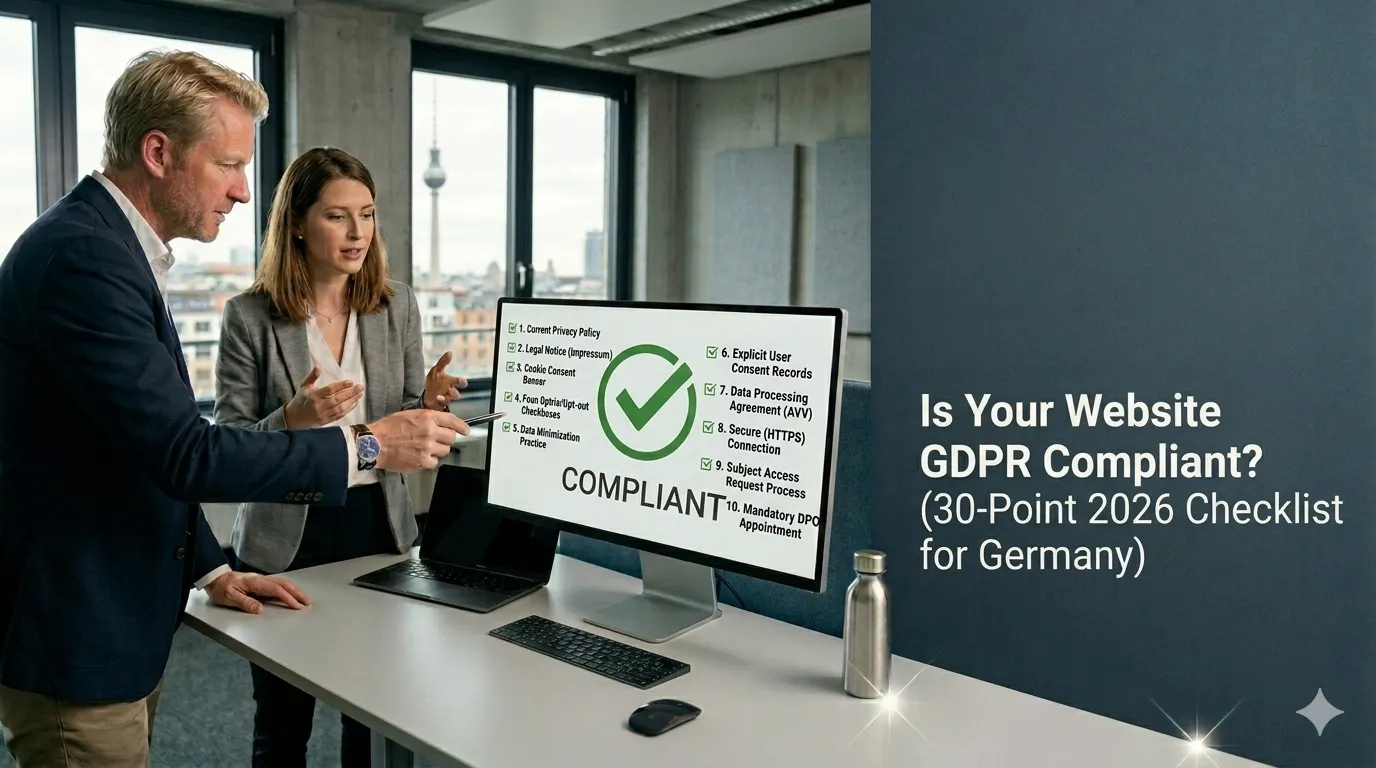
The 30-point GDPR compliant website checklist
Work through these by category. Each is either yes (compliant) or needs fixing.
1: Cookie consent (TTDSG)
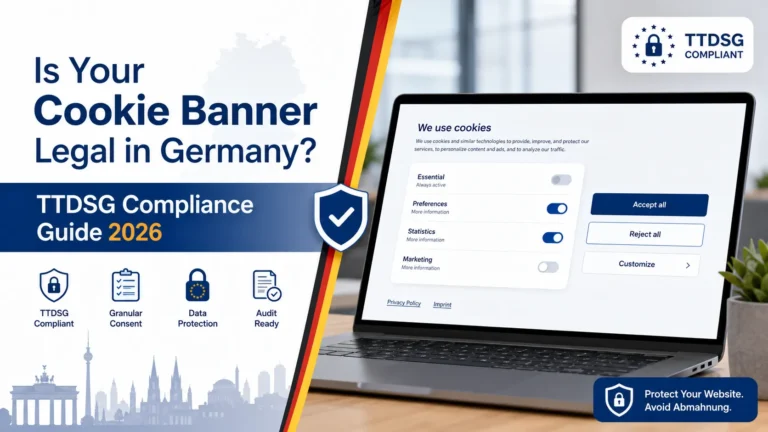
- Cookie banner uses opt-in, not opt-out, and not pre-ticked checkboxes
- Equal-prominence Accept and Reject buttons (no dark patterns)
- Granular consent: separate categories (essential, statistics, marketing)
- Tracking cookies do not fire until user consent is given
- Cookie banner re-asks after consent expiry (typically 6 months)
- Consent records stored with timestamp and choices made
- Cookie policy page lists every cookie set, its purpose, and duration
2: Privacy policy (Datenschutzerklärung)
- Datenschutzerklärung covers every data processing activity
- Each third-party service is named (Google Analytics, Stripe, Cloudflare, etc.)
- Legal basis for each processing is identified (Art. 6 GDPR)
- Data retention periods stated for each data type
- Data subject rights explained (access, deletion, portability, objection)
- Contact information for data protection inquiries published
- Datenschutzerklärung in the language of the audience served
3: Imprint (Impressum)
- Impressum is reachable within 2 clicks from any page
- Contains full company info: name, address, USt-IdNr., Handelsregister
- Contains contact: email, phone number
- Names the Geschäftsführer / Inhaber
- Includes professional regulation details if applicable (e.g., Rechtsanwalt, Arzt)
4: Third-party services (AVV)
- Auftragsverarbeitungsvertrag (AVV/DPA) signed with hosting provider
- AVV signed with email marketing tool, CRM, analytics provider
- AVV signed with any other service processing personal data
- AVV documents stored and retrievable for audit
5: Technical requirements
- Google Fonts self-hosted, not loaded from Google CDN
- SSL/TLS active across the entire site (HTTPS only)
- IP addresses anonymised in analytics where supported
- Server-side tracking or cookieless analytics where possible
6: BFSG accessibility (consumer-facing sites)
- WCAG 2.1 Level AA compliance verified
- Keyboard navigation works throughout
- Accessibility statement published on the site
A site scoring 28+ out of 30 is well-positioned. Sites scoring under 25 face active Abmahnung risk in 2026.
What does the Google Fonts ruling mean for German websites?
In January 2022, a Munich court ruled that loading Google Fonts from Google’s CDN transmits the visitor’s IP address to Google in the US — and that’s processing of personal data requiring consent under the GDPR compliant website checklist 2026. After that ruling, an Abmahnung wave targeted thousands of German sites.
The fix is simple:
- Download the Google Fonts you use
- Host them on your own server (
/wp-content/themes/yourtheme/fonts/) - Update CSS to reference local files only
- Remove any
fonts.googleapis.comorfonts.gstatic.comcalls
For WordPress, plugins like OMGF (Optimize My Google Fonts) automate this. For headless or custom sites, manual setup is straightforward.
Most German Datenschutz lawyers in 2026 consider self-hosted fonts non-negotiable.
Which cookie consent platform is best for German sites?
Three serious options for 2026:
- Borlabs Cookie — German-built, €39/year, deepest TTDSG awareness
- Real Cookie Banner — German-built, free + paid tiers, very polished
- Usercentrics — enterprise CMP, €40+/month, used by larger DACH companies
For most German SMEs: Borlabs or Real Cookie Banner. Both are designed by German developers for German Datenschutz requirements and ship with templates pre-configured for common patterns (Google Analytics, Meta Pixel, Stripe, YouTube embeds, etc.).
Avoid: Cookiebot’s free tier (cookie scanning quality is uneven), DIY banner code without proper consent management.
What does TTDSG actually require for cookies?
The Telekommunikation-Telemedien-Datenschutz-Gesetz came into force in late 2021 and tightened cookie rules compared to GDPR alone:
- Consent is required before any non-essential cookie is set
- Pre-ticked checkboxes are explicitly illegal
- Cookie banners must give equal prominence to Accept and Reject
- No “legitimate interest” basis for tracking cookies — opt-in only
- Consent records must be maintained for audit
The practical implication: most “old” cookie banners (one big Accept button, small “Settings” link) are not TTDSG-compliant. They need redesign.
Do you need an AVV with every third-party service?
If the service processes personal data on your behalf, yes. Common services requiring an Auftragsverarbeitungsvertrag:
- Web hosting (Hetzner, IONOS, AWS) — yes
- Email marketing (Brevo, Mailchimp, CleverReach) — yes
- Analytics (Google Analytics, Plausible, Matomo if hosted) — yes
- Payment processors (Stripe, PayPal, Klarna) — usually yes
- Live chat (Userlike, Intercom, Crisp) — yes
- CRM (HubSpot, Pipedrive, Salesforce) — yes
- File storage (Dropbox, Google Drive, S3) — yes
Reputable providers offer a standard AVV via their account settings or by request. If a provider can’t produce one, that’s a sign they’re not built for the EU market.
What changed with BFSG accessibility in 2025?
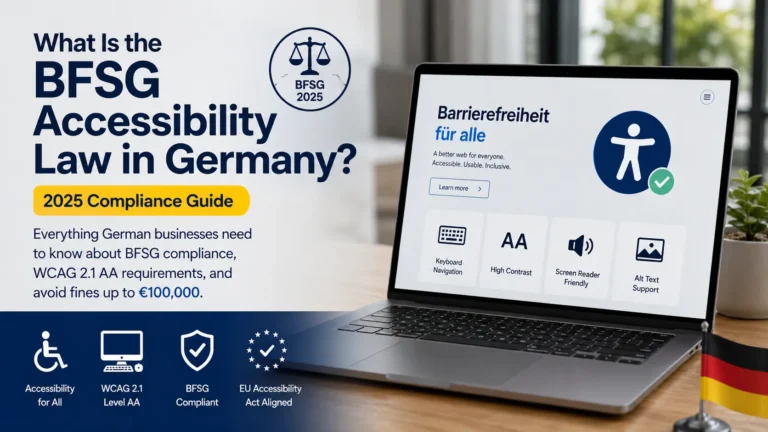
The Barrierefreiheitsstärkungsgesetz came into force on June 28, 2025. It requires most consumer-facing digital services to meet WCAG 2.1 Level AA standards.
Who must comply:
- E-commerce shops selling to consumers
- Banking and financial services
- Telecommunications providers
- E-books and reading apps
- Transport ticketing
- Consumer-facing service businesses
Who is exempt:
- B2B-only websites (in most cases)
- Microenterprises (under 10 employees AND under €2M revenue) for certain services
For affected sites, BFSG compliance typically adds €2,000–€8,000 to a build/redesign and requires an accessibility statement on the site.
For deeper accessibility coverage, our Web Development Trends in Germany 2026 post explains BFSG implications.
How do you handle Datenschutzerklärung translations for a multilingual site?
If you serve English-speaking customers, your Datenschutzerklärung must be available in English (or whatever language(s) the audience speaks) as part of a GDPR compliant website checklist 2026. Three options:
Lawyer-translated full version (€500–€2,000) — safest legally
Professional translator review of a lawyer-template translation (€200–€800) — middle ground
DeepL Pro draft + native English-speaking lawyer review (€300–€1,000) — modern hybrid
Pure machine translation of legal text is risky. Datenschutzerklärung translations should be reviewed by someone who understands both languages and German law.
For broader multilingual context, see ourGDPR compliant website checklist 2026 guide.
What is server-side tracking and do you need it?
Server-side tracking sends analytics events from your server to the analytics provider (Google Analytics, Meta Pixel), instead of from the visitor’s browser. Benefits for German Datenschutz:
- Better control over what data is sent (you choose what to forward)
- Avoids ad-blocker interference (cleaner data)
- Easier consent enforcement (server checks consent before forwarding)
- Reduces direct contact between visitor and US analytics services
Common setups: Google Tag Manager Server Container, Stape, Elevar.
Server-side tracking adds €1,500–€5,000 in setup cost. For sites running €5,000+/month in advertising, ROI is typically strong. For smaller sites, cookieless analytics (Plausible, Matomo) is the cleaner alternative.
How long does it take to make a website GDPR compliant?
For a typical German SME WordPress site that’s been operating without serious compliance:
- Quick fixes (cookie banner, Google Fonts, basic Impressum/Datenschutzerklärung): 1–2 days
- Full compliance audit and remediation: 1–2 weeks
- Major rebuild with privacy-by-design architecture: 4–8 weeks
Total cost: €1,500–€8,000 for a typical SME compliance project. Compared to a single Abmahnung (€2,000–€5,000) plus the rework, the proactive approach pays back fast.
When should you hire a Datenschutzbeauftragter (DPO)?
German law requires appointing a Datenschutzbeauftragter when:
- You employ 20+ people regularly processing personal data
- You process special categories of personal data (health, religious, racial) at scale
- Your core activity involves regular and systematic monitoring of data subjects
Below those thresholds, a DPO is optional but often valuable for any e-commerce shop or B2C service handling significant customer data.
External DPO services typically cost €100–€500/month for an SME. For sites running €1M+ in revenue with personal data processing, this is usually money well spent.
Frequently Asked Questions About the GDPR Compliant Website Checklist 2026
Not by itself — need opt-in consent, equal buttons, Datenschutzerklärung, Impressum, AVVs, and TTDSG adherence.
Same regulation — DSGVO is the German name, GDPR is the English term.
€1,500–€8,000 one-time; €500–€2,000/year maintenance.
Yes with IP anonymisation, opt-in consent, AVV, and disclosure; cookieless alternatives are lower-risk.
A paid cease-and-desist letter; settlement costs €500–€5,000. Take seriously.
Yes — any site collecting personal data needs one (email addresses count).
Not by GDPR, but by German Verbraucherrecht for e-commerce and consumer services.
Final thoughts on GDPR compliance for German websites in 2026
The 30-point checklist above represents what a Datenschutz-aware German lawyer would expect to see on any serious 2026 website. Most SMEs can reach full compliance in 1–2 weeks with proper tooling (Borlabs or Real Cookie Banner, OMGF for fonts, lawyer-reviewed Datenschutzerklärung template) and modest investment.
If you’d like a free 30-minute compliance audit of your current site with prioritised fixes, our team offers a written report covering all 30 checklist points. You can book a meeting or browse our website development services for the broader compliance + maintenance offer.