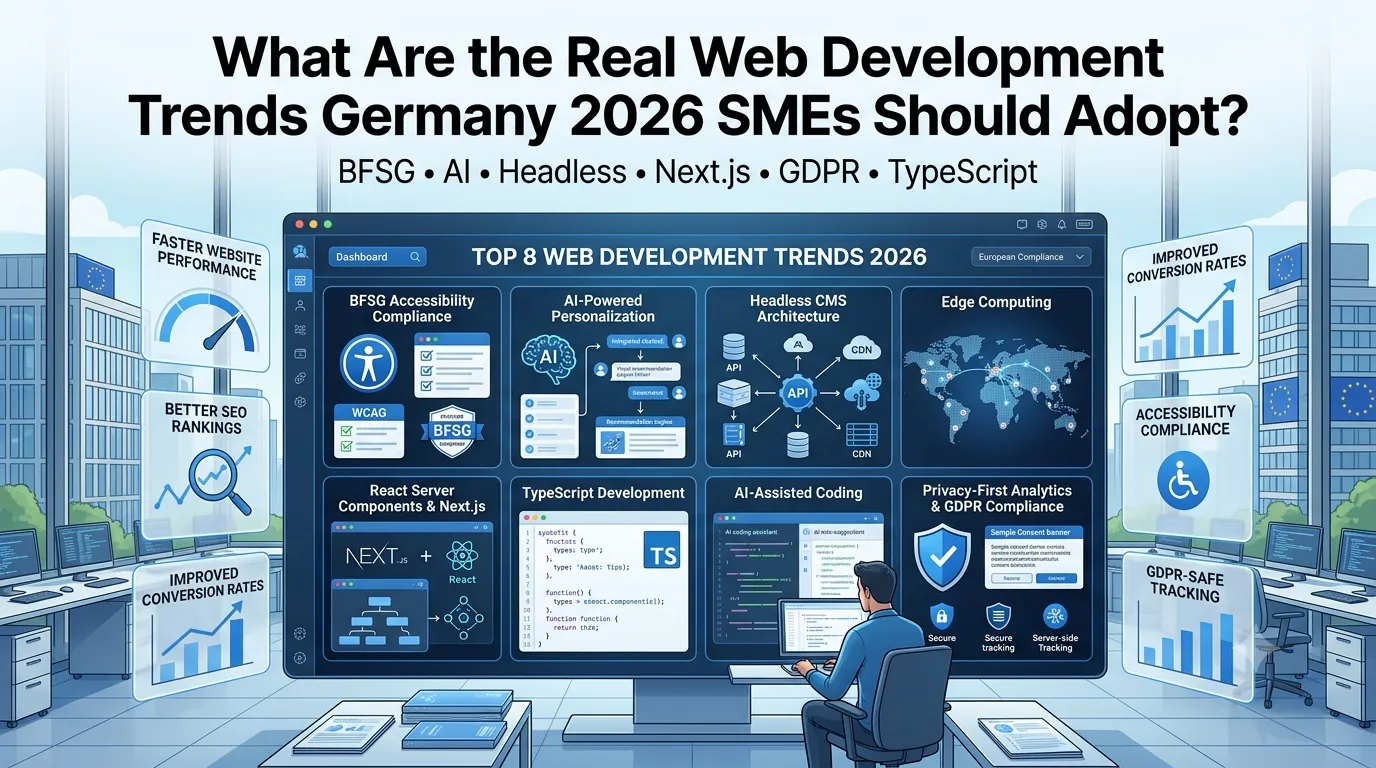
Most “web development trends Germany 2026” articles are written for clicks, not for the people who actually have to ship a website this year. This guide is the opposite — eight shifts that genuinely matter for German SMEs, GmbH founders, and Mittelstand operations leads, each with a clear “adopt now / wait / skip” rating and the ROI logic behind it.
If a trend isn’t earning its place on your roadmap, we’ll say so. If a trend is mandatory under German law (yes, that’s a real category now), we’ll say that too.
Trend 1: Is BFSG accessibility compliance now mandatory?
This isn’t a trend — it’s now German law. The Barrierefreiheitsstärkungsgesetz (BFSG) came into force in June 2025, requiring most consumer-facing digital services to meet WCAG 2.1 Level AA accessibility standards.
Who must comply: e-commerce shops, banking sites, telecom providers, transport, e-books, and most consumer-facing service businesses.
What it actually means:
- Keyboard navigation for every interactive element
- Sufficient colour contrast (4.5:1 minimum for body text)
- Alt text on every meaningful image
- Form labels properly associated
- ARIA landmarks and skip-to-content links
- Captions on video content
Penalty for non-compliance: up to €100,000.
If your site falls under BFSG, this is the highest-priority web work in 2026. Skip it at your own risk.
Trend 2: Where does AI-powered personalisation deliver real ROI?
Every agency now talks about “AI integration.” Most of it is theatre. The honest 2026 picture:
Where AI delivers real ROI:
- Customer support chatbots fed your own documentation (RAG-based)
- E-commerce product recommendation engines
- Email content personalisation for repeat customers
- AI-assisted content generation for SEO (with human editing)
- Automated tag suggestion and image alt-text generation
Where AI is still mostly hype:
- “AI-powered everything” branding without specific use cases
- Generic chatbots with no business context
- AI-generated full blog posts without editing (Google’s helpful-content penalty waiting to happen)
- AI design tools replacing UX designers
For German businesses, also note the EU AI Act classification of any AI system that touches customer data — particularly in HR, healthcare, education, and financial services.
Trend 3: Should you adopt headless and composable architecture?
Headless commerce and headless CMS aren’t new, but 2026 is when they cross from “early adopter” to “default for performance-sensitive brands.”
Adopt headless when:
- Performance / Core Web Vitals are revenue-critical
- You’re publishing content to multiple channels (web + mobile app + email)
- Your dev team is comfortable with React / Vue
- Budget can support 30–80% premium over traditional builds
Skip headless when:
- Marketing-led team with no developers
- Site is fundamentally a brochure with low traffic
- Project budget is under €15,000
For German SMEs without an in-house dev team, traditional WordPress with strong caching beats poorly-implemented headless every time. Our WordPress vs Custom Development guide goes deeper on the decision.
Trend 4: Is edge computing worth adopting for German SMEs?
Edge platforms (Vercel, Cloudflare Workers, Netlify Edge) execute code at the network edge close to the user, cutting latency dramatically.
ROI is real when:
- You serve EU + non-EU traffic and need sub-200ms response everywhere
- Your stack is JavaScript / TypeScript (Next.js, SvelteKit, Astro)
- You’re already paying for performance-sensitive infrastructure
Wait when:
- You serve mostly German traffic, single-region hosting is sub-150ms anyway
- Your stack is PHP / WordPress without headless
For most Mittelstand sites serving DACH traffic, edge is over-engineering. For SaaS or D2C brands serving EU + US, it’s a meaningful win.
Trend 5: Should new builds use server components and modern React?
React Server Components, Next.js App Router, and the broader “ship less JavaScript” movement are now stable enough to be default choices for new projects.
Why it matters in Germany:
- Better Core Web Vitals → better Google rankings
- Faster mobile loading → higher conversion rate
- Lower JavaScript bundle → better accessibility (BFSG benefits)
- Smaller data over the wire → relevant for sustainability angles
Adopt rating: if you’re building a new React-based site in 2026, default to Next.js 15 + App Router + Server Components. Don’t start a new project on the old Pages Router.
Trend 6: Should TypeScript be standard for any serious project?
TypeScript has reached the point where not using it for a serious commercial project is the exception, not the norm. For a German SME building anything beyond a simple WordPress site, your contractor should be writing TypeScript by default.
Why it matters for your business (not just your developers):
- Fewer production bugs (real, measurable in support load)
- Easier handover to a new agency in 2 years
- Better long-term maintainability
- More qualified hiring pool
Adopt rating: mandatory baseline for any custom or headless project.
Trend 7: How does AI-assisted code generation help delivery?
GitHub Copilot, Claude, Cursor, and similar tools have become standard in professional development teams. By 2026, agencies not using them are slower and more expensive — that’s part of why competitive agency pricing has held flat despite inflation.
What this means for clients:
- Faster delivery on routine work (CRUD, boilerplate, tests)
- More time for senior engineers on architecture and complex logic
- Lower defect rates on routine code
- IP-protection: ensure your agency has an enterprise plan that doesn’t train models on your code
For DACH clients, verify any agency you hire has clear IP / data-handling policies for AI coding tools. Reputable agencies have already navigated this.
Trend 8: What does privacy-first and GDPR-mature tracking require?
The Google Fonts case in 2022 was just the start. By 2026, German Datenschutz expectations have hardened around:
- Server-side tracking (GA4 via Server Container, Stape, Elevar)
- Cookieless analytics for first-party data (Plausible, Fathom self-hosted)
- Consent Management Platforms with granular opt-in (Borlabs, Real Cookie Banner, Usercentrics)
- Self-hosted fonts (Google Fonts only via local copies)
- AVV (DPA) with every third-party processor
Adopt rating: the baseline is now self-hosted fonts, GDPR-mature CMP, and ideally server-side tracking. Sites still loading Google Fonts via CDN are easy Abmahnung targets.
What should you skip in 2026?
Some “trends” are clutter. Save your budget for what matters:
- Web3 / NFT integrations for SMEs. The retail moment passed; mainstream business use cases are minimal.
- Excessive animation libraries. GSAP and Framer Motion are fine, but heavy scroll animations hurt accessibility and Core Web Vitals.
- Voice-first interfaces for content websites. Very narrow use cases.
- AR / VR for marketing sites. Niche even in 2026 — relevant for furniture, fashion, eyewear shops, not for a Mittelstand B2B site.
- AI-generated thin content for SEO. Google’s helpful-content updates have made this a ranking liability.
Which web development trends should you prioritize first?
For a typical German SME with €10k–€40k of web budget in 2026, the priority order is:
- BFSG accessibility (legal mandate)
- GDPR-mature tracking and CMP (legal + Abmahnung risk)
- Core Web Vitals + Server Components (SEO + conversion)
- AI customer support / chat (cost saving on support load)
- TypeScript baseline (long-term maintainability)
- Headless architecture (only if scaling justifies)
- Edge computing (only if traffic geography justifies)
The first three are non-optional. The rest are real options on a real roadmap.
How do these trends affect 2026 pricing in Germany?
Trends translate to project costs:
- BFSG compliance adds €2,000–€8,000 to a standard build
- Mature GDPR tracking setup adds €1,500–€5,000
- AI chatbot integration adds €3,000–€15,000
- Headless rebuild premium is 30–80% over traditional
- Edge migration is €5,000–€25,000 depending on stack
For total cost context, see our Web Development Cost Germany 2026 breakdown.
How do you brief an agency about 2026 trends?
Don’t ask “do you use AI?” — ask specific questions:
- “Are you BFSG-aware for new builds? Show me an accessibility audit you ran.”
- “How do you handle Google Fonts compliance in 2026?”
- “What’s your default approach to consent management for German sites?”
- “Do you write TypeScript by default? Can I see a recent codebase?”
- “Where do you use AI in your delivery workflow, and how do you protect client IP?”
Specific answers separate teams keeping up with the industry from teams selling 2020-era playbooks.
Frequently asked questions about web development trends Germany 2026
BFSG accessibility compliance. Legal requirement with penalties up to €100,000.
Not always. Most trends are additive. Rebuild only for genuinely outdated stacks.
€2,000–€8,000 for a standard SME site. €5,000–€20,000 for complex e-commerce or SaaS.
In narrow use cases: support chat on your docs, SEO drafting, email personalisation.
Only if traditional caching can’t solve performance, or you publish to many channels.
Risk-based AI obligations. Generic chatbots are low-risk; HR/healthcare/finance AI is higher-risk.
LCP under 2.5s, INP under 200ms, CLS under 0.1. Optimise mobile first.
Ready to act on web development trends Germany 2026?
The honest 2026 trend stack for German SMEs is mostly unglamorous: comply with BFSG, harden GDPR, ship modern React with Server Components, layer in narrowly-scoped AI where it actually saves money. The rest is mostly noise.
If you’d like a candid look at which trends apply to your specific project — and which to skip — our team offers a free 30-minute tech-roadmap call. You can book a meeting directly, or explore our broader website development services page.