Choosing between WordPress vs custom development for German business projects sounds like a tech decision, but it’s actually a business decision. Pick wrong and you’ll spend three years fighting either plugin chaos or premature engineering complexity. Pick right and the platform fades into the background while the team focuses on growth.
This guide gives you a clear decision matrix — by business size, project complexity, GDPR posture, and 3-year total cost of ownership — so a GmbH founder, Mittelstand operations lead, or German SaaS founder can decide once and not revisit the question every quarter.
When does WordPress win for German SMEs?
WordPress powers somewhere around 40% of the web globally, and for very real reasons. For a wide range of German SME needs, it’s the right answer even when the founder is convinced custom would be “better.”
WordPress is the right choice when:
- The site is primarily content (corporate site, blog, news, knowledge hub, brochure)
- You need non-developers to publish and edit pages weekly
- You’re running a moderate-traffic e-commerce shop (€500k–€5M/yr) on WooCommerce
- Time-to-launch matters more than long-term engineering elegance
- Your team doesn’t have a full-time developer on staff
- Budget is €5,000–€30,000 for build, with predictable ongoing cost
- You want a large ecosystem of plugins, themes, and German Datenschutz tools (Borlabs, Real Cookie Banner)
For 70%+ of German SMEs, WordPress is the right answer. The “custom build” instinct often comes from developer aesthetics, not business needs.
When does custom development win?
Custom (Laravel + Vue, Next.js + Node, NestJS + React, etc.) becomes worth the investment when:
- You’re building a SaaS product where the application is the business
- You need a marketplace, multi-tenant architecture, or two-sided platform
- Complex business logic (calculations, rules engines, workflows) sits at the core
- You’re handling sensitive data with strict compliance (BaFin, KBV, GoBD)
- You expect high concurrent load or unusual scaling patterns
- The team includes (or will hire) full-time developers
- 3-year TCO clearly favors avoiding plugin sprawl
For the right project, custom development pays for itself within 12–18 months through better performance, lower maintenance overhead, and avoided plugin-vendor lock-in.
What is the 3-year total cost of ownership comparison?
Headline build cost is misleading. Real cost shows up over 3 years of ownership.
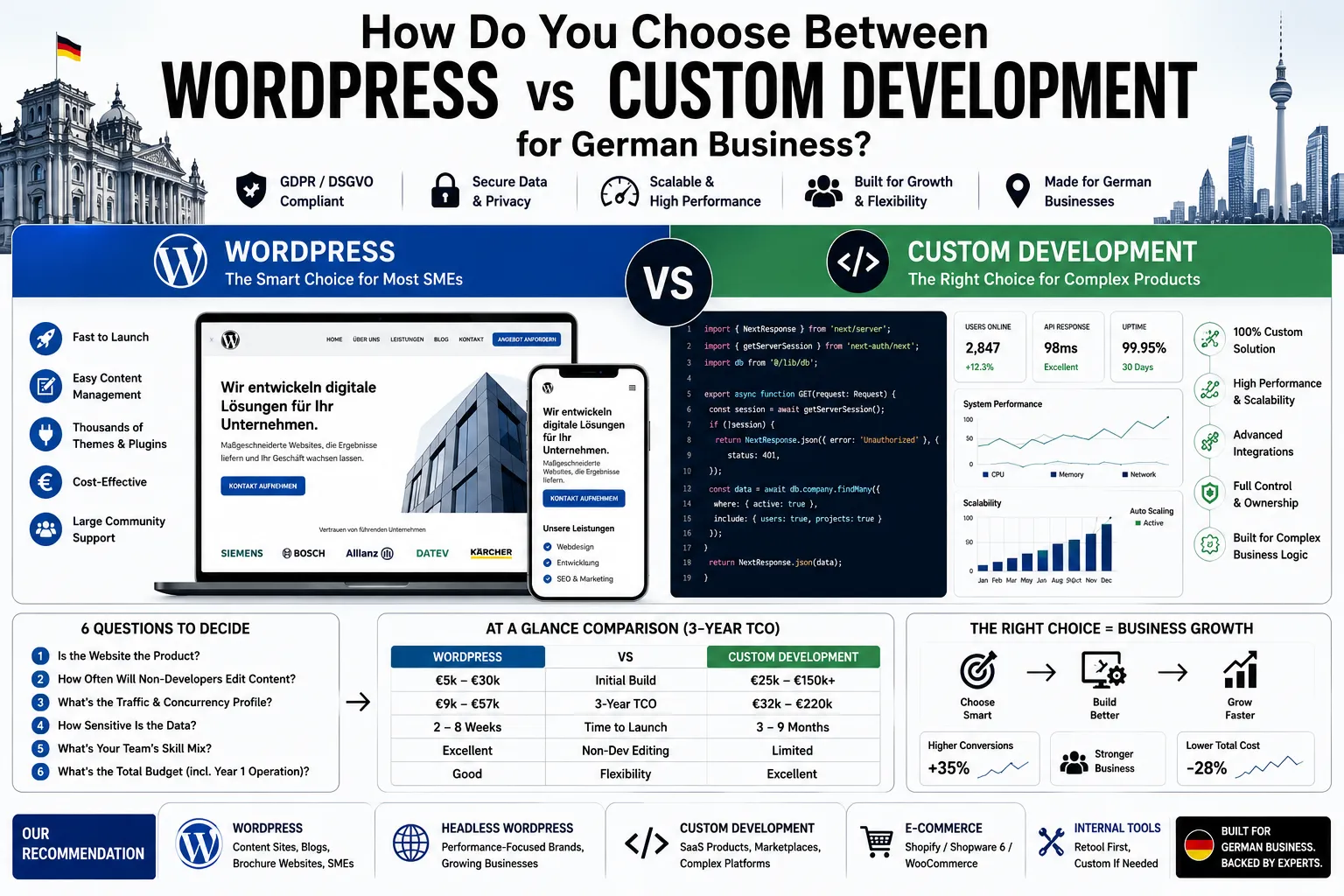
| Cost component (3 years) | WordPress | Custom |
|---|---|---|
| Initial build | €5k–€30k | €25k–€150k+ |
| Year-1 plugins & licences | €500–€3,000 | Minimal |
| Hosting (3 years) | €600–€3,600 | €1,800–€18,000 |
| Maintenance & updates | €2,000–€15,000 | €5,000–€40,000 |
| Plugin replacement cycles | €1,000–€6,000 | Low |
| Security patches | Included in maintenance | Included in maintenance |
| 3-year TCO range | €9,000–€57,000 | €32,000–€220,000 |
For projects under €50,000 of business value to capture, WordPress almost always wins on TCO. For projects supporting €500k+ ARR or sensitive workflows, custom often wins.
What are the six questions that settle the WordPress vs custom decision?
Answer these six questions honestly. The pattern reveals the right choice.
1. Is the Website the Product?
If you’re a service business selling consulting, a Mittelstand manufacturer marketing products, or a SaaS company with a marketing site → WordPress.
If you’re a SaaS product, marketplace, or internal SaaS platform → custom.
2. How Often Will Non-Developers Edit Content?
Weekly or more → WordPress (Gutenberg or page builders empower editors).
Rarely / never → either works.
3. What’s the Traffic & Concurrency Profile?
Up to ~500,000 monthly visits with normal patterns → WordPress with good hosting handles it fine.
Heavy concurrent users (real-time apps, live dashboards) → custom architecture.
4. How Sensitive Is the Data?
Standard B2B contact forms, e-commerce orders → WordPress + good security plugins is sufficient.
Patient data (KBV/eHealth), financial records (GoBD, BaFin), or critical IP → custom build with formal security review.
5. What’s Your Team’s Skill Mix?
No developers in-house, marketing-led → WordPress.
Engineering team available or planned hires → custom is realistic.
6. What’s the Total Budget Including Year 1 of Operation?
Under €30,000 → WordPress.
€60,000+ → custom is on the table.
Between €30k–€60k → depends on questions 1–5.
How does GDPR / DSGVO affect WordPress vs custom?
Some founders assume custom = more secure for GDPR. Not necessarily.
WordPress GDPR posture:
- Mature, German-built compliance plugins (Borlabs Cookie, Real Cookie Banner, Complianz)
- Easy AVV-friendly hosting in Germany (Hetzner, IONOS, Mittwald, Raidboxes)
- Risk is plugin-sprawl: every new plugin adds a third-party data flow
- Auditable, well-documented, lawyer-tested setups exist
Custom GDPR posture:
- Total control over every data flow — nothing happens you didn’t write
- Cookie banner, consent management built into application code
- No plugin marketplace adding hidden trackers
- Risk: any compliance work you skip is on you
For German Datenschutz, both can be fully compliant. The plugin-sprawl risk is the main difference, and it’s manageable with discipline.
What is the headless WordPress middle ground?
A third option is often the best for content-rich, performance-sensitive brands: headless WordPress + Next.js / Vue frontend.
You keep WordPress as the editor-friendly CMS, but the public site is rendered by a modern JavaScript framework — getting faster speed, better SEO, and a developer-friendly frontend without giving up the content editing UX.
Sweet spot: marketing sites €15k–€60k budget, growing brands, content teams who want WordPress simplicity but engineering wants modern tooling.
What common mistakes do German businesses make?
Five patterns we see repeatedly when this decision goes wrong:
- Choosing custom for ego reasons. “We’re a serious business, we need a serious build.” But if the site is essentially content + a contact form, WordPress is more serious about your budget.
- Choosing WordPress for a real SaaS product. Eventually the application logic outgrows what plugins can do, and you rewrite the whole thing at year 2.
- Combining 47 plugins to avoid custom code. This produces fragility, slow load, and a compliance nightmare. Three good plugins beat 47 mediocre ones.
- Picking based on developer preference. Developers tend to recommend the stack they like working in. Ask three vendors with different stack bias.
- Ignoring TCO. The €8,000 WordPress build that costs €25,000 to maintain over 3 years isn’t cheaper than the €25,000 custom build that costs €5,000 to maintain.
Which German industries benefit most from WordPress vs custom development?
How the decision shakes out across common DACH business types:
- Mittelstand B2B manufacturer: WordPress almost always wins. Content site + product catalogue + contact forms. €10k–€30k build.
- Berlin SaaS startup: Custom for the product; WordPress (or Webflow) for the marketing site. Two systems, each in its lane.
- German Shopify retailer: Shopify for the shop, WordPress for the blog if needed. Not WordPress + WooCommerce unless very specific reasons.
- Healthcare / medical practice: WordPress + KBV-aware plugins for the public site, custom for any patient-data system.
- Mittelstand digital transformation: Custom internal tools (Retool, custom Laravel apps), WordPress for the external site.
What’s the fastest way to decide with your team in one hour?
Run this 60-minute internal workshop:
- 15 min: Brief everyone on the decision matrix above
- 15 min: Answer the six questions as a team
- 15 min: Ask: “If this site needed to evolve in three years, what would we need to add?”
- 15 min: Match the answers to WordPress, headless, or custom
Answers clustering toward content + non-developer editing + moderate budget point to WordPress. Complex logic + sensitive data + dev team requirements suggest a custom build. A mixed result often means headless WordPress is the right compromise.
What’s a realistic tech stack recommendation for 2026?
For most German SMEs and GmbH founders without an in-house dev team, our 2026 stack recommendations are:
- Content site / Mittelstand B2B: WordPress + Gutenberg + Hetzner hosting + Borlabs Cookie + WP Rocket
- Performance-focused brand site: Headless WordPress + Next.js + Vercel + Hetzner DB backup
- SaaS product: Next.js + tRPC + Prisma + PostgreSQL + Vercel + Stripe
- E-commerce DACH: Shopify + Klaviyo + Trusted Shops; OR Shopware 6 for native DACH
- Internal tools: Retool first, custom React + NestJS if Retool can’t fit
For a deeper stack discussion, see our Best Tech Stack for German Startup Web App guide.
Frequently asked questions about WordPress vs custom development for German business
Yes when properly maintained: updates, security plugin, 2FA, reputable German host. Banks need custom; everyone else is fine on WordPress.
Build: WordPress €5k–€30k, custom €25k–€150k+. 3-year TCO: WordPress €9k–€57k, custom €32k–€220k.
Plugin sprawl around platform limits, business logic that does not fit WordPress, or scale/performance not fixable by hosting.
With managed hosting (Raidboxes, Kinsta) plus caching, WordPress comfortably handles 500k–2M monthly visits.
Rarely. WordPress or Webflow handles content plus lead capture elegantly. Custom is for SaaS, marketplaces, or platforms.
Both can be compliant. WordPress benefits from mature German Datenschutz plugins. Custom gives total control but every detail is on your team.
WordPress CMS plus a Next.js/Vue/Astro frontend. Editor simplicity plus modern speed and SEO. €15k–€60k sweet spot.
Ready to choose WordPress vs custom development for German business?
This isn’t a technology decision dressed up as a business decision — it’s a business decision dressed up as a technology decision. Match the platform to the problem: WordPress for content and SME marketing, custom for SaaS and complex logic, headless WordPress as the elegant middle ground.
If you’d like a neutral opinion on which fits your specific project, you can book a tech stack consultation with our team or browse our website development services for a full picture of our delivery model. We build in both WordPress and custom stacks, so the recommendation is honest, not vendor-locked.