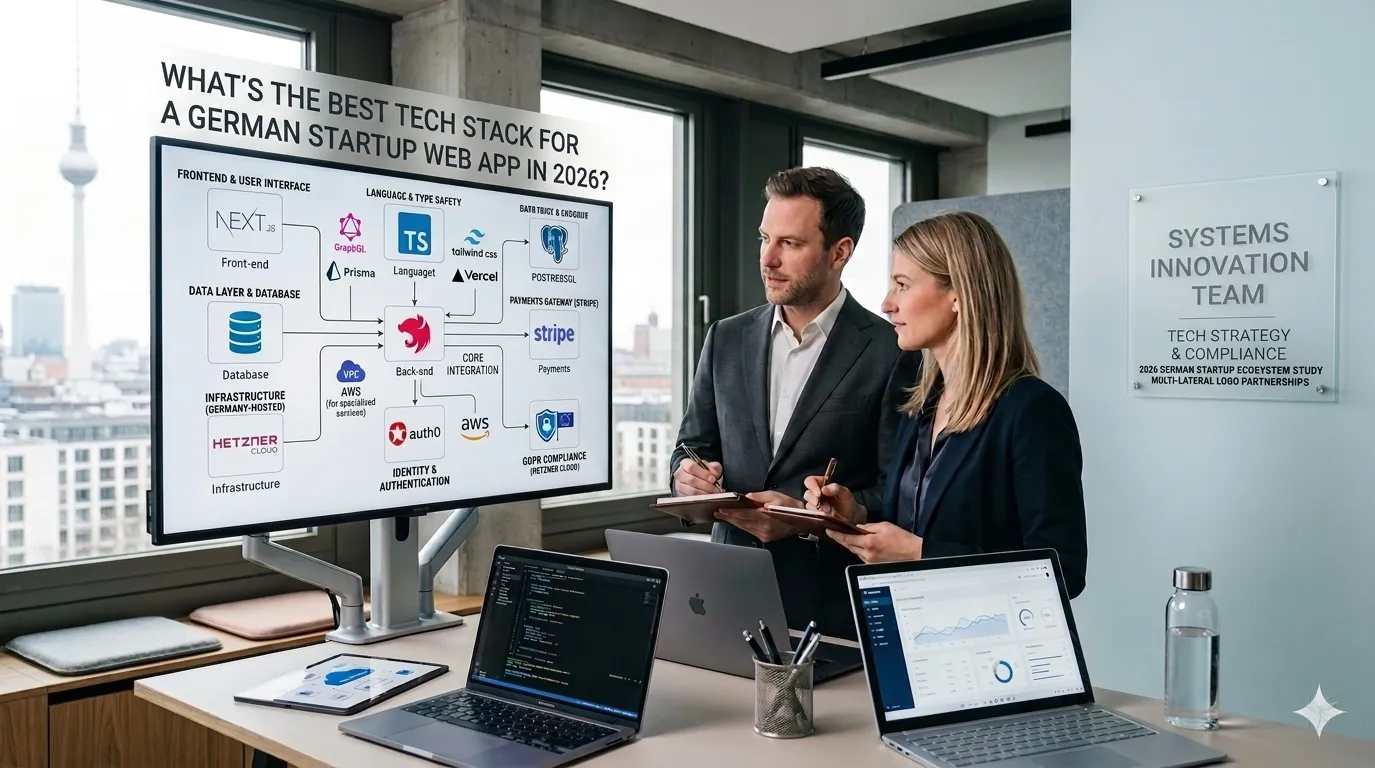
Choosing the best tech stack for German startup web app projects in 2026 is less about chasing the newest framework and more about making three honest trade-offs: vendor lock-in vs delivery speed, EU data residency vs developer convenience, and TypeScript-fluent hiring pool vs nostalgia for older stacks. This guide gives you three battle-tested stacks — lean, balanced, and enterprise — with the GDPR / DSGVO realities baked in.
Written for technical founders, CTOs, and DACH product owners deciding what to build their next SaaS or web app on.
What does “best stack” actually mean in 2026?
The right stack is the one your team can ship and maintain for the next three years without rewriting. For a German startup, that means optimising for:
- GDPR / DSGVO data residency — production data in EU (ideally Germany)
- Hiring pool depth — junior to senior talent available in DACH
- Vendor lock-in level — how reversible the choices are if circumstances change
- Time-to-MVP — weeks from kickoff to first paying customer
- 3-year operating cost — hosting, third-party services, maintenance overhead
- Compliance fit — AVV with vendors, BFSG accessibility, GoBD if needed
The three stacks below represent the three honest points on that trade-off curve.
Stack 1: Lean — what ships in 8 weeks and iterates fast?
For pre-seed startups or solo founders wanting a paying-customer-ready MVP fast.
Frontend: Next.js 15 + TypeScript + Tailwind CSS, deployed on Vercel Backend: Supabase (Postgres + Auth + Storage + Edge Functions) Payments: Stripe with SEPA recurring + Klarna Email: Resend (transactional) + Brevo (marketing, German-friendly) Analytics: Plausible (cookieless, EU-hosted) Monitoring: Sentry (EU region) Auth: Supabase Auth (with optional Clerk if more enterprise SSO needed later)
Strengths:
- Fastest path from kickoff to live MVP (8–12 weeks realistic)
- Excellent DX, low operational overhead
- Cookieless analytics avoid Datenschutz headaches
- Vercel’s German edge gives sub-100ms response in DACH
Trade-offs (be honest about these):
- Supabase hosts on AWS by default — you can choose EU region (Frankfurt) but the underlying provider is US-owned
- Vercel is a US company hosting EU edge servers — for some German enterprise customers, this is a procurement objection
- Migration away from Supabase to self-hosted Postgres is non-trivial as you grow
Best for: SaaS MVPs, B2C apps, marketing-first products. €15k–€50k MVP budget.
Stack 2: Balanced — what’s scale-ready and EU-first?
For seed-to-Series-A startups that expect 6–18 months of growth and want to remove vendor lock-in around critical pieces.
Frontend: Next.js 15 + TypeScript + Tailwind, deployed on Vercel or self-hosted with Hetzner + Docker Backend: NestJS or Hono on Bun, custom REST/tRPC Database: Self-hosted PostgreSQL on Hetzner Cloud (Frankfurt or Falkenstein) ORM: Prisma or Drizzle Auth: Auth0 EU region, or Clerk with EU compliance, or self-hosted Keycloak Payments: Stripe (same as Lean) Email: Brevo / CleverReach (German-headquartered, native German GDPR compliance) Object storage: Hetzner Storage Box or self-hosted MinIO Analytics: Plausible self-hosted or Matomo (Germany-headquartered) Monitoring: Sentry EU + Grafana Cloud EU CI/CD: GitHub Actions
Strengths:
- 80% of the speed of Stack 1 with 90% less vendor lock-in
- Production database lives on EU-owned infrastructure
- GDPR data residency story is clean for sceptical German customers
- All vendors offer signed AVV (DPA) with no friction
Trade-offs:
- Slightly higher devops overhead (you maintain DB backups, monitoring)
- Faster to break things if your team is inexperienced
- Migration from Supabase to this stack adds ~3–4 weeks if you switch later
Best for: B2B SaaS, scaling D2C, Mittelstand-targeting startups. €30k–€100k MVP budget. Most German startup-stage companies should default here.
Stack 3: Enterprise — what fits regulated industries and long-term compliance?
For startups serving banking, healthcare, public sector, or selling to large DACH enterprises.
Frontend: Next.js + TypeScript with SSR-only (no client-side data fetches), deployed on AWS Frankfurt or Hetzner Backend: NestJS or Spring Boot (Java) for enterprise codebase appeal, deployed on AWS ECS / Hetzner Cloud Kubernetes Database: PostgreSQL on AWS RDS Frankfurt with read replicas, or self-hosted PostgreSQL with PITR backups Auth: Keycloak self-hosted (full control, OIDC, SAML for customer SSO) Payments: Stripe Plus + Klarna + Mollie (multi-PSP for redundancy) Email: Brevo + Mailgun EU region Object storage: AWS S3 Frankfurt or self-hosted MinIO Analytics: Matomo self-hosted (full data control) Monitoring: Datadog EU or Grafana Cloud EU Security: WAF (Cloudflare Enterprise or AWS WAF), pen-tested annually Compliance: ISO 27001-aligned hosting partner, signed AVV with every processor, BFSG and GoBD audit-ready
Strengths:
- Passes most German enterprise procurement processes
- Full data residency, full control
- Auditable trail for regulated industries
- Supports complex customer-side SSO requirements
Trade-offs:
- 50–100% more expensive to operate vs Stack 1
- Requires more senior engineers; not a solo-founder stack
- Longer time-to-MVP (16–32 weeks vs 8–12)
Best for: Fintech, health-tech, public sector, B2B SaaS selling to DAX clients. €80k–€300k+ budget.
How do you choose between the three stacks?
Five questions that settle it:
- Will any customer require a signed AVV / data residency clause? → Stack 2 or 3.
- Are you in a regulated industry (BaFin, KBV, eHealth, public sector)? → Stack 3.
- Solo founder or 2-person team building an MVP? → Stack 1.
- Series A funded with a clear roadmap to scale? → Stack 2 is the default.
- Selling to DAX-scale enterprises? → Stack 3 (or migrate Stack 2 → 3 as you grow).
For most DACH startups, Stack 2 is the sweet spot. Stack 1 is for speed; Stack 3 for compliance.
What’s the honest story on EU data residency?
A few specifics every German founder should know:
- AWS Frankfurt stores data in the EU but the parent company is US-based (CLOUD Act exposure). For most use cases acceptable; for highly sensitive data, not.
- Hetzner is German-owned, German-operated, with German data centres. The strongest GDPR posture available.
- Vercel is a US company. They offer EU edge servers, but for some German enterprise customers this is a procurement blocker.
- Supabase runs on AWS by default. EU region available; ownership is US.
- Brevo (formerly Sendinblue) is French-headquartered. Strong EU GDPR posture.
- CleverReach is German-headquartered. Best-in-class for German email compliance.
- Plausible is open source, can be self-hosted in Germany.
- Matomo is open source, self-hostable in Germany.
For most DACH startups, the mix of Hetzner (infrastructure) + Brevo / CleverReach (email) + Plausible or Matomo (analytics) covers the data residency conversation cleanly.
What should you avoid in 2026?
Some stacks have aged badly or carry hidden costs:
- PHP / Symfony for new projects. Mature but hiring is getting harder; modern Laravel still fine.
- Angular for new SaaS frontends. React + Next.js has a far larger DACH developer pool.
- MongoDB as a primary database. Postgres + JSONB beats Mongo for most use cases now; Postgres is also better for compliance audits.
- Firebase for production B2B SaaS. Vendor lock-in is total; data residency is murky; pricing scales painfully.
- WordPress as a backend for SaaS. Use it for content sites, not as a custom-app foundation.
- Heroku for production. Pricing and feature set have stagnated; Vercel / Hetzner are cleaner choices.
What’s the hiring pool reality for each stack?
DACH talent depth as of 2026:
- Next.js + TypeScript: very deep pool, junior to senior, English-fluent dev hires available across Berlin / Munich / Hamburg
- NestJS / Laravel: strong DACH developer community, especially Munich and NRW
- PostgreSQL: ubiquitous, every backend dev knows it
- Keycloak / Auth0: specialist knowledge, fewer but quality engineers available
- Java / Spring Boot: strong in Mittelstand-adjacent talent pools, big enterprise hiring pool
Stack 1 and 2 hire the fastest. Stack 3 needs senior generalists who command higher rates.
How do you brief an agency on stack choice?
If you’re outsourcing the build, the right way to discuss stack:
- “Show me a recent project on this stack — what was the time-to-launch?”
- “How do you handle production database backups and PITR?”
- “Where does the production database live? Show me the AVV with that vendor.”
- “What’s your approach if we need to migrate from Supabase to self-hosted Postgres in year 2?”
- “How do you ensure GDPR data residency through every layer of the stack?”
Agencies who answer specifically have shipped these stacks. Agencies who pivot to feature conversations haven’t.
For broader agency vetting, see our How to Choose a Web Development Agency in Germany guide.
What’s the tech stack and cost reality?
For a typical SaaS MVP scope, here’s what the three stacks cost to build:
| Stack | MVP build cost | Year-1 hosting + tooling | Time to launch |
|---|---|---|---|
| Lean (Stack 1) | €15,000 – €50,000 | €100 – €500/mo | 8–12 weeks |
| Balanced (Stack 2) | €30,000 – €100,000 | €200 – €1,500/mo | 12–20 weeks |
| Enterprise (Stack 3) | €80,000 – €300,000+ | €1,500 – €8,000/mo | 16–32 weeks |
For broader budget context, see our Web Development Cost Germany 2026 guide.
How do you migrate between stacks over time?
A common pattern: start Lean, migrate to Balanced at €100k ARR, migrate to Enterprise at €1M ARR (or when first enterprise customer demands it).
Migration costs roughly:
- Lean → Balanced: €15,000 – €40,000 (3–6 weeks)
- Balanced → Enterprise: €30,000 – €100,000 (3–6 months)
Plan for these. Lean is fine to start, but architect with the migration path in mind — e.g., abstract auth behind a clean interface, keep data access through your own API rather than direct Supabase SDK calls.
Frequently asked questions about best tech stack for German startup web app
Next.js + TypeScript, Supabase or self-hosted Postgres, Stripe, Plausible, Brevo. 8–20 weeks to MVP.
Supabase for speed. Self-hosted Postgres on Hetzner for data residency and reduced lock-in.
Yes for most. Self-host on Hetzner if EU-only or CLOUD Act sensitivity matters.
Hetzner wins on cost and Datenschutz. AWS wins on ecosystem and certifications.
Not recommended. Heavy lock-in, complicated EU residency, expensive at scale.
Stripe default plus Klarna for B2C. Mollie for DACH-specific PSP needs.
Own your Postgres data, abstract SDKs behind your API, prefer self-hostable open-source tools.
Ready to pick the best tech stack for German startup web app?
The right stack for a German startup web app in 2026 depends on your stage, regulatory exposure, and growth ambitions. For most: Stack 2 (Next.js + self-hosted PostgreSQL on Hetzner + Auth0/Keycloak + Stripe + EU email tools) is the right default. Stack 1 if you’re moving very fast and accepting some vendor lock-in. Stack 3 if you serve regulated industries or large DACH enterprises.
If you’d like a stack-consultation call to discuss your specific project, you can book a meeting with our team or explore our website development services for our broader approach.