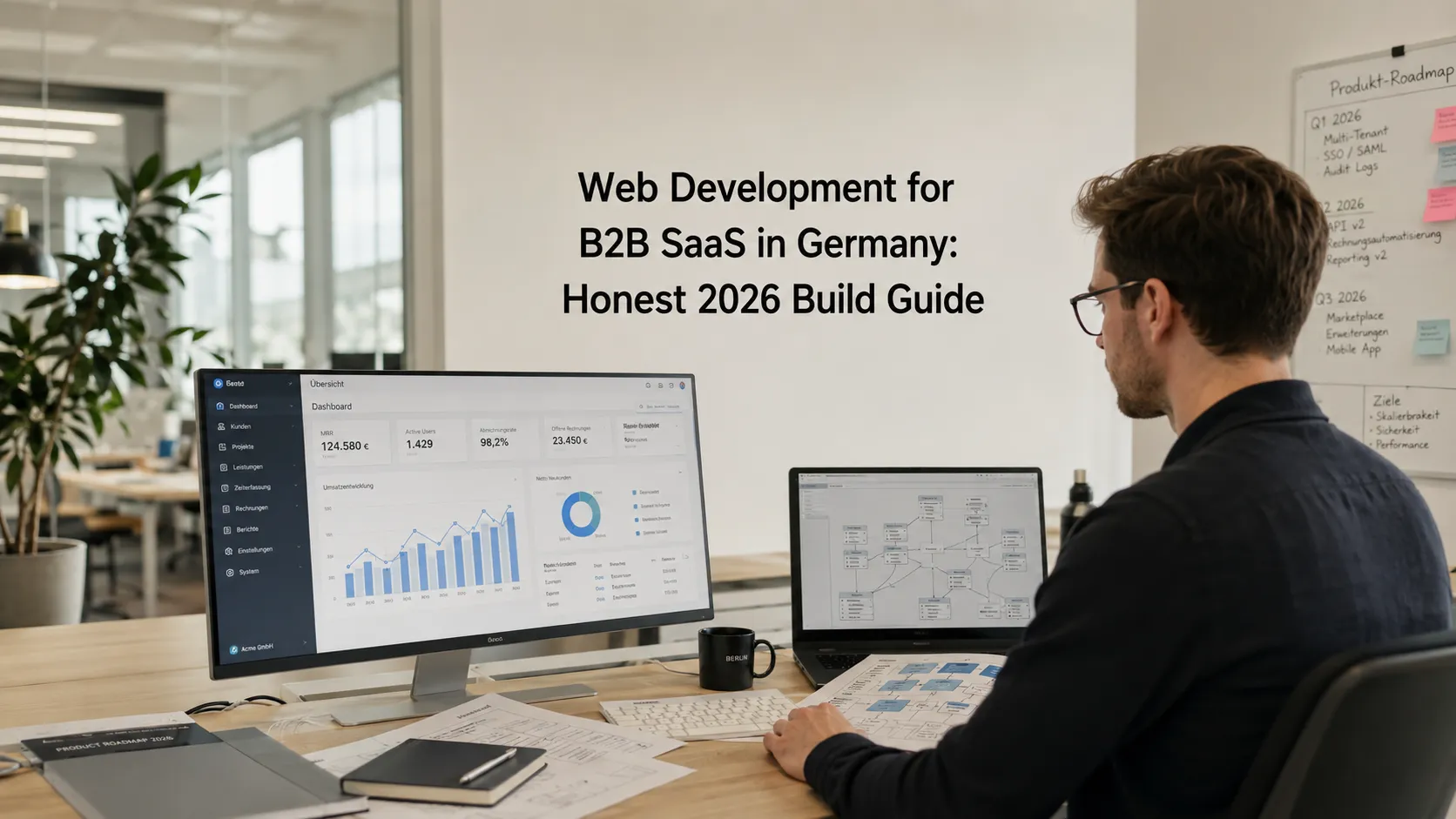
German B2B SaaS founders in 2026 face a different web-development reality than their US counterparts. The German buyer market is sophisticated and demanding — but it’s also conservative on contract terms, careful about DSGVO, and resistant to vendors who can’t speak to Mittelstand procurement realities. The build cost gap between “an MVP” and “a production B2B SaaS that German enterprises will actually buy” can easily exceed €100,000, and most founders don’t see it until month 6.
This guide walks through what web development for B2B SaaS in Germany actually looks like in 2026: MVP and growth-stage scope, multi-tenant architecture, EUR data residency, German payment integration, and realistic EUR budgets.
What does “B2B SaaS” actually mean in 2026?
Five common German B2B SaaS categories:
- Vertical SaaS — software for German Handwerker, Pflegedienste, Steuerberater, Anwälte, Bauunternehmer.
- Horizontal Mittelstand SaaS — CRM, HR, project management, document signing.
- Developer / IT SaaS — tools, monitoring, security for German engineering teams.
- Marketing / sales SaaS — analytics, lead-gen, automation.
- FinTech / Banking-adjacent SaaS — accounting, payments, treasury (heavily regulated).
Architecture, cost, and timeline differ dramatically by category.
What does a B2B SaaS MVP actually need?
Honest minimum scope for a credible German B2B SaaS MVP:
- Auth + SSO — email/password plus Microsoft 365 SSO (almost universally expected by German enterprise). 2FA.
- Multi-tenant architecture — shared DB with tenant scoping is the right starting point.
- Role-based access control — admin/user/viewer permissions, sensible UI.
- One core feature done extremely well — not 47 half-done features.
- Billing — Stripe + SEPA Lastschrift, plus manual invoicing for enterprise (see our Stripe SEPA integration guide).
- Admin / customer-success backend — see all tenants, impersonate users (audited), reset passwords.
- Audit logging — every state-changing action with user, tenant, timestamp, IP.
- Observability — Sentry/Rollbar for errors, metrics, logs.
- DSGVO baseline — EU hosting, signed DPAs, export/erasure endpoints.
What does a B2B SaaS MVP cost in Germany in 2026?
Lean MVP
- German agency: €35,000–€85,000
- Nearshore (Poland/Romania/Ukraine): €20,000–€55,000
Standard MVP (multi-tenant, billing, admin backend)
- German agency: €70,000–€180,000
- Nearshore: €40,000–€110,000
Enterprise-ready MVP (SSO, audit logs, RBAC)
- German agency: €140,000–€350,000
- Nearshore: €85,000–€220,000
Growth-stage rebuild
- €100,000–€500,000+ depending on complexity
For broader context see our web development cost in Germany guide.
What’s the right tech stack in 2026?
Three battle-tested stacks:
Stack A: Next.js + Node.js + PostgreSQL
Frontend: Next.js + TypeScript + Tailwind. Backend: Node.js (often NestJS) or Next.js server actions. Database: PostgreSQL on Hetzner Cloud or AWS Frankfurt RDS. Auth: Auth.js or Clerk EU. Best for modern SaaS, fast iteration, React-fluent team.
Stack B: Laravel + Inertia/Livewire + PostgreSQL
Backend + frontend in Laravel. Filament for admin. Best for admin-heavy B2B, solo founder builds, content-rich SaaS. See our hire Laravel developer guide.
Stack C: Python (Django/FastAPI) + React
For data-heavy or AI-heavy SaaS. Best for ML/AI-integrated products.
For more see our best tech stack for German startup web app guide.
How do you architect multi-tenancy?
The biggest single architectural decision.
Shared database with tenant scoping (most common)
One database, every table has tenant_id, every query filters by tenant. ORM-level enforcement via global scopes / middleware. Easier to operate, lower cost. Risk: bug here causes data leakage.
Database per tenant
Each customer gets their own database. Stronger isolation. More operational complexity, higher cost.
Hybrid
Small/free tenants on shared DB, enterprise on dedicated. Best at scale.
For most German B2B SaaS MVPs: shared database with tenant scoping.
How does DSGVO shape B2B SaaS in Germany?
Six architectural decisions from day one:
- EU data residency — Hetzner Cloud, AWS Frankfurt, OVHcloud Strasbourg.
- Sub-processor list + DPAs — every third-party tool that processes customer data.
- Data export endpoints (Article 15) — tenant admins export their data in structured format.
- Data erasure flows (Article 17) — soft delete with retention timer, then hard delete.
- Audit logging — required for DSGVO disputes and enterprise procurement.
- EU AI Act — declare LLM provider and data flow in your DPA if you use AI.
See our GDPR compliance guide.
How does German B2B SaaS billing actually work?
Three things German enterprise buyers expect:
Invoice-based billing
Most German Mittelstand and enterprise pay via Rechnung + bank transfer. Self-service credit card works for SMB. Enterprise contracts require invoices with net 14 / net 30 terms.
SEPA Lastschrift for recurring SMB
Competitive advantage in the German market.
GoBD-compliant invoicing
Sequential numbers, full company address, VAT breakdown, USt-ID, reverse-charge for EU B2B. Integrate with Lexware Lexoffice, FastBill, sevDesk.
Transparent pricing
German buyers expect tier prices on your website before they schedule a sales call.
What integrations should a German B2B SaaS support?
In order of typical priority:
- Microsoft 365 SSO — almost universally expected by German enterprise.
- Google Workspace SSO — for startups and modern Mittelstand.
- Accounting export — Lexware, Datev, sevDesk, FastBill.
- CRM — HubSpot, Pipedrive, Salesforce, CentralStationCRM.
- Slack / Microsoft Teams — notifications and chatops.
- Zapier / Make.com / n8n — long tail.
What are the most common B2B SaaS build mistakes German founders make?
Four patterns:
Building features instead of value
47 features and 0 paying customers. Launch with one feature and 3 paying customers.
Underestimating admin / operations tooling
Admin, support tools, audit logs, impersonation. 25–40% of total dev time, often cut from MVP — becomes bottleneck within 6 months.
Skipping multi-tenancy “until later”
Rebuilding from scratch is the result. Build multi-tenant from day one.
Picking US-only tools that hurt DSGVO
Default Vercel, Cloudflare US, US-region S3 — then redo data residency 6 months later. Pick EU from day one.
When should you hire vs. buy vs. build?
- Build: core product feature, multi-tenancy, custom integrations
- Buy: auth (Clerk, Auth.js, Keycloak), email (SendGrid, Postmark, Resend), payments (Stripe + SEPA, Mollie), error tracking (Sentry), analytics (PostHog EU, Plausible)
- Hire: see our hire React developer and hire Node.js developer guides
- Agency: for initial 3–9 month build without in-house engineering
Frequently Asked Questions About B2B SaaS Development in Germany
€35,000–€85,000 lean (agency); €70,000–€180,000 standard; €140,000–€350,000 enterprise-ready.
3–5 months lean; 5–9 months standard; 8–14 months enterprise-ready.
Next.js + Node + PostgreSQL; Laravel + Inertia/Livewire; or Python + React. Pick by team depth.
Multi-tenant from day one — shared DB with tenant scoping is the right starting point.
EU hosting, signed DPAs, sub-processor list, Article 15/17 endpoints, audit logging.
Both — cards + SEPA for SMB self-service, invoice + net 14/30 for enterprise.
Clerk EU, Auth.js, or self-hosted Keycloak; Keycloak on Hetzner for strict DSGVO.
Yes — Eastern Europe at 40–60% lower rates with senior depth.
Need help scoping a B2B SaaS build?
If you’re early-stage and want a 30-minute scoping conversation about MVP scope, stack, and realistic EUR budget, book a meeting or send details via our contact page.
Need expert help? Gem Programmers provides web design and development services for businesses in Germany, Austria and Switzerland. Request a free, no-obligation quote and get a clear plan with scope, timeline and price.