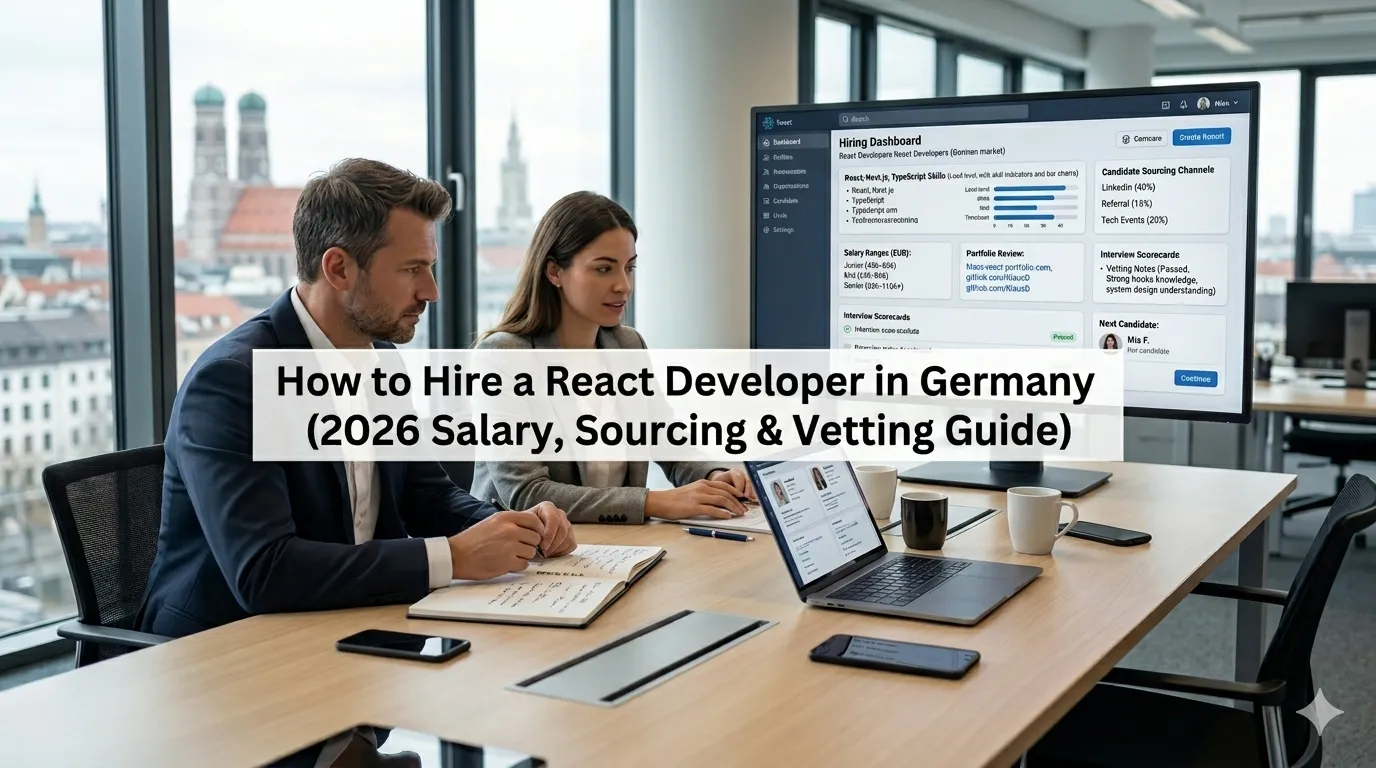
Finding a React developer in Germany in 2026 isn’t a “shortage” problem the way it was 2021–2023, but it’s still a non-trivial hiring challenge: EUR rates have settled higher than pre-pandemic, the bar for senior React has risen as the ecosystem matured, and the gap between “writes React” and “ships production React for a German GmbH” is wider than ever.
This guide walks through how to actually hire a React developer in Germany in 2026: realistic salary ranges, the four hiring models (full-time, freelance, dedicated nearshore, agency project), where to source candidates, the technical interview questions that actually predict quality, and the contract details that protect a German GmbH from common hiring pitfalls.
What does a React developer actually do in 2026?
A React developer in 2026 typically works across one or more of these areas:
- Frontend UI development for SaaS web apps, dashboards, B2B portals — the classic React role.
- Next.js full-stack development — server-side rendering, routing, API routes, edge functions. Most “React developer” roles in 2026 are actually Next.js roles.
- React Native mobile development — same engineer reused for iOS/Android via React Native or Expo.
- Headless / decoupled WordPress + Next.js frontends — increasingly common for marketing sites.
- Design system maintenance — building and maintaining component libraries (Radix, Headless UI, custom).
When you write a job description, be explicit about which of these you actually need. A “React developer” who only does pure SPA work is rarer than 5 years ago — the market has converged on Next.js + TypeScript + Tailwind as the default modern stack.
What does a React developer cost in Germany in 2026?
Realistic 2026 EUR ranges by hiring model.
Full-time German employee (Festanstellung)
| Seniority | Annual Gross EUR | Loaded Cost (incl. employer NK) |
|---|---|---|
| Junior (0–2 yrs) | €50,000–€65,000 | €62,500–€81,250 |
| Mid-level (2–5 yrs) | €65,000–€85,000 | €81,250–€106,250 |
| Senior (5–8 yrs) | €85,000–€110,000 | €106,250–€137,500 |
| Staff / Lead (8+ yrs) | €110,000–€150,000 | €137,500–€187,500 |
| Principal / Architect | €140,000–€200,000+ | €175,000–€250,000+ |
Add ~25% for employer social contributions, holiday pay, parental leave, and incidentals. Berlin, Munich, and Hamburg sit at the high end; smaller cities are 15–25% lower.
Freelancer (German Freiberufler with VAT)
- Junior: €60–€80/hour
- Mid: €80–€110/hour
- Senior: €110–€160/hour
- Specialist (Next.js + complex SSR/edge or React Native expert): €120–€180/hour
Day rates typically €640–€1,300. Most German React freelancers prefer day rates over hourly.
Nearshore developer (dedicated team via agency)
- Junior: €30–€45/hour
- Mid: €45–€70/hour
- Senior: €60–€95/hour
Eastern Europe (Poland, Romania, Ukraine, Bulgaria) and parts of Spain/Portugal cluster in this range. Quality matches German senior developers when the agency has done German-client work before.
Agency project (fixed scope React build)
- Small feature/component build: €4,000–€15,000
- Full SaaS MVP frontend: €25,000–€80,000
- Enterprise React/Next.js application: €80,000–€400,000+
For complete cost context across all engagement types, see our web development cost in Germany guide.
When should you hire a full-time React developer vs. a freelancer?
Five practical filters:
Choose full-time hiring when
- You have at least 12 months of continuous React work ahead
- You need someone embedded in product decisions, not just executing tickets
- Your codebase will be maintained for 3+ years
- You’re building a product team, not just shipping a project
- You want IP, knowledge, and institutional memory to stay with you
Work with a freelancer when
- You need 1–6 months of focused work
- You have a clear scope (build feature X, migrate from A to B, optimize performance)
- You don’t have the budget for full-time + recruiter fees + onboarding
- You need a specialist for a narrow problem (React Native, Three.js, complex Redux refactor)
Use a dedicated nearshore developer when
- You want full-time capacity without the German Festanstellung overhead
- You have 6+ months of work and need consistent dedicated capacity
- You’re comfortable with daily Slack/Zoom collaboration across a small time-zone gap
- Your budget is 35–60% lower than full-time German Festanstellung at similar quality
Pick an agency for fixed-scope React projects when
- You have a defined deliverable with a clear “done” definition
- You don’t have engineering management capacity in-house to lead a freelancer
- You want code ownership + post-launch warranty + handover to internal team later
Where do you actually find React developers in Germany?
Six channels that work in 2026.
LinkedIn (paid)
LinkedIn Recruiter or sponsored InMail. Expensive (€8,000–€12,000/year for Recruiter) but still the broadest pool of German-resident React developers. Best for mid-to-senior full-time roles.
The German-native LinkedIn equivalent. Smaller pool but stronger for traditional German Mittelstand companies and for candidates not active on LinkedIn.
GitHub + direct outreach
Search for German-based React contributors to relevant open-source projects. Cold reach-outs to people with public Next.js / React work. Higher signal than LinkedIn-only candidates but more time-intensive.
Specialist German tech job boards
- Honeypot (Berlin-based, developer-focused, candidate-side)
- Lokafy / Tideri / sourceCodeJobs for senior backend/full-stack
- t3n Jobs, dev.to job board, Stack Overflow Jobs (worldwide)
Berlin / Munich tech meetups and conferences
ReactJS Berlin, JS Munich, JSConf EU, Web Performance Berlin — sponsorship or organic attendance puts you in front of the right people. Especially valuable for senior + staff hires.
Nearshore agencies with German experience
For non-Festanstellung capacity, agencies that already work with German GmbH clients understand DSGVO, GoBD, and Mittelstand engagement expectations. Reduces friction vs. raw freelance marketplace hires.
What technical questions actually predict a strong React developer?
After dozens of technical interviews, the questions that correlate with shipping ability:
“Walk me through what happens when this component re-renders.”
Give them a small React component with useState and useEffect. Ask: when does this re-render? What if I add a new useState? What happens if the parent re-renders? Strong candidates explain reconciliation, dependency arrays, and the cost of unnecessary re-renders. Weak candidates wave their hands.
“How would you make this component faster?”
Show them an obviously slow component (rendering 5,000 items, inefficient state). Look for: memoization (React.memo, useMemo, useCallback), virtualization (react-window), state colocation, key prop usage. Bonus: profiling with React DevTools.
“Walk me through your last hard React debugging session.”
Real bugs reveal real experience. Strong candidates have specific stories: “I had a re-render storm because a Context value was being recreated on every render.” Weak candidates have vague stories: “I had some performance issues once.”
“How do you handle data fetching in Next.js in 2026?”
Should know: Server Components, Server Actions, the trade-offs between fetch on the server vs. SWR/React Query on the client, when to use ISR vs SSR vs SSG. If they’re still defaulting to useEffect + fetch for everything, they haven’t kept up.
“Show me a React project you’re proud of.”
The best signal is a real, well-built codebase you can read together. Look for: clear component structure, sensible state management, accessibility, TypeScript usage, testing.
What non-technical questions matter for German hiring?
Three areas that frequently catch out otherwise-strong candidates:
Communication in English (or German)
If your team works in English, verify the candidate can hold a 30-minute technical conversation, ask clarifying questions, and disagree respectfully. Written communication matters more for distributed teams.
DSGVO and German-context awareness
Have they worked on EU-data-resident projects? Do they understand cookie consent gating? Do they know what an AVV is? Not deal-breakers, but tells you how much context they bring.
Cultural fit for distributed work
Most German tech teams are at least partly remote. Verify the candidate has worked async, knows how to write structured PRs and clear written updates, and doesn’t need 24/7 Slack handholding.
What contract terms protect a German GmbH hiring a React developer?
Five clauses to insist on, regardless of hiring model.
IP and code ownership
Work-for-hire clauses transferring all code to the GmbH. Especially critical for freelancers and nearshore — without explicit IP transfer, the developer technically retains copyright under German law.
NDA / Verschwiegenheitsvereinbarung
Pre-engagement NDA covering business logic, customer data, and unreleased product information. Standard, but often forgotten with freelancers.
Source code delivery
Code lives in the GmbH’s Git repository (GitHub/GitLab/Bitbucket under your account, not the developer’s). Continuous push, not “we’ll hand it over at the end.”
Probationary period (full-time)
German Festanstellung allows up to 6 months Probezeit with 2-week notice. Use it. Many “great in interviews” candidates underperform in week 4.
Scheinselbständigkeit risk (freelancers)
German freelancers can be deemed “scheinselbständig” (false self-employment) if they work effectively as employees — fixed hours, no other clients, fully integrated. Tax authorities can retroactively reclassify the relationship, with serious cost consequences for the GmbH. Mitigate by: ensuring the freelancer has other clients, project-based scope, true independence in how they work.
For a deeper contracting framework, see our 15 red flags when hiring a web developer guide.
What are the most common React hiring mistakes German GmbHs make?
After auditing hiring outcomes for clients, four mistakes dominate.
Hiring on framework familiarity instead of judgment
A candidate who recites React docs from memory but can’t justify architectural decisions ships brittle code. Hire for judgment, not for vocabulary.
Skipping pair-programming or take-home
Interviews-only hiring has a 30%+ false-positive rate. Add either a paid take-home (2–4 hour scope, real-world style) OR a live pair-programming session. Both have trade-offs; pick one and apply consistently.
Not verifying senior claims
Lots of “5-year senior” candidates have 5 years of intermediate work. Probe specifics: largest team they led, hardest bug they fixed, last time they made a wrong architectural call and what they did about it.
Underpaying and trying to compensate with culture
The German React market in 2026 pays well. Below-market offers attract junior candidates who think they’re senior, or candidates who’ll leave as soon as a better offer arrives.
When should you use a hiring agency or recruiter?
For mid-to-senior full-time German Festanstellung roles, a recruiter or hiring agency is often worth the 18–30% placement fee. Reasons:
- They have warm pipelines of vetted candidates
- They handle sourcing, scheduling, reference checks, salary negotiation
- They reduce time-to-hire from 3–4 months to 6–10 weeks
Recruiters worth talking to for German React roles in 2026: Talently, Honeypot, Recruiting Germany specialists, plus mid-tier German tech recruiting firms.
For freelance and nearshore, skip the recruiter — use direct sourcing or a specialized nearshore agency.
When should you build a custom team-augmentation solution?
Almost never. Full-time, freelance, dedicated nearshore, or agency cover 95% of capacity needs. Custom team-augmentation (building a German GmbH in another country, internal sourcing platform, etc.) makes sense only at enterprise scale where ongoing developer demand justifies the operational complexity.
For more on the build vs. buy question generally, see our custom WordPress plugin development guide.
Frequently Asked Questions About Hiring a React Developer in Germany
€50,000–€150,000/yr full-time; €60–€180/hr freelance; €30–€95/hr nearshore; €25,000–€400,000+ agency project.
LinkedIn, XING, GitHub, Honeypot, t3n Jobs, Berlin/Munich meetups, and nearshore agencies.
Full-time for 12+ month roles; freelance for 1–6 month scope; nearshore for cost-efficient capacity; agency for fixed deliverables.
€85,000–€110,000 senior; €110,000–€150,000 staff/lead. Berlin/Munich/Hamburg at the high end.
Multiple clients, project-based scope, own equipment, real independence; check via DRV Statusfeststellungsverfahren.
React internals, real debugging stories, modern Next.js patterns, walk-through of a real project.
6–14 weeks full-time; 2–4 weeks freelance/nearshore; 1–3 weeks agency.
Yes — React + Next.js + TypeScript + Tailwind is the dominant productivity stack.
Need help hiring or scoping a React build?
If you’re weighing whether to hire full-time vs. freelance vs. work with an agency on a React project, the fastest path to clarity is a 30-minute scoping call.
Book a meeting or send the details via our contact page. We’ll come back with a written recommendation including realistic EUR budget, timeline, and an honest “is this the right engagement model” answer.
Need expert help? Gem Programmers provides professional web design services for businesses in Germany, Austria and Switzerland. Request a free, no-obligation quote and get a clear plan with scope, timeline and price.