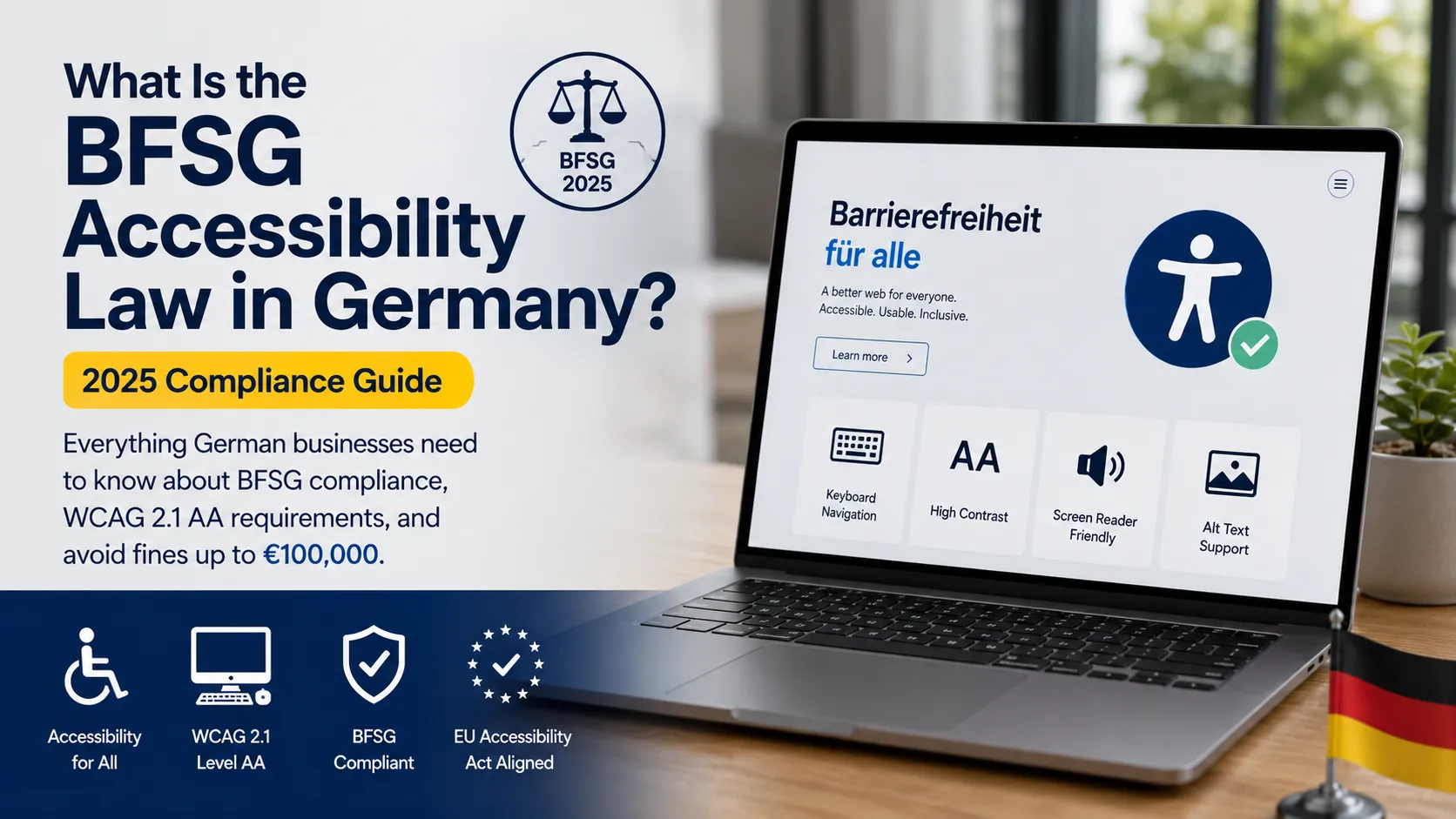
If you run a German consumer-facing website, the BFSG accessibility law in Germany is no longer something you can ignore. The Barrierefreiheitsstärkungsgesetz came into force on June 28, 2025 and now requires most consumer-facing digital services to meet WCAG 2.1 Level AA standards — with fines up to €100,000 per violation for non-compliance. Yet most German SMEs we’ve audited in 2026 still don’t know if they’re affected, or what “WCAG AA” actually requires.
This guide answers the practical questions: who must comply, what the requirements actually mean in plain language, how to audit your site, and how to get to compliance without rebuilding from scratch.
What is the BFSG law in Germany?
BFSG stands for Barrierefreiheitsstärkungsgesetz — the German implementation of the EU’s European Accessibility Act (Directive 2019/882). It became enforceable on June 28, 2025.
In plain terms: most consumer-facing German websites and apps must now be usable by people with disabilities — including those using screen readers, keyboard-only navigation, voice control, and assistive technologies.
The technical standard BFSG points to is WCAG 2.1 Level AA, the international web accessibility benchmark.
Who must comply with BFSG accessibility in 2025?
Affected businesses include:
- E-commerce shops selling to consumers
- Banking and financial services (online banking, account management)
- Telecommunications providers (mobile contracts, internet service)
- E-books and digital reading apps
- Transport ticketing (train, bus, flight booking)
- Consumer-facing service businesses
- Streaming platforms and audiovisual media services
- Smartphone-based services
Exemptions:
- Microenterprises: under 10 employees AND under €2M annual revenue, for services
- Pure B2B websites that don’t serve consumers directly
- Internal-only intranet sites
- Legacy archived content (pre-June 2025, with caveats)
For German SMEs in scope, BFSG compliance is not optional in 2026.
What does WCAG 2.1 AA actually require?
WCAG (Web Content Accessibility Guidelines) version 2.1 Level AA covers four principles:
Perceivable
- Alt text on every meaningful image
- Captions on video content
- Sufficient colour contrast (4.5:1 for body text, 3:1 for large text)
- Content readable when zoomed to 200%
- Text resizable without breaking layout
Operable
- All functionality available via keyboard
- No content that flashes more than 3 times per second
- Skip-to-main-content link for keyboard users
- Time limits adjustable or removable
- Clear focus indicators on interactive elements
Understandable
- Page language declared in HTML
- Predictable navigation across pages
- Form fields with associated labels
- Error messages clear and actionable
- Consistent terminology and patterns
Robust
- Valid HTML that assistive technologies can parse
- ARIA landmarks (main, nav, footer, etc.)
- Custom widgets accessible to screen readers
- Compatibility with current and future assistive tools
In practice, most German websites already meet 60–70% of WCAG 2.1 AA without effort. The remaining 30–40% — proper alt text, keyboard focus, ARIA landmarks, colour contrast on weak spots — is where audits identify the work.
What are the penalties for BFSG non-compliance?
Realistic 2026 enforcement picture:
- Fines up to €100,000 per violation
- Mandatory remediation orders (you must fix within a deadline)
- Market exclusion in severe cases (product banned from German market)
- Reputational damage and lost B2B contracts (often the larger real cost)
- Lawsuit exposure from advocacy groups and individual consumers
Enforcement is handled by Marktüberwachungsbehörden (market surveillance authorities) at the federal state level. They can act on complaints or proactively audit.
For German SMEs, the realistic risk is not a €100,000 fine on day one — it’s an investigation, mandatory remediation order, and the cost of rushed compliance work under deadline.
How do you audit a German website for BFSG compliance?
Three-step audit process:
Step 1: Automated scan
Free tools that catch 30–50% of issues:
- WAVE (webaim.org/wave) — browser-based, instant results
- axe DevTools — Chrome extension, more thorough
- Lighthouse Accessibility audit — built into Chrome DevTools
- Google PageSpeed Insights — includes accessibility score
Run all four on your homepage and 5–10 representative inner pages. Note every flagged issue.
Step 2: Manual keyboard navigation
Open the site, put your mouse in a drawer, and try to:
- Reach every interactive element using Tab
- Submit a contact form using only keyboard
- Navigate the main menu using Tab + Enter
- Close any modals or popups using Esc
- See where focus is at all times (visible focus indicator)
If you can’t navigate confidently with keyboard alone, screen reader users can’t either.
Step 3: Screen reader test
Free screen readers to test with:
- NVDA on Windows (free)
- VoiceOver on macOS (built in)
- TalkBack on Android (built in)
Listen as the screen reader announces the page. Does it make sense? Can a blind user understand the navigation, fill the form, complete a purchase? This is where most sites fail and where the real BFSG work lives.
What are the top 10 BFSG quick wins?
If you have one weekend and need to make meaningful progress:
- Add alt text to every meaningful image (decorative images get
alt="") - Fix colour contrast on weak spots (use WebAIM contrast checker)
- Ensure all form fields have proper
<label>associations - Add a “Skip to main content” link at the top of every page
- Verify keyboard navigation reaches every interactive element
- Make focus indicators visible (don’t disable
:focusstyles) - Add ARIA landmarks (main, nav, footer, aside)
- Ensure heading hierarchy is logical (H1 → H2 → H3, no skipping)
- Add language attribute to
<html lang="de">(or appropriate) - Test on real screen reader with at least the top 5 pages
These ten alone move most sites from clearly non-compliant to substantially compliant.
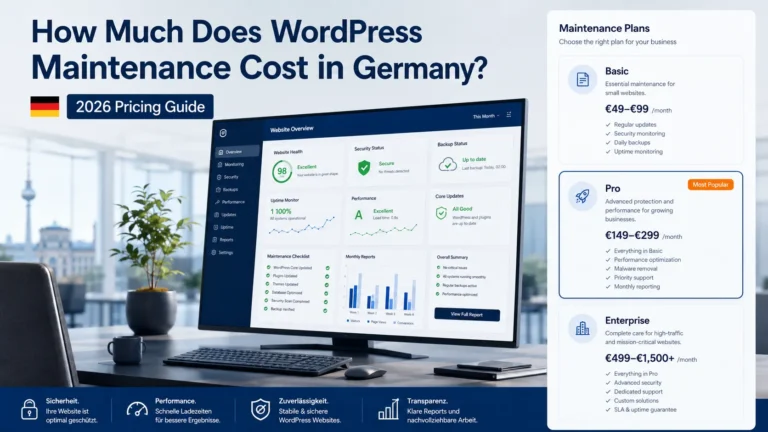
How much does BFSG compliance cost for a German SME?
Realistic 2026 costs depending on starting point:
- Modern site, already mostly compliant: €1,500–€4,000 for audit + minor fixes
- Standard SME site, no prior accessibility work: €5,000–€12,000 for audit + remediation
- E-commerce shop with custom theme: €8,000–€20,000 for full BFSG audit + remediation
- Legacy site with deep accessibility debt: €15,000–€50,000+ (sometimes cheaper to redesign)
Annual maintenance to keep BFSG compliant: €1,000–€3,000/year (audit on new content, plugin updates, training).
For broader cost context, see our Web Development Cost Germany 2026 guide.
How long does BFSG compliance take to achieve?
Typical project duration:
- Audit phase: 1–2 weeks
- Quick wins implementation: 1–2 weeks
- Deep remediation: 4–8 weeks for a typical site
- Final compliance verification: 1 week
- Accessibility statement published: ongoing requirement
Total: usually 6–12 weeks for a typical German SME site. Plan accordingly if a deadline is approaching.
What needs to be in an accessibility statement (Erklärung zur Barrierefreiheit)?
BFSG requires an accessibility statement on the site. The statement must:
- Confirm compliance with BFSG (or partial compliance with explanation)
- List any non-compliant elements and reasons
- Provide a way for users to report accessibility issues
- Be reachable within 2 clicks from any page
- Be updated annually
For most SMEs, the statement is a single page linked from the footer alongside Impressum and Datenschutzerklärung.
Are there specific requirements for e-commerce shops under BFSG?
E-commerce shops face the strictest scrutiny because they’re consumer-facing transactions. Key requirements:
- Product images have descriptive alt text
- Add-to-cart and checkout buttons keyboard-accessible
- Form errors clearly announced
- Payment method labels readable by screen readers
- Order confirmation page navigable without sight
- Search functionality usable with screen reader
For Shopify shops, themes vary widely on accessibility. Premium themes (Dawn, Studio) tend to be more compliant out of the box; many older themes need significant work.
What about WordPress sites — are they BFSG compliant by default?
WordPress core is fairly accessible. The compliance gap usually comes from:
- Theme: many themes prioritise design over accessibility
- Page builders: Elementor, Divi, WPBakery all have accessibility issues unless carefully configured
- Plugins: form plugins, sliders, popups often fail WCAG AA
- Custom code added by previous developers
Most WordPress sites need 2–6 weeks of remediation work to reach BFSG compliance, depending on theme and plugin choices.
Does BFSG apply to B2B websites?
Generally no — BFSG targets consumer-facing services. However:
- Banking and financial services apply even for B2B in some interpretations
- B2B sites with consumer-facing elements (newsletter signup, content access) may still face partial requirements
- If your B2B site sells to small businesses that include sole traders (Einzelunternehmer), there’s a grey area
When in doubt, get a written opinion from a German Datenschutz or accessibility lawyer. For most pure B2B SaaS, BFSG is not currently in scope.
What’s the relationship between BFSG and BITV?
Two German accessibility frameworks coexist:
- BITV — Barrierefreie-Informationstechnik-Verordnung, applies to federal public sector websites
- BFSG — Barrierefreiheitsstärkungsgesetz, applies to private sector consumer-facing services
Most private companies only need BFSG. Public sector / government contractors need both. The technical standard (WCAG 2.1 AA) is the same.
How does BFSG interact with GDPR / DSGVO?
They’re separate regulations but overlap in some areas:
- Cookie consent banners must themselves be accessible (BFSG)
- Datenschutzerklärung needs alt text on images, proper headings (BFSG)
- Accessibility statement contains contact info — Datenschutzerklärung must cover that data
- Both regulations require ongoing maintenance, not one-time setup
For broader GDPR coverage, see our GDPR Compliant Website Checklist 2026 guide.
Frequently Asked Questions About the BFSG Accessibility Law in Germany
No — consumer-facing only; pure B2B sites and microenterprises have exemptions.
Fines up to €100,000 per violation, plus mandatory remediation orders.
€5,000–€12,000 typical SME; €8,000–€20,000 e-commerce; €1,000–€3,000/year maintenance.
International web accessibility standard, middle tier — keyboard navigation, alt text, colour contrast, ARIA.
Run WAVE, axe DevTools, Lighthouse; test keyboard nav; use NVDA screen reader on top 5 pages.
Yes if BFSG applies — Erklärung zur Barrierefreiheit, updated annually, with issue-report channel.
Yes — theme choice matters; plan 2–6 weeks of remediation.
Final thoughts on BFSG accessibility law in Germany
BFSG is here, enforceable since June 2025, and German SMEs running consumer-facing sites face real fines for non-compliance. The good news: most sites can reach substantial compliance with 2–8 weeks of focused work, and the accessibility improvements typically also boost SEO and conversion rates.
If you’d like a BFSG compliance audit on your German website — automated + manual + screen reader testing with a prioritised fix list — our team offers a fixed-fee audit service. You can book a meeting or browse our website development services page for the broader accessibility and compliance offer.