
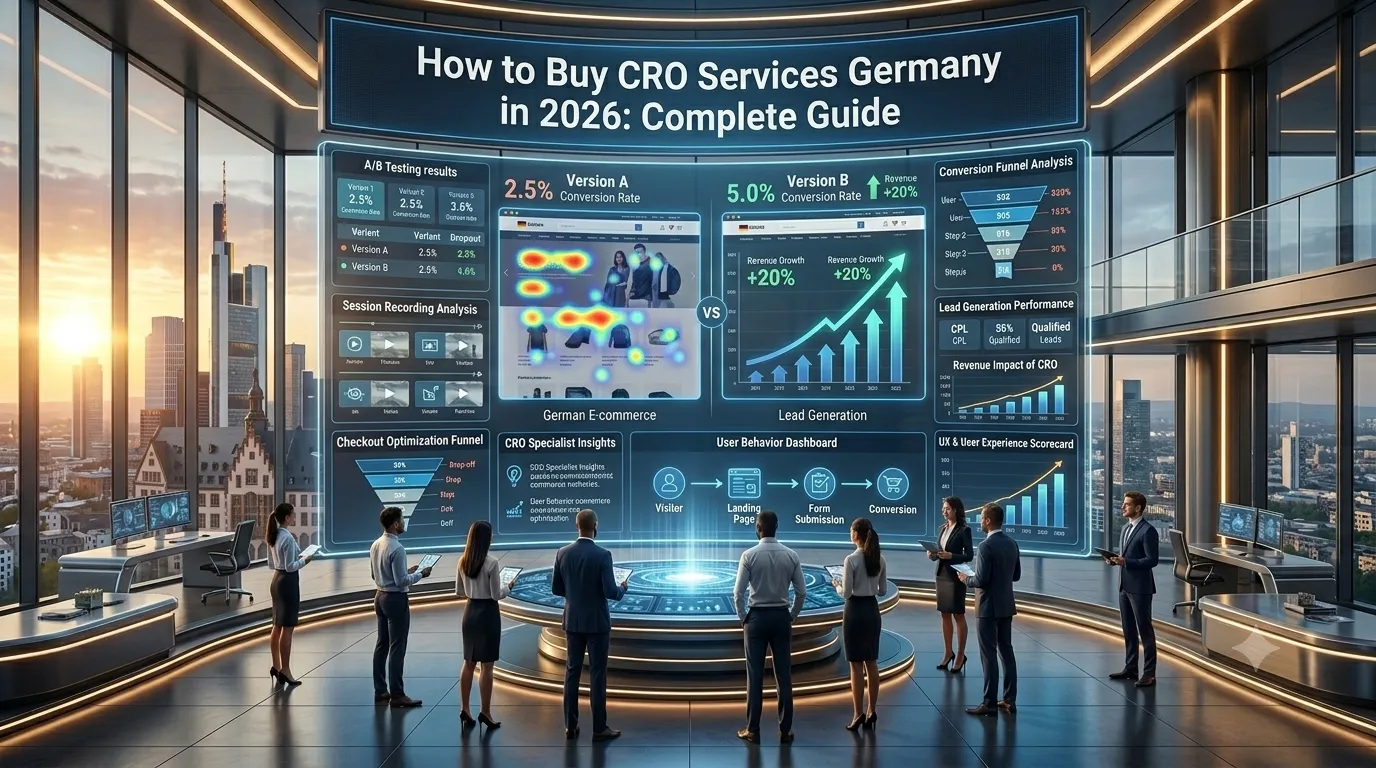
CRO services Germany work focuses on increasing the percentage of website visitors who take desired actions — Conversion Rate Optimization is the discipline — buy, signup, request demo, fill form. For German businesses in 2026, CRO often delivers higher ROI than acquiring more traffic. A site converting at 2.5% with 10,000 visitors performs identically to a site converting at 5% with 5,000 visitors — at much lower acquisition cost.
This guide walks through what CRO services Germany actually mean in 2026: what’s included, EUR pricing, agency vs in-house trade-offs, research vs testing balance, and German market conversion specifics.
What does CRO actually include?
Four core disciplines:
User research
Understanding why users do/don’t convert. Heatmaps, session recordings, user interviews, surveys, on-site feedback.
Hypothesis development
Identifying improvement opportunities. “If we [change X], then [metric Y] will [improve] because [reason].”
Testing
A/B testing, multivariate testing, before-after comparisons. Statistical validation.
Implementation + measurement
Building winning variations. Tracking impact. Iterating.
CRO is process discipline + cumulative learning. Not one-off “let’s add a popup.”
What does CRO cost in Germany in 2026?
Realistic EUR ranges:
Freelance CRO specialist
- Junior: €1,500–€3,500/month retainer
- Senior: €4,500–€10,000/month retainer
- Per-project: €5,000–€25,000 for audit + 3-month engagement
Boutique CRO agency
- Starter (research + testing): €5,000–€15,000/month
- Standard: €15,000–€40,000/month
- Premium / enterprise: €40,000–€100,000+/month
In-house CRO
- CRO Specialist (mid): €60,000–€85,000/year gross
- Senior CRO / Growth Manager: €85,000–€120,000/year
- Head of CRO / Growth: €120,000–€180,000+/year
Plus tools
- Testing tool (VWO, Optimizely, Convert): €100–€2,000+/month
- Heatmap (Hotjar, Microsoft Clarity): €0–€200/month
- Analytics: included in stack typicall
For most growing German businesses: budget 5–15% of marketing budget for CRO at growth stage.
What’s the right CRO investment by business stage?
Pre-product-market fit
Skip CRO. Focus on product + customer acquisition. CRO without traffic doesn’t matter.
Early growth (€100k–€500k revenue)
DIY foundations + basic testing. €0–€2,000/month investment.
Growing stage (€500k–€5M revenue)
Freelance CRO specialist + tools. €3,000–€10,000/month.
Scale-up (€5M–€50M revenue)
CRO agency + in-house ownership. €15,000–€50,000+/month.
Enterprise (€50M+ revenue)
In-house CRO team + agency support + experimentation platform. €50,000–€200,000+/month.
What’s specific about CRO for German market?
Five characteristics:
Trust signal importance
German buyers research extensively. Trust signals (reviews, credentials, awards, German vendor) influence conversion heavily.
Conservative buyer behavior
Germans convert at slightly lower rates than US for same products. Compensate with stronger trust + value proposition.
Sie-form respect
Aggressive US-style copy (“Don’t miss out!!!”) often hurts conversion in German market. Calm professional tone wins.
SEPA + Klarna critical
Payment method options dramatically affect conversion. See our Stripe SEPA integration guide and Shopify Klarna guide.
DSGVO + cookie banner UX
German users have decision-making fatigue from cookie banners. Optimize banner UX without violating compliance.
For broader CRO context see our why your website isn’t generating leads guide.
What’s the CRO process?
Six phases that repeat:
Phase 1: Audit / baseline
Understand current performance. Identify obvious issues. Set baselines.
Phase 2: Research
User interviews, heatmaps, session recordings, on-site surveys. Generate qualitative insights.
Phase 3: Hypothesis development
What changes could improve conversion? Prioritize by expected impact + ease.
Phase 4: Test design
A/B test setup. Statistical sample size calculation. Test duration estimation.
Phase 5: Test execution
Run test. Don’t peek + don’t stop early. Reach statistical significance.
Phase 6: Implementation + learning
Implement winners. Document insights. Build knowledge base for future tests.
Cycle repeats. CRO compounds over time.
What conversion rates should German businesses target?
Industry benchmarks for Germany in 2026:
E-commerce (B2C)
- Average: 1.5–3.5%
- Good: 3–5%
- Excellent: 5%+
B2B SaaS
- Lead form: 5–15%
- Trial signup: 2–8%
- Demo request: 1–5%
- Trial-to-paid: 15–25%
Service businesses
- Inquiry form: 3–10%
- Booking conversion: 5–15%
Local services
- GBP profile view-to-call: 5–15%
These are industry medians. Your benchmark = your historical performance.
For e-commerce specifics see our SEO for ecommerce Germany guide.
What are highest-impact CRO improvements?
After auditing dozens of German sites, common high-impact wins:
Payment method mix (e-commerce)
Adding SEPA + Klarna often lifts conversion 15–30%.
Form field reduction
Each removed form field typically lifts completion 5–15%.
Trust signals above fold
Trusted Shops, customer logos, testimonials. 5–20% lift typical.
Mobile checkout flow
Streamlining mobile checkout. 10–30% lift on mobile.
Clear pricing
Displaying prices vs. hiding. 10–25% lift for services.
Above-fold value proposition clarity
Clear “what you do + for who + why care” in first 5 seconds. 5–15% lift.
For specific pages see our pricing page optimization, landing page optimization, form optimization guides (forthcoming).
What are common CRO mistakes German businesses make?
Five patterns:
Testing without research
Random tests on “best practices.” Most fail because they don’t address actual problems.
Stopping tests early
Statistical significance before declaring winner. Many “winners” reverse with more data.
Testing too many variants
Multivariate tests with 8 variations on low-traffic sites. Need too much traffic. Better: simpler tests.
Ignoring qualitative research
Pure analytics-driven testing. Misses why users do what they do.
Copying US tactics
Aggressive popups, fake urgency, gamification. Often hurt in German market.
How do you measure CRO ROI?
Five metrics:
Conversion rate change per test
Before/after with statistical confidence interval.
Revenue impact
CR change × traffic × AOV = incremental annual revenue.
Cost per test
Test setup + implementation + tool costs.
Win rate
% of tests producing winners. Healthy: 20–30% win rate.
Revenue per test (cumulative)
Sum of revenue impact from winning tests over period
For mid-size German business: well-run CRO program typically delivers 3–10x ROI on investment over 12 months.
What tools does German CRO need?
Testing platforms
- VWO (~€330+/month)
- Optimizely (enterprise pricing)
- Convert (~€450+/month)
- Kameleoon (European, DSGVO-friendly, custom pricing)
Analytics
- Google Analytics 4 (with proper DSGVO consent)
- Plausible / Matomo (DSGVO-friendly)
- Mixpanel / Amplitude for product analytics
Heatmaps + session recording
- Hotjar (~€80–€350+/month)
- Microsoft Clarity (free)
- FullStory (enterprise)
User research
- Maze (~€85+/month)
- UserTesting (custom pricing)
- Lyssna / UsabilityHub (~€100+/month)
For most German growth-stage businesses: VWO + Hotjar + GA4 + occasional UserTesting = sweet spot.
When does in-house CRO win vs agency?
In-house wins when
- CRO is primary growth lever
- 12+ months continuous testing program
- Need tight product + dev team integration
- €5M+ revenue with dedicated growth function
Agency wins when
- Multi-discipline expertise needed (research + testing + analysis)
- Bench depth important
- Starting CRO from zero — agency brings playbooks
- €1M–€10M revenue range
For broader engagement framing see our in-house SEO vs agency vs freelancer guide — similar logic applies to CRO.
What German-specific CRO patterns work?
Five tactics consistently winning in German market:
Real customer testimonials with German names
Real, named testimonials beat anonymous or stock photos.
Trusted Shops or industry trust seals
Visible. Especially above fold or near checkout.
Clear pricing with German tax handling
“inkl. MwSt.” labels. Transparent fees.
Sie-form professional copy
Calm, factual, expertise-focused. Not aggressive American style.
German customer service options
Phone number visible. German-language live chat. WhatsApp Business contact.
Frequently asked questions
EUR 1.5k to 100k+/month depending on engagement model.
Industry-specific; use your historical performance as benchmark.
Both in parallel; SEO drives traffic, CRO converts it.
VWO, Hotjar, GA4 or Plausible; EUR 200-1,000/month.
2-4 months first wins; 12-24 months compounding impact.
Higher trust signals, Sie-form, SEPA/Klarna critical.
Freelance for defined scope; agency for multi-discipline depth.
Research first, statistical significance, avoid US-style aggressive tactics.
Need help with CRO?
If you’re scoping CRO for your German business and want a 30-minute scoping conversation about strategy + investment level, book a meeting or send details via our contact page.