
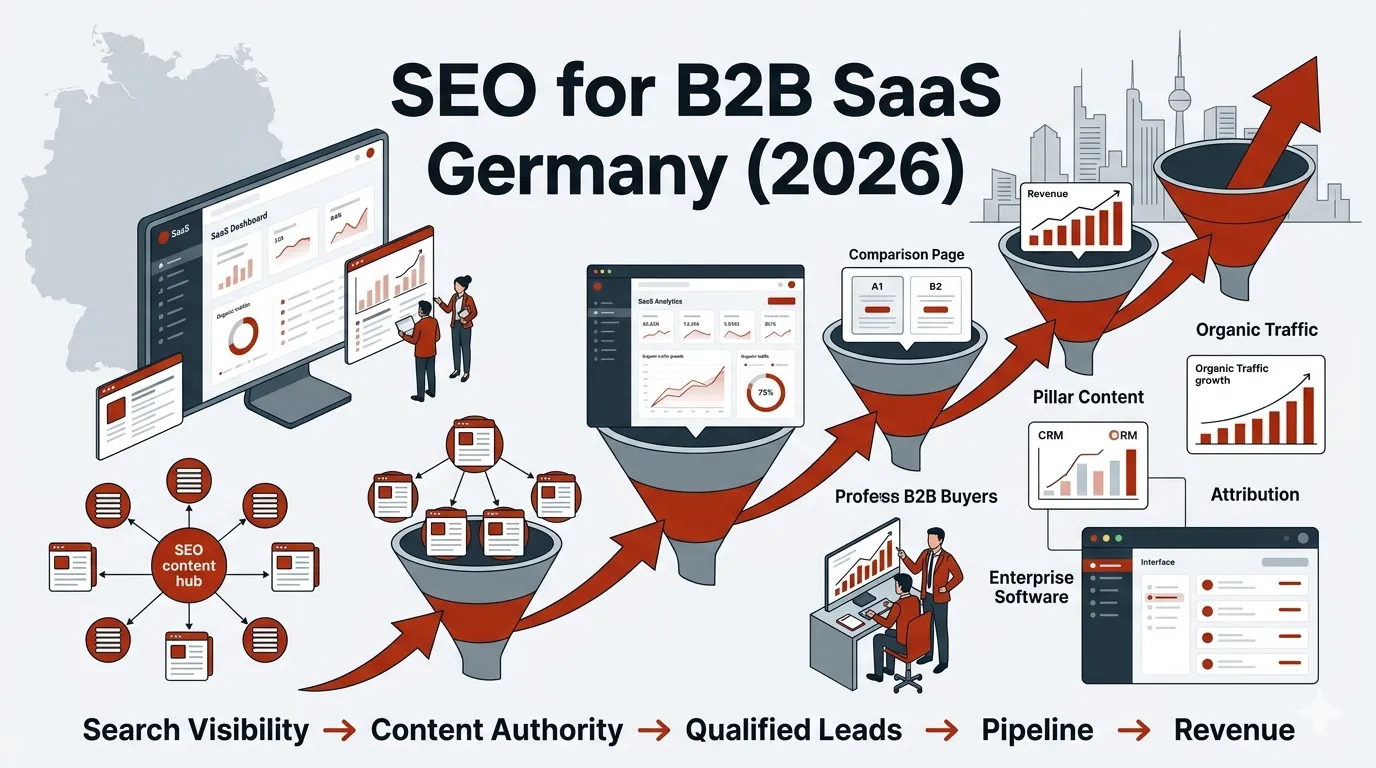
SEO for B2B SaaS Germany follows distinct patterns vs. B2C or other B2B. Buyer journey is longer, conversion is harder to attribute, content depth matters more, and the German Mittelstand market has specific search behaviors that US-focused SaaS SEO playbooks miss.
This guide walks through what SEO for B2B SaaS Germany actually requires in 2026: keyword strategy, content cluster patterns, German market specifics, sales-led vs. PLG SEO differences, and revenue attribution.
For broader B2B SaaS see our B2B SaaS development Germany guide.
Why is B2B SaaS SEO different?
Five distinctions:
Long buying cycles
B2B SaaS buyers research for months. SEO captures top-of-funnel + nurtures.
Multiple decision-makers
Different personas search different queries. Content needs broader topic coverage.
High-value conversions
Each lead can be worth €5,000–€500,000 ACV. Per-keyword ROI dramatic.
Comparison-heavy search behavior
“X vs Y” comparison queries highly converting.
Technical buyer research
Buyers research technical capabilities deeply. Long-form technical content rewarded.
What’s the German B2B SaaS keyword strategy?
A 5-tier approach:
Tier 1: Bottom-of-funnel (BOFU)
- “[Your category] Software Vergleich”
- “[Competitor X] Alternative”
- “Beste [category] für Mittelstand”
- “[Category] Software Preise”
Lowest volume, highest conversion intent.
Tier 2: Mid-funnel (MOFU)
- “Was ist [category]?”
- “Wie wählt man [category] Software aus?”
- “[Category] Implementierung”
Educational queries from informed buyers.
Tier 3: Top-of-funnel (TOFU)
- “[Industry problem] lösen”
- “[Productivity / efficiency] Tipps”
- General industry content
Broad audience building.
Tier 4: Brand keywords
- “[Your brand] Erfahrungen”
- “[Your brand] vs [competitor]”
- “[Your brand] Login”
Capture branded search.
Tier 5: Long-tail use-case
- “[Industry] [function] software”
- “[Specific role] tools”
- “[Specific problem] software”
Highly targeted, high-conversion.
What content patterns work for German B2B SaaS?
Six high-performing content types:
1. Definitive guides / pillar pages
3,000–10,000 word comprehensive content on category topics.
2. Comparison articles
“[Your tool] vs [Competitor]” — high commercial intent.
3. Buyer’s guides
“Wie wählt man [Category] Software aus?” — captures buyers researching.
4. Use-case + industry-specific content
“[Category] für Steuerberater” — tailored to specific buyer personas.
5. Tools + templates
Free downloadable resources earn links + leads.
6. Case studies + customer stories
Especially with German Mittelstand customers. Build trust + earn links.
For broader content strategy see our topic clusters pillar content guide
How does PLG vs SLG affect SEO?
Product-Led Growth (PLG) SEO
- Tools + calculators + free templates
- Bottom-of-funnel content directly to free trial signup
- Lower-friction conversion paths
Sales-Led Growth (SLG) SEO
- Demo request CTAs
- Long-form thought leadership for executive audiences
- Account-based content + retargeting
Hybrid (most common in 2026)
- PLG content for self-service buyers
- SLG content for enterprise + Mittelstand decision-makers
For German market specifically: more SLG-leaning than US SaaS. Trust + relationship matter for Mittelstand buyers.
What’s the German B2B SaaS technical SEO?
Same fundamentals as general technical SEO with specific emphasis:
Site architecture for cluster topics
Pillar pages + cluster articles. See our site architecture SEO guide.
Multi-region for DE/AT/CH
Most German B2B SaaS serves all three. hreflang implementation. See our multilingual SEO DE/AT/CH guide.
Schema markup for SaaS product
SoftwareApplication schema. Product schema with offers. Organization schema with founder + funding info.
E-E-A-T signals critical
Named author bios, customer logos, case studies, awards, integrations.
Page speed for content-heavy SaaS sites
Long-form content pages must be fast. See our Core Web Vitals SEO impact guide (forthcoming).
How long does B2B SaaS SEO take to compound?
Realistic timeline:
Months 1-6: Foundation
Technical SEO + initial content production. Long-tail rankings emerge. Limited revenue impact yet.
Months 7-12: Acceleration
Cluster authority builds. Mid-funnel content ranks. Pipeline contribution measurable.
Months 13-24: Significant impact
BOFU queries ranking. Branded search growing. Significant pipeline + revenue from SEO.
Months 24+: Compounding moat
Authority compounds. Hard for competitors to displace. Year-over-year growth continues.
For most German B2B SaaS: budget 18–36 months before declaring SEO success/failure.
What does B2B SaaS SEO cost in Germany?
Bootstrapped / early stage
- DIY founder-led: €0 + time
- Freelance support: €1,500–€4,500/month
Series A+ funded SaaS
- Agency retainer: €5,000–€20,000/month
- Plus in-house content writer/lead: €60,000–€90,000/year
Scale-up (€10M+ ARR)
- In-house SEO + content team: €200,000–€500,000/year
- Plus agency specialty support: €5,000–€15,000/month
For broader cost see our SEO cost Germany guide.
How do you measure B2B SaaS SEO revenue attribution?
Five attribution approaches:
Marketing automation tracking
HubSpot, Marketo, Pardot track lead source. First-touch + multi-touch attribution.
UTM tagging discipline
All SEO content links use UTM parameters. Tracked in CRM.
Search Console + GA4 + CRM integration
Connect organic traffic to leads to opportunities to closed-won.
Pipeline contribution dashboard
Organic-attributed pipeline value per quarter.
Customer interviews
Ask new customers: “How did you find us?” SEO often credited indirectly.
For German B2B SaaS at €1M+ ARR: invest in proper attribution tooling. Without it, can’t justify ongoing SEO investment.
What are common B2B SaaS SEO mistakes German founders make?
Five patterns:
Generic English content translated
Auto-translated EN → DE content. Doesn’t rank or convert in German market.
Too much TOFU content
Thousands of how-to articles, no comparison/BOFU content. Traffic without revenue.
No comparison content
Skipping “Your Brand vs Competitor” articles. Missing highest-conversion content type.
Treating SEO as standalone
SEO disconnected from sales, customer success, product marketing. Less effective than integrated.
Quick-results expectation
Expecting 90-day transformation. B2B SaaS SEO is 18-month minimum investment.
How does AI search affect German B2B SaaS SEO?
Three shifts in 2026:
Decision-makers using AI for research
CEOs + Mittelstand decision-makers increasingly use ChatGPT Search. GEO matters.
Long-form content stays valuable
AI engines cite comprehensive content. SaaS long-form articles still earn citations.
Brand mentions across web matter more
AI engines learn brand-topic associations. Strategic brand mention building pays off.
For AEO + GEO see our AEO guide and GEO guide.
Frequently asked questions
Long cycles, multiple personas, high-value conversions, comparison search.
18-month minimum; compounds over years.
Comparison, buyer’s guides, pillar content, case studies, use-cases.
Hybrid; German market leans more SLG than US.
EUR 1.5k/month early to EUR 500k+/year at scale-up.
DE primary for DACH; both for international.
CRM, automation, UTMs, attribution models, customer interviews.
AEO and GEO increasingly important for B2B research.
Need help with B2B SaaS SEO?
If you’re scoping SEO for your German B2B SaaS and want a 30-minute scoping conversation about strategy + content + attribution, book a meeting or send details via our contact page.