
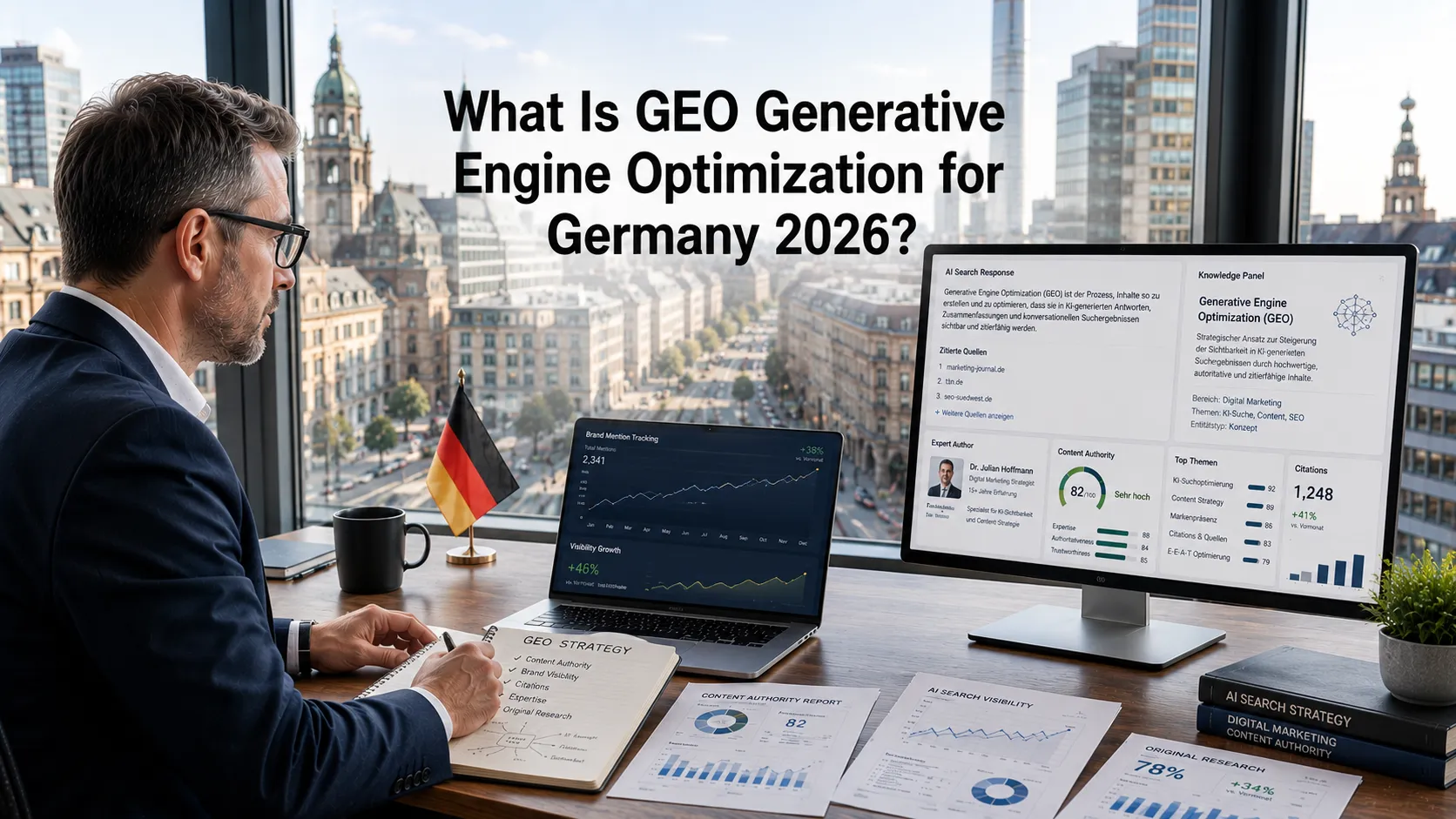
Generative Engine Optimization (GEO) is the practice of getting your content cited + your brand mentioned by generative AI engines: ChatGPT Search, Perplexity, Claude, Bing Copilot’s generative responses. Different from AEO (which focuses on Google AI Overviews + voice). In 2026, GEO is increasingly relevant as German users adopt ChatGPT Search + Perplexity for research queries that previously went to Google.
This guide walks through what GEO Generative Engine Optimization for German brands actually requires in 2026: how generative AI engines select sources, brand mention strategy, content patterns that get cited, measuring GEO visibility, and how it interacts with traditional SEO + AEO.
For AEO (Google AI Overviews) see our AEO guide.
What is GEO?
Generative Engine Optimization. Optimizing for AI-powered search engines that generate answers + cite sources:
Core engines
- ChatGPT Search (OpenAI)
- Perplexity
- Claude (with search)
- Bing Copilot (generative answers)
- You.com
- Various LLM-based search tools
What they do
- Answer user questions in natural language
- Synthesize information from multiple sources
- Cite sources with links (varying degrees)
- Format responses for user query
Different from AEO
AEO targets Google’s AI Overview, voice assistants. GEO targets standalone generative AI search engines. Some overlap, distinct optimization patterns.
Why does GEO matter for German brands in 2026?
Four reasons:
User shift to AI search
20–35% of German users now use ChatGPT Search or Perplexity for research queries. Growing.
Lower-funnel queries captured
AI engines answer informational queries entirely, intercepting traffic before user reaches Google.
Citation drives brand visibility
Even unlinked brand mentions in AI responses build visibility.
Future-proofing organic strategy
AI search trajectory clear. Brands optimizing now will compound advantage.
How do generative AI engines select sources?
Patterns observed in 2026:
Trusted high-authority domains
Established publications, major brands, .edu, .gov sites preferred.
Schema-marked content
Well-structured content with Schema.org markup parsed reliably
Recent content
Freshness matters. Older content less likely cited.
Author expertise signals
E-E-A-T applies. Named author with credentials + Person schema.
Original research + data
AI engines preferentially cite original sources of data + insights.
Comprehensive topic coverage
Pillar-style comprehensive articles vs. thin scattered articles.
Brand mentions across the web
Frequency of brand mentions in training data + indexed content affects AI awareness.
How do you optimize for GEO?
A 7-tactic approach:
1. Build comprehensive expert content
Pillar pages + deep topic coverage. AI engines cite comprehensive sources.
2. Publish original research + data
Surveys, statistics, case studies unique to your content. AI engines reference originals.
3. Strong author bylines + expertise
Named expert authors. Schema.org Person markup with credentials.
4. Strategic brand mention building
Get your brand mentioned across the web — Reddit, Quora, German forums, industry publications. AI engines learn brand-topic associations.
5. Citation-friendly formatting
Clear factual statements with supporting context. Easy for AI to extract + cite.
6. FAQ + Q&A content
Direct question-answer pairs. AI engines extract these readily.
7. Schema markup
Article + Person + Organization schema. Help AI engines understand context.
What content patterns get cited by ChatGPT Search?
After analyzing German ChatGPT Search results:
Definitive guides
Long-form comprehensive content. 3,000+ words preferred.
Original research
“Recent surveys by X show…” patterns frequent.
Expert commentary
“According to expert X…” patterns common.
Statistics + data
Specific numbers cited preferentially.
Comparison content
“X vs Y” comparison content shows in comparison queries.
Recent news / updates
Current events queries pull from recent reputable sources.
What content patterns get cited by Perplexity?
Slightly different than ChatGPT Search:
Citation density higher
Perplexity cites more sources per response. More opportunities.
Visible source links
Sources clearly linked. Click-through traffic possible.
Recent + authoritative balance
Mix of authoritative + recent. Both required.
Specific data preferred
Same as ChatGPT — original data wins.
What about Claude?
Claude (Anthropic) with search:
Conservative citation pattern
Cites fewer sources but more selectively.
Strong preference for authoritative
High-quality sources favored heavily.
Comprehensive synthesis
Less direct quotation, more synthesis of multiple sources.
Honesty about uncertainty
Acknowledges when sources disagree. Sources with clear factual positions cited.
How is GEO different from traditional SEO?
Five key differences:
1. Brand mentions matter more than backlinks
For AI engines, mention frequency + context matters. Less reliance on backlinks specifically.
2. Comprehensive content vs short articles
AI prefers comprehensive. Short SEO articles less cited.
3. Author expertise more important
E-E-A-T amplified. Anonymous content rarely cited.
4. Less focus on technical SEO
AI engines crawl differently. Some technical SEO still matters but less critical than for Google.
5. Different KPIs
Not rankings — citation frequency + brand mention frequency.
How do you measure GEO performance?
Difficult — tooling still emerging. Approaches:
Manual testing
Search your target queries on ChatGPT Search, Perplexity, Claude. Are you cited?
Brand monitoring
Google Alerts + Mention.com track AI engine outputs mentioning your brand (limited automation).
Sistrix / Semrush AI visibility (emerging)
Some tools starting to track AI search visibility. Early days.
Referral traffic analytics
Check analytics for referral traffic from chatgpt.com, perplexity.ai, etc.
Indirect signals
Brand search increase post-GEO investment. Domain authority growth.
What’s the typical GEO timeline?
1–3 months: Foundation phase
- Publish 3–5 comprehensive cornerstone articles
- Add author bios + Person schema
- Initial brand mention building
4–6 months: Content velocity phase
- 10–20 additional GEO-optimized articles
- Original research publication
- Brand mentions accumulating across web
7–12 months: Authority building
- Cited by AI engines for niche queries
- Brand mentions in AI responses
12–24 months: Compounding growth phase
- Citation frequency growing
- AI engines associate brand with topics
- Brand becomes go-to source in vertical
GEO is long-term play. Don’t expect 90-day results.
What’s the GEO + SEO + AEO integrated strategy?
In 2026, integrated organic strategy includes:
Foundation: Traditional SEO
Technical foundations + on-page + content + links. Still essential.
Enhancement: AEO
Question-format headings, FAQ schema, direct answers. Wins Google AI Overviews + featured snippets.
Future-proofing: GEO
Comprehensive content + original research + expert authors + strategic brand mentions. Wins ChatGPT Search + Perplexity.
For most German businesses: SEO budget reallocates 10–20% toward AEO + GEO without abandoning traditional SEO foundations.
What are common GEO mistakes?
Five patterns:
Treating it as separate from SEO
GEO is enhancement to SEO discipline, not replacement.
Mass AI content for GEO
Thinking publishing 100 AI articles will get cited. Backwards — quality + originality cited.
Ignoring brand mention building
GEO requires brand mentions across the web, not just on your site.\
No original research
Recycling generic content. AI engines cite original sources.
Anonymous content
No author bylines. AI engines value expertise indicators.
What’s the German-specific GEO consideration?
Three:
Lower German search volume in AI engines (currently)
German users in 2026 use AI search engines somewhat less than English users. Still growing.
German content quality matters more
Native German content visibly outperforms translated for AI citation.
Industry-specific German publications matter
Brand mentions in German publications matter for German AI citation.
Frequently asked questions
Generative Engine Optimization for AI search citation.
GEO targets generative AI; AEO targets answer engines.
Yes; 20-35% of German users use AI search.
Comprehensive content, original research, expert bylines, brand mentions.
Difficult; manual tests plus brand monitoring plus emerging tools.
3-6 months initial; 12-24 months for established authority.
No; AI engines cite human-authored original content.
Voice search is AEO territory; distinct from GEO.
Need help with GEO strategy?
If you’re scoping GEO for your German brand and want a 30-minute scoping conversation about content + brand mention strategy, book a meeting or send details via our contact page.