
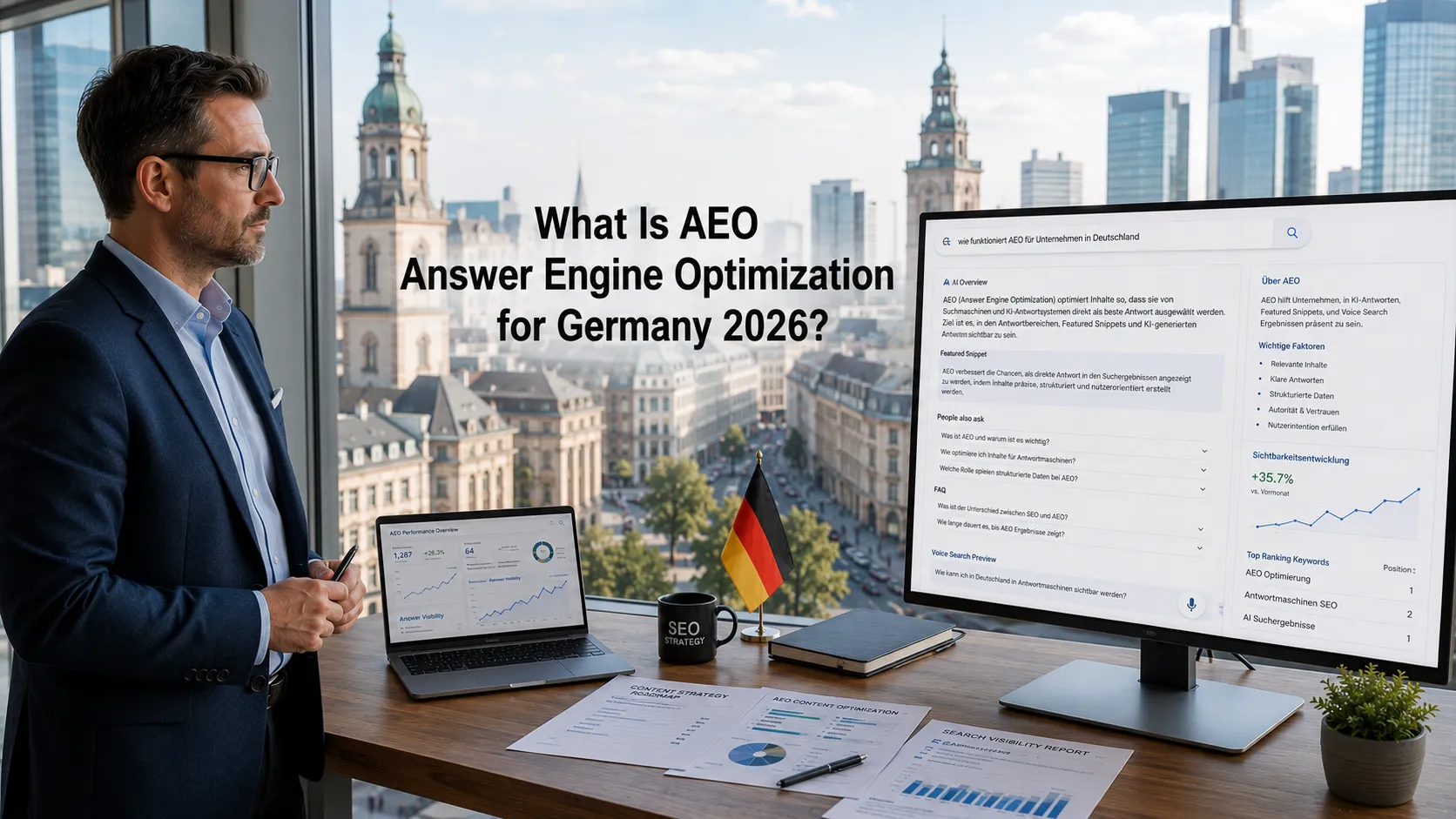
Answer Engine Optimization (AEO) is the practice of optimizing content for AI-powered answer engines — Google AI Overviews, Bing AI, Apple Intelligence. Different from traditional SEO + different from GEO (Generative Engine Optimization for ChatGPT/Perplexity). AEO is increasingly critical as Google’s AI Overviews capture more SERP real estate in 2026.
This guide walks through what AEO Answer Engine Optimization for German SEO actually requires in 2026: optimizing for Google AI Overviews, featured snippet alignment, voice search, question-format content, and measuring AEO visibility.
For GEO (Generative Engine Optimization) see our GEO guide (forthcoming, #117).
What is AEO and how does it differ from SEO?
Traditional SEO
Optimizing content to rank in Google’s organic results.
AEO
Optimizing content to be the source AI engines cite when answering questions.
GEO
Optimizing for generative AI (ChatGPT, Claude, Perplexity) — different audiences, different patterns.
Overlap
AEO + SEO + GEO have overlapping practices but distinct goals.
What AI answer engines matter in 2026?
Google AI Overviews (formerly SGE)
Generative AI answer at top of Google SERPs. Increasingly common — 30%+ of queries in 2026.
Bing Copilot
Microsoft’s AI search. Smaller market share but growing.
Apple Intelligence (Siri AI)
iOS / macOS integrated AI search. Apple ecosystem users.
Voice assistants
Google Assistant, Siri, Alexa. Answer-based queries.
Featured snippets (precursor to AEO)
Traditional featured snippets — same optimization principles apply.
For ChatGPT / Perplexity see GEO guide (separate post).
Why does AEO matter for German businesses in 2026?
Four reasons:
AI Overview reduces organic CTR
When AI Overview shows, organic position 1 CTR drops 20–40%. Need AI Overview citation to maintain visibility.
AI search growth trajectory
By 2027, estimated 50%+ of queries will trigger AI Overview or equivalent. Trend accelerating.
Brand mentions in AI Overviews
Even unlinked mention by AI builds brand visibility.
Voice search dependency
German Google Assistant + Siri increasingly used. Voice queries answered by AI.
What content gets cited by AI Overviews?
After analysis of German SERPs:
Comprehensive answer-style content
Direct answers to questions, not buried in long content.
High-authority domains
Established + trusted sources favored.
Schema-marked-up content
Especially FAQ + HowTo + Article schema.
Recent + updated content
Freshness matters. Old content less likely cited.
Author-attributed content
Named author with expertise indicators (Schema.org Person markup).
Original data + research
AI engines cite original sources, not aggregators.
How do you optimize for AEO?
A 7-tactic checklist:
1. Question-format headings
Convert H2/H3 to natural questions:
- “What does X cost?” → “Was kostet X?”
- “How do I do Y?” → “Wie macht man Y?”
2. Direct answers near top of sections
First 40–60 words after question = clear factual answer. AI extracts these.
3. FAQ sections with schema
Dedicated FAQ section. FAQ schema markup. AI engines love FAQ structure.
4. Comprehensive topic coverage
Pillar pages cover topics comprehensively. AI engines summarize from comprehensive sources.
5. E-E-A-T signals
Author bios, expertise indicators, citations from authoritative sources.
6. Original research / data
Surveys, statistics, calculations unique to your content. AI engines cite originals.
7. Schema markup
Article schema with Author + datePublished. FAQ schema for questions. HowTo for tutorials.
What’s question-format content?
Reformatting traditional declarative headings as natural questions:
Traditional headings
- “SEO Cost in Germany”
- “Local SEO Best Practices”
- “WordPress Maintenance”
AEO-optimized headings
- “What does SEO cost in Germany in 2026?”
- “What are local SEO best practices for Germany?”
- “How often should WordPress be maintained?”
Why this works
AI engines parse Q&A structures readily. Question + answer pairs match natural user queries.
Don’t force it
If question feels unnatural, keep declarative heading. Mix is fine.
How does AEO interact with traditional SEO?
Strong overlap:
Both reward
- Quality content
- Topic depth
- Schema markup
- Recent updates
- Author expertise
- Original research
AEO additional
- Question-format structure
- Direct answer extraction-friendliness
- FAQ schema specifically
SEO additional
- Backlinks (still matter for both, but AEO weights different)
- Technical SEO foundations
For most German businesses: AEO is additive to SEO, not replacement.
How do you measure AEO visibility?
Difficult — AI Overview citations aren’t reported in traditional SEO tools yet.
Manual checks
Search your target keywords + check if AI Overview triggers + if you’re cited.
Sistrix / Ahrefs SERP feature reports
Increasingly track AI Overview presence per query.
Brand mention monitoring
Google Alerts + Mention.com + Sistrix Brand. Track AI Overview brand mentions.
Voice search testing
Manually test voice queries on Google Assistant + Siri. Are you the cited source?
Indirect signals
- Featured snippet wins typically correlate with AI Overview citation
- Schema markup performance in Search Console
What German-specific AEO considerations matter?
Three considerations:
German question phrasing
“Was kostet…?” vs “Wieviel kostet…?” — both natural. Use both as headings.
Sie-form in answers
For B2B / professional content, Sie-form in AI-optimized answers. Match audience expectation.
Native German content quality
Auto-translated content rarely cited by AI engines. Native quality matters more for AEO than traditional SEO.
For German content quality see our German SEO content writing guide.
What are common AEO mistakes?
Five patterns:
Question headings without direct answers
H2 question followed by long fluff. AI engines can’t extract clear answer.
Generic answers
“It depends” or vague answers. AI engines prefer specific direct answers.
No FAQ schema
Missing the easy schema win for AEO.
Skipping author expertise
No author bio, no Person schema. AI engines value expertise signals.
Treating AEO as separate from SEO
AEO is enhancement to SEO, not replacement. Both required.
How does AEO affect content investment?
In 2026:
More expensive per article
Comprehensive AEO-optimized articles need: original research, expert input, comprehensive coverage. €500–€2,000 per article more typical than €200 mass content.
Higher ROI per article
Quality AEO content gets cited by AI = compounding visibility.
Fewer articles per year
Quality over quantity. 50–100 quality articles/year beat 500 thin articles.
For broader content strategy see our German SEO content writing guide and topic clusters pillar content guide.
What’s the 90-day AEO action plan?
1-30: Audit + foundation
- Identify priority topics
- Audit current content for AEO readiness
- Add FAQ schema where applicable
- Convert key H2/H3 headings to questions
31-60: Content optimization
- Rewrite top 10 priority articles for AEO
- Add author bios + Person schema
- Include direct answers near tops of sections
- Update featured snippet-targeting content
61-90: New content + monitoring
- Produce 5–10 AEO-first new articles
- Monitor AI Overview presence for priority queries
- Track brand mentions in AI results
By month 4: AEO baseline established + measurable progress.
Frequently asked questions
Answer Engine Optimization for AI answer engines.
AEO adds question headings, direct answers, FAQ schema priority.
GEO targets generative AI; AEO targets answer engines.
Where natural; mix is fine.
FAQ schema most impactful; Article and HowTo also help.
Manual SERP checks, brand monitoring, voice search tests.
Reduces CTR 20-40%; combine organic plus AEO.
3 to 9 months initial; compounds over years.
Need help with AEO?
If you’re scoping AEO strategy for your German business and want a 30-minute scoping conversation about content + technical AEO priorities, book a meeting or send details via our contact page.