German SEO content writing has higher quality expectations than US or UK markets. German readers research more thoroughly, expect formal Sie-form on commercial content, and reject auto-translated or shallow AI-generated articles more visibly than other markets. Getting German SEO content right means investing in native writers + thoughtful editorial workflow + E-E-A-T signals — not chasing word count or AI mass content.
This guide walks through what German SEO content writing actually requires in 2026: native quality bar, Sie-form vs. du decision, content brief format, E-E-A-T signals, AI content disclosure ethics, and realistic production cost.
What makes German SEO content different?
Five key differences from US/UK markets:
Higher quality bar
German readers expect comprehensive, factually accurate content. Shallow articles rank worse + convert worse.
Formal Sie-form default
For commercial, professional, B2B content. Sie is the standard. Du only for explicitly younger consumer brands.
Native quality required
Auto-translated content is visible. German readers notice unnatural phrasing within 2 sentences.
E-E-A-T signals matter more
Author expertise, brand authority, recent updates, citations from German sources — German readers + Google value these.
Less marketing fluff
German tone prefers factual over emotional. “Discover amazing benefits!” works worse than “Drei messbare Vorteile.”
What’s the German content quality baseline in 2026?
Word count
- Commercial pages: 800–2,500 words
- Service pages: 1,500–3,500 words
- Blog articles: 1,500–4,000 words
- Pillar / definitive guides: 4,000–10,000+ words
Structure
- Clear H2/H3 hierarchy
- Question-format headings where natural
- Short paragraphs (2–4 sentences)
- Lists, tables, examples
- Original data + specific examples (not generic)
Sources + citations
- Link to authoritative German + international sources
- Cite German laws, statistics, studies where relevant
- Original research preferred
Author expertise
- Named author with bio
- Author has demonstrable expertise
- Schema.org/Person markup with sameAs links
For broader on-page see our on-page SEO checklist guide.
What’s the Sie-form vs. du decision?
Use Sie-form when
- B2B audience (Mittelstand, enterprise)
- Professional services (Steuerberater, Anwalt, Berater)
- Financial / regulated industries
- Older demographic
- Traditional German brand
Use du-form when
- Consumer brand for younger demographic
- Explicitly modern / startup voice (yoga apps, fitness, lifestyle)
- B2B SaaS in startup-friendly verticals
- Brand has decided “du” is its voice
Be consistent
Pick one and stick to it across all content. Mixed Sie/du within site looks unprofessional.
Don’t randomly switch for SEO
Some writers mix Sie/du thinking it helps reach broader audience. Looks weird; doesn’t help SEO.
What does a German SEO content brief look like?
A complete brief covers:
1. Target keyword + secondary keywords
Primary keyword with search volume + intent. 3–8 secondary keywords.
2. Search intent + content type
Informational / comparison / how-to / definitive guide.
3. SERP analysis
Top 3–5 ranking pages summarized. What they cover, gaps to fill.
4. Target word count
Based on top-ranking competitors + content type.
5. Required sections (outline)
H2/H3 structure to follow. Must-include topics + recommended order.
6. Tone + voice
Sie/du, formal/casual, target reader.
7. Internal links to include
Specific internal pages to link from this article.
8. External sources to consider
Authoritative German + international references.
9. Visual assets
Hero image, infographics, screenshots expected.
10. Schema markup recommendations
Article schema, FAQ, HowTo as relevant.
A 2–4 page brief saves writers 5–10 hours of research per article.
How do you handle E-E-A-T in German content?
Four pillars:
Experience
Writer has hands-on experience with the topic. Case studies, real examples, specific numbers. “We’ve audited 50 German Shopify stores” beats “There are many German Shopify stores.”
Expertise
Writer demonstrates knowledge depth. Specific terminology, nuanced caveats, accurate technical detail.
Authoritativeness
Writer + publication have authority in the space. Bylines on other recognized publications, speaking engagements, citations.
Trustworthiness
Site has Impressum, Datenschutzerklärung, named authors, contact info, social proof. Transparent business.
For German market specifically: trust signals matter even more than US. Imprint quality, author credibility, traceable expertise are heavily weighted.
What about AI-generated content?
The 2026 reality:
Google’s stance
Quality matters more than method. AI content allowed if useful + original perspective. Mass AI content penalized as part of helpful content updates.
What works
- AI-assisted writing (human editor adds expertise + perspective)
- AI for outline/research; human for synthesis + writing
- AI for first draft; human for German quality polish + fact-check
What fails
- Pure AI mass generation
- Untouched AI output published
- AI translation without native review
Disclosure ethics
No legal requirement to disclose AI use in Germany yet (some jurisdictions considering). Many German publications voluntarily disclose. For B2B / professional content, disclosure builds trust.
For broader AI content + SEO see our AEO guide (forthcoming).
What does German content cost in 2026?
Realistic EUR per article:
Freelance German writer
- Generalist: €100–€300 per 1,000-word article
- Specialist / expert: €300–€800 per 1,000-word article
- Senior journalist / industry expert: €800–€2,500+ per article
Agency content production
- Standard: €300–€900 per article (with brief + editing)
- Premium: €900–€2,500 per article (research + interview + editing)
Translation (not recommended for SEO)
- Auto-translated (DON’T): €0
- Professional translation: €0.08–€0.25 per word
- Native-written: priced as fresh content
For most German SEO programs: budget €400–€1,200 per article for quality content. Below €300, quality typically suffers.
What are common German SEO content writing mistakes?
Five patterns:
Auto-translated from English
DE → EN or EN → DE machine translation. Looks artificial. Hurts both rankings + conversions.
Word-padding without substance
Writers hitting target word count by adding filler. Page reads like AI-generated.
Generic examples
“For example, many businesses…” without specific cases. German readers want concrete examples.
No data / sources
Pure opinion content without citations. Lower authority.
Mixed Sie/du
Inconsistent address across paragraphs. Looks unprofessional.
How do you build content production at scale?
For €100k–€1M annual content investment:
Content strategy + briefs
In-house or strategist consultant. €5,000–€20,000/month.
Writer team
3–8 specialized German writers + 1 editor. €15,000–€80,000/month.
Editorial workflow
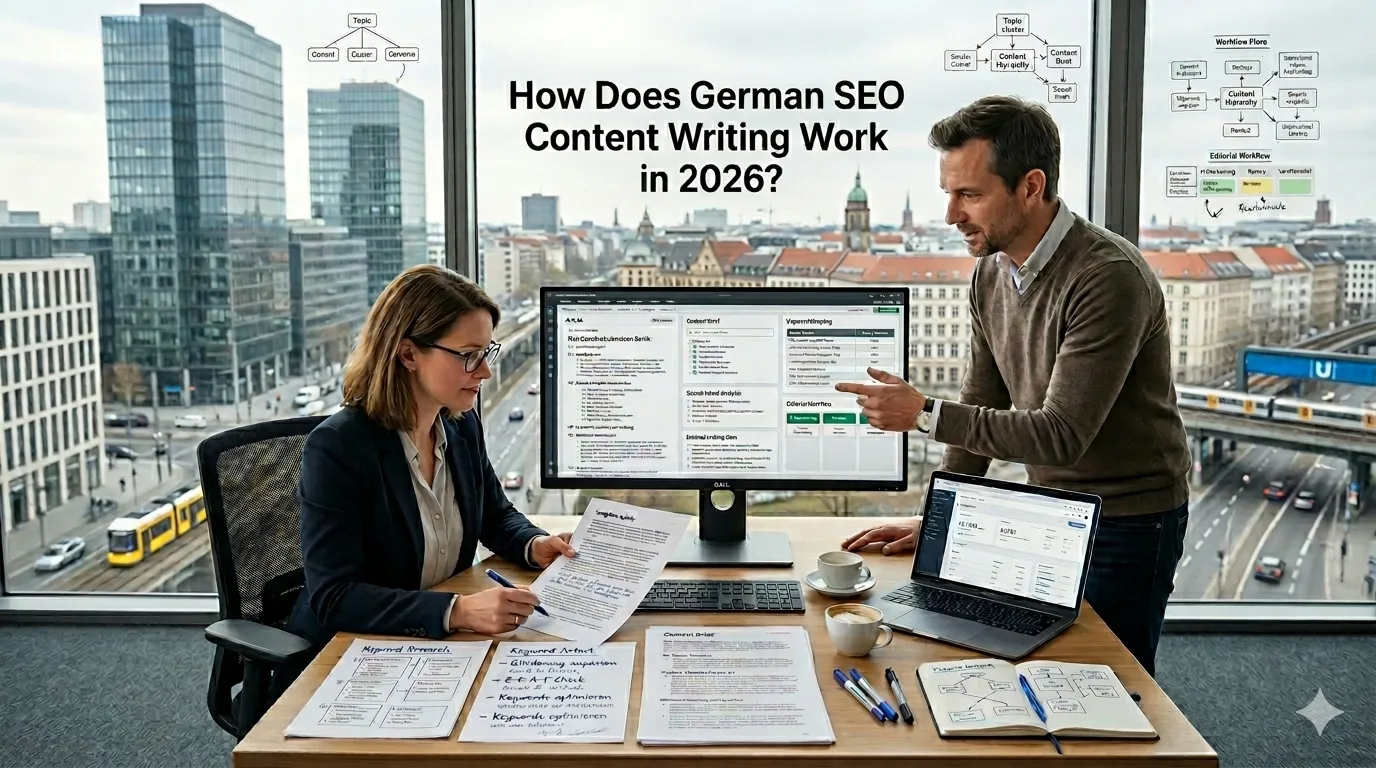
Brief → draft → edit → SEO review → fact-check → schema → publish. Notion / Airtable / dedicated CMS.
Quality control
Random sample review. Performance review against KPIs (organic traffic, rankings, conversions).
For most German businesses: outsource to specialist agency or freelancer team. In-house only at scale-up tier.
How does AI search affect German content writing?
Three shifts:
Question-format headings rise
ChatGPT Search + AI Overviews parse Q&A structures readily. Format H2/H3 as questions where natural.
Direct factual answers near the top
Lead each section with a clear answer. AI extracts these for snippets.
Original research increasingly valuable
AI engines cite original sources. Original German surveys, calculations, studies become differentiators.
For broader AI search prep see our GEO Generative Engine Optimization guide (forthcoming).
Frequently asked questions
EUR 100 to 2,500 per article by writer level and length.
Sie for B2B; du for younger consumer brands. Be consistent.
For SEO no; native quality required.
800 to 10,000+ words depending on page type.
AI-assisted yes; pure AI mass content fails.
Critical; trust signals are heavily weighted.
No legal requirement yet; expected for B2B trust.
Quarterly for fast-evolving; annually for evergreen.
Need help with German SEO content?
If you’re scoping German content production for your business and want a 30-minute scoping conversation about brief + writer + workflow setup, book a meeting or send details via our contact page.
Need expert help? Gem Programmers provides full-service SEO for businesses in Germany, Austria and Switzerland. Request a free, no-obligation quote and get a clear plan with scope, timeline and price.