
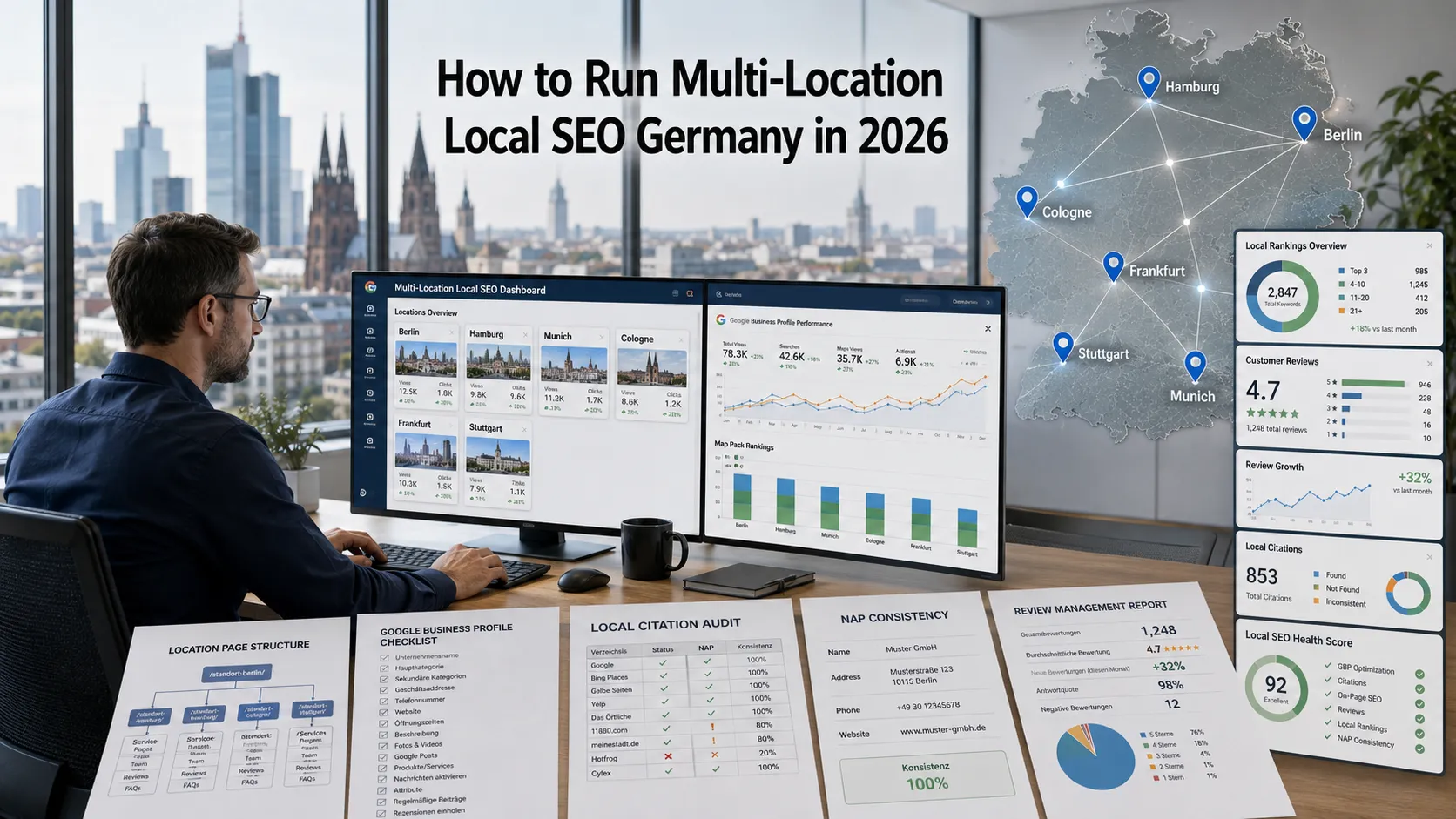
Multi-location local SEO Germany scales the challenges of single-location local SEO: each location needs its own Google Business Profile, its own page, its own citations, its own reviews. Done well, multi-location SEO captures local-pack rankings across all your service areas. Done poorly, locations cannibalize each other or stay invisible.
This guide walks through what multi-location local SEO Germany actually requires in 2026: location page structure, GBP management at scale, citation strategy, NAP consistency, schema markup, and common mistakes that hurt multi-location brands.
For single-location basics first see our local SEO Germany guide and Google Business Profile guide.
What does multi-location SEO involve?
Six core workstreams:
1. Separate GBP per location
Each physical location gets its own claimed + optimized GBP.
2. Unique location page per location
Dedicated page on your website per location with unique content.
3. Consistent NAP across all citations
Name, Address, Phone consistent for each location across all directories.
4. LocalBusiness schema per location
Schema markup unique to each location.
5. Location-specific reviews + reputation
Reviews accumulate per GBP per location.
6. Location-specific content + offers
Marketing content tailored to each location’s market.
How do you structure location pages?
Each location page needs:
Unique hero content (200–400 words)
Not duplicate across locations. Mention specific location, services there, team, why this location.
Embedded Google Map
For that specific location.
Address + hours + contact
Click-to-call phone, directions link.
Services offered at this location
Linked to detailed service pages.
Local team + photos
Real photos of the actual location + staff if applicable.
Local testimonials / reviews
Reviews from customers of this specific location.
Local FAQ
Common questions specific to this location.
LocalBusiness schema
Unique to this location (address, GeoCoordinates, openingHours).
Internal links
To other locations + main service pages.
What’s the page hierarchy for multi-location?
Three common patterns:
Pattern 1: Subdirectories per location
/standorte/berlin/, /standorte/hamburg/, /standorte/muenchen/. Most common + recommended.
Pattern 2: Subdomain per location
berlin.yourbrand.de, hamburg.yourbrand.de. Less common. Treats each location as separate site.
Pattern 3: Service + city pages
/leistung/standort/ combinations. E.g., /steuerberatung-berlin/, /steuerberatung-hamburg/. Effective for service businesses.
Pattern 4: Custom city pages from main service pages
Main service page (e.g., /steuerberatung/) + city-specific sections + internal links to location pages.
For most German multi-location: Pattern 1 (subdirectories) is the cleanest.
How do you manage Google Business Profile at scale?
For 2–10 locations:
Manual management
Log into each GBP separately. Update photos, posts, hours per location.
Workflow tip
Use a content calendar to schedule posts across all locations. Often the same post works across locations.
For 10+ locations:
Bulk upload via GBP API
Upload locations in batch via Google Business Profile API.
Third-party tools
Yext, BrightLocal, Moz Local for citation management + GBP bulk operations.
Dedicated local SEO management
For 50+ locations: dedicated local SEO team or specialized agency.
How do you handle NAP consistency at scale?
Define exact format
Single source of truth document. Exact format per location:
Brand Name
Street Address + Number
PLZ City
+49 30 1234567
Audit citations quarterly
Use BrightLocal / Yext audit features to find NAP inconsistencies.
Update systematically
When you change phone or address, update everywhere: GBP, website, every citation.
Use call tracking carefully
Different phone numbers per location for call tracking can hurt NAP consistency. Use call tracking integration that respects this.
What about service-area businesses (no physical location)?
For German service businesses serving customers at customer’s location (e.g., Handwerker, mobile services):
GBP service area instead of address
Set GBP to “service area business.” Don’t display physical address.
Define geographic service area
Cities, postal codes, radius covered.
Per-city landing pages on website
/service-berlin/, /service-hamburg/ even without physical location.
Citation handling
Some directories require physical address. Use HQ address. Be consistent.
What German-specific multi-location considerations matter?
Four considerations:
Different chambers of commerce (IHK) per region
Each location may need separate IHK registration. Document in local citations.
Regional language nuances
DE: standard German. AT: Austrian variants. CH: Swiss German variants. Reflect in location-specific content if appropriate.
Different competition density
Berlin competition very different from Frankfurt or smaller cities. Location strategy adapts.
GDPR per location
If different locations process customer data differently (different teams, different systems), document separately.
How do you measure multi-location SEO performance?
Six KPIs per location:
GBP views
How often this location’s profile is viewed.
Direct actions per location
Calls, directions, website clicks specific to this location.
Map pack rankings per location
Where this location ranks for “[Service] [City]” queries.
Review velocity per location
New reviews per month per location.
Average rating per location
Aggregate per location.
Citations completeness per location
% of important directories where this location is listed.
Aggregate dashboards across all locations show brand-level performance.
What are common multi-location mistakes?
Five patterns:
Duplicate content across location pages
Same generic content with city name swapped. Google penalizes. Unique content per location required.
Inconsistent NAP
Different formats across citations. Confuses Google.
Single GBP for multiple locations
Trying to put 5 locations under one GBP. Penalty risk.
Reviews concentrated at headquarter
All reviews go to main location, not local locations. Sub-locations stay invisible.
No LocalBusiness schema per location
Free win ignored.
How does AI search affect multi-location?
Three shifts in 2026:
Local intent queries via AI
ChatGPT Search + Perplexity increasingly handle local queries. Optimize for AI-friendly local content.
Aggregate brand authority + per-location specificity
AI engines need both brand-level authority + per-location specificity.
Question-format local content
“Wo gibt es einen guten Steuerberater in Köln-Sülz?” — natural AI queries. Optimize for these.
For AEO depth see our AEO Answer Engine Optimization guide (forthcoming).
Frequently asked questions
Subdirectory per location with unique content and schema.
Yes, one GBP per physical location.
Bulk upload via API and Yext/BrightLocal at scale.
Service-area business; define coverage; per-city landing pages.
Single source of truth, quarterly audits, systematic updates.
Use carefully; preserve primary NAP number.
Per-location 3 to 9 months; brand authority 12 to 24 months.
Reflect regional variations; hreflang per location.
Need help with multi-location SEO?
If you’re scoping multi-location SEO for your German business and want a 30-minute scoping conversation about location pages + GBP management + citation strategy, book a meeting or send details via our contact page.