
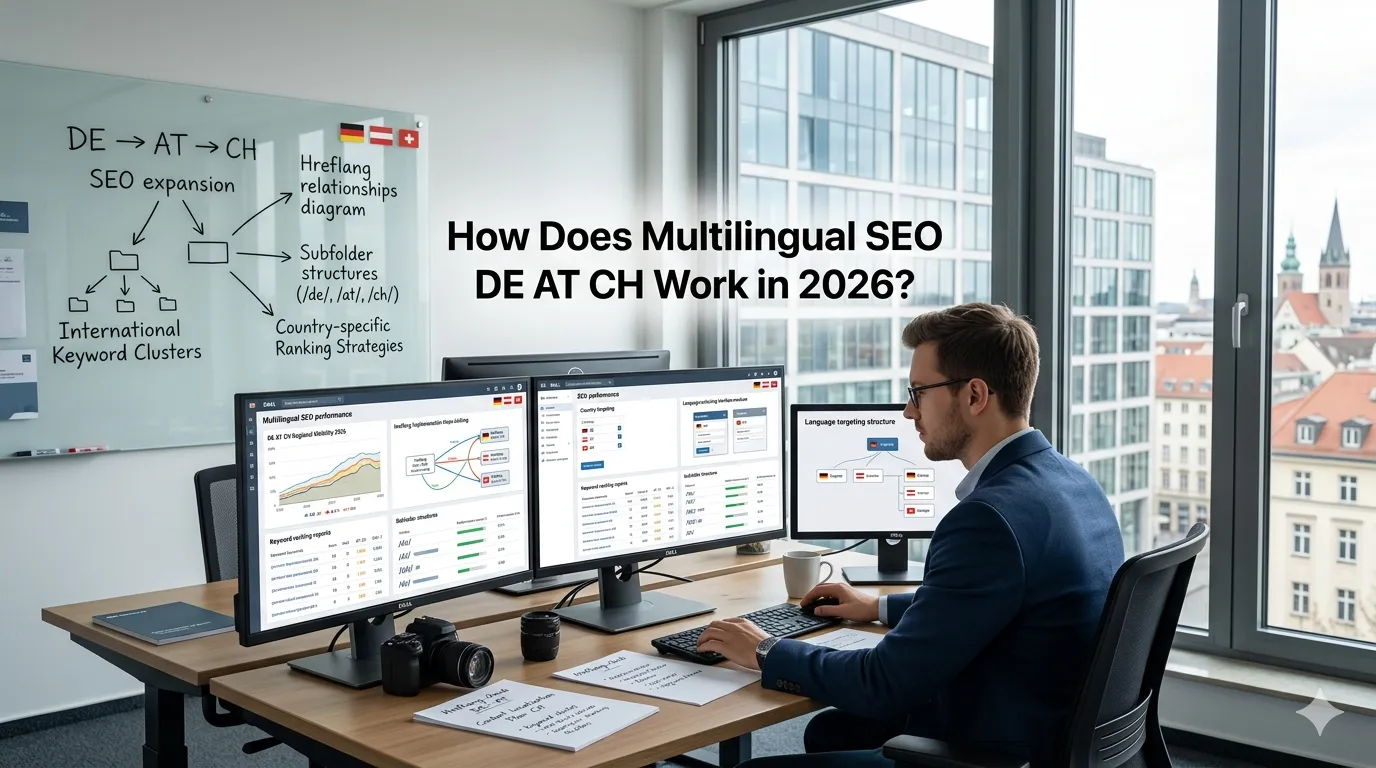
Multilingual SEO DE AT CH is the specific challenge German brands face when expanding to Austria and Switzerland or adding English for international. Same language (mostly) across DE/AT/CH but different markets, different competitors, different Google search behavior. Done well, multilingual SEO captures the full German-speaking market. Done badly, your DE site competes with itself in AT/CH SERPs.
This guide walks through what multilingual SEO DE AT CH for German-speaking markets actually requires in 2026: hreflang implementation, subfolder vs subdomain decisions, regional content strategy, Swiss German variants, and common mistakes.
What’s the challenge of DE/AT/CH SEO?
Three overlapping issues:
Same language, different markets
Standard High German used in all three. Slight vocabulary + idiom differences. Google may serve same content in all three but ranks differently.
Different Google search behavior
What ranks for “[Service] Wien” (Austrian query) vs “[Service] Berlin” (German query) differs. Different competitor sets, different SERP features.
Different legal context
DE/AT/CH have different consumer law, tax law, payment customs. Content might be technically correct for DE but legally questionable for CH.
How does hreflang work?
hreflang tells Google which language/region version of a page to serve to which users.
Tag format
<link rel="alternate" href="https://example.com/de/" hreflang="de-DE" />
<link rel="alternate" href="https://example.com/at/" hreflang="de-AT" />
<link rel="alternate" href="https://example.com/ch/" hreflang="de-CH" />
<link rel="alternate" href="https://example.com/" hreflang="x-default" />
Three implementation methods
- HTML head tags — in
<head>of each page - HTTP headers — sent via server response
- XML sitemap — declared in sitemap entries
For most German sites: HTML head tags simplest. Sitemap method scales better for large sites.
Bidirectional requirement
If page A links to page B via hreflang, page B must link back to A. Missing reverse = invalid hreflang.
What URL structure should you use?
Three options for DE/AT/CH:
Subfolders (recommended for most)
example.com/de/, example.com/at/, example.com/ch/
Pros: easiest to manage, consolidated domain authority. Cons: less localization signal than ccTLD.
Subdomains
de.example.com, at.example.com, ch.example.com
Pros: more separation of regional content. Cons: split domain authority across subdomains.
ccTLDs (country code top-level domains)
example.de, example.at, example.ch
Pros: strongest local ranking signal. Cons: requires three separate domains, three separate authority builds. Most expensive option.
For most German businesses expanding to AT/CH: subfolders (/de/, /at/, /ch/) is the right starting point. Migrate to ccTLD only if competitive necessity emerges.
Should the content differ across DE/AT/CH?
Depends on type:
Commercial / product pages
Often identical or near-identical. Same products, same services. Just localize prices (EUR for DE/AT, CHF for CH).
Pricing pages
Different. EUR for DE/AT. CHF for CH (often higher Swiss prices).
Legal pages
Different per country. Different Impressum requirements, different consumer protection laws.
Local content
Different. City names + regional references differ.
Blog / informational content
Often the same. Some regional variation if there are country-specific topics.
Vocabulary
Subtle differences: “Handy” used in DE + AT but “Mobiltelefon” in formal CH. “Steuer” in DE but “Steuern” in CH usage. Most readers accept either.
How do you implement hreflang on different platforms?
WordPress
Plugins handle it: Yoast SEO, RankMath, Polylang, WPML. Most popular: WPML for multilingual sites.
Shopify
Shopify Markets auto-generates hreflang. See our Shopify multi-currency Markets guide.
Custom Next.js / React
Implement in <Head> per page. Use libraries like next-i18next.
Webflow
Built-in localization features generate hreflang.
Custom builds
Implement manually. Document in Verfahrensdokumentation.
What about Swiss German variants?
Swiss German (Schweizerdeutsch) is a spoken dialect, not written. Written Swiss German uses Standard High German with minor variations:
Vocabulary
- “Velo” (Swiss) vs “Fahrrad” (DE/AT)
- “Estrich” (Swiss for attic) vs “Dachboden” (DE/AT)
- “Glace” (Swiss) vs “Eis” (DE/AT) for ice cream
Grammar / phrasing
Minor differences. Most readers don’t notice.
Currency
CHF instead of EUR. Always.
Pricing strategy
Swiss prices often 15–25% higher than EUR pricing for same product. Different market pricing tolerance.
For most German brands serving CH: same German content + currency localization is acceptable. Native Swiss German content is differentiator but not requirement.
How do you handle Google Search Console for multi-region?
One property per region
Create separate properties for de-DE, de-AT, de-CH.
International Targeting
In Search Console → Legacy tools → International Targeting → set country preference per property.
Sitemaps per region
Submit separate sitemap per region. Or one sitemap with hreflang annotations.
Monitor per-region performance
Different keywords win in different regions. Track per-region.
What’s the German + English multilingual case?
For brands serving DE + EN international:
Subfolder pattern
example.com/de/ + example.com/en/
hreflang tags
<link rel="alternate" href="https://example.com/de/" hreflang="de" />
<link rel="alternate" href="https://example.com/en/" hreflang="en" />
<link rel="alternate" href="https://example.com/en/" hreflang="x-default" />
x-default
For users in languages other than DE/EN. Typically point to English version.
Content translation
Professional translation for commercial pages. Auto-translation acceptable for non-critical content.
What are common multilingual SEO mistakes?
Five patterns:
Missing hreflang reverse links
Page A → Page B in hreflang, but Page B doesn’t link back to Page A. Invalid implementation.
Auto-translated commercial content
DE → EN machine translation on product pages. Poor quality hurts both SEO + conversion.
Wrong hreflang region codes
“de-AT” not “at-DE.” Common typo.
Same content across DE/AT/CH without hreflang
Google sees as duplicate. Cannibalization risk.
Skipping x-default
Without x-default, Google guesses for users in other languages. Add it.
How do you measure multilingual SEO performance?
Five KPIs per region:
Rankings per priority keyword per region
Where DE site ranks in DE Google vs AT Google vs CH Google.
Organic traffic per region
Sistrix has per-region Visibility Index. Search Console filterable by country.
CTR per region
May differ — DE users may click differently than AT users.
Conversion per region
Ultimate test: do per-region versions convert?
hreflang errors
In Search Console → Legacy tools → International Targeting → hreflang section.
When does ccTLD beat subfolders?
ccTLD makes sense when:
- Strong local competition demands maximum local SEO signal
- Different brand identities per region
- Different operating entities per country
- 24+ months of investment justifying domain authority rebuild
For most German brands: subfolders suffice. ccTLD only at competitive necessity.
Frequently asked questions
Signals which language/region version Google should serve.
Subfolders for most brands; ccTLDs only at competitive necessity.
Pricing and legal yes; commercial often the same.
Standard High German plus CHF is fine; native Swiss is a bonus.
WPML or Polylang generate hreflang automatically.
Fallback hreflang for users with no explicit match.
Only at competitive scale necessity.
Shopify Markets auto-generates hreflang and handles currency.
Need help with multilingual SEO?
If you’re scoping DE/AT/CH SEO expansion and want a 30-minute scoping conversation about hreflang + URL structure + content strategy, book a meeting or send details via our contact page.