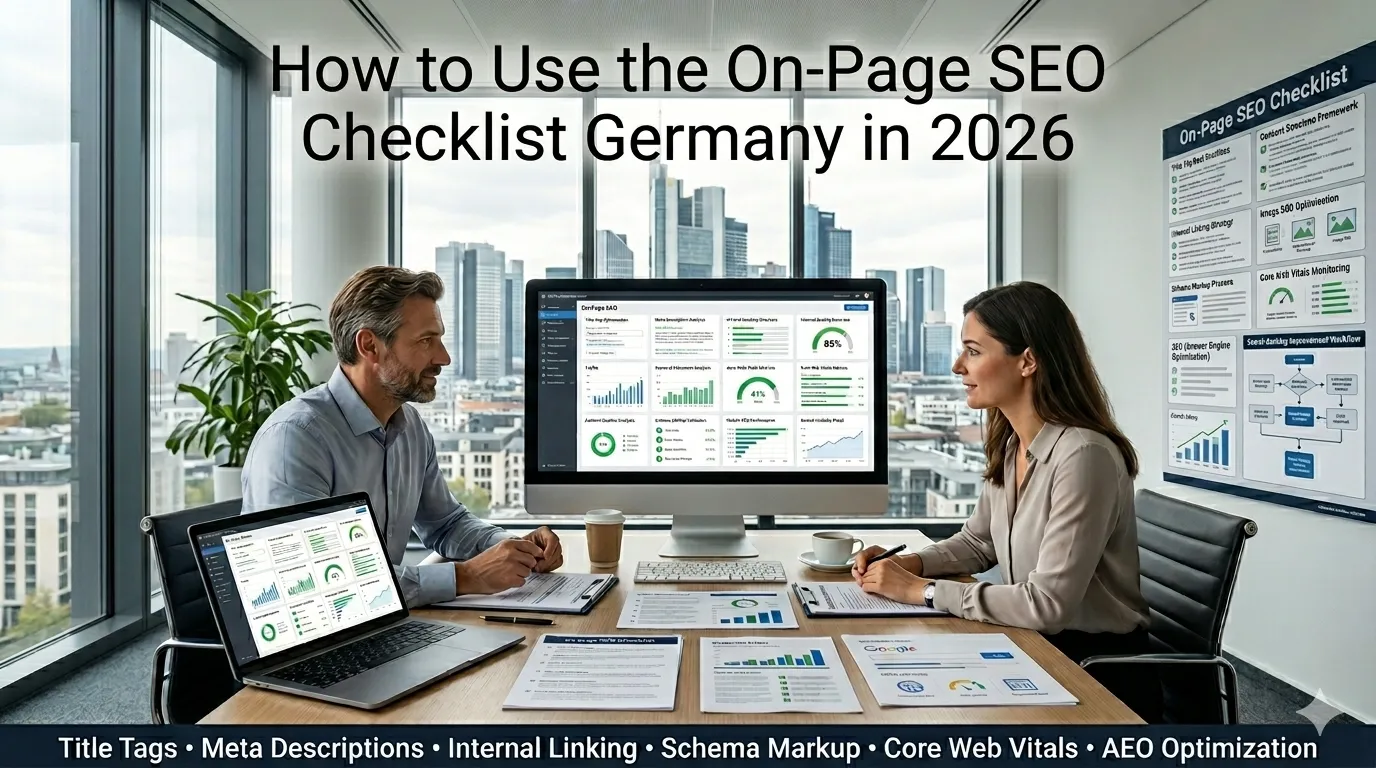
An on-page SEO checklist captures the signals on each individual page that tell Google what the page is about. While technical SEO is the foundation, on-page SEO is what gets each individual page to rank. For German websites in 2026, the on-page checklist has evolved with AI search, but the fundamentals remain: clear titles, useful content, internal linking, and structured data.
This guide walks through the complete on-page SEO checklist for German websites in 2026: title tags, meta descriptions, headers, content depth, keyword targeting, internal linking, image optimization, schema markup, and the AEO considerations that matter for AI search visibility.
What does on-page SEO cover in 2026?
Twelve categories per page:
1. Title tag
- 50–60 characters
- Primary keyword near the start
- Brand name at end (separator: | or –)
- Unique per page
- Compelling enough to drive CTR
2. Meta description
- 140–160 characters
- Primary keyword + value proposition
- Call to action where natural
- Unique per page
- Honestly describes page content
3. H1 heading
- One per page
- Includes primary keyword variant
- Matches search intent
- Different from title tag (often longer + more descriptive)
4. H2/H3 heading hierarchy
- Logical structure
- Includes secondary keywords / related terms
- Question-format headings where natural (helps AEO)
- Not skipping levels (H1 → H2 → H3, not H1 → H3)
5. Content depth + quality
- 1,000+ words for competitive commercial queries
- 500+ words for low-competition informational
- Original insights / data / examples
- Not auto-translated; native German quality
- Updated regularly
6. Keyword targeting
- Primary keyword in: title, H1, first 100 words, URL
- Secondary keywords throughout body
- Natural language (no stuffing)
- Related entities and concepts mentioned
7. Internal linking
- 3–8 internal links per page (varies by content length)
- Descriptive anchor text
- Links to relevant cluster pages
- Avoid orphan page
8. Image optimization
- Descriptive German file names (kein DSC_1234.jpg)
- Alt text for every image (German + accessibility)
- Appropriate sizing + format (WebP preferred)
- Lazy load below-fold
9. URL structure
- Lowercase, hyphenated
- Includes primary keyword
- No unnecessary parameters
- Consistent with site architecture
10. Schema markup
- Article schema (blog posts)
- Product schema (e-commerce)
- BreadcrumbList schema
- FAQ schema where relevant
- HowTo schema for tutorial content
11. Mobile-friendliness per page
- Responsive layout
- Touch targets adequate
- No layout shift (CLS)
12. Page speed per page
- LCP under 2.5s
- INP under 200ms
- CLS under 0.1
What’s the German-specific on-page checklist?
Four additional considerations:
German content quality bar
German readers expect comprehensive, formal Sie-form content. Auto-translated content visibly underperforms.
Trust signals on page
Author byline, date updated, related expert mentions, schema.org/Person markup. German E-E-A-T expectations are high.
Local relevance (if applicable)
For local businesses: address, opening hours, service area on page. LocalBusiness schema.
Multilingual handling
If page exists in DE + EN + other: hreflang per page. Canonical pointing to right version
For broader German SEO see our SEO services Germany guide.
What’s the AEO / AI-search on-page checklist for 2026?
Six additions to traditional on-page SEO:
Question-format headings
Convert H2/H3 to natural questions where possible. AI engines parse Q&A structures readily.
Direct, factual answers near the top
Lead each section with a clear answer. AI extracts these for snippets.
FAQ schema for question content
Use FAQ schema explicitly. Both Google AI Overviews and ChatGPT Search read these.
Author + expertise signals
Schema.org/Person with sameAs links to author profiles. AI checks expertise.
Original data + research
Original surveys, studies, calculations. AI engines cite original sources.
Avoid AI-style fluff
Skip “in conclusion,” “in today’s fast-paced world,” “this article will explore.” AI engines learned to skip them too.
How long should German on-page content be?
By page type:
Commercial / transactional pages
- Product page: 300–600 words description + reviews + FAQ
- Category page: 400–800 word intro + product grid
- Service page: 800–2,000 words
Informational / blog content
- How-to guides: 1,500–3,500 words
- Definitive guides / pillar content: 3,500–8,000+ words
- News / updates: 600–1,200 words
Local / location pages
- Each location page: 400–900 words unique content per location
The German market generally rewards comprehensive content slightly more than US market. Thin pages rank worse.
What are the most common on-page mistakes German websites make?
Five patterns:
Title tags too long
Title gets truncated in SERPs. Keep under 60 characters.
Generic / duplicate meta descriptions
“We offer the best [product] in Germany.” Templated descriptions across products. Bad CTR.
Missing H1 or multiple H1s
H1 should be unique per page. Single H1.
Auto-translated content for international
DE → EN auto-translation hurts both languages. Native quality matters.
No schema markup
E-commerce sites without Product schema, blog without Article schema. Free wins ignored.
For pre-launch checklist see our 50-point pre-launch QA checklist.
What tools help with on-page SEO?
Yoast SEO / RankMath / SEOPress (WordPress)
Page-level meta + content analysis.
Sistrix Site Audit
Page-level on-page issues across the site.
Screaming Frog
Bulk title/meta/H1 export + analysis.
Ahrefs Site Audit
On-page issues + ranking opportunities.
Surfer SEO / Frase / Clearscope
Content optimization vs. ranking competitors.
Google Search Console
What you actually rank for vs. what you’re optimizing for.
What’s the on-page workflow for a new German blog post?
A 10-step workflow:
- Keyword research — primary + secondary keywords with German search volume
- Search intent analysis — what type of content ranks? (How-to, list, comparison)
- SERP analysis — top 10 results, what they cover, gaps to fill
- Content brief — outline, target word count, must-include sections
- Writing — native German, comprehensive, original perspective
- On-page optimization — title, meta, H1, headers, internal links
- Image creation + optimization — German file names, alt text, WebP
- Schema markup — Article + FAQ as relevant
- Internal linking — link from existing pages to new post
- Promotion + monitoring — share, then watch Search Console for indexation + rankings
Frequently asked questions
Title tag, H1, and content quality drive most of the on-page impact.
50 to 60 characters.
Yes where natural; helps AEO and AI search.
Question headings, FAQ schema, direct answers, expertise signals, original data.
One primary plus related secondaries; topic targeting wins.
Annually for evergreen; quarterly for time-sensitive content.
German file names, alt text, WebP, lazy load, appropriate sizing.
JSON-LD preferred; easiest to maintain.
Need help with on-page SEO?
If you’re scoping on-page SEO improvements for your German site and want a 30-minute scoping conversation about priorities + workflow, book a meeting or send details via our contact page.
Need expert help? Gem Programmers provides search engine optimisation services for businesses in Germany, Austria and Switzerland. Request a free, no-obligation quote and get a clear plan with scope, timeline and price.