
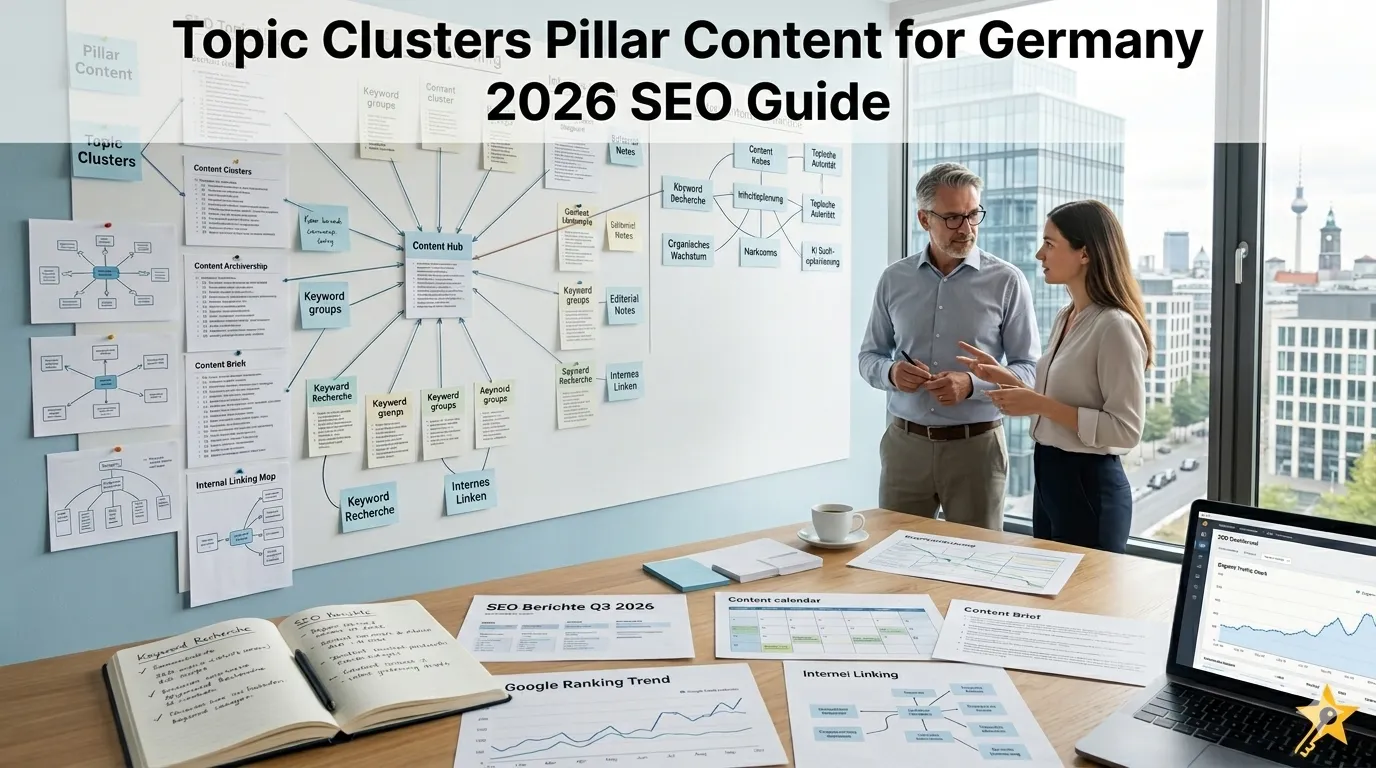
Topic clusters pillar content is the dominant content architecture pattern for serious German SEO in 2026. A pillar page covers a broad topic comprehensively; cluster articles target specific subtopics with long-tail keywords; bidirectional internal linking ties them together. The structure signals topical authority to Google + AI search engines, and consistently outperforms scattered individual articles.
This guide walks through what topic clusters pillar content actually require in 2026: hub-and-spoke architecture, pillar page structure, cluster article briefs, internal linking patterns, and how to plan a cluster from scratch.
What is a topic cluster?
Three connected components:
Pillar page
Comprehensive overview of a broad topic. Targets head keyword. 3,000–10,000 words. Acts as topic authority hub.
Cluster articles
8–20 supporting articles on specific subtopics. Each targets long-tail keyword. 1,000–3,000 words each.
Internal linkin
- Cluster articles link UP to pillar (top + bottom of article)
- Pillar links OUT to all cluster articles
- Cluster articles link ACROSS to 2–4 related cluster articles
This pattern compounds topical authority across the cluster.
Why do topic clusters work?
Four reasons:
Signals topical authority to Google
Comprehensive treatment of topic + interlinking signals depth.
Compounding internal link equity
External backlinks to pillar flow to cluster articles via internal links.
Better user journey
Reader can deep-dive into specific subtopic from broad overview.
AI search advantage
ChatGPT Search + AI Overviews favor comprehensive topic treatment. Clusters provide this.
How do you plan a topic cluster?
A 6-step planning process:
Step 1: Identify pillar topic
Broad topic with substantial search interest. Should support 8–20 subtopic articles. Example: “SEO Services Germany.”
Step 2: Keyword research for cluster
Find 30–60 keyword variants under the broad topic. Filter to 10–20 with meaningful volume + intent.
Step 3: Group into subtopics
Cluster keywords by user intent. Each cluster article will target a specific subtopic.
Step 4: Design pillar structure
Outline pillar page covering all cluster subtopics at high level. Each subtopic = section in pillar + link to deeper cluster article.
Step 5: Plan cluster article briefs
For each cluster article: target keyword, search intent, outline, word count, related links.
Step 6: Schedule production
Phase rollout: pillar first (or simultaneously), then cluster articles over 3–9 months.
What does a pillar page actually look like?
A typical pillar covers:
Introduction (300–500 words)
Set the stage. Why this topic matters. Who this guide is for.
Section per major subtopic (300–800 words each)
High-level treatment with internal link to cluster article.
Comprehensive coverage
Pillar shouldn’t have gaps. Reader could understand the topic from pillar alone.
Table of contents / TOC
For long pillars (3,000+ words), TOC at top for navigation.
FAQ section
8–15 common questions with brief answers. Targets featured snippets + AI search.
Conclusion + CTA
Wrap up + next-step CTA.
Schema markup
Article schema + FAQ schema + TOC schema if applicable.
For broader content structure see our on-page SEO checklist guide.
What does a cluster article look like?
Each cluster article:
Targets one specific subtopic
Long-tail keyword with clear search intent.
1,000–3,000 words deep on subtopic
More detail than pillar’s high-level treatment.
Links back to pillar 1–2 times
At top + bottom of article. Anchor: pillar topic keyword.
Links across to 2–4 related cluster articles
Where topically related. Anchor: target keyword of linked article.
Stands alone as a useful article
User landing on cluster article should get value without reading pillar first.
What’s an example cluster for German SEO?
Pillar: “SEO Services in Germany”
Comprehensive overview of SEO services landscape.
Cluster articles (each links back to pillar):
- “SEO Cost in Germany”
- “Hire SEO Consultant Germany”
- “Best SEO Agency Germany”
- “Technical SEO Audit”
- “On-Page SEO Checklist”
- “Local SEO Germany”
- “Link Building Germany”
- “German SEO Content Writing”
- “Multilingual SEO DE/AT/CH”
- “AEO / Answer Engine Optimization”
- “SEO for B2B SaaS”
- “Sistrix Germany Guide”
(This is roughly the cluster you’re reading right now.)
How do you build a cluster from scratch?
A 90-day rollout:
1–14: Strategy development + content briefs
- Define pillar topic
- Keyword research
- Group into 10–20 subtopic clusters
- Write content briefs for pillar + all cluster articles
15–30: Build and publish pillar page
- Write pillar (or commission writer)
- Edit + SEO optimize
- Add internal links to placeholders for cluster articles (initially can be section anchors)
- Publish
31–60: First cluster wave (5–8 supporting articles)
- Write + publish 5–8 cluster articles
- Each links back to pillar
- Update pillar internal links to point to live cluster articles
61–90: Second cluster wave (remaining supporting content)
- Write + publish remaining cluster articles
- Cross-link cluster articles to each other where relevant
90+: Ongoing iteration, updates, and expansion
- Monitor rankings + traffic
- Update pillar based on what’s working
- Add additional cluster articles as opportunities emerge
How do you measure topic cluster success?
Five KPIs:
Pillar page ranking
Target head keyword. Aim for top 10 within 6 months, top 3 within 12.
Cluster article rankings
Long-tail keywords. Top 10 within 3 months typical for low-competition clusters.
Internal link equity flow
Sistrix / Ahrefs can show internal link distribution. Pillar should accumulate most internal links pointing to it.
Organic traffic across cluster
Combined traffic of pillar + cluster. Should grow consistently month-over-month
Topical authority indicator
Sistrix shows topic-level visibility. Cluster should lift overall topic visibility for the site.
What are the most common topic cluster mistakes?
Five patterns:
Pillar without cluster
Single comprehensive page without supporting articles. Misses the cluster effect entirely.
Cluster without pillar
8–10 individual articles on related subtopics with no central hub. Loses interlinking pattern.
One-way pillar-to-cluster linking
Pillar links to clusters; clusters don’t link back. Breaks the bidirectional flow.
Generic pillar without depth
Pillar that’s 2,000 words of fluff doesn’t differentiate. Needs to be genuinely comprehensive + insightful.
Keyword cannibalization within cluster
Multiple cluster articles targeting the same keyword. Pick one primary per article.
How does AEO affect topic cluster strategy?
In 2026, AI search engines (ChatGPT Search, Perplexity, Google AI Overviews) favor comprehensive topic treatment. Topic clusters are well-suited:
- Pillar provides comprehensive overview AI can summarize
- Cluster articles provide specific answers AI can extract
- Strong interlinking signals topical depth
- FAQ schema on pillar captures direct AI queries
For AEO depth see our AEO Answer Engine Optimization guide (forthcoming in this section).
How long until topic clusters compound?
Realistic timeline:
Month 1–3: Foundation
Pillar + 5–8 cluster articles live. Initial indexation + early rankings on long-tail.
Month 4–6: Acceleration
Full cluster live (15–20 articles). Cluster articles ranking on long-tail. Pillar gaining authority.
Month 7–12: Authority
Pillar ranking on competitive head keywords. Cluster ranking high on multiple long-tail. Internal traffic flow strong.
Month 12–24: Compounding
Cluster becomes authoritative resource. External links accumulate. Difficult for competitors to displace.
Month 24+: Moat
Cluster is a moat. Authority compounds. Year-over-year traffic growth continues.
For broader timeline see our SEO services Germany guide.
Frequently asked questions
Pillar plus 8 to 20 interlinked cluster articles.
8 to 20 typical.
Either works; pillar-first or cluster-first patterns both succeed.
3,000 to 10,000+ words depending on topic depth.
Yes, to 2 to 4 most-related cluster articles.
Yes; larger sites operate 5 to 15 clusters in parallel.
3 to 12 months for initial; 24+ months for moat.
Yes; especially powerful for B2B.
Need help planning a topic cluster?
If you’re scoping topic cluster strategy for your German business and want a 30-minute scoping conversation about pillar selection + cluster planning, book a meeting or send details via our contact page.