
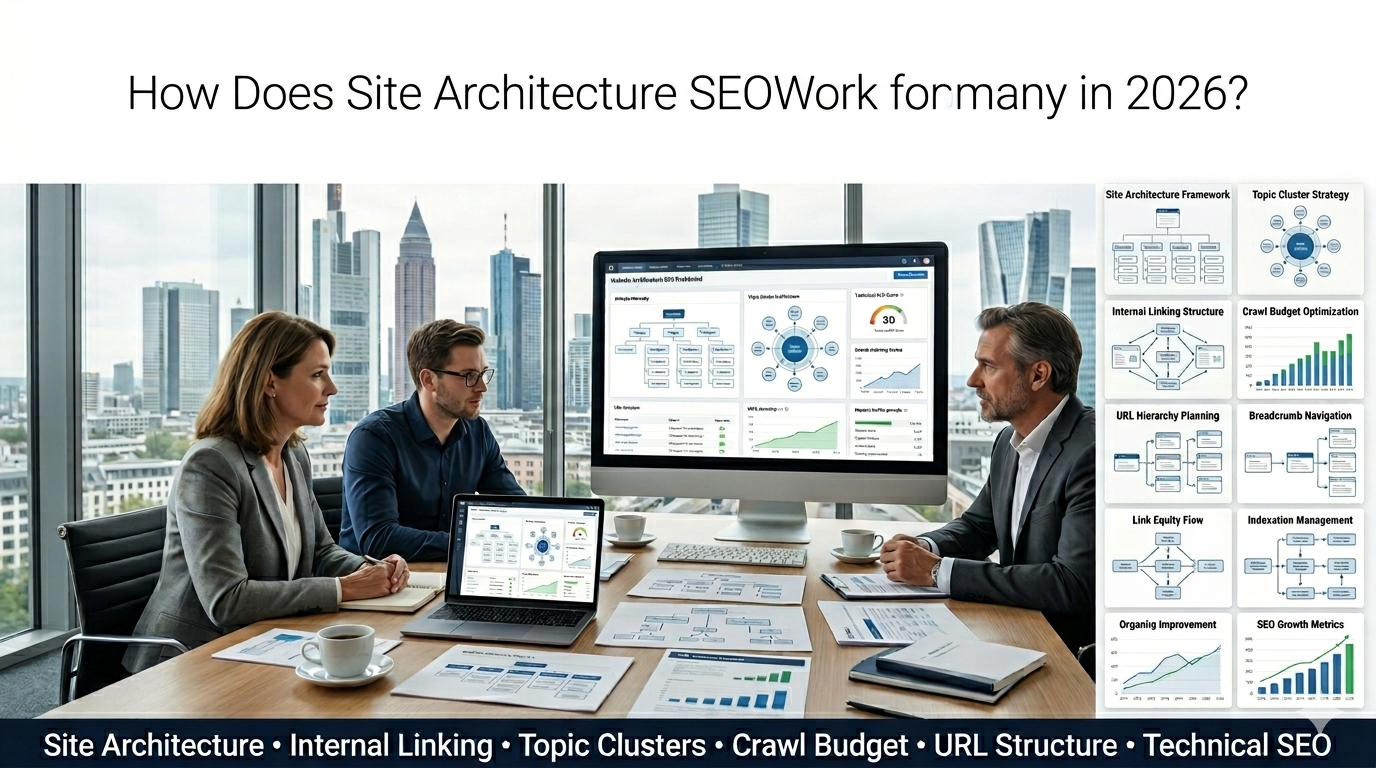
Site architecture SEO is the invisible foundation that determines how Google crawls, indexes, and understands your website. Strong architecture compounds SEO results; weak architecture caps them — even with great content and strong links. For German websites in 2026, getting architecture right is one of the highest-leverage SEO investments.
This guide walks through what site architecture SEO for Germany actually requires in 2026: hierarchy depth principles, URL structure, category organization, crawl budget management, and internal linking strategy.
What does “site architecture” mean for SEO?
Four overlapping concepts:
Information architecture
How content is organized into categories + hierarchies. Logical structure makes sense to users.
URL structure
The pattern of URLs. /category/subcategory/page slug consistency.
Internal linking architecture
How pages link to each other. Powerful pages link to important pages.
Crawl depth
How many clicks from homepage to any page. Shallow = better crawled + indexed.
Why does site architecture matter for SEO?
Six reasons:
Crawl budget allocation
Google allocates limited crawl budget per site. Architecture determines where Googlebot spends it.
Internal link equity flow
Pages closer to homepage receive more internal link equity. Architecture determines what’s “close.”
User experience signals
Logical architecture → lower bounce rates → better engagement signals → better rankings.
Indexation control
Architecture determines what gets crawled + indexed. Bad architecture = wasted crawl on thin pages.
Topical authority
Cluster organization signals topic depth to Google. Strong architecture builds topical authority.
Scalability
Architecture decided today determines feasibility of adding 1,000 new pages tomorrow.
What are the architecture principles for German SEO in 2026?
Six principles:
1. Flat hierarchy where possible
Important pages should be 1–3 clicks from homepage. Pages 5+ clicks deep get less crawl + less link equity.
2. Topic clusters
Group related content. Pillar page + supporting articles all interlinked. Signals topical authority.
3. Consistent URL structure
category/page-slug. Predictable. Includes keywords.
4. Breadcrumbs everywhere
Visual + schema breadcrumbs help users + Google understand hierarchy.
5. Internal linking discipline
Every page links to 3–8 related internal pages. Powerful pages link to growth opportunities.
6. Avoid orphan pages
Every indexable page should have at least 2 internal links pointing to it
What does good URL structure look like?
Seven rules:
Lowercase only
No mixed case. Confuses + creates duplicates.
Hyphens, not underscores
/web-development-germany/ not /web_development_germany/.
German keywords for German market
/webentwicklung-deutschland/ if site is primarily German. /web-development-germany/ if English-first.
Logical hierarchy in URLs
Reflects site structure. /dienstleistungen/seo/ makes sense.
No unnecessary parameters
?utm_source=... for tracking is fine. ?page=2&filter=color for filters can cause indexation bloat — control with canonical.
Short where possible
Long URLs work but shorter wins for memorability + sharing.
Stop words can stay
/das-beste-cms-fuer-deutschland/ is fine. Don’t strip “das/der/die” if it makes the URL natural German.
How deep should hierarchy go?
A practical guide:
Small site (under 100 pages)
Flat: homepage → page. 1–2 levels deep.
Medium site (100–1,000 pages)
Hierarchical: homepage → category → page. 2–3 levels deep.
Large site (1,000–10,000 pages)
Deep: homepage → category → subcategory → page. 3–4 levels deep.
Very large site (10,000+ pages)
Multi-level: homepage → category → subcategory → page-type → individual page. 4–6 levels deep.
Important pages should always be 1–3 clicks from homepage regardless of total site depth. Use breadcrumbs and internal linking to shortcut deep paths.
What’s the topic cluster model?
In 2026, the dominant content architecture pattern:
Pillar page
Comprehensive overview of a broad topic. Targets a high-volume head keyword. 3,000+ words. Acts as topic authority hub.
Cluster content
8–20 supporting articles on subtopics. Each targets a specific long-tail keyword. 1,000–2,500 words each.
Interlinking
Every cluster article links back to pillar. Pillar links out to cluster articles. Cluster articles cross-link to each other.
Example for German SEO
Pillar: “SEO Services in Germany” (this site’s pillar) Cluster: “SEO Cost Germany”, “Hire SEO Consultant”, “Technical SEO Audit”, “Local SEO Germany”, “Link Building Germany”, etc.
Topic clusters signal topical authority to Google. Strong cluster = ranking advantage on the entire topic.
How does crawl budget work?
For small sites (under 1,000 pages): crawl budget not a constraint. Google crawls everything.
For mid-large sites (1,000–100,000+ pages): crawl budget matters. Google allocates limited crawler attention per site.
Crawl budget wins
- Block thin pages from crawl (via robots.txt or noindex)
- Reduce duplicate content via canonical
- Don’t waste crawl on parameter URLs (filter combinations, session IDs)
- Fast pages → more pages crawled per visit
Crawl budget waste patterns
- Faceted navigation creating millions of URL combinations
- Pagination indexed when shouldn’t be
- Test/staging pages indexed accidentally
- Tag archive pages that don’t add value
What’s the right internal linking strategy?
Five principles:
1. Link to relevant pages
Don’t link homepage → homepage. Link to topically related pages.
2. Descriptive anchor text
“Best WordPress hosting in Germany” beats “click here.” But don’t over-optimize anchors — looks unnatural.
3. Powerful pages link to growth pages
Homepage and high-traffic pages have valuable link equity. Link from them to pages you want to grow
4. New pages get links from existing pages
When publishing new content, link to it from 3–5 existing relevant pages.
5. Bidirectional in clusters
Pillar ↔ cluster articles ↔ each other.
What are the most common architecture mistakes?
Five patterns:
Important pages buried 4+ clicks deep
Crawl + link equity suffers. Move important pages closer to homepage.
No category structure
Just /page-slug/ flat URLs. Confuses Google about topical relationships.
Faceted navigation indexed
Filter combinations creating millions of indexable URLs. Use canonical to consolidate.
Orphan pages
Pages with no internal links pointing to them. Effectively invisible.
Inconsistent URL structure
Some pages /category/page/, others /page/, others /tag/keyword/. Confuses users + crawlers.
What’s the architecture migration approach?
If you have existing site with weak architecture:
Step 1: Audit current state
Screaming Frog crawl. Map current hierarchy + URL patterns + internal links.
Step 2: Design new architecture
Plan ideal structure. URL mapping (old → new).
Step 3: Implement with redirects
301 redirects for every changed URL. Avoid losing rankings.
Step 4: Internal link cleanup
Update all internal links to new URLs (don’t rely on redirects).
Step 5: Monitor
Search Console + Sistrix for 60–90 days post-migration.
For broader migration framing see our website redesign without losing rankings guide.
How does multilingual architecture work?
DE, AT, and CH markets (same language, different regions):
- /de/ for Germany
- /at/ for Austria
- /ch/ for Switzerland
- hreflang tags pointing to each version
- Canonical pointing to same-language version
German and English market setup:
- /de/ for German content
- /en/ for English content
- hreflang per page
- Or subdomain (de.yourbrand.com, en.yourbrand.com)
See our Shopify multi-currency Markets guide for Shopify multi-region setups.
Frequently asked questions
1 to 6 levels by size; important pages always 1 to 3 clicks deep.
Lowercase, hyphenated, keyword-rich, reflects hierarchy.
Pillar plus cluster articles, interlinked bidirectionally.
Find them in Screaming Frog and add 2 to 5 internal links each.
Above 10,000 pages yes; above 100,000 pages critical.
One focused topic per page wins; clusters beat omnibus pages.
Subfolders /de/, /at/, /ch/ with hreflang.
Yes, visual plus BreadcrumbList schema.
Need help with site architecture?
If you’re scoping site architecture improvements for your German website and want a 30-minute scoping conversation about hierarchy, URL structure, and topic clusters, book a meeting or send details via our contact page.