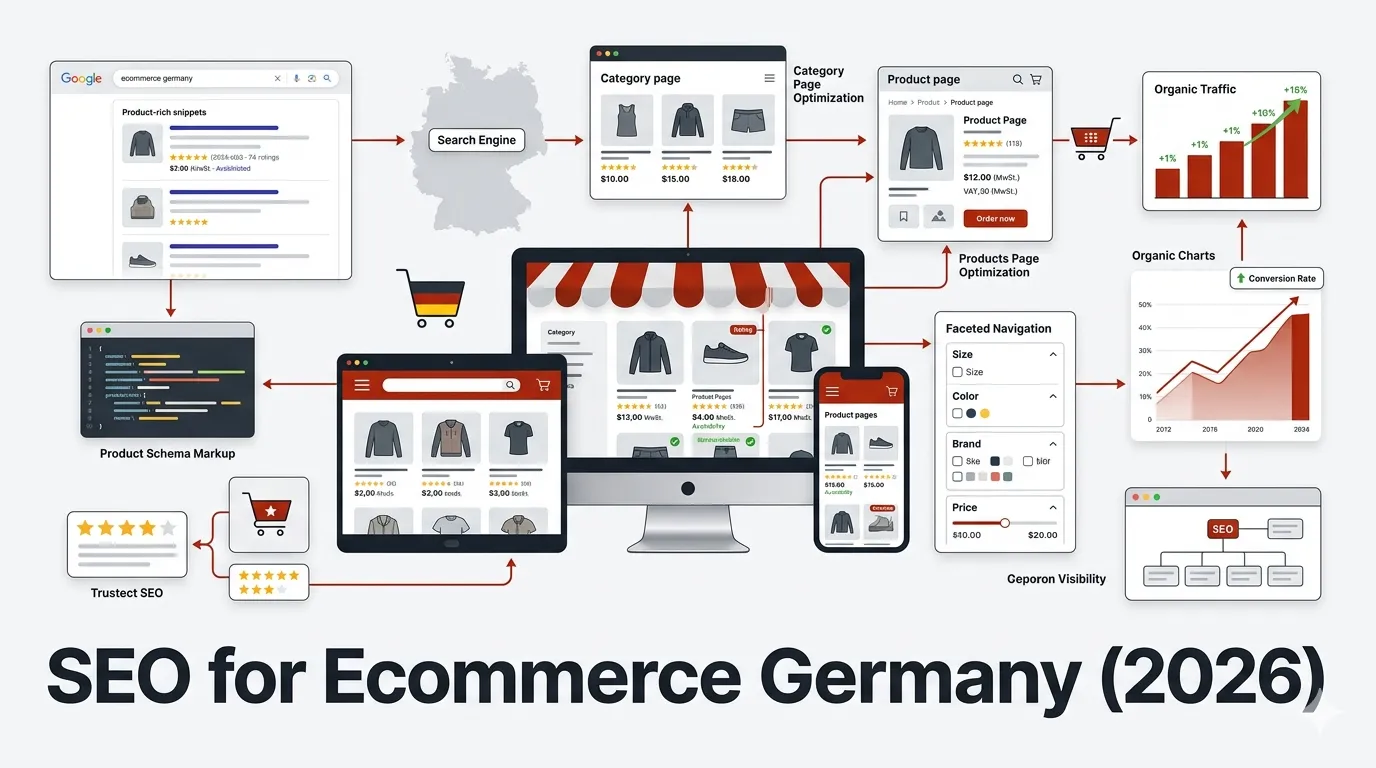
SEO for ecommerce Germany is its own discipline. Product pages, collection / category pages, faceted navigation, schema markup, image optimization, technical handling of out-of-stock SKUs — all distinct from content-site SEO. For German e-commerce in 2026, getting e-commerce SEO right is the difference between dependent-on-Meta-ads stores and brands that compound organic revenue over years.
This guide walks through what SEO for ecommerce Germany actually requires in 2026: product page optimization, category SEO, schema markup, faceted navigation handling, and Shopify vs WooCommerce vs Shopware-specific considerations.
For Shopify-specific SEO see our Shopify SEO Germany guide.
What makes e-commerce SEO different?
Five key differences from content-site SEO:
Product page heavy
Hundreds or thousands of product pages. Each needs optimization.
Collection / category pages dominant
Often higher-value SEO targets than individual products. “Damen Sneakers” beats “Specific Nike Air Force 1 White.”
Schema markup essential
Product schema with prices, availability, reviews — drives rich snippets + click-through.
Faceted navigation complexity
Filters create millions of URL combinations. Manage carefully.
Conversion + revenue attribution direct
E-commerce SEO results show up in revenue dashboards within weeks.
What’s the e-commerce site architecture for SEO?
Standard pattern:
Homepage
Brand-level. Navigation hub.
Category / collection pages
/damen-sneakers/, /damen-stiefel/ etc. High-value SEO targets.
Subcategory pages
/damen-sneakers/sport/, /damen-sneakers/lifestyle/.
Product pages
/damen-sneakers/sport/nike-air-force-1-white-uk-7/ or similar.
Brand pages
/brands/nike/, /brands/adidas/.
Filter combinations
/damen-sneakers/?farbe=schwarz&grösse=39 — handle with canonical or noindex.
For broader site architecture see our site architecture SEO guide.
How do you optimize product pages for German SEO?
Eight elements per product page:
1. Unique product title
Brand + model + key attribute + size/variant. Format: “[Brand] [Model] [Color] [Size]”
2. Comprehensive product description
400–800 words minimum. Specific details, materials, dimensions, use cases. Not manufacturer-default text.
3. Multiple high-quality images
Hero image + 4–8 supporting. Proper file names (descriptive German). Alt text per image.
4. Product schema markup
JSON-LD with name, image, description, brand, offers (price + currency + availability + condition), aggregateRating, review.
5. Reviews + ratings
Customer reviews on product page. Aggregate rating in schema.
6. Breadcrumbs
Home > Damen > Sneakers > Nike Air Force 1
7. Related products
Internal linking. “Häufig zusammen gekauft” or “Ähnliche Produkte.”
8. Question + answer / FAQ
Common product questions answered. FAQ schema.
For German invoicing + checkout see our Shopify Germanized app guide.
How do you optimize collection / category pages?
Often more important than individual product pages for SEO:
Comprehensive intro text
300–800 words at top of category. Explains category, what to look for, sub-categories.
Top products displayed first
Best-sellers / featured products above the fold.
Faceted filtering
Filters for size, color, brand, price. Helps users find products.
Pagination handling
<link rel="next"> and <link rel="prev"> for paginated category pages.
Schema markup
CollectionPage schema. BreadcrumbList. Optional aggregate aspects.
Optimized URLs
/damen-sneakers/ not /category-id-12345/.
How do you handle faceted navigation?
The crawl budget challenge:
Problem
Filters like color × size × material × price = millions of URL combinations. Indexing all = crawl waste.
Solutions
Option 1: Canonical to base category
All filter URLs canonical to base category URL. Filters work for users; not indexed.
Option 2: Selective indexing of high-value filters
Index “/damen-sneakers/farbe-schwarz/” if it’s a high-intent search query. Canonical for others.
Option 3: AJAX-based filtering
Filters update URL parameters but page uses AJAX without separate URL state. Less SEO-relevant filter URLs.
For most German e-commerce: canonical-to-base + selective indexing for high-volume filters is right.
For crawl budget context see our crawl budget guide.
How do you handle out-of-stock SKUs?
Important for e-commerce SEO:
Temporarily out-of-stock
Keep page live with “ausverkauft” status. Update schema availability. Don’t remove from sitemap.
Permanently discontinued
Redirect (301) to similar product or parent category. Don’t leave as 404.
Variant out-of-stock
Show available variants. Don’t make user think entire product gone.
Schema availability values
- “InStock” — available
- “OutOfStock” — currently unavailable
- “Discontinued” — permanently gone
What about German-specific e-commerce SEO?
Four considerations:
Grundpreis (price per unit)
Required by §1 PAngV for products sold by weight/volume. Display on product page. See our Germanized for Shopify guide.
Versandkosten transparency
Per §312j BGB, shipping costs visible before checkout. Affects conversion + indirectly SEO via reduced bounce.
Trust signals
Trusted Shops badge + reviews. Critical for German e-commerce. See our Shopify Trusted Shops guide.
MwSt display
“inkl. MwSt.” prominent on pricing. German consumer law requirement.
What schema is essential for German e-commerce?
Six schema types:
Product
Per product page. Required fields: name, image, description, brand, offers (price, currency, availability).
Offer
Within Product. Price, currency, availability, valid from/until dates.
AggregateRating + Review
If you have reviews. Star ratings in SERPs.
BreadcrumbList
Navigation. Cleaner SERP display.
Organization
Sitewide. Brand info.
FAQPage
For product FAQ sections.
For schema depth see our schema markup Germany guide.
How do platform choices affect e-commerce SEO?
Shopify
Default Dawn theme has decent SEO foundation. Apps fill gaps. See our Shopify SEO Germany guide.
WooCommerce
Maximum flexibility but requires manual setup. Yoast SEO / RankMath plugins.
Shopware
Strong B2B SEO features. Native German market understanding.
Custom / headless
Maximum control + cost. Hydrogen, Next.js Commerce, Saleor.
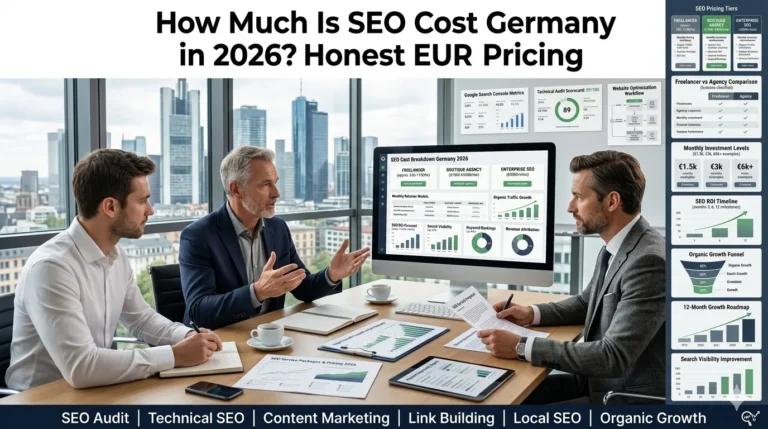
For platform comparison see our Shopify vs WooCommerce guide and Shopify vs Shopware guide.
What does e-commerce SEO cost in Germany?
Small online shop (under €500k revenue)
- Freelance SEO: €1,500–€3,500/month
- Plus content production for category/blog: €1,000–€3,000/month
Mid-size e-commerce (€500k–€5M)
- Agency retainer: €5,000–€15,000/month
- Plus tools + content
Scale-up e-commerce (€5M+)
- In-house SEO team + agency: €15,000–€50,000+/month
For broader e-commerce see our D2C ecommerce web development guide.
What are common German e-commerce SEO mistakes?
Five patterns:
Manufacturer-default product descriptions
Same text across thousands of stores. Zero ranking potential.
Faceted navigation creating indexation bloat
Filters creating millions of URLs all indexed. Crawl waste.
Missing product schema
Free win ignored. Reduces SERP visibility.
Thin category pages
Just product grid, no intro text. Hard to rank for category queries.
Auto-translated content for German market
DE → EN auto-translation. Doesn’t rank or convert.
How does AI search affect e-commerce SEO in 2026?
Three shifts:
Product comparison queries via AI
“Welche Sneakers für breite Füße?” — AI engines answer. Get cited.
Buyer research via AI
Pre-purchase research increasingly happens in AI search. GEO matters.
Aggregator-style answers
AI summarizes product options. Brand mentions critical.
For AEO/GEO see our AEO guide and GEO guide.
Frequently asked questions
Product heavy, category focused, schema essential, facets complex.
Both; categories often higher revenue per ranking.
Canonical to base; selective indexing for high-value filters.
Product with Offer and AggregateRating, BreadcrumbList, Organization, FAQ.
400-800 words native German, not manufacturer default.
Keep temp pages live; redirect discontinued SKUs
Less than content quality; Shopify/Woo/Shopware all rank.
EUR 2.5k/month small to EUR 50k+/month scale-up.
Need help with e-commerce SEO?
If you’re scoping e-commerce SEO for your German store and want a 30-minute scoping conversation about strategy + audit + content, book a meeting or send details via our contact page.
Need expert help? Gem Programmers provides search engine optimisation services for businesses in Germany, Austria and Switzerland. Request a free, no-obligation quote and get a clear plan with scope, timeline and price.