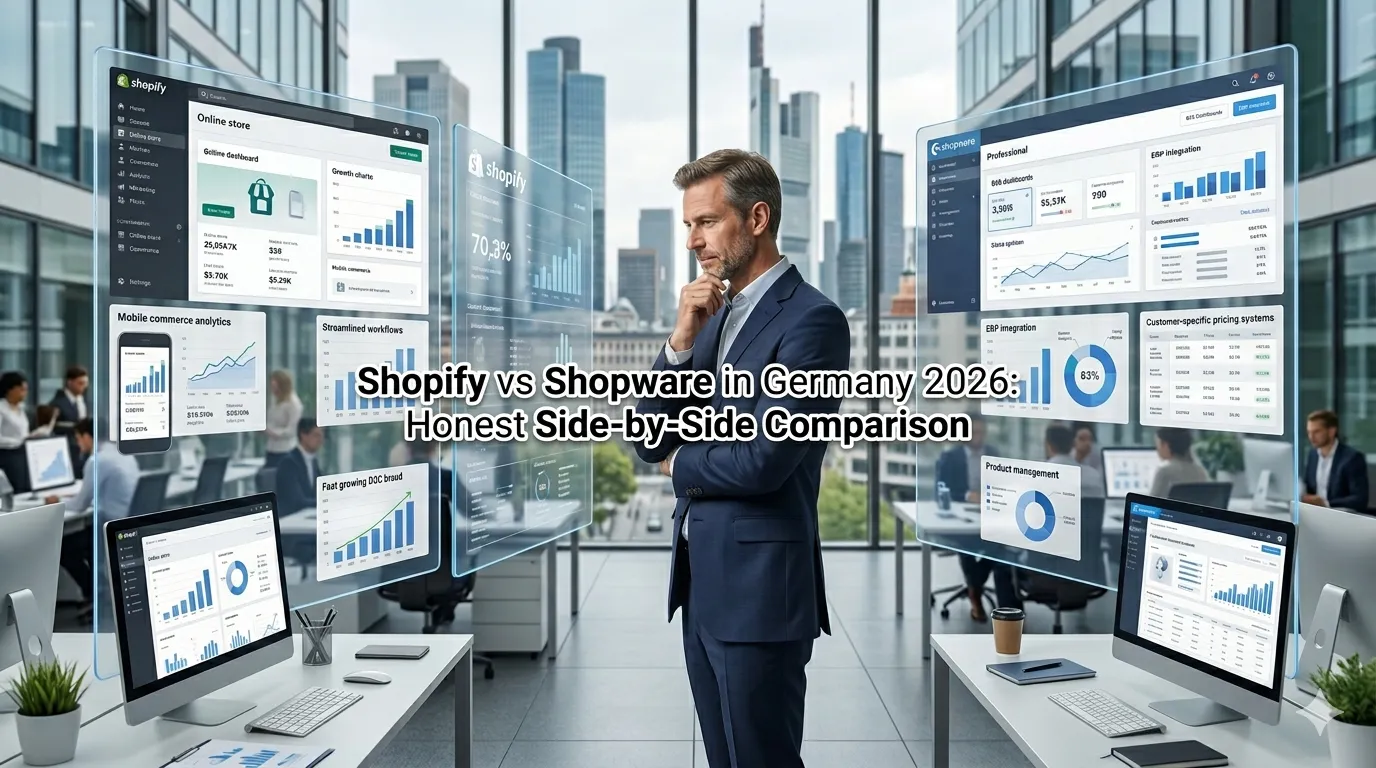
Shopify and Shopware are the two dominant e-commerce platforms for serious German brands in 2026. Both can run a successful German store; both have specific strengths. The wrong choice between them costs €50,000–€200,000+ to undo within 2 years, so this decision deserves more than a marketing-comparison reading.
This guide walks through the honest Shopify vs Shopware comparison for German brands in 2026: where each wins, where each struggles, realistic EUR cost differences, B2B capabilities, German legal compliance, and how to choose based on your specific situation rather than vendor pitch.
What’s the fundamental difference between Shopify and Shopware?
Two distinct philosophies:
Shopify
SaaS, hosted by Shopify, US-Canadian company (Ottawa HQ with EU offices). You don’t manage servers, infrastructure, or scaling. Pay monthly for the platform; pay for apps to extend functionality. Lock-in: high (your data lives in Shopify’s infrastructure).
Shopware
Open-core, made in Schöppingen (NRW, Germany). Available as self-hosted (Community Edition free) or as SaaS (Shopware Cloud). You can self-host on Hetzner, AWS Frankfurt, IONOS — full data residency, full control, but you’re responsible for hosting, scaling, security. Lock-in: lower.
Shopify wins on operational simplicity. Shopware wins on flexibility, data sovereignty, and B2B depth.
When does Shopify win for a German brand?
Six scenarios:
D2C consumer-focused brand
Speed-to-market matters more than infinite customization. Shopify’s setup is faster, mobile-first themes are better, modern checkout is more polished.
Small-to-medium brand without in-house engineering
Operational simplicity matters. Shopify hosts and maintains everything. Less DevOps overhead.
Fast iteration / product launches
Shopify deploys instantly. Shopware self-hosted requires CI/CD discipline.
Strong app ecosystem need
Shopify’s app marketplace is larger and more mature than Shopware’s. For typical D2C stacks (Klaviyo + reviews + bundles + email), Shopify wins.
Multi-region with simple architecture
Shopify Plus’s Expansion Stores handle DE/AT/CH separation cleanly.
Limited budget for ongoing ops
Shopify’s monthly fee is predictable; Shopware self-hosted has variable hosting + DevOps + agency costs.
When does Shopware win for a German brand?
Six scenarios:
B2B-dominant business
Shopware 6 has B2B as a first-class feature: customer-specific catalogs, tiered pricing, contract pricing, German PVS/ERP integration. Shopify B2B (Plus-only) is improving but still less mature for complex German Mittelstand B2B.
Complex German tax / OSS / ERP integration
Shopware integrates with Lexware, Datev, sevDesk, SAP B1, JTL-Wawi natively. Shopify requires apps + custom integration work.
Made-in-Germany / data-sovereignty requirements
For regulated industries, public-sector buyers, or strict DSGVO posture, Shopware self-hosted on German infrastructure is more defensible than Shopify (US-Canadian SaaS).
Heavy customization beyond Shopify’s limits
Custom checkout flows, complex product configurators, deep workflow customizations. Shopware’s Symfony-based codebase is fully open and customizable.
Multi-tenant / marketplace needs
Shopware 6 supports multi-tenant SaaS-style setups more flexibly than Shopify.
Mid-market German Mittelstand
Shopware fits German Mittelstand procurement and operational culture more naturally — German vendor, German support, German invoicing built-in.
What does each platform cost in Germany in 2026?
Shopify total cost of ownership
- Platform: €29–€2,300+/month
- Apps: €150–€12,000/month
- Theme/build: €1,500–€500,000+
- See our Shopify cost Germany guide
Shopware total cost of ownership
Community Edition (self-hosted)
- License: €0
- Hosting: €30–€500+/month
- DevOps / agency support: €500–€5,000+/month
- Build: €10,000–€140,000+
Professional (mid-tier, self-hosted)
- License: ~€199/month
- Plus hosting, DevOps, apps as above
Rise / Evolve / Beyond (Cloud or enterprise)
- ~€600–€8,000+/month
- Custom enterprise pricing
For most mid-market German brands: Shopware self-hosted on Hetzner + light agency support runs €1,500–€8,000/month all-in. Comparable to Shopify Advanced + apps tier.
How do they compare on German legal compliance?
Shopify
Requires apps and configuration: Germanized for Shopify, Sufio for GoBD invoices, Trusted Shops, Cookiebot/Borlabs/Consentmanager. Total ~€100–€500/month for compliance stack. Setup time: 8–20 hours with German Shopify expert.
Shopware
Built-in for German market: Widerrufsbelehrung, AGB, Impressum, GoBD invoicing, German VAT, OSS handling. Less apps required. Some agencies still add Trusted Shops integration separately.
For DSGVO see our GDPR compliance guide.
How do they compare on performance?
Both can be fast or slow depending on theme/hosting/apps.
Shopify
Built-in CDN, image optimization, fast checkout. Performance degrades with too many apps. Lighthouse 75–95 typical for well-built stores.
Shopware
Performance depends on hosting + theme + caching strategy. Well-hosted Shopware (Hetzner CCX with Redis cache) can match or exceed Shopify. Poorly-hosted Shopware can be dramatically slower.
How do they compare on B2B?
Shopify B2B (Plus-only)
Customer-specific catalogs, draft orders, company accounts, payment terms. Mature but newer (launched 2023 in current form). Less proven for deep German B2B procurement.
Shopware B2B Suite
First-class B2B from the start: tiered pricing, contract pricing, line-item discounts, ERP integration, German PVS workflows. More mature for German Mittelstand B2B.
For B2B-dominant German brands, Shopware typically wins.
How do migrations between the two work?
Shopware → Shopify
6–14 weeks for typical mid-size catalog. Product data exports cleanly; order history exports as data dump. Customer accounts need re-registration or merge logic. Theme rebuild required. App stack rebuild required.
Shopify → Shopware
6–18 weeks. Often driven by B2B needs or German data sovereignty requirements. ERP integration usually drives complexity.
For migration framing see our Wix to WordPress migration guide (similar principles apply).
What are the most common mistakes German brands make picking between them?
Four patterns:
Picking Shopify because it’s faster, then hitting B2B limits
B2B was an afterthought. Six months in, you realize Shopify B2B can’t handle your customer-specific catalogs.
Picking Shopware for “data sovereignty” then failing to operate it
Shopware self-hosted requires DevOps competence. Without it, the store becomes slow, insecure, or both.
Following marketing pitches instead of evaluating fit
Both vendors have strong marketing. Talk to actual operators of both platforms in your industry.
Picking on lowest-EUR-monthly without TCO analysis
Shopware “free” license + cheap hosting hides DevOps and agency costs. Shopify’s higher monthly fee includes infrastructure.
When should you skip both and consider alternatives?
Five cases for going beyond Shopify or Shopware:
- WooCommerce if you’re WordPress-heavy and content-led (see our D2C ecommerce web development guide)
- BigCommerce for North American expansion with EU operations
- commercetools for enterprise headless at €50M+ revenue
- Saleor for open-source headless with Python team
- Custom for truly unique commerce models
For most German SMEs at €100k–€20M revenue, Shopify or Shopware covers the need.
Frequently Asked Questions About Shopify vs Shopware in Germany
Shopify for fast-iteration D2C; Shopware for B2B-heavy, data sovereignty, or deep customization.
Total cost is often similar at the same revenue level — what differs is where the spend goes.
Yes — Shopware B2B Suite is more mature and fits German Mittelstand better than Shopify B2B.
Shopware has more built-in; Shopify covers via Germanized + Sufio + Trusted Shops apps.
Yes — 6–18 weeks for mid-size catalogs; SEO redirect strategy is critical.
Both can be fast; Shopify has built-in CDN, Shopware depends on hosting + theme + caching.
Shopify Plus Expansion Stores for simplicity; Shopware Sales Channels for scale economics.
No — talk to real operators, visit live stores, read German Mittelstand case studies.
Need help picking a platform?
If you’re weighing Shopify vs Shopware and want a 30-minute scoping conversation about fit for your specific business model and budget, book a meeting or send details via our contact page.
Need expert help? Gem Programmers provides Shopify store development for businesses in Germany, Austria and Switzerland. Request a free, no-obligation quote and get a clear plan with scope, timeline and price.