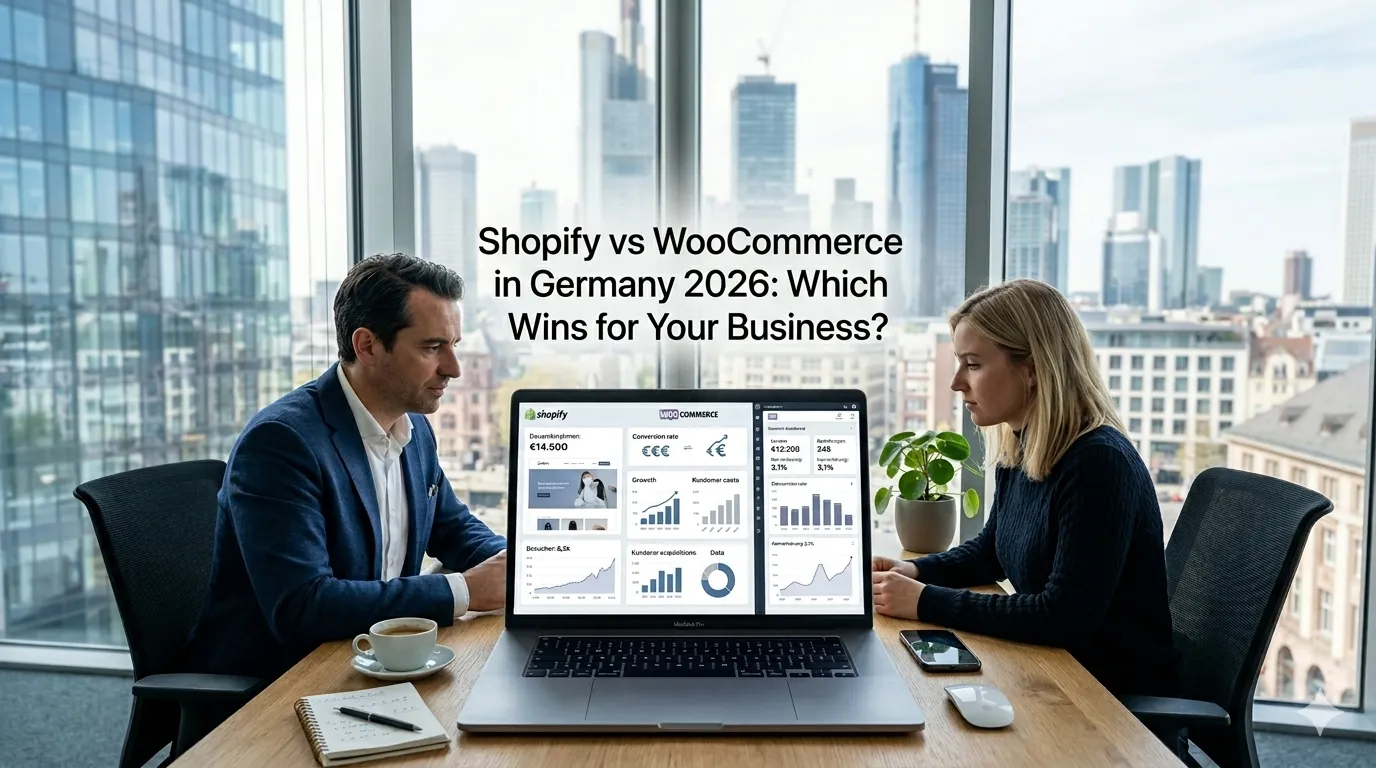
Shopify and WooCommerce are the two most common e-commerce platforms among German SMEs in 2026. Both can run a thriving German store. They differ fundamentally on hosting model, ops burden, and the kinds of brands they serve best. The wrong choice between them locks in operational costs (or operational pain) for years.
This guide walks through the honest Shopify vs WooCommerce comparison for German brands in 2026: where each wins, the real EUR TCO at each revenue stage, ops burden differences, German legal-compliance setup, and how to pick based on your team and business — not vendor marketing.
What’s the fundamental difference between Shopify and WooCommerce?
Two opposite philosophies:
Shopify
SaaS, hosted by Shopify. Monthly fee covers platform + infrastructure. No DevOps burden. Apps extend functionality (€100–€800+/month app stack). High operational simplicity, lower flexibility, high lock-in.
WooCommerce
WordPress plugin. Self-hosted (you run it on Hetzner, Mittwald, Raidboxes, IONOS, AWS Frankfurt). You’re responsible for hosting, maintenance, security, performance. Maximum flexibility, lower licensing cost, you own the data.
Shopify wins on operational simplicity. WooCommerce wins on flexibility and cost-at-scale.
When does Shopify win for a German brand?
Six scenarios:
Fast-iteration D2C brand
Shopify deploys instantly. WooCommerce needs CI/CD discipline + WordPress maintenance.
No in-house engineering
Shopify hosts and maintains everything. WooCommerce requires WordPress maintenance plan or developer hire.
Modern checkout + mobile-first
Shopify’s checkout (especially Shop Pay) converts better on mobile than typical WooCommerce checkout.
Strong app marketplace need
Shopify’s app marketplace has more polished commerce apps than WooCommerce.
Growth from €100k to €5M without rebuilding
Shopify scales smoothly on platform upgrades. WooCommerce often needs migration to better hosting around €1M revenue.
B2C with SEPA + Klarna + cards baseline
Shopify Payments + Klarna app + standard checkout covers most German D2C needs out of the box.
When does WooCommerce win for a German brand?
Six scenarios:
Content-led brand already on WordPress
Marketing site + blog + commerce in one CMS. WordPress + WooCommerce keeps content and commerce in one place.
Very small budget / lean launch
WooCommerce on Hetzner can launch for under €100/month including hosting + domain. Shopify Basic + apps + theme is €60–€250/month.
Heavy customization beyond Shopify’s limits
WooCommerce is open source — any customization is possible. Shopify customization is constrained to themes + apps + Functions.
Deep WordPress ecosystem integration
Membership + LMS + e-commerce in one site (see our membership website guide and LMS course platform guide).
Maximum data ownership
Self-hosted on German infrastructure (Hetzner, Mittwald). Full DSGVO control.
Plugin-heavy stack you already know
If your team is WordPress-fluent, WooCommerce reuses existing skills.
What’s the EUR TCO at each revenue stage?
Starter (€0–€100k revenue)
- Shopify: €180–€880/month all-in (platform + apps + agency retainer)
- WooCommerce: €60–€350/month (hosting + plugins + maintenance plan)
WooCommerce wins on cost at the starter tier.
Growth (€100k–€2M)
- Shopify: €930–€3,700/month
- WooCommerce: €350–€1,800/month (better hosting + premium plugins + agency retainer)
WooCommerce still cheaper but the gap narrows.
Scale-up (€2M–€10M)
- Shopify (Plus): €5,700–€13,300/month
- WooCommerce: €1,800–€5,500/month (managed WordPress + premium plugins + dedicated developer)
WooCommerce cheaper, but operational burden meaningfully higher.
Enterprise (€10M+)
- Shopify (Plus): €13,300–€50,000+/month
- WooCommerce: €5,500–€25,000+/month (full hosting + dev team + ops)
Both viable but the TCO gap can flip depending on team capability.
For full Shopify TCO see our Shopify cost Germany guide. For WooCommerce TCO patterns see our WordPress maintenance pricing guide.
How do they compare on German legal compliance?
Shopify
Requires apps: Germanized for Shopify (€19–€39/month), Sufio for invoices, Trusted Shops, Cookiebot/Borlabs. Total ~€100–€500/month for compliance stack.
WooCommerce
Germanized for WooCommerce plugin (free + premium tier €69–€199/year) covers most German legal requirements. PDF invoices via plugin. Trusted Shops via plugin. Cookie banner via plugin. Often cheaper compliance stack than Shopify.
See our GDPR compliance guide for context.
How do they compare on payment integrations?
Shopify
Shopify Payments (SEPA where available), Klarna app, PayPal native, Mollie app. Strong out of box.
WooCommerce
Stripe + SEPA, Mollie, PayPal, Klarna, GoCardless, Heidelpay/Unzer all available via plugins. Some require careful setup. SEPA Lastschrift specifically: see our Stripe SEPA payment integration guide.
How do they compare on performance?
Shopify
Built-in CDN, image optimization, fast checkout. Performance degrades with too many apps but generally fast by default.
WooCommerce
Performance depends entirely on hosting + theme + caching. Well-tuned WooCommerce on Hetzner CCX + WP Rocket + Cloudflare can match or exceed Shopify. Poorly-hosted WooCommerce can be dramatically slower.
How do they compare on B2B?
Shopify
B2B Plus-only. Customer-specific catalogs, draft orders, company accounts, payment terms. Mature but newer.
WooCommerce
B2B via plugins (B2BKing, WooCommerce B2B Suite, custom). Less mature than Shopify B2B Plus or Shopware B2B Suite, but flexible.
For B2B-dominant German brands, neither Shopify nor WooCommerce is the strongest fit. Shopware typically wins (see our Shopify vs Shopware Germany guide).
What about WooCommerce maintenance burden?
Real ongoing work for a WooCommerce store:
- Monthly WordPress + plugin updates — 2–8 hours
- Quarterly security audit — 4–8 hours
- Daily backups + monitoring — automated but needs verification
- PHP / MySQL major upgrades — annually, 8–24 hours
- Performance optimization — quarterly review
Most German WooCommerce stores run on a maintenance plan at €79–€499/month — see our WordPress maintenance pricing guide.
Shopify doesn’t have this burden — Shopify handles it.
How do you switch from one to the other?
WooCommerce → Shopify
6–14 weeks for a typical mid-size catalog. Product data exports cleanly. Order history imports as a one-time data load. Customer accounts require re-registration. SEO redirect strategy critical.
Shopify → WooCommerce
6–18 weeks. Product data exports cleanly. Apps need to be re-built as WooCommerce plugins or removed.
For migration framing see our Wix to WordPress migration guide.
What are common mistakes German brands make?
Picking WooCommerce for “free” then drowning in ops
License is free; hosting + plugins + dev time + agency retainer is not. Realistic minimum monthly TCO: €60–€350.
Picking Shopify then resisting paying for proper apps
Shopify’s “we’ll do it without apps” approach hits walls fast. Budget €150–€900/month for the right app stack.
Migrating to “save money” without TCO math
Migration itself costs €5,000–€60,000 + 6–18 weeks. Make sure the savings justify the migration.
Ignoring team capability
WooCommerce works for WordPress-fluent teams. Forcing WooCommerce on a non-WordPress team is painful.
When should you skip both for Shopware or custom?
- B2B-dominant business: Shopware B2B Suite. See our Shopify vs Shopware guide.
- Enterprise headless at scale: commercetools, BigCommerce Enterprise, or custom.
- Unique commerce models: custom Next.js Commerce, Medusa, Saleor.
For most German SMEs in 2026: Shopify or WooCommerce is the right answer.
Frequently Asked Questions About Shopify vs WooCommerce in Germany
Shopify for fast iteration, no in-house engineering; WooCommerce for content-led, WordPress teams, lean budgets.
WooCommerce wins at starter tier; gap narrows at growth; depends on team capability at scale-up.
Neither is — both need Germanized, EU hosting, cookie banner, consent gating, legal pages.
Yes on Hetzner/Mittwald/Raidboxes + WP Rocket + Cloudflare; Shopify wins out of the box.
Only if hitting operational limits — migration costs €5,000–€60,000 plus 6–18 weeks.
Yes — needs serious hosting, dev team, and disciplined performance optimization.
Shopware wins for B2B-dominant or German data-sovereignty needs.
Shopify marketplace larger and more polished for commerce; WooCommerce broader but variable quality.
Need help picking a platform?
If you’re weighing Shopify vs WooCommerce and want a 30-minute scoping conversation about fit for your specific business and team, book a meeting or send details via our contact page.
Need expert help? Gem Programmers provides experienced Shopify developers for businesses in Germany, Austria and Switzerland. Request a free, no-obligation quote and get a clear plan with scope, timeline and price.