
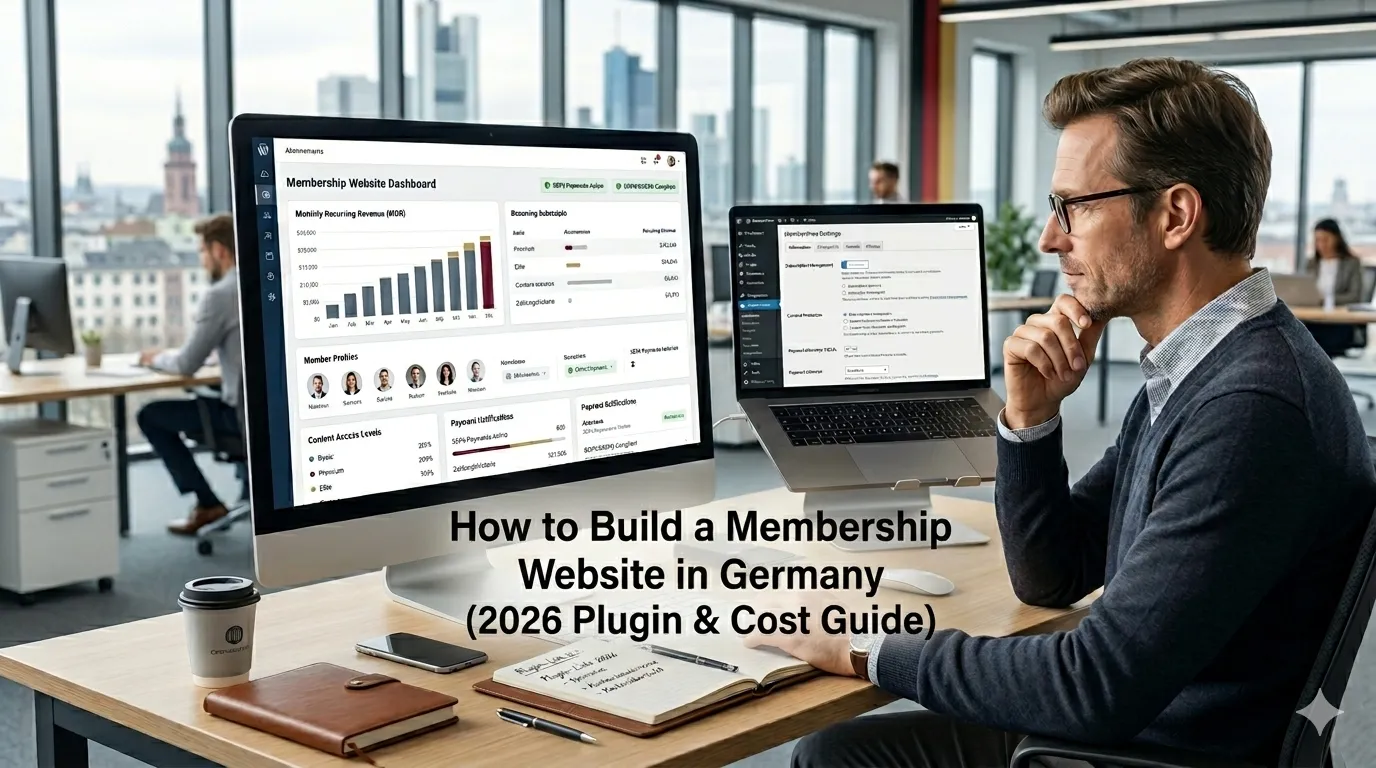
Recurring revenue beats one-off projects. Every consultancy, course creator, association, and Mittelstand B2B business in Germany figures this out eventually — and at some point, building a membership site lands on the to-do list.
The platform options seem endless: WordPress with MemberPress, Kajabi, Memberstack, Mighty Networks, Circle, Skool, Patreon, Substack, a custom build from scratch. The right answer for a German business is rarely the trendiest one — it’s the one that handles SEPA Lastschrift, German invoicing, DSGVO consent, and German-language support without compromise.
This guide walks through how to build a membership site in Germany in 2026: which platforms actually work for German payments and compliance, realistic EUR pricing, and the architectural decisions that separate a membership site that compounds for years from one that gets ripped out in 18 months.
What is a membership site, and what kinds work in Germany?
A membership site charges users — usually on a recurring monthly or annual basis — for access to content, community, services, or tools. The common types in the German market:
- Content membership — courses, video libraries, downloadable PDFs (think a German nutrition coach or marketing consultant).
- Community membership — a forum, Discord, or in-site discussion area with paid access (German Mastermind groups).
- Tool/SaaS-lite membership — calculators, templates, mini-apps behind a paywall.
- Association membership — a Verein or Berufsverband with paying members, member directories, and event access.
- Hybrid — most successful German memberships combine 2–3 of the above.
The platform you pick should match the type. A Discord-style community on a course-focused platform feels wrong. A Verein with 8,000 members on Patreon would be insane.
What are the main membership platform options for German businesses?
In 2026 the realistic landscape for German clients is:
WordPress with a membership plugin
The classic, flexible, and usually most cost-effective approach. You run a WordPress site and add a plugin like MemberPress, Paid Memberships Pro, Restrict Content Pro, or LearnDash (if courses are core).
- Pros: Own your data, full control, EU hosting straightforward, no per-member fee from the platform vendor, integrates with German payment processors and tools (Lexware, FastBill, etc.).
- Cons: You’re responsible for maintenance, security, hosting. Requires technical setup.
- Best for: Most German Mittelstand and creator businesses with 100–10,000+ members.
Kajabi
US-based all-in-one for course creators.
- Pros: Polished, all-in-one (courses, email, payments, landing pages).
- Cons: US-hosted (DSGVO requires careful AVV setup), no native SEPA Lastschrift, USD pricing, weaker German-language support, monthly fee scales aggressively.
- Best for: German creators who sell mostly in English internationally and accept the trade-offs.
Memberstack + Webflow / Next.js
Modern combo for design-led brands.
- Pros: Beautiful design freedom, modern auth, Stripe integration.
- Cons: Still requires building the frontend yourself, no out-of-the-box German invoicing, costs add up with multiple SaaS subscriptions.
- Best for: Design-conscious German SaaS or premium consultancies.
Circle / Mighty Networks / Skool
Community-led platforms.
- Pros: Best-in-class community UX, no maintenance.
- Cons: US-hosted (DSGVO complications for paid members), no German invoicing, you don’t own your member list cleanly, monthly platform fees.
- Best for: Communities where the discussion IS the product and German legal exposure is acceptable.
Custom build
For unusual requirements where off-the-shelf doesn’t fit.
- Pros: Exactly what you need.
- Cons: €40,000–€150,000+ initial cost, you maintain it forever.
- Best for: Memberships with truly unique workflows (regulated industries, complex B2B portals, large Vereine with custom needs).
For 90% of German clients we recommend WordPress + a membership plugin as the starting point. The rest of this guide focuses there.
Which WordPress membership plugin is best for a German business in 2026?
There are four serious contenders.
| Plugin | EUR Pricing (2026) | Strengths | Weaknesses |
|---|---|---|---|
| MemberPress | $179–$359/year | Mature, strong access rules, courses add-on | USD pricing, English support |
| Paid Memberships Pro | Free + €247–€597/year for add-ons | Open core, very flexible | Steeper learning curve |
| Restrict Content Pro | $99–$249/year | Clean, focused, well-coded | Smaller ecosystem |
| WooCommerce + Subscriptions | €99–€199/year | Tight WooCommerce integration, Germanized available | Subscriptions setup is complex |
For most German clients we land on MemberPress or Paid Memberships Pro. MemberPress wins on polish and access rule UI; Paid Memberships Pro wins on flexibility and price for advanced needs.
If the membership is fundamentally a course business, LearnDash or Tutor LMS plus a membership plugin works well.
What payment methods does a German membership site need to support?
Three at minimum.
Credit card (Stripe or Mollie)
The baseline. Both Stripe and Mollie handle German EUR transactions, recurring billing, and SCA cleanly. Mollie has better German-market UX for older audiences; Stripe has more developer-friendly tooling.
SEPA Lastschrift (direct debit)
Critical for the German market. A surprising share of German members — especially in the 35+ demographic — prefer SEPA Lastschrift over credit card. Both Stripe and Mollie support SEPA recurring debits with mandate handling.
PayPal
Still important in Germany, especially for first-time buyers who don’t want to share their bank details. Native to most membership plugins via PayPal Subscriptions.
Bonus options worth considering:
- Klarna Rechnung — increasingly common for annual memberships
- Sofortüberweisung — still used post-giropay sunset
- Apple Pay / Google Pay — checkout speed, especially on mobile
How does a membership site stay GDPR / DSGVO compliant in Germany?
DSGVO compliance for a membership site comes down to seven things.
Where is member data stored?
EU hosting only. Hetzner (Falkenstein, Nürnberg), Mittwald, Raidboxes, IONOS, AWS Frankfurt with a signed AVV. No US-only platforms.
What’s the legal basis for processing?
For paid members, the basis is “performance of a contract” (Article 6(1)(b)). For marketing emails to members, you need explicit Article 6(1)(a) consent. Most German membership sites separate these clearly in the signup flow.
Is the consent flow clean?
Granular consent at signup: separate checkboxes for marketing communications, third-party data sharing, and (where relevant) processing of sensitive categories. No pre-ticked boxes. Consent text version stored with each acceptance.
Are there clean export and erasure flows?
Members can download their data and request deletion. WordPress provides hooks for this, but the membership plugin and any add-ons must hook in too. Test that “request my data” actually returns all member records, not just the WordPress core ones.
Are German legal pages in place?
Impressum, Datenschutzerklärung, Widerrufsbelehrung (right of withdrawal), AGB (terms). All linked from checkout and member account pages. Widerrufsrecht for digital memberships needs careful handling — you typically need explicit acknowledgment that the member waives the 14-day right when the content is delivered immediately.
How is the invoice generated?
German invoice requirements (§14 UStG): sequential invoice number, full company details, member’s address, VAT rate breakdown, USt-ID if applicable. Plugins like Germanized for WooCommerce or PDF Invoices for MemberPress handle this — but verify outputs match what your Steuerberater accepts.
Where do recurring tax records live?
GoBD requires 10-year retention of financial records in a tamper-evident format. Pseudonymize member personal data after legal retention windows, but keep the financial record itself.
What does building a membership site in Germany actually cost?
Realistic 2026 EUR ranges.
Self-built starter
DIY on WordPress + MemberPress, basic theme, single tier:
- Domain & hosting (year 1): €60–€200
- MemberPress license: €179–$359 (~€170–€340)
- Payment processor fees: 1.4–2.9% + €0.25 per transaction
- Stock theme: €0–€80
- Total to launch: €250–€700
- Time investment: 40–120 hours of your own work
Agency-built starter (German agency)
WordPress + MemberPress + custom theme, 1–3 tiers, payment integration, basic course module:
- Discovery + design + build: €8,000–€18,000
- Ongoing maintenance: €150–€400/month
Mid-range custom membership
3–5 tiers, drip content, community add-on, German invoicing, custom onboarding:
- Build: €18,000–€45,000
- Ongoing maintenance + new features: €400–€1,200/month
Enterprise / Verein-scale
5,000+ members, custom workflows, member directory, event integration, multi-language:
- Build: €45,000–€150,000+
- Ongoing: €1,200–€4,500/month
The biggest cost driver isn’t tiers or features — it’s content production. A membership site with a thin content offering loses members faster than retention math works.
How long does it take to build a German membership site?
Realistic calendar timelines:
- DIY starter: 2–6 weeks (depends on content readiness)
- Agency starter: 4–8 weeks
- Mid-range custom: 8–16 weeks
- Enterprise / Verein: 4–9 months
The biggest schedule killer is content readiness. A platform without content is useless. Many launches stall because the agency finishes the platform and then the founder needs three more months to record the videos.
The fix: write the content first, build the platform second. Or, run them in parallel with hard weekly content deadlines.
How do you structure pricing tiers for a German membership in 2026?
Three patterns work consistently in the German market.
Single tier (simple)
One price, everything included. Works for solo creators with a focused offer. Easiest to operate, hardest to grow ARPU.
Three tiers (classic)
Basic / Pro / Premium. The middle tier is the anchor. The top tier has 1–2 high-value items (1:1 calls, in-person events). Hits diverse member willingness-to-pay.
Common German tier price points in 2026: €19 / €49 / €149 monthly or €190 / €490 / €1,490 annual.
Free + paid (freemium)
Free community access + paid course/content access. Works well for community-led products where social proof drives conversion.
A common mistake: pricing too low. The German B2B and prosumer market consistently pays €50–€200/month for high-quality, narrowly-targeted memberships. If you’re considering €9.99/month, your acquisition cost will eat you alive.
What features matter most for member retention?
After audits of dozens of German membership sites, churn comes down to four things.
Member onboarding within 7 days
If a new member doesn’t engage meaningfully in week one, they’re 4x more likely to cancel in month two. A scripted onboarding sequence (email + in-site prompts) matters more than any other feature.
A live element
Memberships with a recurring live element (weekly Q&A, monthly group call, scheduled cohorts) retain dramatically better than purely on-demand libraries.
Searchable content library
Once you have 30+ content pieces, members can’t find anything without search and structured taxonomy. Plan for this from day one.
Clear cancellation flow
Counterintuitive, but a respectful, friction-free cancellation flow correlates with lower churn over 12 months. Members who feel trapped post angrily to forums and warn others away.
What integrations does a German membership site actually need?
Six categories matter:
- Payments — Stripe, Mollie, PayPal (covered above).
- Email — ActiveCampaign, ConvertKit, Mailchimp. German-friendly: rapidmail, CleverReach (Bremen-based, DSGVO-friendly).
- Invoicing — Lexware, FastBill, sevDesk integration so invoices flow into your accounting automatically.
- CRM — HubSpot, Pipedrive, or simple CSV exports if you’re under 500 members.
- Community — Discord, Circle, or BuddyBoss embedded in WordPress.
- Analytics — Plausible (EU-hosted, no consent needed) or self-hosted Matomo. Skip Google Analytics 4 for DSGVO simplicity.
Most of these are 30-minute setups via Zapier or Make.com. The exception is invoicing — that integration is the one that should be done carefully with developer help.
What are the biggest mistakes German businesses make with membership sites?
Four mistakes dominate.
Launching with no SEPA Lastschrift option
German members WILL ask for it. Without it, you lose a meaningful slice of the addressable market — especially in the 35+ demographic.
Confusing Widerrufsrecht
The 14-day right of withdrawal for digital goods requires explicit waiver acknowledgment when content is delivered immediately. We’ve seen German memberships pulled into refund disputes because the checkout didn’t capture this correctly.
Treating the platform as the product
The platform is the container. The product is the content, community, and outcomes. Founders who obsess over plugin choice and ignore content creation always lose.
No churn data
If you can’t see your monthly churn rate, you can’t run the business. Build a simple dashboard tracking new members, churned members, MRR, and average tenure from week one.
When is a custom membership build worth it?
Rarely. The bar should be high. Custom makes sense when:
- You’re a Verein or association with 5,000+ members and specific workflows that no plugin supports
- You’re in a regulated industry where access rules are too complex for plugin permission UI
- You’re at €1M+ ARR and the platform-fee math genuinely tips toward custom
Below that, configure existing tools. Save the custom dev budget for the year you actually need it.
For more on the build vs. buy decision, see our custom WordPress plugin development guide.
Frequently Asked Questions About Building a Membership Website in Germany
€250–€700 DIY; €8,000–€18,000 agency starter; €18,000–€45,000 mid-range; €45,000+ enterprise.
MemberPress for polish; Paid Memberships Pro for flexibility; WooCommerce Subscriptions if already on WC.
Yes via Stripe or Mollie with mandate management — critical for the German market.
Germanized, PDF Invoices for MemberPress, or Lexoffice/FastBill integrations; verify with Steuerberater.
2–6 weeks DIY; 4–8 weeks agency; 8–16 weeks mid-range custom.
Possible with careful AVV/consent setup, but EU-hosted WordPress is simpler and more defensible.
€49–€199/month or €490–€1,990 annual is the sweet spot for B2B/prosumer.
Yes — German consumer law requires it; for immediate-access digital content, members must explicitly waive the 14-day right.
Ready to plan your membership site?
A membership site is one of the highest-leverage assets a German consultant, course creator, or association can build — but only if it’s set up to handle SEPA, German invoicing, DSGVO consent, and the German member experience from day one.
If you want a 30-minute scoping call where we map out the right platform, payment stack, and timeline for your specific membership idea, book a meeting or send the details via our contact page.