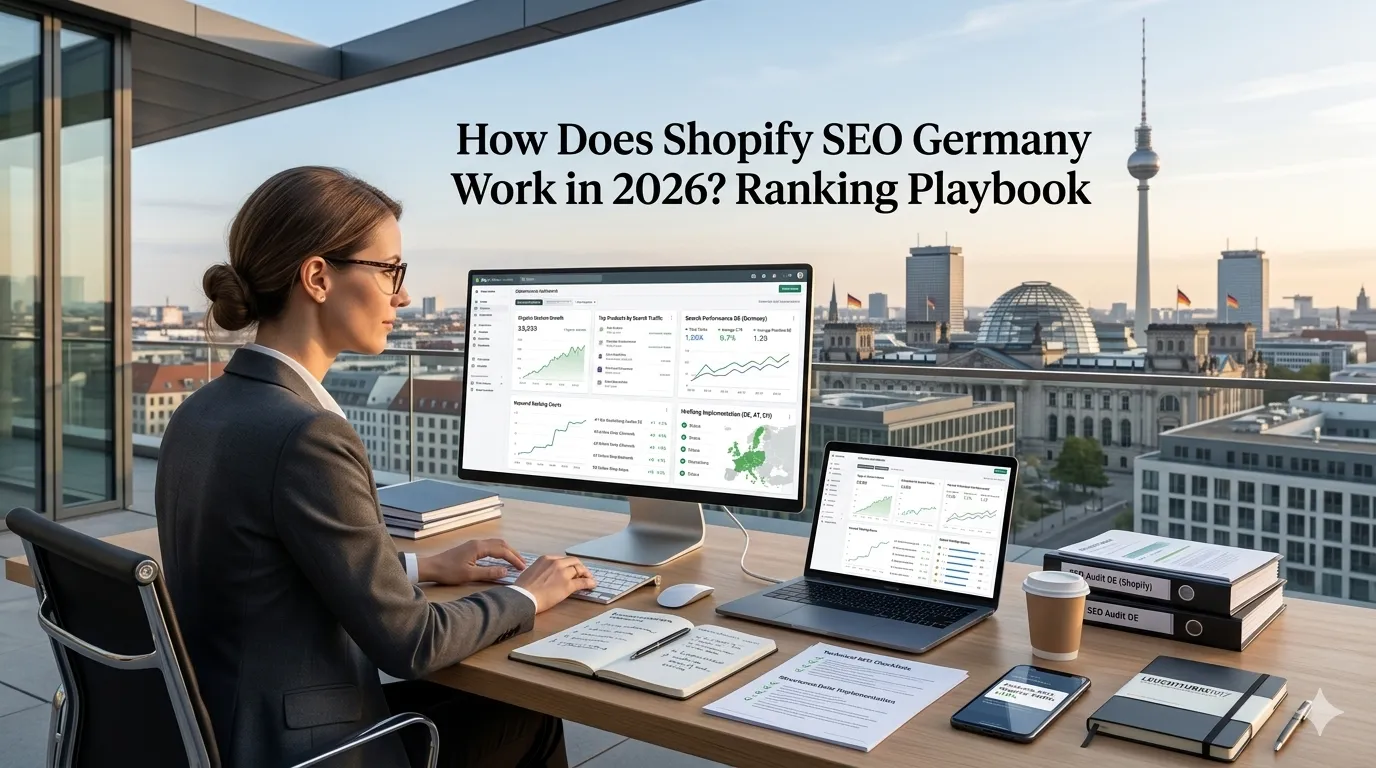
Shopify SEO Germany is increasingly competitive in 2026 — German D2C brands fight for visibility against established retailers (Otto, Amazon, Zalando), large international brands, and direct competitors. Generic “we use Yoast” advice doesn’t move the needle. Real Shopify SEO for the German market requires technical discipline, German-specific content strategy, structured data, multilingual setup if applicable, and ongoing investment.
This guide walks through what Shopify SEO Germany actually requires in 2026: technical foundations, content strategy, structured data, multilingual hreflang, Core Web Vitals’ SEO impact, and the ranking checklist that consistently moves German rankings.
What does Shopify get right and wrong for SEO out of the box?
What Shopify gets right
- Clean URL structure (/products/, /collections/, /pages/)
- Mobile-responsive themes by default
- Decent Core Web Vitals on Dawn
- Built-in sitemap.xml
- Schema.org structured data on product pages (Dawn theme)
- HTTPS by default
- CDN-served images
Where Shopify falls short / needs improvement
- Limited control over URL structure
- Some duplicate-content patterns (collection filters)
- Limited control over hreflang for multilingual
- Some auto-generated meta titles aren’t optimal
- Robot.txt not fully customizable
- 301 redirects manageable but limited at very large scale
Apps that help
- Yoast Shopify (paid, ~€29–€49/month) — meta titles, descriptions, content analysis
- SEO Manager — alternative with strong feature set
- Smart SEO — focuses on automation
- JSON-LD for SEO — extended structured data
- Schema App — Schema markup specialist
What does Shopify SEO involve in Germany in 2026?
Six core pillars:
1. Technical SEO
URL structure, meta tags, structured data, canonical tags, internal linking, page speed, mobile UX. Foundation everything else builds on.
2. On-page SEO
Product titles, descriptions, image alt text, headings (H1/H2/H3), keyword targeting, content depth.
3. Content marketing (blog + collection pages)
German-language editorial content that ranks for informational queries and drives organic traffic.
4. Backlinks / PR
German publications, magazines, blogs linking to your store. Hard to fake; valuable.
5. Local SEO (if applicable)
For brands with physical presence in German cities: Google Business Profile, local citations.
6. Monitoring + iteration
Search Console, Ahrefs/Semrush, ongoing keyword research, content updates.
What’s the German technical SEO checklist for Shopify?
12 must-haves:
URL structure
- German URLs (e.g., /collections/winterkollektion not /collections/winter-collection if German is primary)
- Trailing slash consistency
- Avoid auto-generated category URLs from filter combinations
Meta titles and descriptions
- 50–60 char title, 140–160 char description per page
- Include primary keyword + brand name
- Compelling enough to drive CTR
Structured data (Schema.org)
- Product schema with offers + reviews + availability
- BreadcrumbList schema
- Organization schema for store
- Optional: FAQ schema for FAQ content
Image alt text
Every product image has descriptive alt text in German (and EN if multilingual).
Sitemap.xml
Auto-generated by Shopify. Submit to Google Search Console.
Robots.txt
Default Shopify is fine. Customize cautiously.
hreflang for multilingual
If you serve DE + AT + CH or DE + EN: hreflang tags per page.
Canonical tags
Default Shopify handles canonical. Verify collection filter URLs are canonicalized.
Internal linking
Collection pages → product pages, related products, blog posts → product mentions.
HTTPS
Default Shopify. Don’t mix HTTP content.
Mobile-first design
Default Shopify themes are responsive. Verify on real devices.
Core Web Vitals
See our Shopify speed optimization Germany guide. LCP, INP, CLS all rank factors.
What’s the German content strategy for Shopify SEO?
Four content patterns that consistently rank:
1. Product / collection content
Product pages with depth: detailed descriptions, use cases, FAQs, related-product internal linking, customer reviews integration. 300–600 words per product, more for high-value SKUs.
2. Blog content (transactional intent)
“Wie wähle ich [Produktkategorie] aus?” “Welche [Produkt] passt zu mir?” “Beste [Produkt] für [Zweck] 2026”. Buying-intent articles that bridge to your products.
3. Blog content (informational intent)
“Was ist [Produktkonzept]?” “Wie funktioniert [Produkt]?”. Top-of-funnel content building authority and capturing search demand.
4. Category education pages
Long-form pages explaining the category in depth. Often live as Shopify pages, not blog posts. Strong internal linking from products.
What about Shopify SEO for multilingual stores?
For brands serving DE/AT/CH or DE+EN:
Shopify Markets
Manages multi-region/currency/language. Each market can have unique pricing + content.
hreflang implementation
- DE for Germany
- de-AT for Austria
- de-CH for Switzerland
- en-US (or en) for international English
Shopify automatically generates hreflang for Markets-enabled stores. Verify in Search Console.
Translation quality
Auto-translation (Weglot, Langify, Shopify Translate & Adapt) is acceptable for non-critical content. For commercial product pages: invest in professional translation.
Subfolder vs subdomain vs ccTLD
Shopify’s Markets default: subfolders (/de/, /at/, /ch/). Subdomains and ccTLDs are also possible. Subfolder is simplest and usually sufficient.
What structured data should German Shopify stores implement?
Five Schema.org types:
Product schema (most important)
Auto-included by Dawn theme. Verify includes: name, image, description, brand, offers (price, currency, availability), aggregateRating + reviews (if Trusted Shops / Judge.me integrated).
BreadcrumbList schema
Auto-included by Dawn. Verify breadcrumb structure.
Organization schema
In theme.liquid header. Includes brand name, logo, contact details, social links.
LocalBusiness schema (if physical store)
For brands with brick-and-mortar locations.
FAQ schema
For product FAQ sections. Increases SERP real estate via FAQ rich snippets.
Schema App or JSON-LD for SEO automate this if your theme doesn’t.
What are the most common Shopify SEO mistakes German brands make?
Five patterns:
Auto-generated product descriptions
Manufacturer-default descriptions used across the store. No unique value for ranking. Fix: write unique German descriptions per product.
Skipping the blog
Shopify blog is “fine” but most stores don’t use it. Missing 30–50% of organic traffic potential.
Wrong canonical for collection filters
Filtered collection URLs treated as unique pages. Causes thin-content + duplicate issues. Fix: verify canonical implementation.
Missing or broken hreflang
Multilingual store without hreflang or with errors. Google can’t tell which version to serve.
Ignoring Core Web Vitals
Slow site = ranking penalty. See our Shopify speed optimization Germany guide.
How long does SEO take to compound on Shopify?
Realistic timelines:
- New domain: 6–18 months to meaningful organic traffic
- Existing domain with redirected SEO: 2–8 weeks for rankings to recover/stabilize
- Existing well-ranked domain optimizing on-page: immediate to 8 weeks for measurable lift
SEO is a long compounding game. German stores investing consistently in content + technical SEO for 24+ months see significant traffic moats.
For broader SEO context see related guides in our SEO category (Section 4 of this content series).
When is paid SEO investment worth it?
Two clean cases:
- Mid-size brand (€500k–€5M revenue): in-house SEO + agency support combined makes sense at €1,500–€8,000/month.
- Scale-up (€5M+ revenue): dedicated in-house SEO team + technical SEO agency is justified at €8,000–€30,000+/month.
Below €500k revenue, focus on getting fundamentals right + content discipline; deep SEO investment doesn’t pay back yet.
Frequently asked questions
Unique German content, technical fundamentals, and authoritative backlinks.
Helpful but not required; alternatives or careful manual setup work.
Yes. Most brands miss 30 to 50 percent of organic traffic by skipping it.
Both rank well; content and links matter more than the platform.
Shopify Markets plus hreflang, subfolder structure, professional translation for commercial pages.
Product, review, breadcrumb, and FAQ schema are the foundation.
Yes; add 200 to 400 word collection intros explaining the category.
Trust default canonicals, verify filter URLs, no-index thin tag pages.
Need help with Shopify SEO?
If you’re auditing or scoping Shopify SEO for your German store and want a 30-minute scoping conversation about technical SEO, content strategy, or hreflang setup, book a meeting or send details via our contact page.
Need expert help? Gem Programmers provides Shopify development services for businesses in Germany, Austria and Switzerland. Request a free, no-obligation quote and get a clear plan with scope, timeline and price.