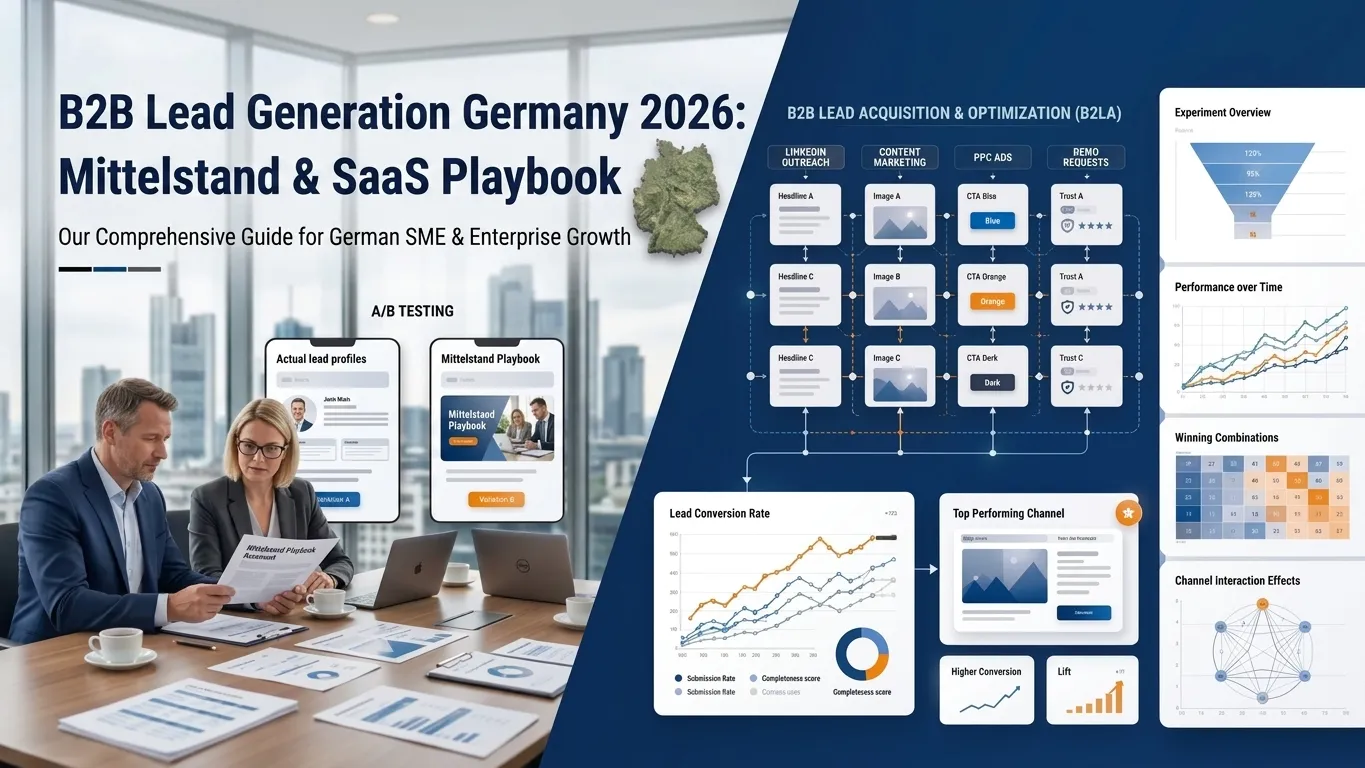
B2B lead generation in Germany is harder than in the US — longer cycles, more deliberate buyers, stricter regulation, higher trust requirements. It’s also more rewarding when done well. The Mittelstand company that builds a predictable lead-gen engine sees compounding pipeline that outlasts marketing trends. The B2B SaaS that masters DACH lead generation grows faster than competitors stuck in US-only playbooks.
This guide covers what works for B2B lead generation in Germany 2026: the channels, the conversion paths, the qualification frameworks, the CRM integration, and the compliance requirements. Whether you’re an early-stage SaaS building your first pipeline or a mature Mittelstand looking to systematize, the principles below apply.
What does B2B lead generation actually include
B2B lead generation in 2026 spans many overlapping activities. The full scope:
Inbound (prospects come to you):
- Organic search (SEO)
- Content marketing (blog, video, podcast, webinars)
- Paid search ads (Google, Bing)
- Paid social ads (LinkedIn, Meta, TikTok)
- Direct/branded traffic from awareness
- Referral traffic from partners and integrations
Outbound (you go to prospects):
- Cold email outreach (compliance-sensitive in Germany)
- LinkedIn outreach via Sales Navigator
- Cold calling (still effective in Mittelstand)
- Direct mail (rising again for ABM)
- Conference and event prospecting
Partner-led:
- Channel partnerships
- Co-marketing with complementary businesses
- Integration ecosystem leads (e.g., Shopify Plus partner program)
- Referral programs with customers and partners
Account-based marketing (ABM):
- Target named accounts
- Coordinated marketing + sales touchpoints
- Personalized campaigns and content
- High-touch enterprise programs
Event-based:
- Webinars (virtual)
- Trade shows and industry events
- Roundtables and dinners
- Workshops and training events
The reality for German Mittelstand: a healthy lead-gen program runs 4-6 channels simultaneously, with one or two dominant. Single-channel dependence creates fragility. Diversified channels create resilience.
For broader context, see our digital marketing services Germany guide and performance marketing Germany guide.
What does the German B2B buying journey look like?
German B2B buyers move through predictable stages, but slower and more deliberately than US counterparts:
Stage 1: Problem awareness (typically 1-4 months)
- Buyer recognizes business problem
- Internal discussions about whether to solve
- Initial research about category
- Light engagement with thought-leadership content
- Not yet identifying as a buyer
2: Solution research (1-3 months)
- Buyer investigates solution categories
- Reads industry guides, comparison content
- Identifies 5-10 potential vendors
- Joins newsletters, downloads whitepapers
- Becomes a known lead but not yet sales-ready
3: Vendor evaluation (1-3 months)
- Buyer creates short list of 3-5 vendors
- Detailed feature comparison
- Requests demos, references, pricing
- Engages internal stakeholders
- Now identifies as MQL → SQL
4: Decision and procurement (1-2 months)
- Final 2-3 vendor selection
- ROI justification with finance/leadership
- Procurement and legal review
- Contract negotiation
- Closes as customer
Total German B2B sales cycle: 4-12 months typical for €10K+ ACV. Longer for enterprise. Shorter for SMB/freelancer-focused products.
Implications for lead generation:
- Top-of-funnel content captures Stage 1-2 buyers
- Mid-funnel content nurtures Stage 2-3
- Bottom-funnel content + sales touchpoints convert Stage 3-4
- Cycle length means you need pipeline 4-12 months ahead of revenue targets
- Cannot “turn on” lead gen for immediate Q1 revenue impact
What channels generate the best B2B leads in Germany?
Ranked by typical ROI for German B2B Mittelstand and SaaS in 2026:
1. SEO and content marketing:
- Highest long-term ROI for in-market intent
- Slow to start (6-12 months to meaningful traffic)
- Compounding effect over years
- See our SEO services Germany guide and content marketing strategy Germany guide
2. LinkedIn (organic + paid):
- Dominant B2B channel in DACH
- Organic founder/team thought leadership
- Paid Sponsored Content and Lead Gen Forms
- ABM via Sales Navigator + paid
- See our LinkedIn Ads B2B Germany guide
3. Google Ads (search):
- Highest-intent capture
- Fast to revenue
- See our Google Ads management Germany guide
4. Webinars and virtual events:
- Strong B2B lead capture
- Educational positioning
- Direct sales handoff opportunity
- See our forthcoming webinar marketing Germany guide
5. Email marketing and automation:
- Nurture for long sales cycles
- See our email marketing Germany DSGVO guide and marketing automation Germany guide
6. Partner-led lead gen:
- Integration partnerships
- Channel partnerships
- Co-marketing
- Often overlooked but high-ROI
7. Industry events and conferences:
- Trade shows in DACH (CeBIT successor events, dmexco, OMR, etc.)
- Roundtables and dinner events
- Speaking opportunities
8. Outbound (cold outreach):
- Compliance-sensitive in Germany
- Effective when well-targeted and personalized
- Less effective than 5 years ago
9. ABM for enterprise:
- High-touch, expensive
- High conversion when right-targeted
- See our forthcoming account-based marketing ABM Germany guide
Multi-channel reality: most German B2B reaches its targets through 4-6 channels working together. Pure single-channel programs hit ceilings within 2-3 years.
What conversion offers work for German B2B?
The “lead magnet” or conversion offer determines who fills out the form. Different offers attract different lead qualities.
Top-of-funnel offers (broad reach, lower commitment):
- Newsletter subscription
- Industry guide / ebook
- Industry report
- Free assessment / audit tool
- Comparison content download
Typical conversion rates: 15-40% (high) but lower lead quality, longer nurture.
Mid-funnel offers (educational engagement):
- Webinar registration
- Case study deep-dive
- ROI calculator / business case template
- Workshop / training program
- Industry benchmark report (gated)
Typical conversion rates: 5-15%, moderate lead quality.
Bottom-funnel offers (sales-ready commitment):
- Demo request
- Consultation / strategy call
- Free pilot / trial
- Audit / assessment with deliverable
- “Talk to expert” inquiry
Typical conversion rates: 1-5%, but high lead quality and short cycles.
The right mix: have offers at all three levels. Top-funnel for building list. Mid-funnel for nurturing through long cycle. Bottom-funnel for capturing in-market buyers.
Common mistakes:
- Only having bottom-funnel offers (“Contact us / Demo”) — misses Stage 1-2 buyers
- Only having top-funnel offers (newsletter, whitepapers) — no direct path to sales
- Generic offers that don’t match audience pain
- Over-gating content (too many fields scares off buyers)
How do you qualify B2B leads?
Lead qualification frameworks help prioritize sales attention. Common frameworks:
BANT (Budget, Authority, Need, Timing):
- Classic but increasingly outdated
- Asks too directly about budget and authority early
- Works for shorter B2B cycles
MEDDIC (Metrics, Economic buyer, Decision criteria, Decision process, Identify pain, Champion):
- Enterprise sales framework
- Detailed qualification across multiple dimensions
- Best for €25K+ ACV B2B
ChAMP (Challenges, Authority, Money, Prioritization):
- More buyer-centric than BANT
- Starts with challenges (the buyer’s problem)
- Works well for Mittelstand B2B
FAINT (Funds, Authority, Interest, Need, Timing):
- B2B SaaS variant
- Subscription-oriented framing
- Common in SaaS sales orgs
Modern approach (signal-based qualification):
- Score leads on behavioral signals (page views, content consumed, demo viewed)
- Augment with firmographic data (company size, industry, geography)
- Score evolution over time (recency matters)
- Hand off to sales at threshold
MQL → SQL handoff criteria for German Mittelstand B2B:
- ICP match (industry, company size, region)
- Demonstrated interest (demo request, multiple content downloads, pricing page visits)
- Engagement quality (replies to nurture emails, attended webinar)
- Optional: explicit qualification questions on form (job title, company size, timeline)
The handoff between marketing and sales is where most B2B lead-gen programs break. Marketing sends leads they think are good; sales rejects most as not qualified. Spend time aligning on definitions and reviewing the handoff weekly during the first 6 months of a program.
What CRM and operational infrastructure does German B2B need?
CRM:
- HubSpot, Salesforce, or Pipedrive
- All contacts and companies tracked
- Lead source attribution
- Lead status / lifecycle stage tracking
- Sales pipeline management
- Deal forecasting
Marketing automation:
- Email nurture sequences
- Lead scoring
- Behavior tracking
- Sales notification automation
- See our marketing automation Germany guide
Sales engagement platform (for larger programs):
- Outreach, Salesloft, Apollo
- Multi-touch outbound sequences
- Cadence management
- Call recording and analysis
Analytics and attribution:
- GA4 with server-side tracking
- HubSpot or Salesforce attribution reports
- Marketing-sourced pipeline reporting
- See our forthcoming marketing analytics attribution Germany guide
Data enrichment:
- ZoomInfo, Cognism, Clearbit, Lusha
- Enrich contact data automatically
- Compliance considerations for DACH (some vendors stronger than others)
Calendar and meeting tools:
- Calendly, Chili Piper, HubSpot Meetings
- Reduce friction in booking sales calls
- Round-robin routing for SDR teams
Documentation and proposals:
- PandaDoc, DocuSign, Adobe Sign
- E-signature for contracts
- Proposal automation
Total infrastructure investment: typically €30K-€150K/year for Mittelstand B2B serious about lead gen. Bigger investment pays back through sales productivity gains.
What’s the realistic CAC and pipeline for German B2B?
Cost-per-lead (CPL) by channel:
- SEO/Content (long-term avg): €30-€150 per MQL
- LinkedIn Ads: €60-€200 per MQL
- Google Ads (B2B): €40-€250 per MQL
- Webinars: €40-€150 per MQL
- Cold outbound: €30-€150 per booked meeting (varies wildly by execution)
- Email nurture (from existing list): near-zero marginal cost
MQL → SQL → Opportunity conversion:
- MQL → SQL: 15-40% typical
- SQL → Opportunity: 30-60% typical
- Opportunity → Closed-won: 15-30% typical
End-to-end conversion:
- MQL → Customer: 1-10% typical
- Implication: 100 MQLs typically yield 1-10 customers
CAC by ACV tier:
- SMB B2B (€1-5K ACV): €300-€1,500 CAC
- Mid-market B2B (€5-25K ACV): €1,500-€8,000 CAC
- Enterprise B2B (€25K+ ACV): €5,000-€50,000+ CAC
LTV:CAC target: 3:1 minimum, 5:1+ healthy
Pipeline coverage: need 3-5x pipeline coverage vs target (i.e., €5M pipeline to close €1M in quarter)
For detailed cost benchmarks, see our digital marketing cost Germany 2026 guide.
How does DSGVO affect B2B lead generation in Germany?
DSGVO impacts every aspect of B2B lead gen:
Form data collection:
- Specific consent for marketing communications
- Granular consent (newsletter, demos, partner offers separately)
- Privacy policy linked at every form
- Pre-checked boxes not compliant
Cold outreach:
- Email: typically requires opt-in or strong legitimate interest basis
- LinkedIn: messages still permissible; InMail compliance simpler
- Phone: legal for B2B but UWG considerations apply
- Cold outbound at scale increasingly difficult under DSGVO
Data enrichment vendors:
- Verify vendor compliance basis for their data
- ZoomInfo, Cognism, Apollo, etc. vary in DACH compliance posture
- Document basis for using enriched data
- Privacy policy must disclose data sources
Lead nurture:
- Marketing emails require consent (DOI standard)
- Easy unsubscribe in every email
- Suppression lists maintained
CRM and data retention:
- Document data retention periods
- Automated deletion for unengaged contacts
- Right to deletion process documented
- Right to access process documented
Vendor agreements:
- AVV with CRM, marketing automation, enrichment, every tool processing data
- Standard Contractual Clauses for non-EU vendors
- Documented in Verzeichnis von Verarbeitungstätigkeiten
For tracking compliance, see our server-side tracking Germany guide.
What KPIs matter for B2B lead generation in Germany?
Top-line:
- Marketing-sourced pipeline (€)
- Marketing-sourced closed-won revenue (€)
- CAC by channel
- LTV:CAC ratio
- Payback period
Volume:
- MQLs per month by channel
- SQLs per month
- Opportunities created per month
- Lead-to-customer conversion rate
Quality:
- MQL → SQL acceptance rate (sales lead acceptance)
- Average deal size by lead source
- Sales cycle length by lead source
- Win rate by lead source
Channel-specific:
- CPL by channel
- Cost per qualified lead (CQL) by channel
- Cost per opportunity by channel
- ROI by channel (revenue ÷ spend)
Operational:
- Time to MQL (from first touch to qualified)
- Time MQL → SQL → Opportunity → Closed
- SDR meetings booked per rep per week
- Pipeline coverage vs target
Frequently asked questions about B2B lead generation Germany
Inbound first (compounds + DSGVO-friendly). Outbound layered for acceleration.
Strict MQL definition + scoring threshold + weekly sales feedback loop.
SaaS: 1 SDR per 200–300 MQLs/month. Enterprise: 1 SDR per 50–100 strategic accounts.
Cold email risky. Use LinkedIn outreach, B2B phone (UWG with care), or warm referrals.
Significant. Virtual webinars + 2–4 in-person events/year. €30K–€150K/year budget.
Paid: weeks. Content/SEO: 6–12 mo. Outbound: 1–3 mo. ABM: 6–18 mo. Multi-channel scaled: 9–12 mo.
For €25K+ ACV: yes. Identifies active-research accounts. €20K–€80K/year for serious programs.
Rising fast. AEO/GEO content. Plan for AI-mediated discovery as primary by 2027–2028.
Ready to build or scale your B2B lead generation in Germany?
B2B lead generation in Germany rewards patience, integration across channels, and rigor in execution. The companies winning aren’t running the most clever single campaign — they’re operating systematic multi-channel programs with sophisticated CRM/automation infrastructure, qualified handoff to sales, and compounding owned audience.
Book a meeting for a free B2B lead gen audit where we’ll review your current channels, conversion rates, MQL definitions, and recommend the top 3 improvements for the next 90 days. Or browse our digital marketing services and contact us to discuss a B2B lead generation engagement.