
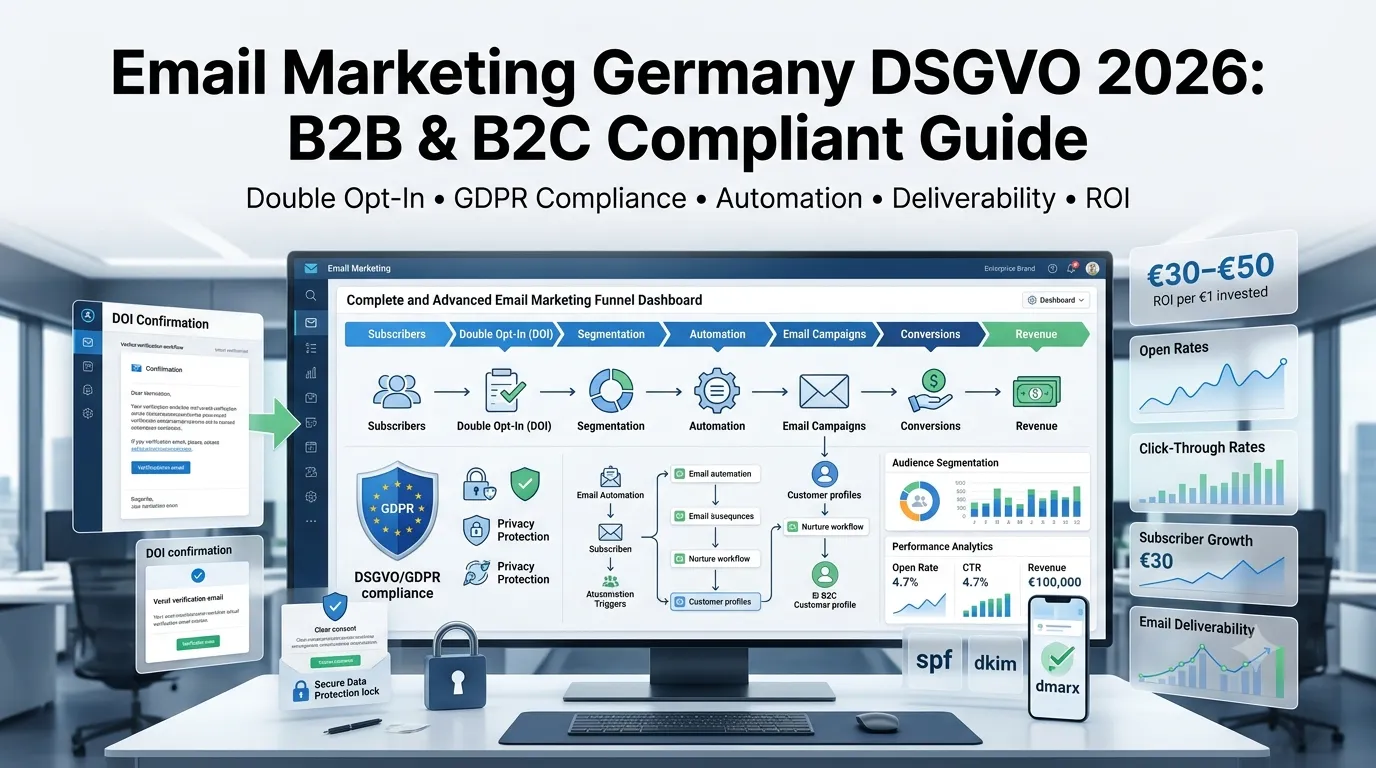
Email marketing germany remains the highest-ROI channel for owned audience engagement — typically €30–€50 returned per €1 invested for German Mittelstand programs. While social and paid channels rise and fall with algorithm changes and CPM inflation, your email list is yours forever. Subscribers chose you. They consented to hear from you. They’re 3–10x more likely to convert than cold traffic.
But email marketing in Germany operates under some of the strictest regulatory frameworks in the world: DSGVO (data protection), UWG (unfair competition law), TTDSG (telemedia), and BGB (civil code for consumer rights). Sending email in Germany without proper consent and infrastructure isn’t just unethical — it’s actionable. Abmahnung from competitors, fines from Datenschutzbehörden, and ISP delivery blacklisting are real risks. This guide explains how to build a high-performing, DSGVO-compliant email marketing program for the German market.
What does DSGVO require for email marketing in Germany?
The core requirements for sending marketing email in Germany:
1. Double opt-in (DOI):
- User submits email address (opt-in 1)
- System sends confirmation email with link
- User clicks confirmation link (opt-in 2)
- Only then can you send marketing emails
DOI is not technically required by DSGVO directly but is the accepted standard for proving consent under UWG § 7 Abs. 2 Nr. 3. Without DOI, your consent basis is shaky and a competitor’s Abmahnung often succeeds.
2. Granular consent:
- Separate opt-ins for marketing, transactional, partner offers
- “Bundling” different types of consent into one checkbox is not compliant
- Pre-checked boxes are not compliant (must be active opt-in)
3. Privacy policy and Impressum:
- Privacy policy linked in signup form and every email
- Impressum visible on confirmation page and in email footer
- Clear description of what subscriber will receive
4. Easy unsubscribe:
- Visible link in every email (typically footer)
- One-click unsubscribe (RFC 8058 List-Unsubscribe header)
- No login required to unsubscribe
- Effective within 30 days max (typically within hours)
5. Documentation:
- Consent records: timestamp, IP address, source, double opt-in confirmation
- AVV with your email service provider (ESP)
- Listed in Verzeichnis von Verarbeitungstätigkeiten
- Privacy policy specific to email data flows
6. Sender authentication:
- SPF, DKIM, DMARC records configured
- BIMI for additional brand visibility (optional)
- Without these, deliverability suffers and ISP block risk rises
7. Content compliance:
- No misleading subject lines
- Sender clearly identifiable
- Footer with company info (Impressum requirements)
- Marketing content clearly labeled when in B2B context
The compliance overhead is real but absolutely manageable. The reward: an email marketing program that’s both legal and high-performing.
For broader context, see our digital marketing services Germany guide and marketing automation Germany guide (forthcoming).
What ESP (email service provider) should German businesses use?
The major email service providers serving German market in 2026:
ActiveCampaign:
- Strong automation capabilities
- Good German support
- Pricing: €30-€500+/month based on contacts
- Best for: SMB and Mittelstand with automation focus
Brevo (formerly Sendinblue):
- French/European company, DSGVO-friendly posture
- Includes SMS, WhatsApp, transactional email
- Pricing: €25-€500+/month based on volume
- Best for: SMB Mittelstand, multilingual European audiences
HubSpot Marketing Hub:
- Integrated with HubSpot CRM
- Strong B2B features
- Pricing: €50-€3,600+/month based on contacts and tier
- Best for: B2B sales-led organizations
Klaviyo:
- E-commerce specialist
- Best Shopify/WooCommerce integrations
- Pricing: €30-€2,000+/month based on contacts
- Best for: E-commerce DTC and Mittelstand retail
Mailchimp:
- Most well-known SMB ESP
- Decent German support
- Pricing: €15-€350+/month
- Best for: smallest businesses; less impressive at scale
rapidmail / CleverReach (German ESPs):
- German companies with German servers
- Strong DSGVO posture
- Pricing: €15-€200+/month
- Best for: German-only businesses prioritizing local hosting
Customer.io / Iterable / Braze (enterprise):
- High-end automation platforms
- Strong for product-led B2B SaaS
- Pricing: €1,000-€10,000+/month
- Best for: scaling SaaS and enterprise
Selection criteria:
- Volume: contacts and emails per month
- Integration with CRM and other tools
- Automation capabilities
- German support and German servers (where required by data residency)
- Compliance features (consent tracking, GDPR tooling)
- Deliverability rates
For ESP comparison detail, see our HubSpot vs ActiveCampaign vs Brevo Germany guide (forthcoming).
What email types should German businesses send?
Transactional emails (one-to-one, triggered by user action):
- Welcome emails after signup
- Order confirmations
- Shipping notifications
- Password resets
- Account changes
- These don’t require marketing consent — they fulfill the user’s request
Newsletter emails (one-to-many, scheduled):
- Weekly or bi-weekly company updates
- Industry insights
- Curated content
- Product announcements
- Require marketing consent (DOI)
Drip campaigns / Nurture sequences (one-to-one, time-based):
- Onboarding sequences after signup
- Lead nurture for B2B sales cycles
- Customer education sequences
- Win-back sequences for lapsed customers
- Require marketing consent
Behavioral / Triggered emails (one-to-one, based on action):
- Cart abandonment emails
- Browse abandonment emails
- Birthday emails
- Anniversary emails
- Lifecycle-stage triggered emails
- Require marketing consent
Promotional emails (one-to-many, time-sensitive):
- Sale announcements
- Discount codes
- Limited-time offers
- New product launches
- Require marketing consent
Re-engagement campaigns (targeted, one-to-many):
- Reactivate dormant subscribers
- “We miss you” campaigns
- Sunset sequences for unengaged subscribers
- Critical for list hygiene
What’s the right email frequency for German subscribers?
German subscribers tolerate less frequency than US subscribers. Typical sustainable frequencies:
B2C consumer brands:
- Weekly newsletter: optimal for engaged audiences
- 2x weekly: works for high-engagement brands (fashion, food, lifestyle)
- 3x+ weekly: risk of unsubscribe spike unless content is genuinely useful
B2B services and SaaS:
- Bi-weekly: standard cadence
- Weekly: for actively-engaged B2B audiences
- Monthly: minimum to maintain mindshare
E-commerce:
- Weekly newsletter + behavioral triggers
- Promotional emails for major sales (Black Friday, etc.)
- 2-4 total emails per week common in retail
Indicators you’re sending too often:
- Unsubscribe rate >0.5% per email
- Spam complaint rate >0.1%
- Open rate decline week-over-week
- Negative survey responses
Indicators you’re sending too rarely:
- Open rates declining due to lost familiarity
- List churn from inactivity-based unsubscribes
- Low revenue per subscriber compared to industry benchmarks
Best practice: let subscribers self-select frequency. “Receive weekly / monthly / occasional” preference selector at signup or in email preferences. Respecting frequency preferences reduces unsubscribes and improves engagement.
What email content works for German audiences?
Subject line principles:
- 30-50 characters optimal (mobile preview)
- No clickbait or misleading subjects (UWG compliance + trust)
- Specific over generic (“3 LinkedIn-Strategien für DACH B2B” beats “Marketing-Tipps”)
- Personalization where genuinely relevant (avoid forced first-name use)
- No spam-trigger words (avoid “kostenlos!!!”, “Garantie!!!”, excessive caps)
- A/B test subject lines for important campaigns
Body content principles:
- One primary message per email
- Clear value proposition in first 100 words
- Sie-form for B2B; Du-form for B2C and creative audiences (consistent with brand voice)
- German-language native (translation rarely works for European audiences)
- Mobile-first design (60%+ open on mobile)
- Visual hierarchy (headers, short paragraphs, scannable structure)
- Clear single CTA per email (avoid multiple competing CTAs)
Personalization beyond first name:
- Send time optimization (when each subscriber typically engages)
- Content personalization by segment (industry, role, behavior)
- Product recommendation based on purchase history (e-commerce)
- Behavioral triggers (visited specific page, didn’t complete signup, etc.)
Design considerations:
- Responsive design (mobile + desktop + dark mode)
- 600-700px max width
- Plain text alternative to HTML
- Image-to-text ratio: at least 60% text (spam filter consideration)
- Branded but not over-designed
- Accessible (alt text on images, semantic structure)
Common content patterns that work:
- Industry insight + actionable tip
- Customer success story
- Product/feature announcement with context
- Curated content roundup
- Founder/expert personal letter
- Survey or feedback request
- Webinar/event invitation
How do you build a B2C email list in Germany?
Tactics that work for German B2C list building:
1. Welcome discount/incentive:
- 10-15% off first order for newsletter signup
- Concrete value, immediate use
- Most common B2C tactic in Germany
2. Content lead magnets:
- Free guide, checklist, calculator
- Specific to audience pain point
- Higher-quality leads than discount-driven
3. Exit-intent popups:
- Trigger when user about to leave
- Offer relevant incentive
- Often 5-10% conversion rate to email
4. Embedded forms:
- Inline forms in blog content
- Footer signup boxes
- Account creation flows
5. Social media to email:
- “Subscribe for [benefit]” link in bio
- Lead Gen Forms on Meta and LinkedIn
- Twitter/X newsletter integration
6. Webinars and events:
- Webinar registration → email list
- Live event RSVP → ongoing email
- High-intent signups
7. Referral programs:
- Existing subscribers refer friends
- “Give 10€, get 10€” Friend-referral
- Compliance: referred friend must DOI
Avoid:
- Buying email lists (illegal in Germany, severe Abmahnung risk)
- Email scraping
- Pre-checked consent boxes
- “Auto-subscribe” from purchase (must be explicit)
How do you build a B2B email list in Germany?
B2B list building tactics:
1. Gated content downloads:
- Whitepapers, eBooks, research reports
- Email + role + company size as minimum form fields
- Higher commitment = higher-quality lead
2. Webinar registration:
- Live webinars with industry expert
- 30-45 minutes optimal length
- Generates email + role + company info
3. Newsletter signup as standalone offer:
- “Get weekly insights for [audience]” value prop
- Less commitment than gated content
- Larger volume, lower quality leads
4. Free tool or calculator:
- ROI calculator, assessment quiz, benchmark tool
- Lead capture before delivering result
- High-intent, business-context leads
5. LinkedIn Lead Gen Forms:
- Native LinkedIn forms with pre-filled data
- Lower friction than website forms
- See our LinkedIn Ads B2B Germany guide
6. Sales-team-driven:
- Sales reps add prospects to email nurture (with consent)
- Trade show / event lead capture
- Direct outreach with explicit opt-in
7. Partnership co-marketing:
- Joint webinars or content with partners
- Shared audiences with mutual consent
- DSGVO-compliant data sharing agreements
B2B-specific compliance considerations:
- B2B email can sometimes operate under “legitimate interest” basis (more flexible than B2C)
- Existing business relationship establishes some consent latitude
- Even for B2B, DOI is best practice and removes Abmahnung risk
- Cold B2B outreach is increasingly restricted under DSGVO
What’s the typical email marketing budget in Germany?
ESP cost:
- SMB (5K-25K contacts): €30-€500/month
- Mittelstand (25K-250K contacts): €200-€3,000/month
- Enterprise (250K+ contacts): €2,000-€15,000+/month
Email design and content production:
- In-house: 1-3 hours per email (€60-€300 fully loaded)
- Outsourced: €100-€500 per email
- Templates and automation reduce per-email cost dramatically
Strategy and management:
- In-house specialist: €58K-€97K fully loaded annually
- Agency: €2,500-€8,000/month for managed program
- Freelancer: €800-€3,000/month for smaller programs
Total annual email marketing investment for Mittelstand: typically €30K-€120K/year for serious program (ESP + production + management). ROI typically 10-40x for healthy programs.
How do you measure email marketing performance?
Top-line KPIs:
- Email-attributed revenue (€)
- Email-influenced revenue (including longer attribution windows)
- Revenue per subscriber (RPS)
- List growth rate (net adds vs churn)
Engagement KPIs:
- Open rate (target: 18-30% for B2B; 15-25% for B2C — varies by industry)
- Click-through rate (CTR) (target: 2-5% for B2B; 1-3% for B2C)
- Click-to-open rate (CTOR) (target: 10-20%)
- Conversion rate from email click
List health KPIs:
- Unsubscribe rate (target: <0.5% per email)
- Spam complaint rate (target: <0.1%)
- Bounce rate (target: <2%)
- Subscriber engagement (% who opened in last 90 days)
Compliance KPIs:
- DOI completion rate (% who confirm after initial signup)
- Time to unsubscribe (should be near-instant)
- Privacy request response time (<30 days)
Diagnostic:
- Send time optimization (when subscribers engage most)
- Subject line performance (A/B test learnings)
- Device breakdown (mobile vs desktop opens)
- Email client breakdown (Gmail, Outlook, Apple Mail)
Frequently asked questions about email marketing Germany DSGVO
Existing customers under § 7 Abs. 3 UWG: yes for similar offers with easy opt-out. DOI safer overall.
B2C: simpler. B2B: more friction produces better leads. Don’t add friction without purpose.
SPF/DKIM/DMARC + consistent sender + IP warm-up + low complaints + monitor Postmaster/Sender Score.
Not required. EU-hosted with AVV is fine. German-hosted (rapidmail, CleverReach) optional comfort.
Complementary. Email for content + reach. WhatsApp for transactional + conversational. Separate opt-ins.
€30–€50 per €1 invested for mature programs. Highest ROI of any digital channel.
One-click, no login, no friction. Immediate removal. Permanent suppression. RFC 8058 List-Unsubscribe.
No. Consent must originate with the subscriber. DOI to purchased addresses violates anyway.
Ready to build or scale your German email marketing program?
Email marketing is the highest-ROI owned channel in your marketing stack. Done with DSGVO compliance, German-native content, intelligent automation, and disciplined list hygiene, it compounds revenue for years. The companies winning email in 2026 invested in infrastructure 1-2 years ago.
Book a meeting for a free email marketing audit where we’ll review your current ESP, automation, list health, and compliance posture to identify the top 5 improvements. Or browse our digital marketing services and contact us to discuss a custom engagement.