Digital marketing in Germany is not the same as digital marketing in the US or UK. The regulatory environment is stricter (DSGVO, TTDSG, UWG), the buyer behavior is more deliberate (Mittelstand decision cycles often run 6–12 months for B2B), the channel mix is different (LinkedIn dominates B2B, WhatsApp Business is rising, TikTok is finally maturing), and the trust threshold is higher than almost any major market. Tactics that work in California fail spectacularly in Bavaria.
This guide is the foundation document for our digital marketing services. We cover what digital marketing actually means for German businesses in 2026, how the channels fit together, what realistic budgets look like, and how to evaluate whether you need an in-house team, an agency, or a hybrid. Whether you run a 50-person Mittelstand manufacturer, a Berlin SaaS startup, or a D2C e-commerce brand, the principles below apply.
What does “digital marketing” actually cover for a German business?
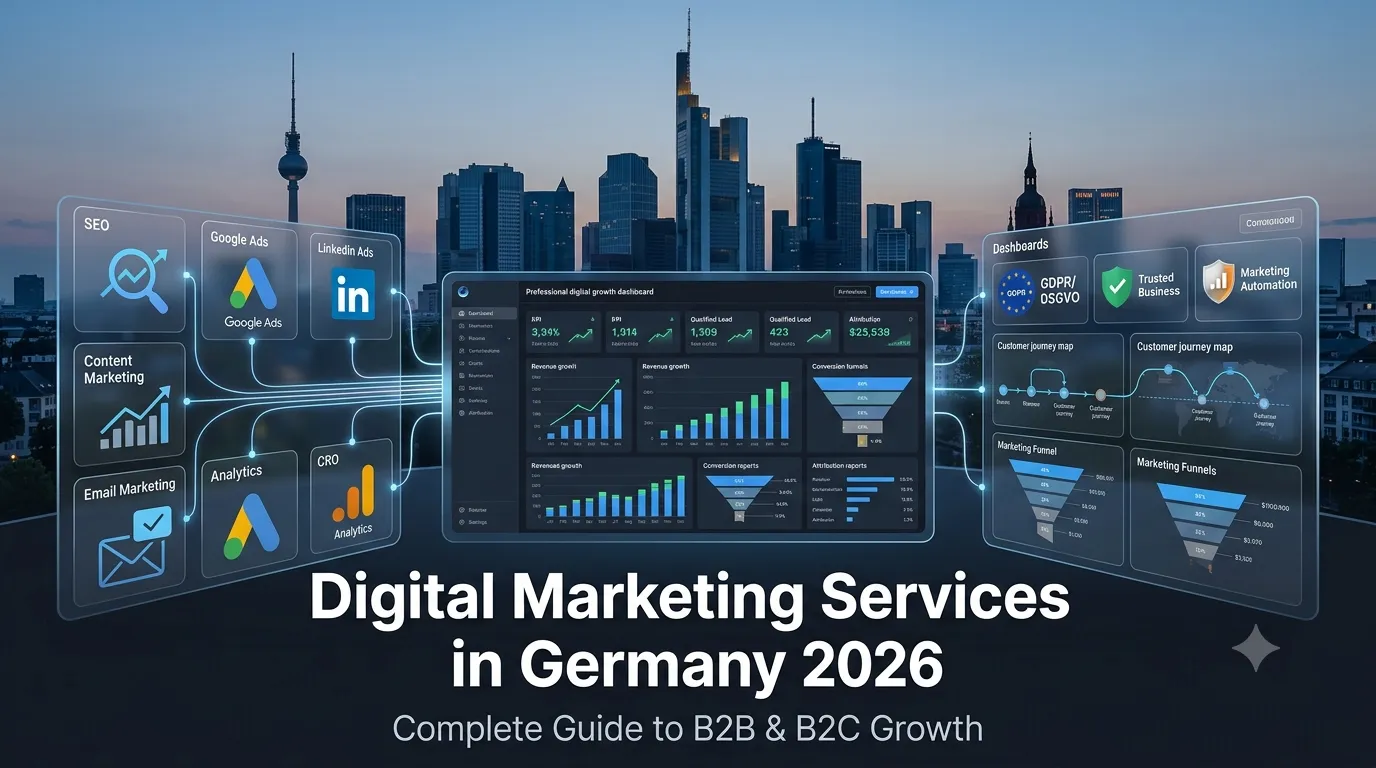
Digital marketing is the umbrella term for every paid, owned, and earned channel that drives qualified traffic and revenue through digital touchpoints. In the German market, the typical scope spans:
- Paid acquisition: Google Ads, Meta Ads (Facebook, Instagram), LinkedIn Ads for B2B, TikTok, YouTube, programmatic display, native advertising
- Organic search (SEO): technical SEO, content SEO, local SEO, multilingual DACH SEO
- Content marketing: blogs, whitepapers, case studies, video, podcast, webinars
- Email marketing and automation: nurture sequences, transactional emails, lifecycle programs
- Conversion rate optimization (CRO): landing page testing, funnel optimization, personalization
- Marketing analytics and attribution: GA4, server-side tracking, multi-touch attribution, MMM (marketing mix modeling)
- Account-based marketing (ABM): for B2B enterprise sales
- Influencer and partnership marketing: increasingly mainstream in DACH
- PR and earned media: traditional press + digital PR for backlinks and brand awareness
What’s NOT digital marketing: print, OOH (out-of-home), TV. These can complement digital but operate on different mechanics and budgets.
The mistake most German businesses make: treating each channel as a silo. Google Ads runs in one report, SEO in another, email in a third, with no cross-channel attribution. The brands that compound growth treat digital marketing as a single integrated system where every channel reinforces the others.
Why is German digital marketing structurally different?
Five forces shape German digital marketing differently than the Anglo-American playbook assumes:
Regulation: DSGVO enforcement is real, with fines tied to global revenue. TTDSG requires opt-in for cookies and tracking. UWG (Gesetz gegen den unlauteren Wettbewerb) prohibits misleading claims, fake scarcity, and certain comparison advertising tactics. Marketing teams that copy US tactics directly face Abmahnung (warning letters from competitors or consumer protection associations).
Buyer behavior: German B2B buyers research deeply, evaluate against alternatives, request references, and rarely make impulsive purchases. B2C buyers expect transparent pricing, German-language interface, and full returns information before they consider buying. Conversion rates are typically lower than US benchmarks but customer lifetime value is higher and churn lower.
Channel mix: LinkedIn is the dominant B2B channel in Germany, far more than in the US. Xing still has presence among older Mittelstand buyers (35+). WhatsApp Business is rising fast. TikTok is finally crossing into B2B for younger Mittelstand. Google Ads dominates paid search; Bing has 10–15% B2B share. Meta Ads work for B2C; less for B2B in Germany than in the US.
Trust threshold: Germans default to skepticism. Trust signals — Trusted Shops, ISO certifications, transparent founder photos, real customer testimonials, Impressum on every page — are not nice-to-have, they are mandatory for conversion.
Language and tone: Sie-form remains standard for B2B and most B2C. Du-form for D2C and younger demographics. English-language marketing fails for most German audiences except specific tech/startup segments.
For the broader CRO and trust signal context, see our CRO services Germany guide and trust signals conversion guide.
What channels deliver the best ROI for German B2B in 2026?
In rough order of ROI for typical German B2B SaaS, services, and Mittelstand companies in 2026:
1. Organic search (SEO) — highest long-term ROI, slowest to start. Strong German-language content + technical SEO + local entity signals + AI search optimization (AEO/GEO) generates compounding traffic. Payback typically 6–12 months. Channel-level ROI often 5–15x once mature.
2. Google Ads — fastest to revenue, predictable scale. Search ads on high-intent keywords (e.g., “shopify entwickler”, “saas crm beratung”) convert quickly. Display and YouTube work for retargeting and brand. Payback typically 1–3 months for service businesses; longer for high-AOV B2B.
3. LinkedIn Ads — best B2B channel for higher-AOV deals. Especially strong for ABM, gated content distribution, demo requests for €10K+ ACV products. Expensive per click but high downstream value.
4. Email marketing and automation — high ROI on owned audience. Nurture sequences for sales-led B2B, transactional and lifecycle for SaaS, abandoned-cart and post-purchase for e-commerce. The cheapest channel per acquired customer once list is built.
5. Content marketing + organic social — slow compounding but high trust. LinkedIn personal brand for founders, company thought leadership, webinars, podcast. Effective for premium positioning and enterprise sales.
6. Account-based marketing (ABM) — for enterprise targeting specific accounts. Combines LinkedIn ads + custom landing pages + outbound sales + direct mail. Expensive per account but high conversion when right-targeted.
7. Meta Ads (Facebook, Instagram) — declining for B2B in Germany; still strong for B2C and consumer Mittelstand.
8. TikTok Ads — rising for B2C and youth-targeted B2B (startups, SaaS targeting young teams). Not yet mainstream for Mittelstand.
9. Programmatic display — works at scale for retargeting and brand awareness; rarely the top channel for SMB and Mittelstand.
For specific channel deep dives, see our forthcoming performance marketing Germany guide, Google Ads management Germany guide, Meta Ads Germany guide, and LinkedIn Ads B2B Germany guide.
What does a typical German digital marketing budget look like?
For a Mittelstand B2B services or SaaS business doing €1M–€10M revenue, total digital marketing investment typically runs 8–15% of revenue. The split varies significantly by stage:
Early-stage (€0–€1M revenue): 15–25% of revenue, weighted toward paid acquisition (Google Ads, LinkedIn) to validate ICP and channel-market fit. Heavy on outbound + paid; light on content (not yet enough team to produce it).
Growth stage (€1M–€10M revenue): 10–18% of revenue, balanced across paid acquisition, SEO/content, and marketing operations (automation, CRM, analytics). This is where in-house marketing team typically reaches 2–5 FTEs.
Mature (€10M+ revenue): 8–12% of revenue, weighted more toward owned channels (SEO, content, email, brand), with paid as growth lever for new products or new markets. In-house team 5–15 FTEs plus specialist agencies.
E-commerce businesses typically invest 12–25% of revenue into marketing because customer acquisition has a direct impact on sales growth. Service-based companies and B2B SaaS brands often spend a smaller percentage since each customer usually delivers higher long-term value
In-house team, agency, or hybrid — which is right for German Mittelstand?
The honest answer: hybrid is right for most companies between €1M and €50M revenue.In-house teams often lack deep specialist expertise, while fully outsourced agencies may miss internal context and long-term accountability.
Pure in-house works when: you have €5M+ in marketing budget annually, marketing is a core competency (e.g., D2C brand), you have a strong VP/CMO who can hire and retain specialist talent, and you’re at a stage where consistent execution matters more than specialist depth.
Pure agency works when: you have €0–€500K marketing budget, you don’t have a marketing leader, you need rapid setup (3–6 months to revenue), and you’re testing whether marketing is even a viable channel for your business.
Hybrid works for everyone in between: 2–5 in-house marketers covering strategy, brand, content, and analytics, plus 1–3 specialist agencies covering paid media, SEO depth, and creative production. The in-house team owns strategy and accountability; agencies provide execution depth.
For agency selection criteria, see our best digital marketing agency Germany guide and hire digital marketing agency Germany guide.
How do German marketing teams actually structure themselves?
The typical Mittelstand digital marketing org chart at €5M–€20M revenue:
- Head of Marketing / Marketing Director — strategy, budget, hiring, board reporting
- Performance Marketing Manager — Google Ads, LinkedIn Ads, paid social, attribution
- SEO Manager / Content Marketing Manager — SEO strategy, content planning, content production oversight
- Marketing Operations Manager — HubSpot/Salesforce admin, automation flows, attribution, reporting
- Designer / Content Specialist — creative production, social content, video, copywriting
- Optionally: Account-Based Marketer for enterprise B2B, Lifecycle Marketer for SaaS, Brand Manager for premium B2C
Smaller teams collapse roles: a “Performance + Operations” combined role, a “Content + SEO + Social” combined role. Larger teams expand: separate SEO Manager, separate Content Manager, separate Paid Search Manager.
The structural mistake most German Mittelstand makes: hiring a “Marketing Manager” generalist instead of a domain specialist. A generalist managing paid + SEO + content + email + analytics rarely produces top-quartile results in any of them. Specialists with agency support consistently outperform generalists, even at smaller team sizes.
What marketing technology stack do German companies actually use?
The typical stack for a €5M–€20M German B2B business in 2026:
- CRM: HubSpot, Salesforce, or Pipedrive
- Marketing automation: HubSpot Marketing Hub, ActiveCampaign, or Brevo (formerly Sendinblue)
- CMS / website: WordPress, Webflow, or headless (Sanity + Next.js)
- Analytics: GA4 + Server-Side Tracking + Looker Studio for reporting
- CDP / data: Segment, RudderStack, or Hightouch (for activating data into ad platforms)
- A/B testing: VWO, Convert, or Google Optimize alternatives
- Heatmaps: Hotjar, Microsoft Clarity (free, increasingly popular)
- SEO: Sistrix (German market leader), Ahrefs, or SEMrush
- Ads management: native Google Ads, Meta Ads Manager, LinkedIn Campaign Manager, plus consolidated tools like Skai or Madgicx
- Content / project management: Notion, Asana, or ClickUp
For DSGVO compliance, ensure every tool has an AVV (Auftragsverarbeitungsvertrag) signed, EU data hosting where possible, and proper documentation in your Verzeichnis von Verarbeitungstätigkeiten.
For the marketing automation comparison specifically, see our HubSpot vs ActiveCampaign vs Brevo Germany guide.
What KPIs should German marketing teams actually track?
The KPI hierarchy from most-important to least-important for B2B services and SaaS:
Top-line revenue KPIs:
- Marketing-sourced pipeline (€)
- Marketing-sourced closed-won revenue (€)
- Customer acquisition cost (CAC) by channel
- LTV:CAC ratio (target 3:1 minimum, 5:1+ excellent)
- Payback period on CAC (target under 12 months for SaaS, under 6 for services)
Channel KPIs (per channel):
- Cost per qualified lead (SQL)
- Cost per opportunity created
- Cost per closed-won customer
- Channel attribution share (first-touch, last-touch, multi-touch)
Funnel KPIs:
- Traffic → MQL conversion rate
- MQL → SQL conversion rate
- SQL → opportunity conversion rate
- Opportunity → closed-won rate
Leading indicator KPIs:
- Branded search volume (Sistrix monthly)
- Direct traffic share (proxy for brand strength)
- Email list growth rate
- LinkedIn followers + engagement on owned page and founder profile
- Demo requests per week
- Sales-qualified pipeline created per month
The mistake most marketing teams make: tracking dozens of channel KPIs without tying them to revenue. The best teams have <10 KPIs total that everyone in the company recognizes and that all roll up to revenue contribution.
How do you handle DSGVO compliance in digital marketing?
DSGVO compliance is not optional and not a marketing speed bump — it’s the operating environment. The non-negotiable items:
- Cookie consent banner: must offer “Akzeptieren” and “Ablehnen” with equal prominence. Granular consent for marketing, analytics, and personalization. Configuration recorded with timestamp.
- AVV (Auftragsverarbeitungsvertrag): signed with every data processor — Google, Meta, LinkedIn, HubSpot, ActiveCampaign, every analytics tool. Filed and accessible.
- Privacy policy: lists every tool, every cookie, every data flow, every transfer. Updated when tools change.
- Verzeichnis von Verarbeitungstätigkeiten: internal record of all data processing activities. Required for companies above certain size or processing sensitive data.
- Opt-in for marketing communications: double opt-in for email newsletters. No pre-checked boxes. No “soft opt-in” assumptions.
- EU data hosting where possible: especially for analytics and tracking. Server-side tracking with EU servers is now standard.
- Consent Mode v2 for Google services: required for Google Ads + Analytics consent forwarding in 2026.
DSGVO compliance and marketing performance are not in tension when you set up the stack correctly from the start. Bolting compliance onto an established stack later is painful.
For Consent Mode v2 and server-side tracking specifically, see our GA4 Consent Mode v2 Germany guide and server-side tracking Germany guide.
How long does it take to see results from German digital marketing?
Channel-by-channel realistic timeframes from a cold start:
- Google Ads: 4–8 weeks to first conversions, 3–6 months to optimized ROAS
- LinkedIn Ads: 6–12 weeks to first qualified leads, 6–9 months to dialed-in CPL
- Meta Ads (B2C): 2–4 weeks to first conversions; ROAS optimization 2–4 months
- SEO: 6–12 months to meaningful traffic for competitive German keywords; longer for “agentur” terms
- Content marketing: 6–12 months to compound effects; thought leadership 12–24 months
- Email marketing: immediate impact on owned list; 3–6 months to build list to meaningful size
- ABM: 9–18 months to closed-won enterprise deals (matches normal enterprise sales cycles)
If a vendor or in-house plan promises faster results than these ranges in the German market, ask hard questions. Compressed timelines usually come with quality compromises.
What does an integrated digital marketing engagement look like in Germany?
A typical 12-month engagement for a Mittelstand B2B at €5M–€15M revenue:
Foundation Phase — Months 1–2:
- ICP refinement and persona work
- Marketing analytics audit and GA4 + Server-Side setup
- Website CRO audit
- Content audit
- Competitive landscape analysis
- Quick wins on Google Ads if currently underperforming
Months 3–4 (Launch & Optimize):
- New Google Ads campaign structure
- LinkedIn Ads launched against target accounts
- SEO foundation (technical fixes, German keyword strategy, content calendar)
- Marketing automation flows live in HubSpot/ActiveCampaign
- Landing page redesign for top-2 ICP segments
Scale Phase — Months 5–8:
- Content production at 4–8 pieces per month
- Paid budget scale-up based on validated CPLs
- LinkedIn organic + founder thought leadership
- Webinar series launched
- Attribution model refined and reported monthly
Compound Growth — Months 9–12:
- SEO traffic compounding (10x by month 12 from baseline)
- Email list grown to 5,000+ qualified subscribers
- Sales-qualified pipeline 3–5x baseline
- Marketing-sourced revenue 30–50% of total new revenue
- CAC payback under 12 months
Year 2 typically focuses on doubling down on what worked, expanding into adjacent ICPs, and starting ABM for high-value accounts.
What digital marketing services does Gem Programmers offer for German companies?
Our integrated digital marketing services are designed specifically for the German market, covering multiple strategies and service areas to help businesses grow effectively.
- Strategy and audit: ICP refinement, channel mix, budget allocation, KPI design
- Performance marketing: Google Ads, LinkedIn Ads, Meta Ads (where applicable), retargeting
- SEO and content: technical SEO, German content strategy, AI search optimization
- Conversion rate optimization: full CRO program including landing pages, A/B testing, funnel optimization
- Marketing operations: HubSpot/ActiveCampaign/Brevo setup and automation, attribution, reporting
- Analytics and tracking: GA4 with Consent Mode v2, server-side tracking, attribution modeling
We work with German B2B SaaS, Mittelstand services, and D2C e-commerce. We do not work with industries that have ethics or legal complications (gambling, crypto speculation, anything UWG-questionable).
Frequently asked questions about digital marketing services Germany
Should German B2B prioritize LinkedIn or Google Ads first?
Depends on ICP and deal size. For €10K+ ACV with clear target accounts, LinkedIn often wins. For broader services with high-intent search demand (e.g., “shopify entwickler”, “saas implementierung”), Google Ads wins. Most mature B2B runs both with budget split 30/70 or 50/50 between paid search and paid social.
How important is German-language content vs English?
For audiences targeting Mittelstand, manufacturing, professional services in Germany — German-language content is essential. English-only sites lose 60–80% of qualified traffic. For audiences targeting Berlin startups, international SaaS, or English-fluent enterprise buyers — bilingual sites work well. For most companies serving the broader German market, German content with selective English for specific pages is optimal.
Is TikTok actually viable for B2B in Germany?
Increasingly yes, for specific niches. SaaS targeting young teams, design and creative tools, certain e-commerce categories — TikTok works. For traditional Mittelstand manufacturing or professional services, not yet. The next 2–3 years will see TikTok become more relevant for B2B as the audience ages.
How does AI search (ChatGPT, Perplexity, AI Overviews) change German digital marketing?
Significantly. Generative engine optimization (GEO) is now a core part of SEO. German-language content needs to be structured for AI answer extraction. Brand mentions, entity recognition, and authoritative German-language signals matter more than ever. See our GEO Generative Engine Optimization guide for the full playbook.
What’s the biggest digital marketing mistake German Mittelstand makes?
Underinvesting in marketing operations and attribution. They spend on ads and content but can’t tell which channel drives revenue. As a result, budget allocation is based on opinion, not data. Investing 10–20% of total marketing budget in marketing operations (CRM, analytics, automation, attribution) pays back 3–10x over a year.
Can we do digital marketing in-house without an agency?
Yes, if you hire specialists rather than generalists. The internal team must include at least a performance marketer, an SEO/content specialist, and a marketing operations specialist. Below this team size, hybrid with an agency is more cost-effective.
How does post-cookie tracking change German digital marketing?
Server-side tracking and first-party data become essential. Third-party cookies are dying. The marketing teams that thrive in 2026 are the ones that built first-party data infrastructure, server-side conversion API integrations, and consent-mode-aware analytics 12+ months ago. If you haven’t yet, this is the highest-priority infrastructure investment.
What’s the role of brand vs performance marketing in German B2B?
Brand matters more than most performance marketers admit. In the German market, brand awareness directly correlates with branded search volume, direct traffic, and demo-to-paid conversion rates. Pure performance marketing without brand investment hits a ceiling after 18–24 months. Allocate 15–30% of marketing budget to brand activities (PR, thought leadership, sponsorships, content) for sustainable compounding.
Ready to talk about digital marketing for your business?
Digital marketing in Germany rewards patience, specificity, and integrated thinking. The companies winning aren’t the ones with the biggest budgets — they’re the ones who understand the German market, run all channels as a single system, and compound their owned audience over years.
Book a meeting for a free marketing audit where we’ll review your current channel mix, attribution setup, and growth potential, then recommend the 3 highest-impact moves for the next 90 days. Or browse our digital marketing services overview and contact us to discuss a custom engagement.