
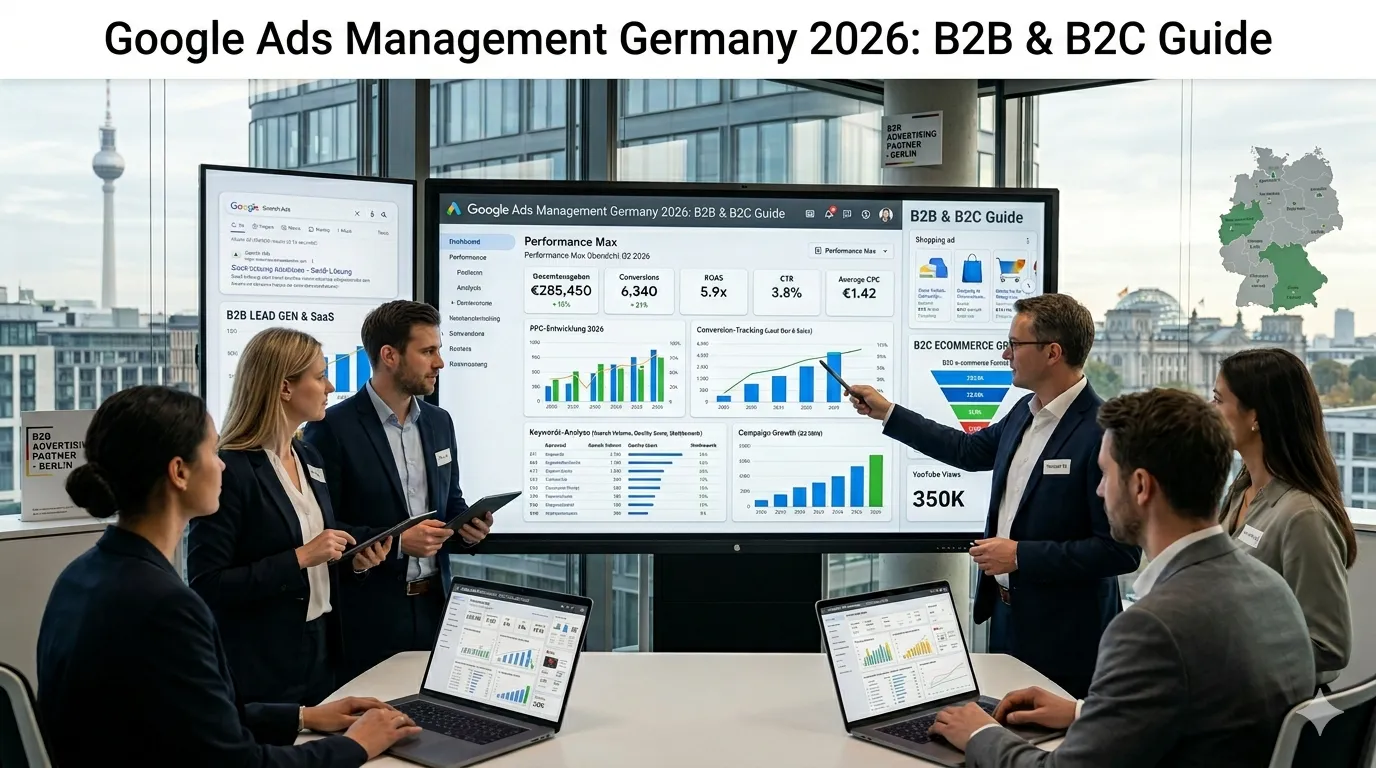
Google Ads Management Germany remains the highest-intent paid acquisition channel in the German market. Buyers actively searching for “shopify entwickler”, “saas crm beratung”, “steuerberater münchen” are further down the funnel than any audience reachable through display or social. Google Search, Shopping, YouTube, and Performance Max collectively account for 40–70% of paid acquisition budget for most German B2B and B2C companies in 2026.
Yet Google Ads is also where most German Mittelstand companies waste 30–60% of their paid budget. Wrong account structure, broad-match keywords without negatives, generic landing pages, no conversion tracking maturity, no Consent Mode v2 setup, no offline conversion import. This guide explains how Google Ads actually works in Germany in 2026 — account structure, bidding, creative, landing pages, attribution, and the compliance details you can’t skip.
What does Google Ads include in 2026?
Google Ads is no longer just “search ads.” The platform now includes:
Search campaigns: text ads on Google search results pages. Highest-intent, primary B2B and lead-gen channel.
Shopping campaigns: product listings with images on Google Shopping and search. Primary e-commerce channel.
Performance Max (PMax): AI-automated campaigns that bid across Search, Display, YouTube, Gmail, Discover, and Maps simultaneously. Most controversial Google product — powerful when set up right, wasteful when set up wrong.
Display Network: image and responsive ads on millions of partner sites. Mainly retargeting and brand awareness.
YouTube Ads: video ads on YouTube and Google video partners. Brand + retargeting + increasingly direct response.
Discovery Ads: native-style ads in Gmail, YouTube Home, and Discover feeds.
App campaigns: for mobile app installs and engagement.
Demand Gen: visual-first campaigns targeting Discover, YouTube Shorts, and Gmail.
For most German Mittelstand B2B in 2026, the spend allocation looks like: 50–70% Search, 10–20% Performance Max, 5–15% YouTube, 5–10% Display retargeting, 5–10% Discovery/Demand Gen. E-commerce: 35–50% Shopping, 15–25% Search, 20–35% Performance Max, 5–15% YouTube and Display.
For broader context, see our performance marketing Germany guide and digital marketing services Germany guide.
How should you structure a Google Ads account for the German market?
Account structure determines everything downstream: bidding, optimization, reporting, attribution. Bad structure cannot be patched with good creative.
Recommended structure for German B2B:
Account: [Company Name] DE
├── Campaign: Brand Search DE
│   └── Ad group: Company name + variants
├── Campaign: Competitor Search DE
│   └── Ad groups: per competitor
├── Campaign: Category Search DE — High Intent
│   ├── Ad group: [Service] Beratung
│   ├── Ad group: [Service] Agentur
│   └── Ad group: [Service] Kosten
├── Campaign: Category Search DE — Long Tail
│   └── Ad groups: per specific use case
├── Campaign: Performance Max — Leads
│   └── Asset groups by ICP segment
├── Campaign: YouTube — Retargeting
└── Campaign: Display — Retargeting
Recommended structure for German B2C e-commerce:
Account: [Brand] DE
├── Campaign: Brand Search DE
├── Campaign: Shopping — All Products (Performance Max)
├── Campaign: Shopping — Best Sellers (manual control)
├── Campaign: Shopping — New Arrivals
├── Campaign: Generic Search DE — Top Categories
├── Campaign: Performance Max — Catalog
├── Campaign: YouTube — Brand Building
└── Campaign: Display — Retargeting & Lookalike
The principle: one campaign per audience/intent/bid strategy. Don’t mix “brand defense” with “generic acquisition” in one campaign — they have different conversion rates, CACs, and strategic priorities.
What keyword strategy works in Germany?
Keyword research in Germany differs from English markets due to compound words, regional dialect variations, and unique search volume patterns.
Best practices for German keyword research:
-
Compound words: German speakers often type compound words (“webentwicklung” not “web entwicklung”). Account for both spaced and compound versions.
-
Anglicisms: German B2B uses English terms inline (“SaaS”, “B2B”, “CRM”). Bid on both English and German variants where they coexist.
-
Mittelstand vs Konzern terminology: enterprise audiences use different terms than Mittelstand. “Enterprise SaaS Lösung” vs “B2B Software Mittelstand”.
-
Regional variation: Austrian and Swiss German have specific terms. “Bewerbung” (DE) vs “Bewerbungsschreiben” (broader). Bid in DACH-wide campaigns with care.
-
Negative keywords from day 1: irrelevant queries waste budget fast. Build robust negative keyword lists: “kostenlos”, “free”, “wikipedia”, “gehalt”, “jobs” — depending on intent.
-
Match types in 2026: phrase match and exact match are most controlled; broad match works only with strong smart bidding (tCPA / Maximize Conversions) and clean conversion data.
nFor complete keyword strategy, see our keyword research Germany guide and German SEO content writing guide (the keyword principles overlap with SEO).
What bidding strategy should you use?
Google’s smart bidding strategies in 2026:
Maximize Conversions: AI bids for maximum conversions within budget. Good starter strategy when you have 30+ conversions/month per campaign.
Maximize Conversion Value: AI bids for highest revenue. Requires conversion value tracking (revenue, not just lead count). Best for e-commerce and revenue-led B2B.
Target CPA (tCPA): AI bids to hit a specified CPA. Requires consistent conversion volume (50+ conversions/month per campaign for stable targeting).
Target ROAS (tROAS): AI bids to hit a specified return on ad spend. Best for e-commerce with reliable conversion value tracking.
Manual CPC: you set bids per keyword. Increasingly rare in 2026 except for very small accounts or highly specific control needs.
Maximize Clicks: bids for traffic, not conversions. Use only for awareness campaigns or while initially gathering conversion data.
Best practice progression for new campaigns:
- Week 1–2: Maximize Clicks (gather traffic data)
- Week 3–4: Maximize Conversions (transition to conversion-driven bidding)
- Month 2+: tCPA or tROAS (control CAC or ROAS specifically)
Smart bidding only works if your conversion data is clean. Garbage in = garbage out. Invest in conversion tracking maturity before relying on smart bidding.
How do you set up conversion tracking properly?
Conversion tracking is where most German Mittelstand Google Ads accounts fail. Without clean conversion data, smart bidding optimizes on noise and budget burns.
Conversion tracking stack in 2026:
-
GA4 with Consent Mode v2: required baseline. Configures consent state correctly for users who reject cookies.
-
Server-side Google Tag Manager (sGTM): recovers conversion data lost to browser restrictions and ad blockers. Hosted in EU (Hetzner, AWS Frankfurt, or Google Cloud europe-west).
-
Enhanced Conversions: hashes first-party data (email, phone) and sends to Google for better match rates. Significant CPA improvement when set up properly.
-
Offline Conversion Import (OCI): imports CRM conversion events (sales-qualified lead, opportunity, closed-won) back to Google Ads. Critical for B2B with long sales cycles.
-
Customer Match: uploads customer email lists for lookalike audience creation and suppression.
-
Floodlight / Campaign Manager (for larger advertisers): unified attribution across Google Ads, Display & Video 360.
For server-side tracking detail, see our server-side tracking Germany guide. For Consent Mode v2 detail, see our GA4 Consent Mode v2 Germany guide.
What landing page strategy works for Google Ads in Germany?
Generic landing pages waste 50–70% of Google Ads spend. Campaign-specific landing pages with message-match to the ad and clear conversion paths win.
Landing page best practices for Google Ads in Germany:
- Message match: headline matches the ad copy that drove the click. Buyer should not feel “this isn’t what I clicked on.”
- Single conversion goal: one primary CTA per landing page. Multiple CTAs reduce conversion rate.
- Above-the-fold clarity: value proposition, benefit, and CTA visible without scroll.
- Social proof near CTAs: trust badges, customer logos, testimonials, ratings.
- DSGVO-compliant forms: clear privacy notice, opt-in checkboxes, server-side validation.
- Mobile-first design: 60%+ of German Google clicks are mobile. Mobile UX is primary, not afterthought.
- Fast load times: <2.5s LCP on 4G mobile. Core Web Vitals affect both quality score and conversion.
- German-language native copy: not translated, written from scratch in German.
- Trust signals visible: Impressum link, AGB, Widerrufsbelehrung, Datenschutz.
For landing page CRO detail, see our landing page optimization guide and above-the-fold optimization guide. For mobile detail, see our mobile conversion optimization guide.
What ad copy works for German Google Ads?
German ad copy is more direct, less hyperbolic than US copy. “Best in the world” claims are dismissed; concrete claims are trusted.
German ad copy principles:
- Sie-form for B2B: formal address standard
- Du-form for B2C and youth audiences: depending on brand voice
- Concrete benefits over claims: “DSGVO-konform” beats “Best for compliance”. “30 Tage Geld-zurück” beats “Risk-free trial”
- Specific numbers: “47% mehr Leads in 90 Tagen” beats “Mehr Leads”
- Local credibility: “Münchner Agentur” or “DACH-Experten” signals proximity
- Compliance with UWG: no fake scarcity, no unverifiable superlatives, no misleading comparison
Headline patterns that work in German:
- “[Service] für [Audience]: [Specific Benefit]”
- “[Topic] in [City/Region]: [Number] [Outcome]”
- “[Audience], [Action verb]: [Outcome]”
Description patterns:
- Lead with the buyer’s problem
- State your specific solution
- One credibility signal
- One CTA
Responsive Search Ads (RSA): provide 15 headlines and 4 descriptions. Google rotates combinations. Make sure all combinations make sense — pin critical headlines to position 1 if necessary.
What about Performance Max specifically?
Performance Max is Google’s automated campaign type that bids across all Google inventory. Powerful but controversial — it’s a black box where Google decides where and to whom your ads show.
When PMax works well:
- E-commerce with quality product feed and strong conversion data
- Lead-gen with clean offline conversion import
- Brands with strong creative assets (image + video + copy variations)
- Accounts with 50+ conversions/month for the algorithm to learn
When PMax works poorly:
- New accounts with <30 conversions/month (algorithm starves)
- Accounts with messy conversion tracking
- Markets where you need to exclude specific placements (PMax exclusions are limited)
- B2B with very specific ICP (PMax audience signal is fuzzy)
PMax setup essentials for Germany:
- 5+ asset groups, each targeting a different ICP segment or product line
- 5+ images, 3+ videos, 5+ headlines, 5+ descriptions per asset group
- Audience signals: customer lists, in-market, custom segments — gives algorithm a starting point
- Conversion goals clearly defined and prioritized (sale > qualified lead > unqualified lead)
- Frequent monitoring: PMax can drift; check weekly for placement quality and search term reports
PMax control tactics:
- Account-level placement exclusions for low-quality sites
- Negative keyword lists at account level (newer feature)
- Customer match exclusion to suppress existing customers
- Brand search exclusion to avoid PMax cannibalizing direct brand traffic
How do you handle DSGVO compliance for Google Ads in Germany?
DSGVO compliance for Google Ads in 2026 is non-negotiable. The setup required:
1. Cookie consent banner with Consent Mode v2
- Granular consent for ad_storage, analytics_storage, ad_user_data, ad_personalization
- Equal prominence for accept and reject options
- Configuration recorded with timestamp per session
2. AVV signed with Google Ireland Ltd.
- Standard contractual clauses (SCC) for data transfer to US Google
- Documented in your Verzeichnis von Verarbeitungstätigkeiten
3. Privacy policy updated
- Lists Google Ads, Google Analytics, Google Tag Manager
- Describes data collected, purposes, retention
- User rights documented (access, deletion, opt-out)
4. Server-side tracking
- EU-hosted server-side container
- IP anonymization before forwarding to Google
- Hashed user identifiers for Enhanced Conversions
5. Customer Match compliance
- Customer email lists uploaded only with prior consent
- Documented consent basis (typically existing customer relationship)
- Easy opt-out mechanism
Compliance failures aren’t theoretical. Datenschutzbehörden in Hamburg, Bavaria, and elsewhere have issued fines specifically for Google Ads tracking without proper consent. Get compliance right from day one.
How long does it take Google Ads to become profitable?
Realistic timeline for German B2B Google Ads from a cold start:
Month 1: Account setup, conversion tracking, initial campaign launch. Often unprofitable as algorithm learns and you identify what works.
Month 2: First indications of channel viability. Some campaigns hitting target CAC, others clearly underperforming. Initial creative and landing page iteration.
Month 3: Most viable campaigns hitting target CAC. Smart bidding starts to optimize effectively with sufficient conversion data. Initial scale-up of working campaigns.
Month 4–6: Stable optimization. Best campaigns scaling; weak ones killed. New campaign types tested (PMax, YouTube). Account hitting overall target CAC.
Month 7–12: Compounding optimization. Branded search volume increases (from awareness in ads + content). Audience targeting refines with more conversion data. Best-performing creative templates identified and scaled.
If your Google Ads program isn’t directionally profitable by month 4 in the German market, something is structurally wrong — usually ICP/offer mismatch, conversion tracking issues, or landing page friction. Diagnose root cause rather than continuing to optimize broken setup.
What does Google Ads management cost in Germany?
Google Ads management cost breaks down as:
Ad spend (Google takes): typical Mittelstand €3K–€50K/month Management fee (agency or in-house):
- Freelancer: €800–€2,500/month
- Boutique agency: €2,000–€8,000/month
- Mid-size agency: €4,000–€15,000/month
- Large agency: €8,000–€30,000/month In-house specialist: €60K–€95K base + benefits = €78K–€124K fully loaded
For detailed cost ranges, see our Google Ads cost Germany guide.
Frequently asked questions about Google Ads management Germany
Both. Google: 90%+ consumer. Bing: 10–15% B2B. Bing CPCs 30–50% lower.
Only with 50+ conversions/month and clean offline conversion data. Below that PMax starves.
Google has imperfect detection. ClickCease/Lunio add filtering. Worth it above €20K/month spend.
Early: 70%+ non-brand. Mature: 30–40% brand, 60–70% non-brand acquisition.
German for German market. Exception: English terms German B2B types — bid both variants.
Build legal + compliance review into workflow before submission. Keep backup copy ready.
Quality Score: 1–10 keyword rating from CTR, ad relevance, LP experience. Higher = lower CPC, better position.
Lead with revenue, pipeline, CAC, payback. Not CTR/impressions/quality score.
Ready to optimize or launch your Google Ads program in Germany?
Google Ads is the highest-leverage paid channel for most German B2B and B2C businesses, but only when set up and managed with discipline. The companies winning in 2026 aren’t the ones spending the most — they’re the ones with clean tracking, structured accounts, German-native creative, fast landing pages, and weekly optimization rhythm.
Book a meeting for a free Google Ads audit where we’ll review your account structure, conversion tracking maturity, landing page conversion, and creative performance to identify the top 3 improvements. Or browse our digital marketing services and contact us to discuss a Google Ads management engagement.