Landing pages are CRO’s most concentrated target. Single page, single purpose, measurable conversion. For German businesses running paid acquisition or organic-traffic campaigns, landing page optimization compounds CPC into closed customers. Bad landing pages waste €5,000–€50,000+ per month in ad spend; optimized landing pages double or triple acquisition efficiency.
This guide walks through what landing page optimization Germany actually requires in 2026: structure, headlines, CTA design, trust signals, mobile considerations, and A/B testing patterns.
For broader CRO see our CRO services Germany guide.
What’s a landing page?
Single-purpose page designed for one specific conversion goal:
Common types
- PPC landing page (from Google Ads / Meta Ads)
- Email campaign landing page
- Content download (lead magnet)
- Webinar registration
- Product launch page
- Coming-soon / waitlist page
Key difference from regular pages
- Single CTA / conversion goal
- No site navigation (or minimal)
- Built for conversion, not exploration
- Often standalone outside main site structure
What’s the high-converting German landing page structure?
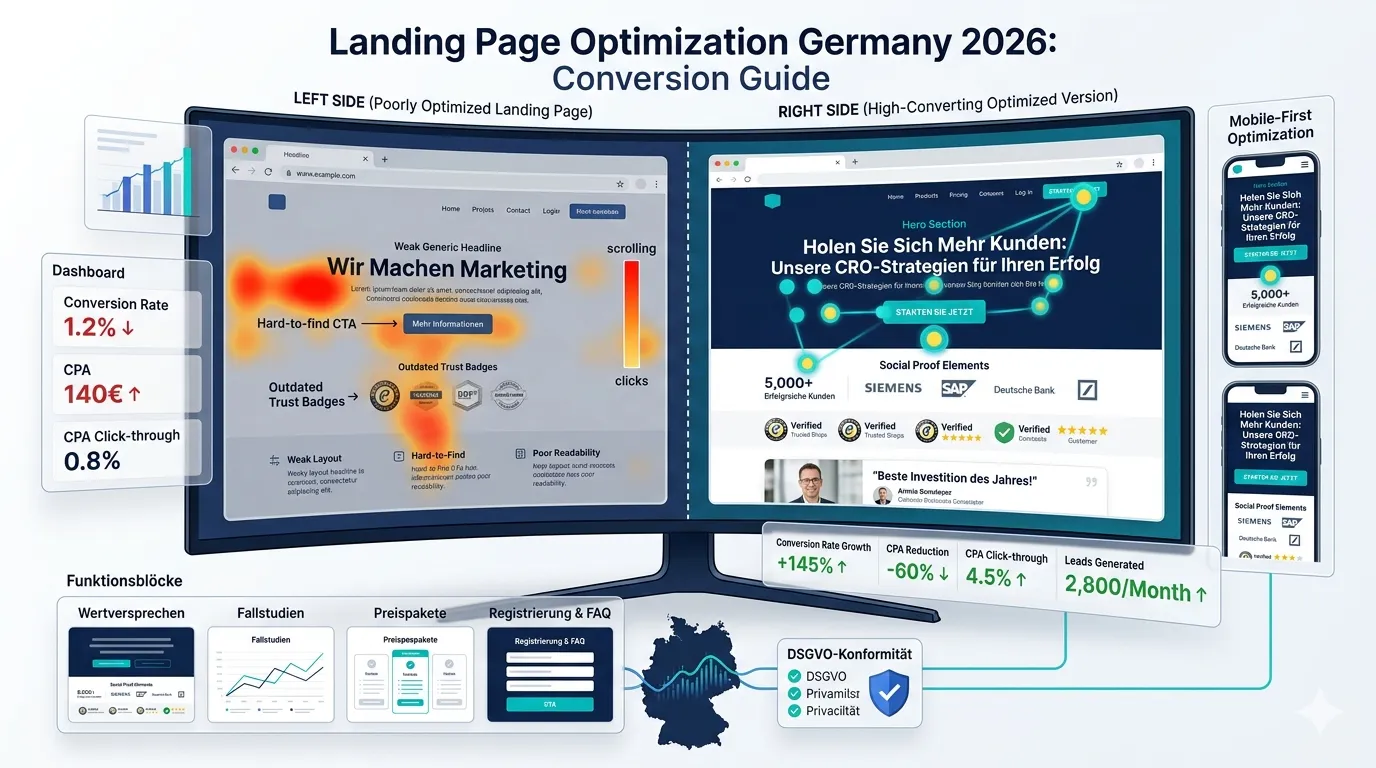
A proven 8-section pattern:
1: Hero (above fold)
- Clear value proposition headline (German + specific)
- Subheading explaining “what + for who”
- Primary CTA button (clear text, prominent placement)
- Trust signal element (customer logos, awards, “Trusted Shops” badge)
- Hero image / video supporting message
2: Social proof
- Customer logos
- Testimonials with names + photos (if possible)
- Star ratings / review count
- “10,000+ German customers” type stats
3: Value propositions
- 3 key benefits visualized
- Specific outcomes (not features
- Icons + brief explanation
4: Detailed product / service explanation
- How it works
- Why it works
- Differentiators
5: Case studies / proof
- Specific customer outcomes
- Quotable testimonials
- Before/after results
6: Pricing / offer
- Clear pricing (if applicable)
- What’s included
- Comparison to alternatives
7: FAQ
- 6–10 common questions
- Honest answers
- FAQ schema markup
8: Final CTA
- Reinforce primary CTA
- Trust signal repeat
- Urgency where appropriate (not fake)
What makes a high-converting headline?
Five characteristics:
Specific outcome promised
“Reduce Steuerberater costs by 30%” beats “Best Steuerberater services.”
For specific audience
“For German Mittelstand B2B SaaS” beats “For everyone.”
Concrete + believable
Specific numbers + outcomes > vague promises.
Brand voice consistent
Sie-form for B2B / professional. Du-form for younger consumer.
Tested against alternatives
3–5 headline variations A/B tested.
What CTA design wins?
Seven CTA best practices:
1. Specific action
“Beratungsgespräch anfragen” beats “Submit”
2. Visible contrast
Stand out from surrounding design.
3. Single primary CTA
Don’t compete with multiple equally-prominent CTAs.
4. Above fold + repeated
Visible immediately. Repeat 2–4 times throughout page.
5. Mobile-friendly tap target
44×44px minimum.
6. Outcome-focused copy
“Get free analysis” beats “Submit form.”
7. Reassurance below CTA
“Free + no credit card” or “Reply within 24 hours.”
What trust signals work for German landing pages?
Seven trust signals:
Customer logos
8–12 recognizable brands. Quick visual proof.
Specific stats
“3,000+ German customers” with numbers.
Trusted Shops or industry seals
Visible above fold for transactional pages.
Testimonials with photos
Named individuals + their photos + their company.
Reviews + ratings
Aggregate star rating + count.
Certifications + awards
Industry recognition.
Press mentions
“Featured in FAZ” type credibility.
For broader trust see our trust signals conversion guide (forthcoming, #152).
What German market specifics matter?
Four considerations:
Sie-form default for professional/B2B
Most landing pages in Sie. Du-form for explicitly modern consumer brands.
Conservative claims
German skepticism. “Best in the world” claims hurt. “Marktführer in Deutschland” with specific evidence works.
Comprehensive content expected
German users want detail. Longer landing pages often outperform short.
Native German quality
Auto-translated content visibly hurts conversion.
For broader German market see our CRO services Germany guide.
What’s the mobile landing page optimization?
Mobile typically 60–80% of landing page traffic in Germany 2026:
Mobile-specific patterns
- Larger CTAs (touch-friendly)
- Shorter forms (less scrolling)
- Quick load (LCP < 2s critical)
- Click-to-call buttons (for service businesses)
- Sticky CTA (always visible)
Mobile-specific failures
- Tap targets too small
- Form fields hard to use
- Hero image dominates entire viewport
- Trust signals only visible after scroll
For mobile see our mobile conversion optimization guide (forthcoming, #154).
What’s the typical landing page A/B testing roadmap?
A 90-day roadmap:
1–30: Foundation phase
- Headline test: 3–5 variations
- Hero image test
- CTA copy test
- Initial baseline established
31–60: Structural testing phase
- Section order
- Trust signal placement
- Form length / fields
61–90: Refinement phase
- Color + visual hierarchy
- Specific element copy
- Social proof variations
For broader A/B testing see our A/B testing Germany guide.
What landing page builders work in Germany?
Unbounce
US-based. Strong builder. ~€85+/month.
Instapage
Enterprise-grade. Higher pricing. ~€199+/month.
Leadpages
Mid-market. ~€37+/month.
ConvertKit Landing Pages
Email-marketing-integrated. Lower cost.
Webflow / Framer
Modern builders. Strong design freedom. Variable pricing.
Custom (Next.js, WordPress)
Maximum flexibility. Cost = dev time.
For DSGVO-strict: prefer EU-hosted builders or self-hosted via WordPress / Next.js.
What landing page mistakes German businesses make?
Five patterns:
Same page for all traffic sources
PPC traffic + organic + email all hitting same generic landing page. Different intents, different needs.
Too many CTAs
“Sign up + download + contact + buy + learn more.” Pick one primary.
Generic stock photos
Stock hero images everywhere. German users sense lack of authenticity.
No social proof
Skipping testimonials + logos. Loses skeptical German buyers.
Slow page
3+ second LCP on landing page. Loses 30%+ of paid traffic before they see content.
What’s the typical landing page conversion rate?
By type, in Germany 2026:
B2C product landing page
3–8% conversion typical. Top: 10%+.
B2B SaaS lead magnet
10–30% conversion typical. Top: 40%+.
Webinar registration
20–40% typical.
Newsletter signup
1–5% typical.
Demo request (B2B)
2–8% typical.
Service inquiry
3–10% typical.
For broader benchmarks see our conversion rate benchmark Germany guide.
When does a custom landing page beat a builder?
Three signals:
Specific design requirements
Brand-specific design language no builder template matches.
Complex interactivity
Calculators, configurators, custom flows.
Performance-critical
Builders often add 50-100KB overhead. Custom can be 10KB.
For most German businesses: builders suffice. Custom for premium brand or specific complexity needs.
Frequently asked questions about landing page optimization Germany
Clear value prop headline, single CTA, social proof, trust signals, fast load, mobile-optimized, German-native quality.
Hero → Social proof → Value props → Detailed explanation → Case studies → Pricing/offer → FAQ → Final CTA.
Specific action: “Beratungsgespräch anfragen,” “Demo buchen,” “Kostenlos starten.” Outcome-focused.
Customer logos, specific stats, Trusted Shops badge, testimonials with photos, reviews, certifications, press.
Sie for B2B/professional. Du for explicitly modern consumer. Match brand voice.
B2C product 3–8%. B2B lead magnet 10–30%. Webinar 20–40%. Demo 2–8%.
Builder for most. Custom for premium brand or specific complexity.
Larger CTAs, shorter forms, fast load, click-to-call, sticky CTA, mobile-first design.
Need help with landing page optimization?
If you’re scoping landing page CRO for your German business and want a 30-minute scoping conversation about structure + testing strategy, book a meeting or send details via our contact page.
Need expert help? Gem Programmers provides conversion optimisation support for businesses in Germany, Austria and Switzerland. Request a free, no-obligation quote and get a clear plan with scope, timeline and price.