“What conversion rate should I have?” is one of the most-asked questions in German digital marketing — and one of the most-misanswered. Industry averages are seductive but often misleading. Your benchmark = your historical performance, segmented by traffic source, device, and audience.
This guide walks through what conversion rate benchmark Germany standards actually look like in 2026: realistic data by industry, how German market differs from US, how to interpret benchmarks, and when to ignore them.
For broader CRO context see our CRO services Germany guide.
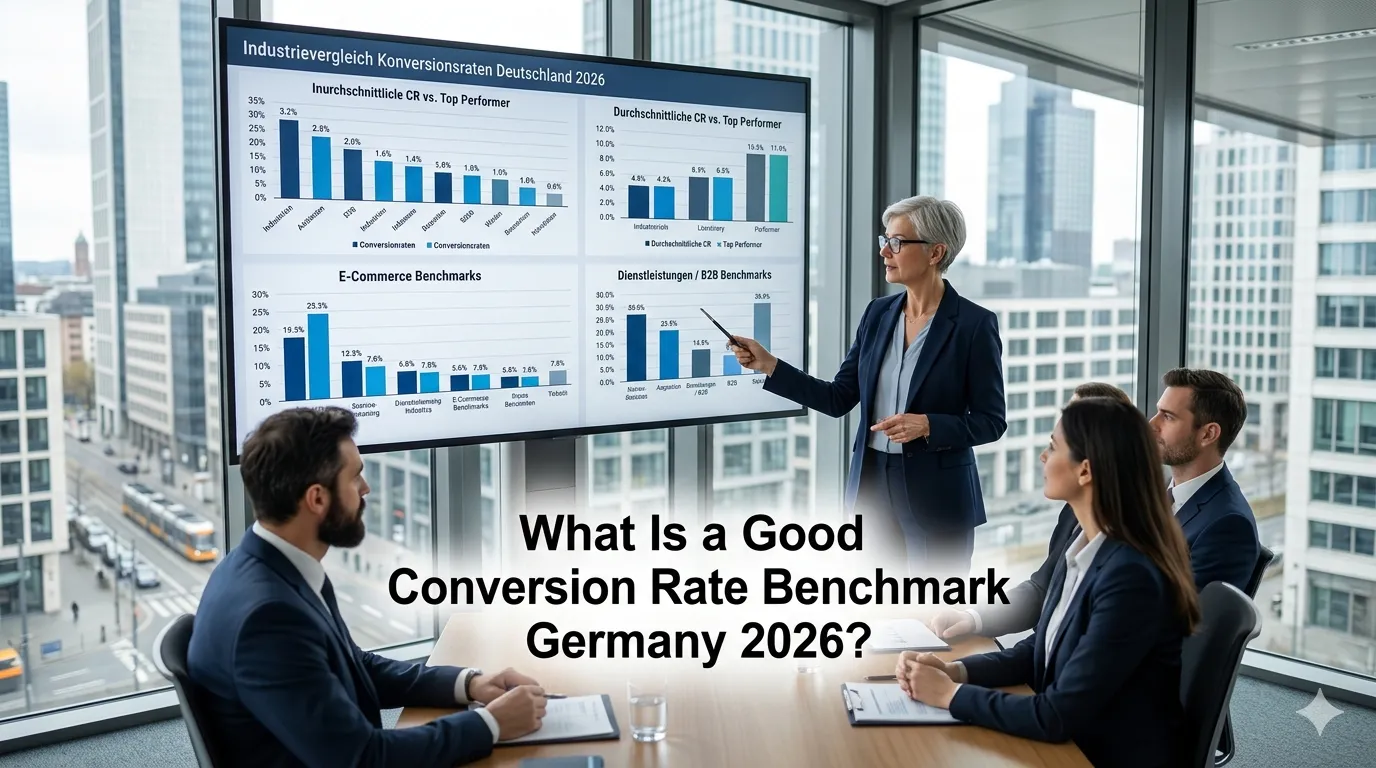
What are typical German conversion rates by industry?
Honest 2026 ranges:
E-commerce (B2C)
- Bottom 25% of stores: 0.5–1.5%
- Median: 1.5–3%
- Top 25%: 3–5%
- Top 10%: 5%+
B2B SaaS
- Lead form (gated content): 5–15%
- Trial signup: 2–8%
- Demo request: 1–5%
- Trial-to-paid: 15–25%
- Demo-to-customer: 15–30%
Service businesses (B2C)
- Inquiry form: 3–10%
- Booking conversion: 5–15%
- Quote request: 2–8%
Service businesses (B2B / Mittelstand)
- Contact form: 2–6%
- Demo / consultation request: 1–4%
- Newsletter signup: 3–10%
Local services (Steuerberater, Anwalt, etc.)
- Phone call from GBP: 10–30%
- Website inquiry: 3–8%
Lead generation sites
- Email signup: 1–5%
- Gated content download: 15–40%
- Webinar registration: 10–25%
How does conversion rate benchmark Germany compare to US?
German market generally converts 10–20% lower than US for same products. Reasons:
Conservative buyer behavior
German buyers research more thoroughly before deciding.
Higher trust threshold
Need more trust signals to convert.
Less impulse buying
Slower decision-making, especially for higher-ticket purchases.
Different payment expectations
SEPA + Klarna + invoice critical. Card-only fails.
Cookie banner fatigue
Mandatory cookie banners affect first-impression conversion.
Implication:conversion rate benchmark Germany should never be compared 1:1 with US benchmarks.
What’s the conversion rate by traffic source?
Different sources convert differently:
Direct traffic
Highest converting typically — branded intent. 5–15% for typical e-commerce.
Organic search (SEO)
Strong converter. 2–6% e-commerce, higher for branded queries.
Paid search (Google Ads)
Variable. Branded keywords convert similar to direct. Generic keywords much lower.
Paid social (Meta, TikTok)
Lower-funnel intent. 1–3% typical e-commerce.
Email marketing
Highest converting — engaged audience. 3–10% typical.
Display / programmatic
Lowest converting typically. 0.1–1%.
Referral traffic
Highly variable depending on source.
For meaningful benchmarking: segment your conversion rate by source. Aggregate site CR misleads.
How does mobile vs desktop conversion differ?
In German market 2026:
Mobile conversion typically 30–50% lower than desktop
- E-commerce desktop: 2.5%
- E-commerce mobile: 1.5%
Why
- Smaller screens
- Slower experience
- Form friction
- Trust signals less visible
- Payment friction
Closing the mobile gap
Mobile-first design, fast load, simplified checkout, mobile-optimized forms. Top performers achieve mobile CR within 20% of desktop.
What’s the conversion rate by device + region?
Germany overall
Conversion rate averages reflect German conservative behavior.
Austria
Similar to Germany. Slightly higher for some categories.
Switzerland
Higher AOV but lower conversion rate. Different buyer psychology.
Mobile German users
Slightly lower mobile CR than US users (already lower than US desktop).
For DACH expansion see our multilingual SEO DE/AT/CH guide.
How do you set realistic CR goals?
Step 1: Establish baseline
Your current rate, segmented by source + device.
Step 2: Compare to peer industry
Use industry averages as rough reference (not as targets).
Step 3: Identify gap
Where is your performance below peer averages? Why?
Step 4: Set incremental target
10–30% improvement over 6–12 months is realistic. 50%+ improvement requires significant work.
Step 5: Set device-specific targets
Mobile target should close % gap with desktop, not match desktop.
Step 6: Set source-specific targets
Optimize highest-volume + lowest-CR source first for biggest impact.
What German industries have highest + lowest conversion rates?
Highest conversion industries
- Insurance comparison sites
- Loan / financial product comparison
- Travel comparison
- Pizza / food delivery
- Daily-need consumer goods
Lowest conversion industries
- Luxury fashion / high-AOV personal goods
- B2B enterprise SaaS (long cycle)
- Real estate (years-long decision)
- Major business equipment
Don’t compare yourself across categories. Your benchmark is your own historical data + closest peers.
What’s a good conversion rate for German Shopify stores?
Typical Shopify German store conversion:
Starter (€0–€500k revenue)
1–2.5% typical. Bottom 25%: <1%. Top 25%: 2.5%+.
Growing (€500k–€2M)
2–4% range typical. Better acquisition + optimization.
Mature (€2M+)
3–5%+ typical. Optimized checkout + payment mix + trust signals.
Top Shopify German stores
5%+ achievable with disciplined CRO + premium brand experience.
For Shopify specifics see our Shopify abandoned cart Germany guide and Shopify SEPA guide.
How do you compare yourself to peer benchmarks?
Five approaches:
Industry reports
Statista, Bitkom, eMarketer publish German market data. Quarterly updates.
Tool-provided benchmarks
VWO, Optimizely, Hotjar publish aggregate data. Some directional.
CRO agency network insights
Agencies see across many clients. Ask your CRO partner.
Direct competitor analysis
Hard to know competitor CR exactly. SimilarWeb gives rough traffic + engagement signals.
Industry events + conversations
German Conversion Day, OMR, e-commerce events. Networking reveals peer data.
When are conversion benchmarks misleading?
Five caveats:
Different audiences = different baselines
Premium brand vs mass-market = different CR expectations.
Different traffic sources = different baselines
Branded vs non-branded traffic.
Different products = different baselines
€50 impulse buy vs €5,000 considered purchase.
Sample size matters
100-visitor / month site CR not statistically meaningful.
Seasonality matters
Black Friday CR vs January CR very different.
How do you set up conversion tracking properly?
For valid benchmarking:
Step 1: Define conversion events
Purchase, lead form submit, demo request, trial signup, etc.
Step 2: GA4 + Search Console setup
Configure conversion events. Verify firing properly.
Step 3: Segment-level tracking
By source, device, audience, page. Not just aggregate.
Step 4: Revenue attribution
For e-commerce: revenue per source.
Step 5: Funnel tracking
Each step of conversion path tracked separately.
Step 6: Periodic data quality audit
Verify events firing. Catch tracking breakages.
For GA4 setup see our GA4 conversion tracking guide (forthcoming).
What CR improvements are realistic by stage?
Year 1 of CRO program
20–40% CR improvement on optimized pages. Compounds across portfolio.
Year 2-3
Additional 20–30% improvement. Diminishing returns possible.
Year 4+
5–15% incremental improvement per year. Mature program.
Step-change improvements
Major redesign, payment mix overhaul, mobile rebuild can produce 50%+ jumps.
Frequently asked questions about conversion rate benchmark Germany
Median 1.5–3%. Top 25%: 3–5%. Top 10%: 5%+. Bottom 25%: under 1.5%.
Lead form: 5–15%. Trial signup: 2–8%. Demo request: 1–5%.
10–20% lower conversion rates typically. Conservative buyers, higher trust requirements, different payment expectations.
Use as rough reference. Your real benchmark is your own historical performance, segmented properly.
20–40% in year 1. Diminishing but ongoing improvement years 2+. 50%+ requires major change.
Mobile typically 30–50% lower than desktop. Closing the gap is high-value CRO work.
Establish baseline, compare to peer industry, identify gap, set incremental (10–30%) targets.
Different audiences, traffic sources, products, small sample sizes, seasonality.
Need help benchmarking?
If you’re scoping CR benchmarking for your German business and want a 30-minute scoping conversation about realistic targets + improvement strategy, book a meeting or send details via our contact page.
Need expert help? Gem Programmers provides conversion optimisation support for businesses in Germany, Austria and Switzerland. Request a free, no-obligation quote and get a clear plan with scope, timeline and price.