
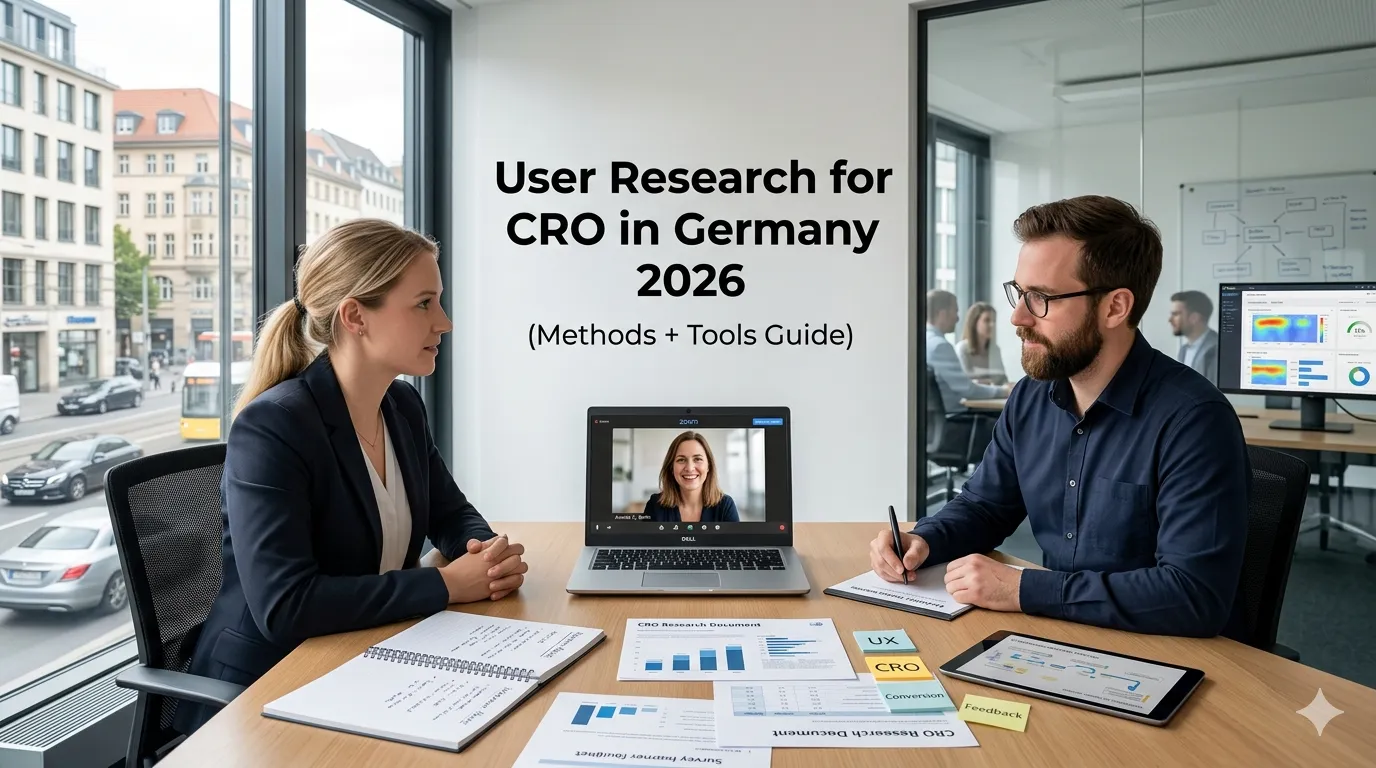
User research is the most underused CRO lever in Germany. Most German businesses run A/B tests without understanding why users behave as they do — leading to random tests with low win rates. Real CRO programs combine quantitative analytics with qualitative user research. The combination is far more powerful than either alone.
This guide walks through what user research for CRO in Germany actually requires in 2026: qualitative methods, customer interviews, on-site surveys, usability testing, tools, and German market specifics.
For broader CRO see our CRO services Germany guide.
Why does user research matter for CRO?
Five reasons:
Test hypotheses come from research
Random tests fail. Research-informed tests win.
Reveals “why” behind analytics
Analytics show what users do. Research shows why.
Reduces wasted testing time
Tests aligned with real user needs convert better.
Surfaces unexpected insights
Research often reveals issues you didn’t know existed.
Builds team empathy
Watching real users use your site changes team thinking.
What user research methods matter for CRO?
Five high-impact methods:
1. Customer interviews
30-min conversations with actual customers + prospects. Open-ended questions about decision process, pain points, alternatives considered.
2. On-site surveys
Embedded surveys at strategic moments. Exit intent, post-purchase, on specific pages.
3. Usability testing
5–10 users completing tasks while thinking aloud. Reveals UX friction.
4. Heatmap + session recording analysis
Hotjar / Microsoft Clarity / FullStory. Watch real users.
5. Voice-of-customer analysis
Customer support tickets, reviews, social media mentions. Aggregate patterns.
How do you run effective customer interviews?
A 7-step process:
Step 1: Recruit participants
10–15 actual customers + 5–10 prospects who didn’t buy. Mix is critical — both wins + losses inform
Step 2: Compensate
€50–€150 per interview (gift card / discount / cash). Increases participation.
Step 3: Open-ended questions
Avoid leading questions. “Tell me about your decision process” beats “Was our pricing too high?”
Step 4: Listen more than talk
70/30 ratio. Researcher should mostly listen + occasionally probe.
Step 5: Record (with consent)
Audio/video recordings let team review. Always get DSGVO-compliant consent.
Step 6: Transcribe + tag
Categorize quotes by theme. Identify patterns across interviews.
Step 7: Generate insights
Translate qualitative data into testable hypotheses.
What on-site surveys work for CRO?
Five high-impact survey types:
Exit-intent survey (B2C)
When user about to leave: “What stopped you from completing today?” 2–3 question max.
Post-purchase survey
After conversion: “What almost prevented you from buying?” Reveals friction points.
On-page surveys (specific pages)
Pricing page: “Are our prices clear?” Product page: “Is anything missing from this page?”
NPS / CSAT (broader)
Net Promoter Score / Customer Satisfaction. Trend over time.
Exit survey (cancellation/refund)
For lost customers. “What could we have done differently?”
Tools
- Hotjar Polls — built into Hotjar
- Typeform — standalone surveys
- Survicate / Refiner — specialist on-site survey tools
- Microsoft Forms — DSGVO-friendly option
How do you run usability testing?
Lean approach:
Step 1: Recruit 5–10 users
Match target audience demographically.
Step 2: Write task scenarios
“Imagine you need to [accomplish goal]. Show me how you’d do that on our site.”
Step 3: Think-aloud protocol
Ask user to verbalize thoughts while completing tasks.
Step 4: Record sessions
Screen + audio. With consent.
Step 5: Watch + take notes
Note friction points, hesitations, confusion, errors.
Step 6: Synthesize patterns
Patterns across 5+ users = real issues worth addressing.
Tools
- Maze — unmoderated remote testing
- UserTesting — moderated + unmoderated
- Lyssna / UsabilityHub — quick tests
- Lookback — live moderated testing
- DIY with Zoom + screen sharing
What German-specific considerations matter?
Four cultural factors:
Privacy expectations
German users more reluctant to share data. Build trust before survey.
Compensation expected
For interviews + usability testing, compensation expected at German rates.
Sie-form in research
Professional Sie-form for surveys + interview scripts.
Sample diversity
Diverse German participants needed — not just Berlin millennials.
Cookie banner research
German users have unique cookie banner UX. Research how it affects them specifically.
How do you handle DSGVO in user research?
Six considerations:
Recording consent
Must be explicit. Document timestamp + IP.
Compensation handling
Track tax-compliant if compensation > €256/year per individual.
Data storage
EU-region storage. Hetzner, AWS Frankfurt, similar.
Data retention
Define retention period in privacy notice. Typically 12-24 months max.
Right to deletion
Participants can request data deletion. Workflow needed.
Anonymization for sharing
Internal team can see real data. External sharing requires anonymization.
For broader DSGVO see our GDPR compliance guide.
What does user research cost in Germany?
Customer interviews
- Participant compensation: €50–€150 × 15 interviews = €750–€2,250
- Researcher time: €1,500–€5,000 per study
- Total: €2,250–€7,250 per interview study
On-site surveys
- Tool subscription: €30–€200/month
- Implementation: minor
- Total: ongoing low cost
Usability testing
- Tool: €0–€500/month
- Participant compensation: €100–€200 × 5 = €500–€1,000
- Researcher time: €1,000–€3,000
- Total: €1,500–€4,500 per round
Aggregate research budget
For mid-size German business: €5,000–€20,000 quarterly research investment is healthy.
How does qualitative research convert to CRO hypotheses?
Example synthesis:
Research insight
“In customer interviews, 7 of 10 buyers mentioned shipping cost as decisive concern. Hotjar shows 35% of users scroll to footer looking for shipping info before any other action.”
Hypothesis
“If we display shipping cost calculator/info above the fold on product pages, conversion will improve 15–25% because users won’t have to dig for this information.”
Test design
A/B test product page with shipping info above fold vs. current.
Expected impact
Calculate based on traffic + current CR + projected lift.
Statistical setup
Sample size needed for 95% confidence. Test duration based on traffic.
This is research-driven hypothesis development. Beats random testing.
What are common user research mistakes?
Five patterns:
Leading questions
“Are our prices too high?” leads to confirmation bias. Open-ended better.
Too few participants
3 interviews ≠ insight. 10+ for patterns to emerge.
Talking too much in interviews
Researcher dominating instead of listening. 70/30 ratio toward listener.
No documentation
Insights stay in researcher’s head. Build knowledge base for team.
Skipping prospects
Only interviewing existing customers. Misses why others didn’t buy.
How often should you do user research?
For active CRO programs:
Quarterly interview studies
10–15 interviews each quarter. Different segments rotated.
Ongoing on-site surveys
Always running on key pages.
Annual deep usability study
20+ participants. Full site / product.
Continuous heatmap + session recording
Always tracking. Quarterly synthesis.
Voice-of-customer monthly
Customer support trends, review analysis.
When does user research not pay back?
Three scenarios:
Pre-launch product
No customers to interview. Use prospects + market research.
Very small business
5 customers / month. Hard to get statistically meaningful insights.
Heavily commodity products
Where decision is purely price-driven. Less qualitative insight to surface.
Frequently asked questions about user research for CRO
Customer interviews, on-site surveys, usability testing, heatmap analysis, voice-of-customer.
10–15 for patterns to emerge. More for nuanced segments.
€50–€150 per interview. €100–€200 for usability testing.
Yes, with consent. Audio at minimum, video preferred.
Interviews: video call + notes. Surveys: Hotjar/Survicate. Usability: Maze/UserTesting.
Explicit consent, EU storage, defined retention, right to deletion, anonymization for sharing.
€5,000–€20,000 quarterly research investment for mid-size German business.
Quarterly interviews, ongoing on-site surveys, annual deep usability, continuous heatmaps.
Need help with CRO user research?
If you’re scoping user research for your German CRO program and want a 30-minute scoping conversation about methods + budget + process, book a meeting or send details via our contact page.