
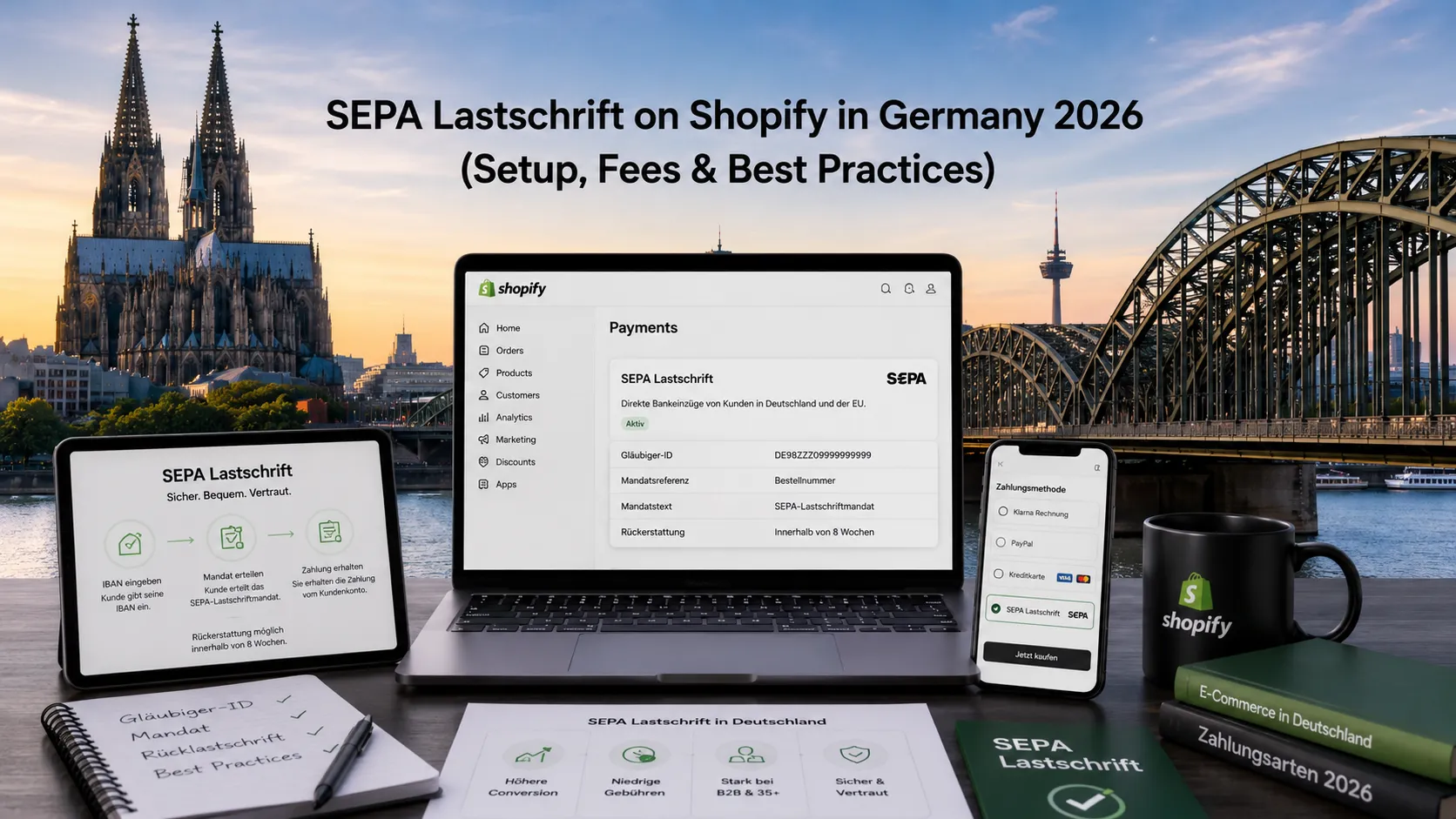
SEPA Lastschrift is the payment method German online buyers — especially in the 35+ demographic and B2B — increasingly demand. Shopify stores that don’t offer SEPA lose meaningful conversion to competitors that do. The good news: Shopify supports SEPA Lastschrift either natively via Shopify Payments (where available) or via Mollie / specialist apps. The bad news: there are setup details unique to Germany that determine whether SEPA actually works for your buyers.
This guide walks through how to actually enable SEPA Lastschrift on a Shopify store in Germany in 2026: Shopify Payments vs Mollie setup, fees, mandate handling, Gläubiger-ID requirements, recurring SEPA, and Rücklastschrift (chargeback) handling.
What is SEPA Lastschrift, and why does it matter for Shopify in Germany?
SEPA Lastschrift is the European direct-debit standard. Customer provides IBAN, signs a mandate, you pull funds. For German market context:
- 30–50% of German online buyers prefer SEPA over credit card
- Strong for 35+ demographic and B2B accounts
- Lower fees than credit card for transactions above ~€60
- Native to German payment culture
Shopify stores without SEPA lose conversion. Shopify stores with SEPA + Klarna + PayPal + cards cover ~95% of German payment preferences.
For a deeper Stripe SEPA framework see our Stripe SEPA payment integration guide.
How does Shopify support SEPA Lastschrift?
Three paths:
Path 1: Shopify Payments with SEPA
Shopify Payments supports SEPA Direct Debit in supported markets including Germany. Cleanest integration — built into native Shopify checkout. Fees included in Shopify Payments rates.
Path 2: Mollie (third-party app)
Mollie is the leading European-friendly Shopify payment app. Strong SEPA support, lower fees than Shopify Payments in some scenarios, broader EU-payment-method coverage.
Path 3: Specialist SEPA apps
Apps focused specifically on SEPA: e.g., Solidpay, Recharge for subscriptions with SEPA.
For most German Shopify stores in 2026: Shopify Payments with SEPA enabled is the simplest path. Mollie for stores with EU-wide payment method needs or specific fee preferences.
How do you actually enable SEPA on Shopify?
The setup, step by step.
Step 1: Activate Shopify Payments
Settings → Payments → Activate Shopify Payments. Confirm your business is German-registered.
Step 2: Enable SEPA Direct Debit
Within Shopify Payments settings, enable “SEPA Direct Debit” as a payment method.
Step 3: Apply for and configure Gläubiger-ID
German businesses need a Gläubiger-ID (creditor identifier) from the Bundesbank to legally process SEPA debits. Application: bundesbank.de — free, takes 1–3 weeks. Configure this in your Shopify Payments settings.
Step 4: Configure SEPA mandate text
Shopify provides default SEPA mandate text. Customize for German legal compliance:
- Creditor identifier (your Gläubiger-ID)
- Reference number (mandate-specific)
- Customer authorization language
- 8-week refund right disclosure
Step 5: Test with test IBANs
Shopify provides test IBANs that simulate success, failure, dispute. Test each path before going live:
- Success: DE89370400440532013000
- Failure: DE62370400440532013001
- Dispute: DE05370400440532013002
Step 6: Add Mollie as backup if needed
For markets Shopify Payments doesn’t cover, install Mollie app. Configure SEPA there too.
Step 7: Update legal pages
Datenschutzerklärung must disclose Shopify Payments / Mollie as data processor. AGB should reference SEPA mandate and 8-week dispute right.
What does SEPA Lastschrift cost on Shopify in 2026?
Shopify Payments SEPA
- Approximate 0.8% capped at €5.00 per transaction
- No additional Shopify transaction-fee surcharge (vs. 1–2% surcharge for third-party gateways)
- Failed payment: €0.25
- Disputed Lastschrift: €15.00
Mollie SEPA
- Approximate 0.25% + €0.35 per transaction
- Plus Shopify’s gateway surcharge (1–2% depending on Shopify plan)
Math: when is Shopify Payments cheaper, when Mollie?
At a €100 average order on Shopify (€79/month plan, 1% surcharge):
- Shopify Payments SEPA: 0.8% = €0.80
- Mollie SEPA: 0.25% + €0.35 + 1% surcharge = €1.60
Shopify Payments wins.
At €500 average order:
- Shopify Payments SEPA: capped at €5.00
- Mollie SEPA: 0.25% + €0.35 + 1% surcharge = €6.60
Shopify Payments wins.
Shopify Payments is the cleaner cost choice for most German stores using SEPA on Shopify.
How do you handle recurring SEPA on Shopify?
For subscription products:
Shopify Subscriptions (native, available 2024+)
Native Shopify subscriptions support SEPA Lastschrift on stores where Shopify Payments supports SEPA. Mandate is reused for recurring debits.
Recharge (third-party subscription app)
Most popular Shopify subscription app. Supports SEPA via Stripe integration. More mature than native Shopify Subscriptions for complex subscription patterns.
Bold Subscriptions
Alternative subscription app. SEPA support varies — verify before committing.
For most German Shopify brands launching subscriptions: native Shopify Subscriptions if simple, Recharge if complex.
How do you handle Rücklastschriften (SEPA chargebacks)?
The 8-week window
For 8 weeks after the debit, the buyer can dispute for any reason. Funds returned automatically. This is European consumer protection — accept it.
Weeks 9–13
Buyer can dispute claiming mandate was unauthorized. You’ll need to prove the mandate exists. Shopify stores this automatically.
After week 13
No more disputes possible.
Minimizing Rücklastschriften
- Clear merchant descriptor (e.g., “BRANDNAME *DE Order #1234” vs “GENERIC CHARGE”)
- Confirmation email day-of-debit with mandate reference
- For subscriptions, “Erinnerung” email 3 days before next debit
- Document consent flow with timestamp, IP, mandate text version
A clean German Shopify business sees 0.5–1.5% Rücklastschrift rate. Above 3% suggests UX problem.
What’s the right payment method mix for a German Shopify store?
Typical recommended mix for 2026:
- SEPA Lastschrift (essential — 30–50% of conversion)
- Klarna Sofort + Rechnung + Ratenkauf (strong for trust + flexibility)
- PayPal (default trust signal for many German buyers)
- Credit/debit cards (Visa, Mastercard, Amex)
- Apple Pay / Google Pay (mobile checkout speed)
Skip: pure cryptocurrency (rarely used in German B2C), Sofortüberweisung (legacy, less relevant)
What are the most common Shopify SEPA mistakes German brands make?
Four patterns:
Skipping Gläubiger-ID
Launching SEPA without Bundesbank Gläubiger-ID. Technically non-compliant.
English mandate text on German checkout
Mandate must be in German for German buyers. Configure in Shopify.
Not testing IBANs before launch
Live IBANs in production with no test of failure/dispute paths.
Hiding SEPA in payment method order
SEPA should be visible and prominently positioned for German buyers. Don’t bury it behind credit cards.
When should you use Mollie instead of Shopify Payments?
Mollie wins when:
- You need broader EU payment methods (Bancontact, iDEAL, Polish BLIK, French Cartes Bancaires)
- You’re in a market Shopify Payments doesn’t fully cover
- Your accounting/Mollie integration is preferable
For pure German market, Shopify Payments usually wins.
Frequently Asked Questions About Shopify SEPA Lastschrift in Germany
Yes — via Shopify Payments where supported, or Mollie app. Critical for German conversion.
Shopify Payments: ~0.8% capped €5.00; Mollie: 0.25% + €0.35 + Shopify gateway surcharge.
Yes — free from Bundesbank; takes 1–3 weeks.
Shopify Payments simpler and cheaper for German-only; Mollie for broader EU coverage.
Native Shopify Subscriptions (simple) or Recharge (complex); both support SEPA.
8-week dispute window is consumer right; minimize via clear descriptors + emails; aim <1.5%.
Use Mollie — broader EU market coverage than Shopify Payments.
Yes — covers ~95% of German preferences; card-only loses 30–50% conversion.
Need help with SEPA setup?
If you’re setting up SEPA on your German Shopify store and want a 30-minute scoping conversation about Shopify Payments vs Mollie, Gläubiger-ID, or recurring billing, book a meeting or send details via our contact page.