
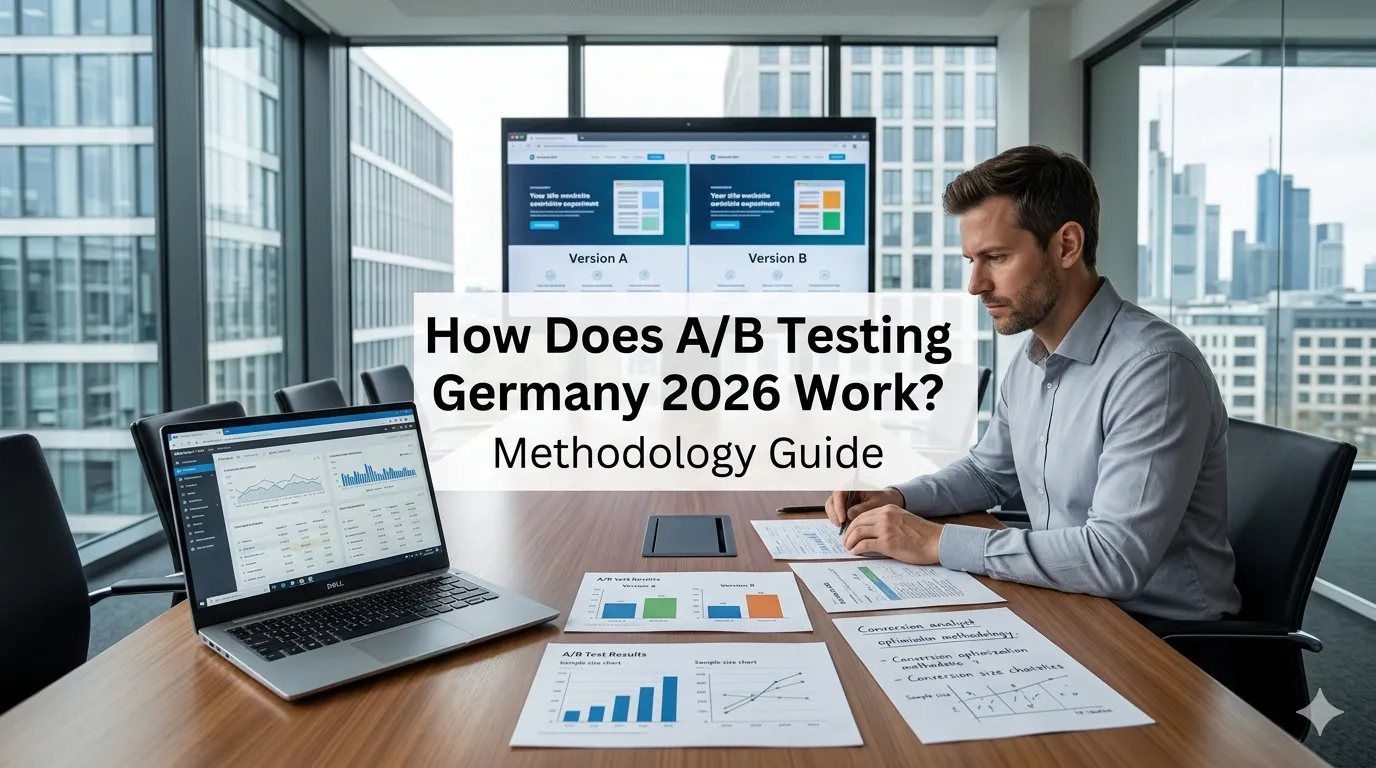
A/B testing is the workhorse of CRO. Run two variants of a page, compare conversion rates, statistically validate which wins. Simple in concept, often badly executed. For German websites in 2026, doing A/B testing properly means understanding sample size, statistical significance, German-market sample considerations, and avoiding the common mistakes that produce false positives.
This guide walks through what A/B testing Germany 2026 actually requires in 2026: hypothesis design, sample size calculation, test duration, common mistakes, tool selection, DSGVO considerations.
For broader CRO see our CRO services Germany guide.
What is A/B testing?
Splitting traffic between two (or more) variants of a page to determine which converts better.
Test setup
- Control (A): existing page
- Variant (B): changed version with one hypothesis
- Random 50/50 traffic split
- Run until statistical significance reached
Outcome
- Winner declared with statistical confidence
- Implement winner
- Document learning
- Move to next test
What does a good A/B test look like?
Six elements:
Clear hypothesis
“If we [change X], then [metric Y] will [improve] because [reason].”
Example: “If we add Trusted Shops badge above fold, conversion will improve 10–15% because German buyers need trust signals before purchase.”
Single variable changed
Test isolated variable. Multiple changes = can’t attribute impact.
Calculated sample size
Sample size needed for statistical significance at desired confidence (95% typical).
Adequate duration
Long enough to capture full weekly cycle minimum.
Pre-defined success metric
Primary conversion event tracked.
Statistical methodology
p < 0.05 for declaring winner. Don’t peek + don’t stop early.
How do you calculate sample size?
A practical approach:
Inputs needed
- Current conversion rate
- Minimum detectable effect (smallest meaningful lift)
- Statistical confidence (95% typical)
- Statistical power (80% typical)
Sample size calculator
Free calculators online (Evan Miller, Optimizely, VWO). Plug in inputs.
Example calculation
- Current CR: 2.5%
- Minimum detectable effect: 10% relative (i.e., new CR of 2.75%)
- Confidence: 95%
- Power: 80%
- Required sample: ~30,000 visitors per variant = 60,000 tota
Implications
Low-traffic sites can’t test small effects. Either accept lower confidence, test bigger effects, or run tests longer.
For small sites: minimum 1,000 visitors per variant + larger effect sizes (20%+ lift).
How long should A/B tests run?
Two requirements:
Statistical sample size reached
As calculated. Don’t stop before sample size hit.
Minimum 1 full week + business cycle
Some weekdays + weekends. For B2B: full business week.
Maximum 6 weeks
After 6 weeks, external factors (seasonality, traffic changes) introduce noise.
Practical rule
2–4 weeks for most tests on mid-sized German sites.
What’s the A/B testing process?
Eight steps:
Step 1: Research-driven hypothesis
From user research, analytics analysis. See our user research for CRO guide.
Step 2: Test design
Define variant changes. Single variable.
Step 3: Sample size + duration calculation
Required visitors + time.
Step 4: Build variants
Develop in testing tool. QA on devices.
Step 5: Launch + monitor
Verify traffic splitting correctly. Initial QA after 24 hours.
Step 6: Run to significance
Don’t stop early. Don’t peek + react.
Step 7: Analyze results
Statistical analysis. Segment review.
Step 8: Implement + document
Winners implemented. Lessons captured for future hypotheses.
What statistical significance level should you use?
Standard: 95% confidence (p < 0.05)
Industry standard. 5% chance of false positive.
More conservative: 99% confidence (p < 0.01)
For high-stakes tests (pricing, brand changes). 1% false positive rate.
Less conservative: 90% confidence (p < 0.10)
For exploratory tests. 10% false positive rate. Use cautiously.
Don’t run tests at <90% confidence
Inconclusive results. Either test bigger effects or accept inconclusive.
For broader statistics see our statistical significance A/B testing guide (forthcoming).
What testing tools work for German market in 2026?
VWO (popular)
- Visual editor + code option
- Strong reporting
- Europe-hosted available
- €330+/month
Optimizely (enterprise)
- Comprehensive enterprise platform
- High learning curve
- Custom pricing
Convert.com
- Strong feature set
- Mid-market pricing
- €450+/month
Kameleoon (European)
- French company, EU-hosted
- DSGVO-strong
- Custom pricing
Custom / homegrown
- For tech-heavy teams
- Build on GrowthBook (open source) or PostHog
- Lower cost but more dev time
For most German growth-stage businesses: VWO or Convert are sweet spot.
For broader tools see our SEO tools comparison Germany guide (similar pricing logic).
What’s DSGVO consideration for A/B testing?
Five compliance items:
Testing tool data residency
EU-hosted preferred. VWO, Kameleoon offer EU regions.
Cookie consent for testing
Testing platform cookies require consent. Gate behind cookie banner.
Sub-processor disclosure
Document testing tool in Datenschutzerklärung as sub-processor.
Personal data minimization
A/B testing shouldn’t expose personal data unnecessarily.
Right to be forgotten
Customer data deletion requests apply to test data too.
For broader DSGVO see our GDPR compliance guide.
What are the most common A/B testing mistakes?
Seven patterns:
Stopping tests early
Peek at results after 3 days, stop when “winner emerges.” Often false positive. Wait for sample size.
Testing too many variables
Multivariate test with 8 variants on low-traffic site. Need too much data.
No primary metric
Testing without clear success metric. Cherry-picking from multiple metrics.
p-hacking
Testing 20 metrics. Reporting whichever shows significance.
Ignoring practical significance
3% lift is significant but not meaningful for low-volume conversion event.
Skipping qualitative research
Random tests without research backing. Low win rate.
Not documenting learnings
Each test produces insights. Without documentation, team repeats mistakes.
What’s a healthy A/B testing program?
Six characteristics:
Research-driven hypotheses
Tests come from user research + analytics insights.
Disciplined statistics
Sample size calculated, tests run to significance.
Consistent cadence
3–6 tests per month at scale.
Win + lose documentation
Both wins + losses provide learnings.
Cumulative impact tracking
Total revenue impact from winning tests over time.
Continuous learning
Insights compound into knowledge base.
For broader CRO see our CRO services Germany guide.
What’s the typical A/B test win rate?
After analyzing many German programs:
Random testing without research
5–15% win rate (most tests lose or inconclusive).
Hypothesis-driven testing
20–30% win rate. Healthy.
Mature CRO program with research backing
30–40%+ win rate. Top tier.
Win rate matters less than cumulative impact
20% win rate × €10k per win = €40k impact from 10 tests. Better than 50% win rate × €1k per win.
When do you NOT A/B test?
Five scenarios:
Pre-product-market fit
Test product, not pages.
Too little traffic
Below 1,000 visitors per variant per week = inconclusive tests.
Brand-critical decisions
Pricing changes, brand identity. Don’t A/B test these casually.
Compliance-required changes
If law requires it (Widerrufsbelehrung wording), no test needed.
Strategic decisions
Some product direction decisions are strategy, not optimization.
Frequently asked questions about A/B testing Germany
Splitting traffic between page variants to determine which converts better. Statistical methodology validates the winner.
Until statistical sample size hit. Minimum 1 week. Maximum 6 weeks. Typical 2–4 weeks.
95% confidence (p < 0.05) standard. 99% for high-stakes. Do not go below 90%.
VWO, Convert, Optimizely, Kameleoon. €100–€2,000+/month depending on tier.
Use online calculators. Inputs: current CR, minimum detectable effect, confidence, power.
Hypothesis-driven: 20–30%. Random: 5–15%. Do not expect every test to win.
EU-hosted tools preferred. Cookie consent for testing. Sub-processor disclosure. Data deletion compliance.
Stopping early, too many variables, p-hacking, no research backing, no documentation.
Need help with A/B testing?
If you’re setting up A/B testing for your German site and want a 30-minute scoping conversation about methodology + tools + program design, book a meeting or send details via our contact page.