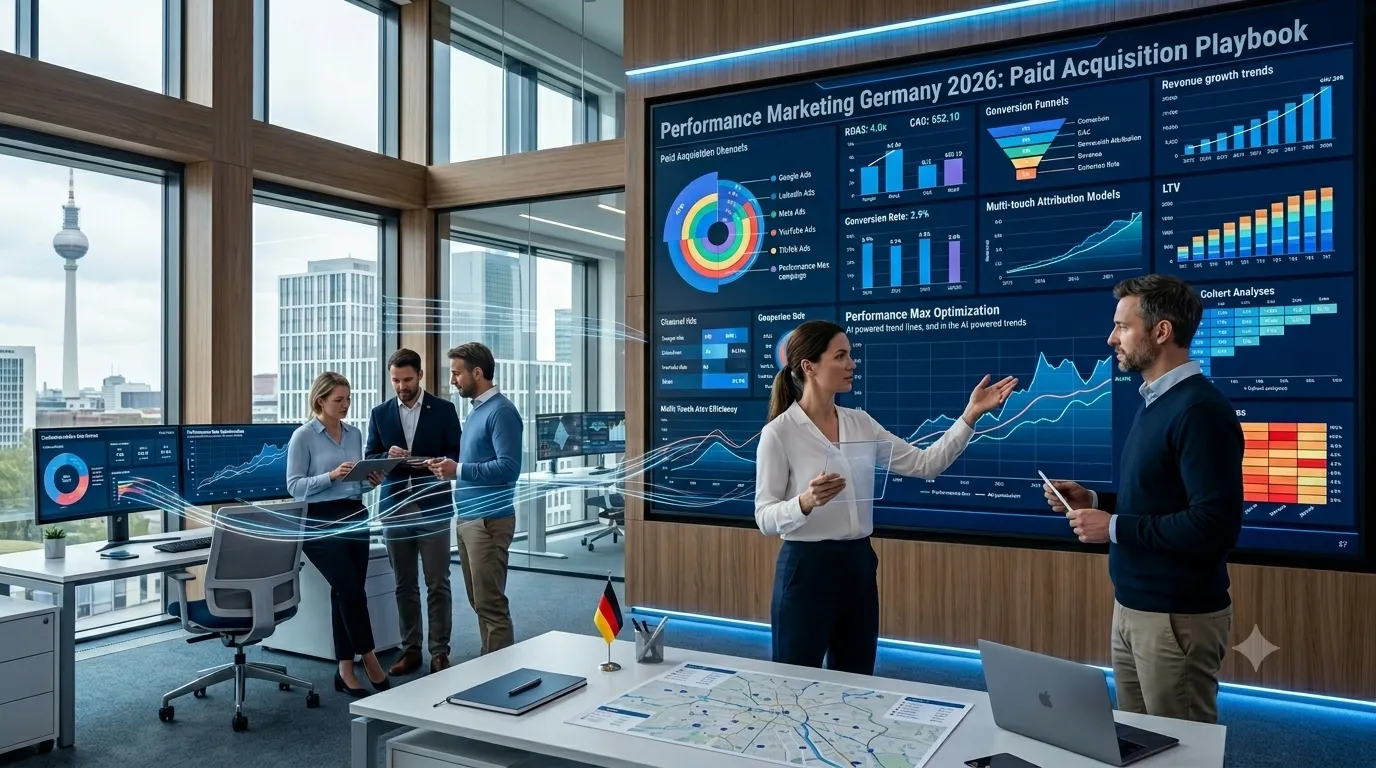
performance marketing germany is the disciplined practice of paid acquisition where every euro is tied to a measurable outcome — clicks, leads, signups, purchases, revenue. It’s the muscle that lets a German business scale predictably: spend €1, expect €X back, scale when X is good and shrink when X is bad. Done right, performance marketing is the closest thing in business to a programmable revenue knob.
In 2026, performance marketing in Germany is harder than five years ago. CPCs are up. Attribution is fragmented by privacy changes. Creative production cycles have compressed. Channel auctions are more competitive. The performance marketers who outperform are the ones running disciplined experimentation, sophisticated attribution, and creative iteration at a faster clock speed than competitors. This guide covers the complete playbook.
What does performance marketing actually mean in 2026?
Performance marketing is paid acquisition with three defining characteristics:
1. Direct measurability: every euro spent is tied to a measurable outcome via tracking. Not “we ran a brand campaign and revenue went up” — but “we spent €X on Google Search ads for keyword group Y and acquired Z customers at €C CAC.”
2. Bid-able auctions: the channels operate as auctions where you set bids, budgets, targeting, and creative, then the platform optimizes delivery. Google Ads, Meta Ads, LinkedIn Ads, TikTok Ads, programmatic display, native — all auction-based.
3. Scalable on demand: when results are good, you increase spend and expect proportionally more results. When results decay, you decrease spend or adjust strategy. The channel responds to investment within days to weeks, not months.
Performance marketing differs from brand marketing, which focuses on long-term awareness rather than immediate measurable results.
It also differs from SEO and content marketing, where growth is primarily driven through organic visibility and owned media channels.
Unlike growth hacking, performance marketing is a structured marketing discipline, while growth hacking is a broader experimentation mindset.
For broader context, see our digital marketing services Germany guide.
Which channels qualify as performance marketing in Germany?
The primary performance marketing channels in the German market in 2026:
Search:
- Google Ads (Search, Shopping, Performance Max, YouTube)
- Bing Ads (Microsoft Advertising) — 10–15% B2B market share
- Amazon Ads for e-commerce
Social:
- Meta Ads (Facebook + Instagram)
- LinkedIn Ads (dominant B2B in Germany)
- TikTok Ads (growing fast, B2C and increasingly B2B)
- Pinterest Ads (niche but valuable for certain verticals)
- Snapchat Ads (limited use in Germany)
Display and video:
- Google Display Network
- YouTube Ads
- Programmatic display (via DV360, The Trade Desk, etc.)
- Native advertising (Outbrain, Taboola, plista — German-specific
Other:
- Affiliate networks (Awin dominant in Germany)
- Influencer marketing (when measurable with tracking links)
- Retargeting platforms (Criteo, AdRoll, RTB House)
- WhatsApp Business Platform (rising for both B2B and B2C
Channels NOT typically classified as performance marketing in Germany: print, TV, radio, OOH (out-of-home), most podcast advertising (mostly bought on brand-equivalent CPMs without granular tracking).
How does the German performance marketing landscape differ from US?
Five structural differences shape performance marketing in Germany versus the US:
1. DSGVO and TTDSG impact on tracking: third-party cookies are dying, server-side tracking is now standard for sophisticated programs, Consent Mode v2 is required for Google services. Tracking depth in Germany is less than in the US for users who reject cookies.
2. LinkedIn dominance for B2B: LinkedIn is the dominant B2B channel in Germany, more so than in the US. LinkedIn typically captures 40–60% of B2B paid budget for German Mittelstand.
3. Lower B2C aggression: German consumers are less responsive to aggressive promotional creative, urgency tactics, and US-style direct response messaging. Conversion rates are lower but customer LTV is often higher.
4. Bing market share for B2B: Bing/Microsoft Ads captures meaningful share (especially older Mittelstand and corporate audiences) in Germany. Skipping Bing is leaving money on the table for B2B.
5. Higher trust threshold: German buyers click ads less impulsively. The creative-to-landing-page-to-conversion path requires stronger trust signals than US equivalent.
The implication: US-style “spray and pray” performance marketing playbooks fail in Germany. German performance marketing rewards precision, patience, and trust building.
How do you structure a performance marketing program from zero?
A 12-week structured launch for a Mittelstand B2B starting performance marketing from baseline:
Foundation phase (Weeks 1–2):
- ICP and persona refinement
- Conversion event mapping in GA4 (leads, demos, trials, MQLs, SQLs)
- Server-side tracking setup (Server-Side GTM or Stape)
- Consent Mode v2 configuration
- Landing page audit and prioritization
Account structure setup (Weeks 3–4):
- Google Ads account structure: campaign by ICP segment, ad groups by keyword theme
- LinkedIn Ads account structure: campaigns by audience and stage
- Conversion API integration (Meta, LinkedIn) for server-side conversion forwarding
- Creative production pipeline (5–10 ad variants per campaign for testing)
Campaign launch phase (Weeks 5–6):
- Soft launch with limited budget per channel
- Daily monitoring of bid prices, search terms, demographic delivery
- First creative iteration based on initial 1-week data
- Landing page A/B test launched
Optimization and testing (Weeks 7–8):
- Move from manual bidding to smart bidding (tCPA / tROAS / Maximize Conversions) once conversion volume permits
- Eliminate underperforming campaigns and ad groups
- Add new campaigns based on what’s working
- Begin attribution analysis (which channels assist vs convert)
Scale and stabilization phase (Weeks 9–12):
- Increase spend on channels and campaigns at target CAC
- Decrease or pause channels not hitting target CAC
- Document playbook for ongoing operations
- Build forward forecast for next quarter
By week 12, you should have: clear channel CAC, validated creative direction, optimized landing pages, attribution model in place, and a defensible scaling plan.
What attribution model should you use?
The attribution model determines which channels get credit for revenue. Wrong model = wrong budget allocation.
Default options:
- Last-click: simple but undervalues top-of-funnel channels
- First-click: simple but undervalues conversion-driving channels
- Linear: equal credit to all touchpoints; conservative
- Time-decay: more credit to recent touchpoints
- Position-based (U-shaped): more credit to first and last touch
- Data-driven (GA4 default): AI-determined credit based on conversion patterns
For German B2B SaaS and services with long sales cycles: data-driven attribution in GA4 plus offline pipeline import from CRM (HubSpot or Salesforce) provides the most reliable view. Pure last-click attribution undervalues LinkedIn, content, and brand investments that drive opportunities that close 90+ days later.
For German B2C e-commerce: data-driven attribution plus marketing mix modeling (MMM) for brand investments. Pure last-click is reasonable for direct response but blind to brand/awareness contributions.
For limited data scenarios: position-based attribution (40% first-click, 40% last-click, 20% middle) is a pragmatic default until you have enough conversion volume for data-driven models.
Whatever model you choose, document it. Changing attribution models mid-quarter breaks all your trend analysis.
For attribution deep dive, see our marketing analytics attribution Germany guide.
What are realistic CACs by channel for German B2B?
Typical CAC ranges for Mittelstand B2B SaaS and services in 2026:
Google Search Ads:
- B2B SaaS (€10K+ ACV): €800–€3,500 CAC
- Mittelstand services: €500–€2,500 CAC
- High-intent local services: €200–€1,200 CAC
LinkedIn Ads:
- B2B SaaS (€10K+ ACV): €1,500–€6,000 CAC
- Enterprise B2B (€50K+ ACV): €5,000–€15,000 CAC
Meta Ads (when B2B applicable):
- B2B SaaS: €1,000–€4,000 CAC
- Less commonly profitable for traditional Mittelstand B2B
Mixed-channel blended:
- Healthy Mittelstand B2B SaaS: €1,500–€4,500 blended CAC
- Healthy Mittelstand B2B services: €1,000–€3,500 blended CAC
These are rough ranges. Your specific CAC depends on your industry, ACV, competitive intensity, creative quality, and landing page conversion rate. Target CAC should be derived from your LTV math: CAC <= LTV ÷ 3 for healthy unit economics.
For LTV:CAC math, see our digital marketing cost Germany 2026 guide.
How do you build a creative production pipeline?
Performance marketing eats creative. The platforms reward variation and freshness. A serious program ships 10–30 new ad variants per month per channel.
Production pipeline components:
- Strategic brief per campaign: ICP, message, offer, CTA, landing page
- Copy variation: 5–10 headline/description combinations per campaign
- Visual variation: 5–10 image/video variants per campaign
- AI-assisted iteration: tools like Midjourney, Adobe Firefly, Runway for visual variation; ChatGPT/Claude for copy variation (with human editing)
- Approval and QA: brand guideline compliance, legal review for regulated industries
- Launch and measurement: 7-day initial measurement window, 14-day full evaluation
- Iteration: kill bottom 30% of creative each cycle, scale top 30%, iterate middle 40%
Common creative production mistakes:
- Producing one “perfect” ad and refusing to iterate
- Refusing to test “weird” creative that the team doesn’t love (often the weird ones win)
- Producing creative without specific audience in mind (generic creative converts generically)
- Not refreshing creative for 3+ months (audience fatigue kills CTR and CVR)
Budget 10–20% of media spend on creative production for a serious program. Below 10%, you’re under-producing; above 20%, you’re under-spending on media.
How do you measure performance marketing success?
The KPI hierarchy for performance marketing:
Top-line (revenue):
- Marketing-sourced revenue (€)
- Marketing-sourced pipeline (€)
- ROAS (e-commerce) or LTV:CAC (B2B)
- CAC payback period
Channel-level:
- CAC per channel
- Customer LTV by acquisition channel (varies meaningfully)
- Conversion rate by channel
- ROAS or CPL per channel
Campaign-level:
- CPL per campaign
- Conversion rate per campaign
- Cost per opportunity per campaign
- Multi-touch attribution share
Creative-level:
- CTR per ad variant
- Conversion rate per ad variant
- Cost per result per ad variant
Funnel diagnostic:
- CPM (impression cost — leading indicator of audience demand)
- CTR (creative + audience match)
- Landing page conversion rate (CRO opportunity)
- Lead-to-opportunity rate (sales qualification or product fit)
Weekly reporting: campaign-level CAC and ROAS.Monthly reporting: channel-level CAC, attribution share, and revenue contribution.Quarterly reporting: cohort LTV by acquisition channel.
What are the common mistakes in German performance marketing?
The patterns we see most often that destroy performance marketing programs:
1. Optimizing for clicks instead of revenue: campaigns get high CTR but low conversion. Cheap clicks are not the goal; cheap customers are.
2. Skipping conversion tracking maturity: running ads without server-side conversion tracking, Consent Mode, or offline pipeline import means optimizing on broken data.
3. Setting budgets without LTV anchoring: spending €X per CAC without knowing if LTV supports it. Programs scale to ruin when budget grows without LTV discipline.
4. Killing tests too fast: pausing campaigns after 5–7 days based on noisy data. Most tests need 14–30 days for statistical confidence.
5. Refusing to test “ugly” creative: the creative that wins is often the one the team finds tacky. Trust the data over taste.
6. Generic landing pages: sending ad clicks to homepage instead of campaign-specific landing page. Conversion rates drop 50–70% for generic vs specific.
7. Underinvesting in attribution: spending €50K/month on ads but €0 on attribution infrastructure. You can’t optimize what you can’t measure.
8. Channel monogamy: putting all spend on one channel because it’s working today. Diversification protects against algorithm changes and audience burn.
9. Treating performance marketing as set-and-forget: campaigns need daily attention, weekly optimization, monthly strategic review. Auto-pilot programs decay within 60 days.
10. Ignoring DSGVO: running ads without Consent Mode v2, without proper AVV, without server-side tracking. Compliance failure has both legal and performance consequences (consent rejection rates of 40%+ blind the algorithms).
What does an ongoing performance marketing engagement look like?
A typical monthly cadence for a Mittelstand performance marketing program:
Daily (15–60 min):
- Pacing check: are campaigns spending on track?
- Anomaly detection: any sudden CAC spike or CTR drop?
- Search term review (Google Ads): negative keywords added
- Comment moderation on social ads
Weekly (2–4 hours):
- Campaign performance review by channel
- Bid adjustments and budget reallocation
- New creative launched, underperformers paused
- Landing page conversion review
- Weekly performance summary email or call
Monthly (1 day):
- Comprehensive multi-channel report
- Attribution analysis
- CAC and ROAS review against targets
- Strategic decisions: scale, contract, pivot
- Quarterly forecast updated
Quarterly (2–3 days):
- Channel mix review (still right?)
- Creative refresh (audiences fatigued?)
- Landing page audit and CRO test prioritization
- Budget reallocation based on quarterly learnings
- Strategic plan update
Performance marketing run with this cadence produces compounding learning. Run with monthly-only attention, results decay.
Frequently asked questions about performance marketing Germany
10–20% on creative, 80–90% on media. Below 10% under-produces variations. Above 20% out-produces testing.
Not yet. AI accelerates execution but doesn’t replace strategy and judgment. Hybrid wins.
Google Ads: €3,000/mo min. LinkedIn: €4,000/mo. Multi-channel: €8,000/mo. Below = noise not signal.
Yes on Meta/LinkedIn — refresh every 3–4 weeks. Google Search lasts longer (audience refreshes via new queries).
Reinforce each other. Brand lifts performance CTR 20–50%. Performance data informs brand. Don’t pit them against each other.
Google’s cross-network automated campaign. Good for e-com/lead gen with mature tracking. Part of strategy, not whole strategy.
Server-side tracking + Conversion APIs now mandatory. First-party data is foundation. Early investors are pulling ahead.
Yes with 1 PM manager + designer + ops specialist. Below this size, hybrid with agency is more cost-effective.
Ready to build or scale your performance marketing program?
Performance marketing rewards rigor: clear ICP, mature tracking, disciplined creative testing, sophisticated attribution, daily attention, monthly strategic review. The companies winning in 2026 aren’t the ones with the biggest budgets — they’re the ones running with the most discipline.
Book a meeting for a free performance marketing audit where we’ll review your current channels, attribution, creative pipeline, and CAC math, then recommend the top 3 improvements for the next 90 days. Or browse our digital marketing services and contact us to discuss a custom engagement.