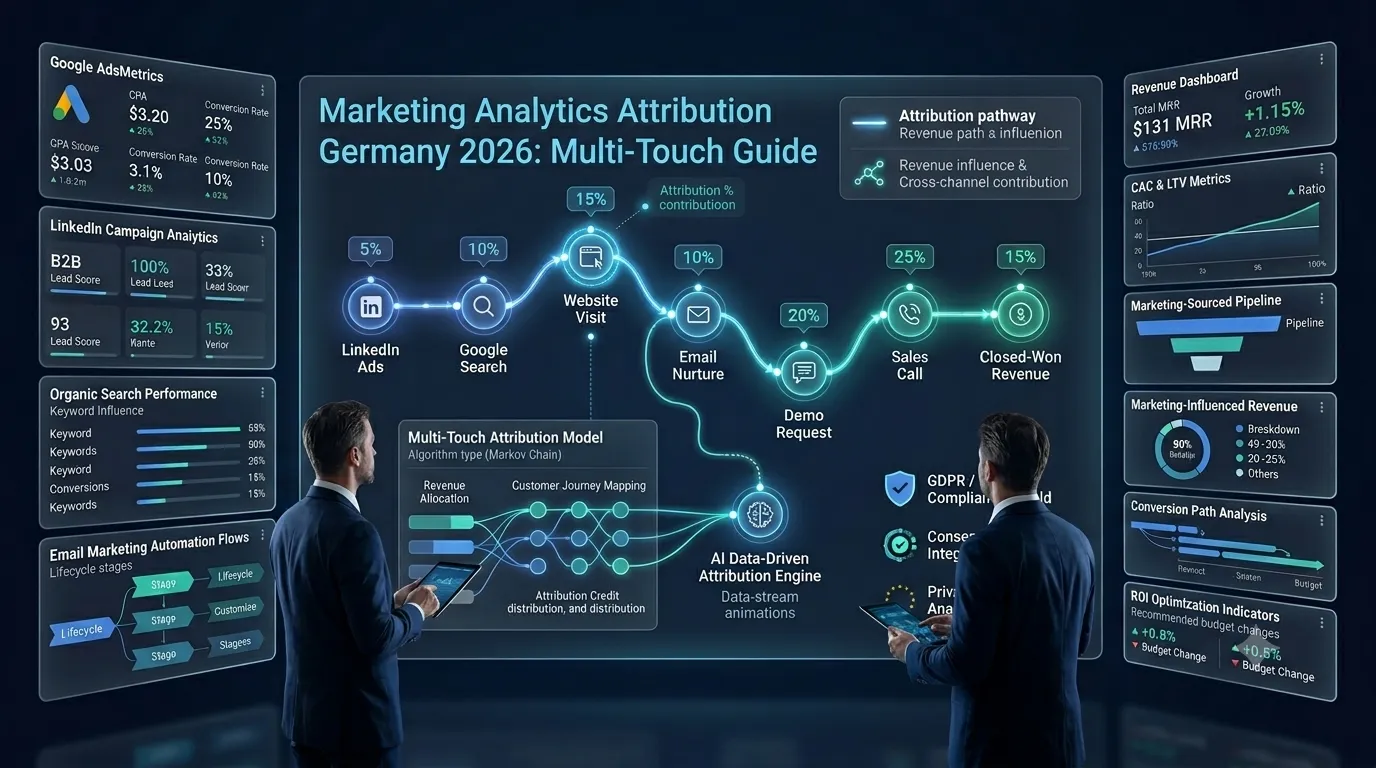
Marketing analytics and attribution determine which marketing investments get credit for revenue — and therefore which get budget, which get cut, and which get scaled. Done well, attribution turns marketing from cost center to predictable revenue engine. Done poorly, it produces budget decisions based on noise rather than signal. For German Mittelstand and B2B SaaS, mature attribution is the difference between marketing teams that compound results and teams that thrash between channels.
In 2026, German marketing analytics is harder than it was 5 years ago. Cookie deprecation cuts cross-domain tracking. iOS privacy limits Meta and TikTok attribution. DSGVO consent requirements remove visibility for users who reject tracking. The teams winning are those that built server-side tracking, multi-touch attribution, marketing mix modeling, and CRM-integrated reporting before the privacy storm. This guide explains what works.
What does marketing analytics actually cover in 2026?
Modern marketing analytics for German business spans:
1. Channel-level performance:
- Cost, traffic, conversions, revenue per channel
- ROAS or CAC per channel
- Audience reach and frequency
- Quality metrics (engagement, time on site)
2. Customer journey analytics:
- Multi-touch attribution across channels
- Path-to-conversion analysis
- Lifetime journey maps for customer cohorts
- Conversion lag analysis
3. Marketing-sourced pipeline (B2B):
- Lead source attribution
- MQL → SQL → Opportunity → Closed-won conversion tracking
- Marketing-influenced revenue (any touch in journey)
- Marketing-sourced revenue (first or last touch)
4. Customer LTV analysis:
- LTV by acquisition channel
- LTV cohort analysis
- Predicted LTV modeling
- LTV:CAC ratio tracking
5. Marketing mix modeling (MMM):
- Aggregate channel impact analysis
- Independent of individual user tracking
- Brand vs performance contribution
- Increasingly important post-cookie
6. Cohort analysis:
- Performance by acquisition cohort
- Channel effectiveness over time
- Customer behavior patterns
7. Incremental measurement:
- Geo experiments
- Holdout audiences
- True lift testing
- Causal impact vs correlation
For broader context, see our digital marketing services Germany guide and GA4 conversion tracking guide.
What attribution models exist and when to use which?
Last-click attribution:
- Full credit to last touchpoint before conversion
- Pros: simple, every analytics tool defaults to it
- Cons: dramatically undervalues top-of-funnel investment
- Use when: pure direct response, short cycles, simple funnel
First-click attribution:
- Full credit to first touchpoint
- Pros: highlights demand generation channels
- Cons: undervalues conversion-closing channels
- Use when: focused on awareness measurement
Linear attribution:
- Equal credit to all touchpoints
- Pros: simple, accounts for all touches
- Cons: doesn’t weight by actual influence
- Use when: directional view of channel diversity
Time-decay attribution:
- More credit to recent touches, less to early
- Pros: balances immediate and earlier contribution
- Cons: arbitrary decay curve
- Use when: medium-length cycles, blended view
Position-based / U-shaped attribution:
- 40% credit to first, 40% to last, 20% to middle
- Pros: weights both discovery and conversion\n\n
- Cons: still rule-based, not data-driven
- Use when: standard B2B with clear funnel stages
Data-driven attribution:
- AI-modeled credit based on conversion patterns
- GA4 default; Google Ads default; Adobe Analytics option
- Pros: actually reflects data patterns
- Cons: black-box; requires sufficient conversion volume
- Use when: enough data (~600 conversions/month minimum), trust in modeling
Markov chain / advanced multi-touch:
- Sophisticated probabilistic modeling
- Requires specialized tools (or custom analytics)
- Use when: enterprise scale with dedicated analytics team
Marketing Mix Modeling (MMM):
- Top-down statistical modeling of aggregate spend → aggregate outcomes
- Doesn’t require user-level tracking
- Useful for offline channels, brand investments, privacy-impacted channels
- Use when: scale supports it (€5M+ annual marketing spend typical floor)
Recommended approach for German Mittelstand B2B in 2026:
- Primary: data-driven attribution in GA4 (with offline pipeline import for B2B)
- Secondary: position-based for stakeholder communication (more intuitive)
- Tertiary: MMM for strategic budget decisions (annual or quarterly)
- Always: cohort LTV analysis to validate attribution-implied channel quality
How does data-driven attribution work in GA4?
GA4’s data-driven attribution (DDA) uses machine learning to model touchpoint contribution.
Requirements:
- Sufficient conversion volume: typically 600+ conversions/month per conversion event
- Sufficient data history: 28+ days
- Multi-channel data collection
- Consent Mode v2 implemented for conversion modeling
How it works:
- Analyzes conversion paths across all users
- Compares converted vs non-converted paths
- Assigns fractional credit based on touchpoint contribution
- Updates continuously as data accumulates
Strengths:
- Better reflects actual channel influence than rule-based models
- Adapts as user behavior changes
- Native to GA4 (no separate tool required)
Limitations:
- Black-box (limited transparency into specific weightings
- Requires volume that smaller advertisers don’t have
- Affected by Consent Mode rejected users
- iOS users may be underrepresented in modeling
Configuration in GA4:
- Admin → Attribution Settings
- Set as Data-driven (default for new properties)
- Configure conversion events properly
- Connect Google Ads for full integration
- Import offline conversions for B2B
For technical implementation, see our GA4 Consent Mode v2 Germany guide and server-side tracking Germany guide.
How does B2B attribution differ from B2C?
B2B attribution requires additional infrastructure:
Long sales cycles:
- Conversions often 3-12 months after first touch
- GA4’s 90-day attribution window may be insufficient
- Custom attribution models with longer windows needed
Account-level (not just user-level) tracking:
- Multiple stakeholders at one company touch your site
- Account-level activity matters more than individual users
- Buying committee mapping
- Tools: 6sense, Demandbase, RB2B for account identification
Offline conversion integration:
- Lead → MQL → SQL → Opportunity → Closed-won often happens partly offline
- Sales calls, demos, contracts
- Import CRM events back to ad platforms for attribution
Pipeline attribution:
- Track marketing source through full pipeline stages
- Marketing-sourced pipeline (first touch)
- Marketing-influenced pipeline (any touch in journey)
- Marketing-attributed revenue at closed-won
Specific B2B attribution infrastructure:
- CRM with lead source field properly populated
- UTM tagging discipline across all campaigns
- Lead capture form passing UTM data to CRM
- Multi-touch attribution platform (Bizible, Dreamdata, Attribution, etc.)
- Reporting that ties marketing activity to revenue outcomes
Common B2B attribution mistakes:
- Only tracking first-touch or last-touch
- Ignoring multi-touch journeys
- Failing to import offline conversions back to ad platforms
- Reporting marketing-sourced revenue without context (cohort analysis)
- Crediting marketing for revenue that would have happened anyway (incrementality blindness)
For B2B context, see our B2B lead generation Germany guide.
How does iOS, browser privacy, and DSGVO affect attribution?
The attribution challenges in 2026:
iOS 14.5+ impact (ongoing since 2021):
- Apple’s App Tracking Transparency restricts cross-app tracking
- Meta, TikTok, etc. lose user-level conversion data on iOS
- iOS share of conversions often 30-50% of total
- Conversion API (server-side) recovers most signal but not all
Browser cookie restrictions:
- Safari ITP (Intelligent Tracking Prevention): 7-day client-side cookie expiry
- Chrome Privacy Sandbox: third-party cookie deprecation
- Firefox ETP: enhanced tracking protection
- Edge: similar trajectory
DSGVO consent rejection:
- Consent rejection rates: typically 20-50% of German users
- Rejected users invisible to client-side tracking
- Consent Mode v2 enables “modeled conversions” for rejected users
- Real conversion data + modeled conversion data = total attribution
Implications:
- Server-side tracking essential (recovers 20-40% of lost signal)
- Conversion APIs (Meta CAPI, LinkedIn CAPI) mandatory for serious advertisers
- Consent Mode v2 essential for Google services
- First-party data foundations critical
- MMM useful for cross-channel measurement beyond user tracking
The infrastructure stack for 2026 attribution:
- Server-side GTM (or similar) hosted in EU
- Conversion API integrations for Meta, TikTok, LinkedIn
- Enhanced Conversions for Google Ads
- Offline Conversion Import for B2B (HubSpot/Salesforce → Google/LinkedIn)
- Consent management platform (CMP) with TCF v2.2
- Privacy-preserving identity solutions (Customer Match, hashed PII)
What marketing analytics tools work for German market?
Web analytics:
- GA4 (free, dominant standard) — DSGVO requires Consent Mode v2 configuration
- Adobe Analytics (enterprise) — used by some larger German brands
- Matomo (formerly Piwik) — German-hosted, DSGVO-friendly, paid
- Plausible Analytics — Estonian-hosted, privacy-first, paid
- Heap — auto-tracking, US-hosted
Multi-touch attribution platforms (B2B):
- Dreamdata — European company, B2B focus
- Bizible (Adobe) — enterprise B2B
- Attribution (Attribution.com)
- HubSpot attribution reports — for HubSpot customers
- Salesforce Multi-Touch Attribution — for Salesforce ecosystem
Marketing Mix Modeling:
- Meta Robyn (open-source, free)
- Google Lightweight MMM (open-source)
- Cassandra, Recast, Mass Analytics — commercial MMM platforms
- In-house custom MMM — for enterprise with data science team
Server-side tracking:
- Server-side Google Tag Manager (free, requires hosting)
- Stape.io — managed sGTM hosting
- Snowplow — full event pipeline, open-source
Visualization and dashboards:
- Looker Studio (free) — Google ecosystem standard
- Tableau — enterprise BI
- Power BI — Microsoft ecosystem
- Metabase (open-source) — increasingly popular
Customer Data Platforms (CDP):
- Segment — popular for tech companies
- RudderStack — open-source alternative
- Hightouch — reverse-ETL for data activation
- Customer.io Data Pipelines
For tracking infrastructure, see our server-side tracking Germany guide.
How much does serious marketing analytics cost in Germany?
Tool stack annual costs:
- GA4: free
- Server-side tracking hosting: €1,000-€8,000/year
- Consent management platform: €500-€8,000/year
- Multi-touch attribution platform (B2B): €15,000-€80,000/year
- MMM platform or implementation: €25,000-€200,000/year
- CDP: €10,000-€100,000/year
- Visualization (Looker Studio free, Tableau €70/user/month)
Implementation cost:
- GA4 + server-side setup: €5,000-€30,000 one-time
- Multi-touch attribution implementation: €15,000-€60,000
- MMM implementation: €30,000-€150,000
- Custom analytics development: €30,000-€500,000+
Ongoing analytics team:
- Marketing Analytics Manager: €70K-€110K base = €91K-€143K fully loaded
- Marketing Operations Specialist: €60K-€95K base = €78K-€124K fully loaded
- Data Engineer (for advanced setups): €75K-€120K base = €97K-€156K fully loaded
Total annual investment for Mittelstand serious analytics: typically €60K-€300K/year all-in. For larger B2B with sophisticated attribution: €300K-€1M+/year.
ROI on analytics investment: typically 5-15% improvement in marketing ROI from better attribution and budget allocation. For programs spending €1M+/year on marketing, analytics investment pays back within 6-12 months.
What KPIs should German marketing teams report on?
Executive-level (monthly):
- Marketing-sourced revenue (€)
- Marketing-influenced revenue (€)
- CAC by channel (or blended)
- LTV:CAC ratio
- Payback period
- Pipeline coverage vs target
Marketing operations (weekly):
- Channel-level cost, conversions, revenue
- Attribution share by channel
- Marketing efficiency by campaign
- Funnel conversion rates by stage
- Cohort performance vs benchmarks
Channel-level (daily/weekly):
- Performance vs target
- Cost-per-result trends
- Quality metrics (engagement, conversion)
- Anomaly alerts
Strategic (quarterly):
- Marketing mix modeling output
- Channel saturation analysis
- Incrementality testing results
- Forward forecast for next quarter
- Year-over-year trend analysis
Common reporting mistakes:
- Reporting too many metrics (information overload)
- Reporting platform metrics without business context
- Inconsistent attribution model across reports
- No trend analysis (just point-in-time numbers)
- No insight or recommendation, just data dump
Frequently asked questions about marketing analytics attribution Germany
GA4 with Consent Mode v2 + server-side is compliant. Strict: Matomo or Plausible. Most use GA4.
MMM. Models aggregate spend → outcomes without user-level tracking. Captures brand attribution.
Position-based, or data-driven with volume. Avoid pure last-click. Build basics first.
GA4 + server-side: 3–6 weeks. MTA: 8–16 weeks. MMM: 8–12 weeks. Full maturity: 6–12 months.
AI for pattern/anomaly detection. Human judgment for strategy. Don’t outsource judgment to AI.
QR UTMs, promo codes, geo/time lift, MMM, customer surveys.
Set ‘good enough’ threshold. Decide on 80% accuracy. Iterate quarterly, not continuously.
Under €10M: ops specialist. €10M–€50M: 1–2 dedicated. €50M+: cross-functional team.
Ready to mature your marketing analytics in Germany?
Marketing analytics is where serious marketing programs become defensible to finance and scalable in decision-making. The brands compounding marketing ROI year over year are those that invested in attribution infrastructure 12-24 months ago. Catching up now still pays back within 18 months.
Book a meeting for a free marketing analytics audit where we’ll review your current tracking, attribution, and reporting maturity, and recommend the top 5 improvements. Or browse our digital marketing services and contact us to discuss a marketing analytics engagement.
\n