
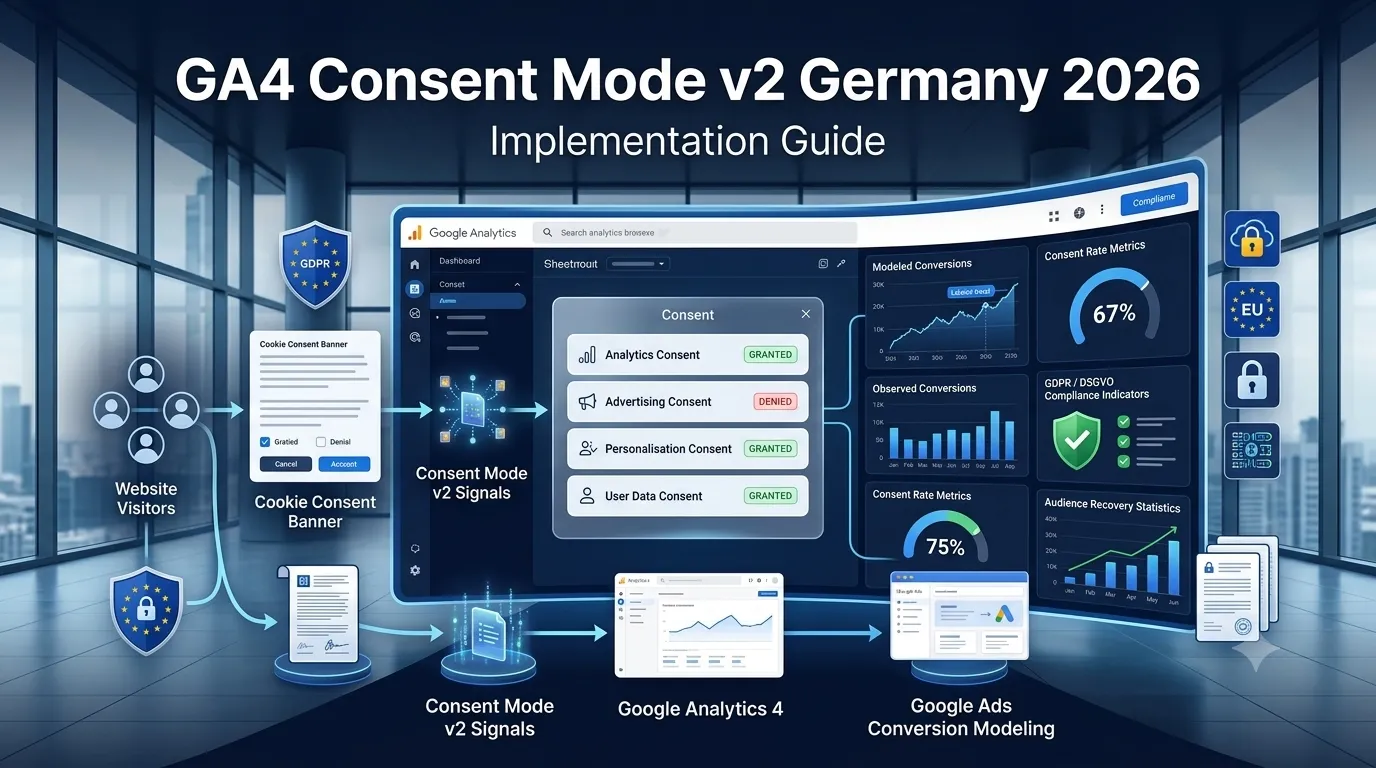
Consent Mode v2 is Google’s framework for collecting analytics and ads data while respecting user consent choices. For German businesses, Consent Mode v2 is not optional — it’s required for Google Ads conversions, Google Analytics audience activation, and meaningful ad performance. Without proper Consent Mode v2 setup, German marketing programs lose 30-50% of their measurement signal and Google’s algorithms underperform.
In 2026, every serious German digital marketing program needs Consent Mode v2 implemented correctly. This guide explains what Consent Mode v2 is, how to configure it for the German market with TTDSG and DSGVO requirements, which consent management platforms (CMPs) work, and how to verify your implementation is functioning properly.
What is Consent Mode v2?
Consent Mode v2 is Google’s signals framework that:
1. Communicates user consent state to Google services:
- ad_storage (cookies for advertising)
- analytics_storage (cookies for analytics)
- ad_user_data (user data for ad personalization)
- ad_personalization (ad personalization specifically)
2. Adjusts Google service behavior based on consent:
- Users who consent: full tracking and tag firing
- Users who don’t consent: pings sent without cookies, modeled data fills gaps
- Updated behavior per user choice in real-time
3. Enables conversion modeling for non-consented users:
- Google’s machine learning models conversion behavior of consented users
- Estimates conversions from non-consented users statistically
- Reports include “modeled conversions” alongside observed
- Restores 30-70% of lost conversion signal for typical sites
Why Consent Mode v2 matters specifically (vs v1)\n
- v1 launched 2020, focused on EU privacy compliance
- v2 launched 2024, required for Google Ads in EEA + UK + Switzerland
- v2 adds ad_user_data and ad_personalization signals
- v2 required for Google Ads conversion tracking and audience activation in EEA
- Without v2: Google Ads can’t use European audience signals, conversion data degraded
Compliance posture:
- Consent Mode v2 itself doesn’t grant consent — it communicates consent decisions made elsewhere
- The actual consent collection happens in your cookie consent banner (CMP)
- Consent Mode v2 is the technical interface between your CMP and Google
- Both Consent Mode v2 AND a properly configured CMP are needed for compliance
For broader context, see our marketing analytics attribution Germany guide and server-side tracking Germany guide.
What’s required for DSGVO and TTDSG compliance?
Cookie and tracking compliance in Germany requires:
TTDSG § 25 (Telemediengesetz, specifically cookies):
- Consent required for storing/accessing data on user device
- Exception only for “strictly necessary” cookies
- Consent must be: informed, voluntary, specific, unambiguous, demonstrable
DSGVO Article 6 + Article 7:
- Lawful basis required for data processing
- Consent must be freely given (no consent walls)
- Granular consent (separate purposes)
- Right to withdraw consent
- Records of consent
Practical implementation requirements:
1. Cookie consent banner that:
- Shows on first visit, before any non-essential cookies fire
- Offers “Akzeptieren” (accept) AND “Ablehnen” (reject) with equal prominence
- Provides granular options (Marketing, Analytics, Personalization separately)
- Has detailed settings page accessible
- Records consent timestamp, IP, choices
2. Cookie policy disclosure that:
- Lists every cookie and tracking technology used
- Identifies third-party recipients
- Explains data flows
- Provides opt-out mechanism
3. Privacy policy that:
- Discloses Google services usage
- Names Google Ireland Limited as data processor
- Documents Standard Contractual Clauses for US transfers
- Explains user rights and how to exercise them
4. Technical implementation that:
- Blocks non-essential cookies until consent
- Conditionally fires tags based on consent state
- Records consent in audit trail
- Honors withdrawal of consent
5. Documentation that:
- AVV (Auftragsverarbeitungsvertrag) with Google
- Verzeichnis von Verarbeitungstätigkeiten entry
- DSFA (Datenschutz-Folgenabschätzung) if required by scope
- Cookie list / processing record
Common compliance mistakes:
- “Accept” button colored prominently, “Reject” hidden or grey
- Pre-checked consent boxes
- “Continuing to browse means consent” banners
- Bundled consent (“accept all cookies for our services”)
- No granular control
- Vague cookie descriptions
- Non-compliant CMPs with German market
What CMPs (consent management platforms) work for German market?
Top CMPs for German market in 2026:
Usercentrics (German company):
- Munich-based, deep DACH expertise
- DSGVO and TTDSG native compliance
- Strong Consent Mode v2 integration
- Pricing: €30-€500+/month based on traffic
- Often the German default
Cookiebot (Cybot, Danish):
- European, strong DSGVO compliance
- Automatic cookie scanning and categorization
- Good Consent Mode v2 integration
- Pricing: free for small sites, €15-€500+/month
OneTrust:
- US enterprise compliance platfor\n\n
- Used by many large enterprises
- More expensive and complex
- Pricing: €1,000+/month typically
TrustArc:
- US enterprise compliance
- Privacy-suite beyond just CMP
- Pricing: enterprise-tier
Iubenda (Italian):
- SMB-focused, multi-language
- Affordable for small sites
- Pricing: €27-€300+/year
Klaro (open source):
- Free, self-hosted
- Requires technical implementation
- For technically-capable teams with budget constraints
Borlabs Cookie (WordPress plugin):
- WordPress-specific, German market
- Affordable for WordPress sites
- Pricing: €99-€349/year
Selection criteria for German market:
- TTDSG compliance native (not afterthought)
- Consent Mode v2 integration tested
- German interface and support
- Cookie categorization accuracy
- TCF v2.2 compliance (for programmatic advertising)
- Reporting and audit trail
Most Mittelstand companies: Usercentrics or Cookiebot Enterprise businesses: OneTrust. WordPress websites: Borlabs or Cookiebot
How do you implement Consent Mode v2 step by step?
Step 1: Choose and configure CMP
Select a CMP that supports Consent Mode v2 natively (Usercentrics, Cookiebot, etc.). Configure:
- Cookie categories: Strictly Necessary, Functional, Analytics, Marketing, Personalization
- Cookie scan and categorization
- Banner appearance (compliant with TTDSG)
- Granular consent options
- Detailed cookie policy
Step 2: Implement on website
CMP placed in <head> of every page, before all tracking scripts:
<!-- CMP script in head, before any tracking -->
<script src="https://app.usercentrics.eu/browser-ui/latest/loader.js" id="..." async></script>

<!-- Initialize Consent Mode v2 default state (denied) -->
<script>
window.dataLayer = window.dataLayer || [];
function gtag(){dataLayer.push(arguments);}
gtag('consent', 'default', {
  'ad_storage': 'denied',
  'analytics_storage': 'denied',
  'ad_user_data': 'denied',
  'ad_personalization': 'denied',
  'wait_for_update': 500
});
</script>

<!-- Google Tag Manager loaded after consent default -->
<script>...GTM code...</script>
Step 3: CMP updates Consent Mode based on user choice
When user makes consent choice:
- CMP fires
gtag('consent', 'update', {...})with user’s choices - Google services adjust behavior accordingly
- Tags conditional on consent fire or remain blocked
Step 4: Configure Google Tag Manager
In GTM:
- Set “Consent Settings” on each tag (Google Analytics, Google Ads, Floodlight, etc.)
- Configure “Additional Consent Checks” if needed
- Variables to read consent state if needed for conditional logic
Step 5: Verify implementation
Testing tools:
- Google Tag Assistant
- GA4 DebugView (with consent debugging)
- CMP testing tools (most CMPs have built-in)
- Real user testing in incognito with various consent choices
Step 6: Monitor and report
- Track consent rates in CMP analytics
- Verify modeled conversions appearing in GA4
- Compare conversion volume vs pre-Consent Mode baseline
- Audit consent records monthly
Step 7: Maintain over time
- Quarterly cookie scan and CMP update
- New tracking technologies require CMP categorization
- Consent rates should be monitored for anomalies
- Regulatory changes may require banner updates
What about Google Tag Manager and Consent Mode v2?
GTM integration is critical. Configuration:
Tag-level consent settings:
- Each tag has “Consent Settings” option
- Set “Require additional consent for tag to fire” with relevant consent types
- Tag fires only when specified consent types are granted
Built-in consent types:
- ad_storage
- analytics_storage
- ad_user_data
- ad_personalization
Custom consent types (advanced):
- Define your own categories (e.g., “social_storage”, “support_chat”)
- Map to broader compliance framework
Consent state in variables:
- Read consent state via built-in variables
- Use in trigger conditions
- Enable conditional logic based on consent
Default consent state:
- Set in container settings
- All defaults should be “denied” for German compliance
- CMP updates to “granted” when user accepts
Best practice:
- Test every tag with various consent scenarios
- Document which tags require which consent types
- Audit quarterly
- Train team on consent-tag relationship
How do you measure modeled conversions and compare to actual?
GA4 reports show conversions split into:
- Observed conversions: from consented users with full tracking
- Modeled conversions: Google’s estimate for non-consented users
Where to find modeled conversion data:
- GA4 → Advertising → Attribution → Model comparison
- GA4 → Reports → Acquisition with attribution view
- Google Ads conversion reports
Validation approach:
- Compare total conversions (observed + modeled) vs pre-Consent Mode baseline
- Total should be 80-95% of pre-Consent Mode levels for properly implemented sites
- Below 70%: implementation problem (Consent Mode not properly configured)
- Above 95%: consent rates exceptionally high (possible UI issue making rejection hard)
Healthy consent rate ranges for German market:
- B2B sites: 50-75% consent rate typical
- B2C sites: 35-60% consent rate typical
- News/content sites: 25-50% typical (often lower due to perceived less value exchange)
- E-commerce: 60-80% typical (users want functionality)
Consent rate optimization (compliant):
- Clear value proposition for accepting (don’t make false claims)
- Easy banner UX (don’t make it tedious)
- Don’t manipulate (no dark patterns)
- Respect rejections gracefully
- Optimize the “Detailed settings” path for users who want control
What KPIs matter for Consent Mode v2 implementation?
Compliance KPIs:
- CMP functioning rate (% of sessions with proper banner display)
- Cookie scan accuracy (% of cookies categorized correctly)
- Audit trail completeness
- DSGVO incident rate (target: zero)
Performance KPIs:
- Total conversion recovery (observed + modeled vs pre-Consent Mode)
- Consent rate by traffic source
- Modeled conversion volume per channel
- Audience size in Google Ads (consent state affects audience eligibility)
Optimization KPIs:
- A/B test results on consent banner UX
- Conversion rate impact of banner changes
- Time to consent decision (UX efficiency)
- Bounce rate from consent banner
Frequently asked questions about GA4 Consent Mode v2 Germany
No. Technical layer only. CMP + banner + policies + AVV all still required.
Conversion tracking degraded + audience limited + performance drops 30–60%. Plus regulatory risk.
Yes but lose modeled conversions and optimization. Consent Mode v2 pings are anonymous + compliant.
Clear value prop + clean design + educational content. No dark patterns.
Google-specific. Meta/TikTok/LinkedIn have own integrations. CMPs support all.
Complementary. Server-side sends events with hashed PII; Consent Mode communicates state.
DSGVO Article 83 fines up to 4% revenue + Abmahnung + investigations. Plus performance degrades.
Quarterly minimum. Plus per new tracking tech, Google updates, regulatory changes.
Ready to implement Consent Mode v2 for your German site?
Consent Mode v2 + properly configured CMP is the table-stakes infrastructure for serious German digital marketing in 2026. The compliance lift is real but manageable; the performance benefits in recovered conversion signal pay back the investment within months.
Book a meeting for a free Consent Mode v2 audit where we’ll verify your implementation, identify compliance gaps, and recommend optimization steps. Or browse our digital marketing services and contact us to discuss a Consent Mode v2 implementation.