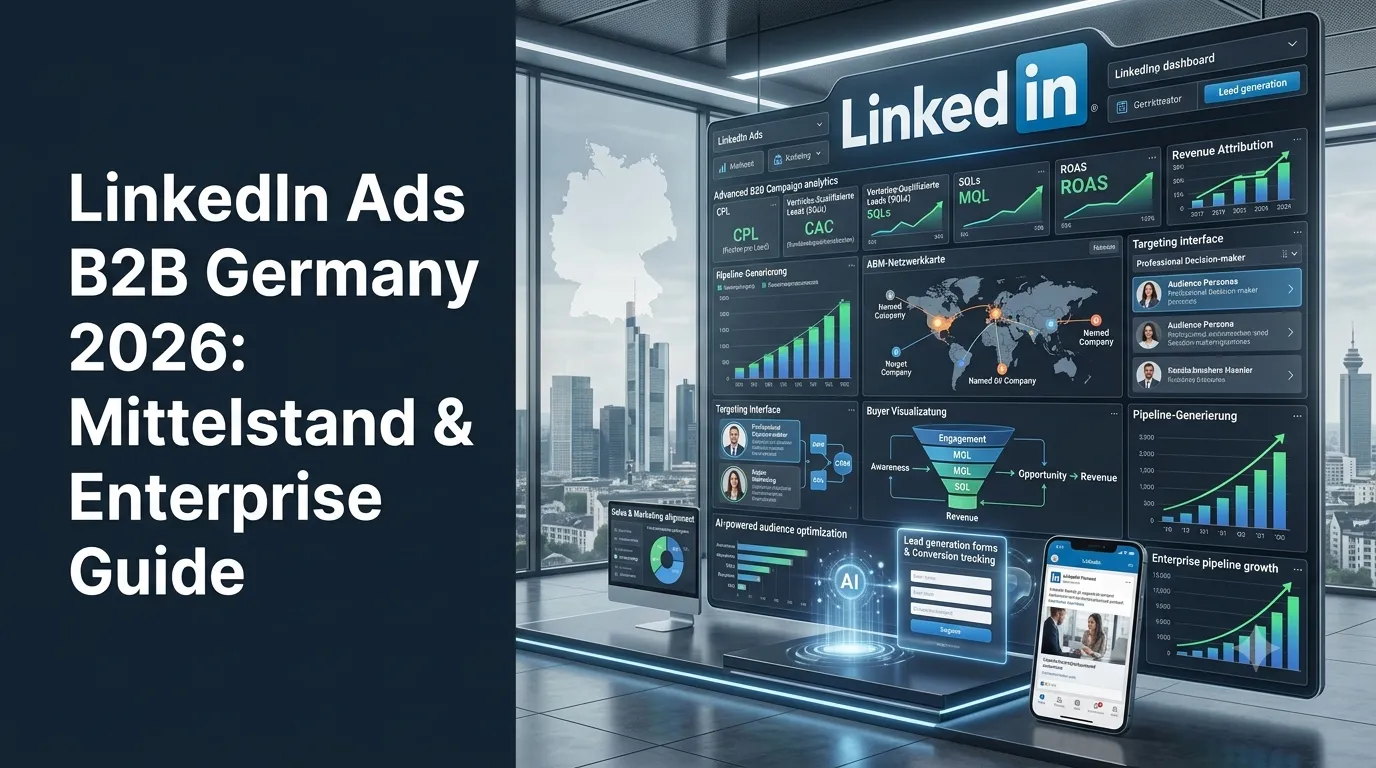
LinkedIn is the dominant B2B paid social channel in Germany — more dominant than in the US. The platform has 22+ million members in the DACH region, the majority of whom check the feed weekly. For Mittelstand B2B SaaS, professional services, enterprise sales, and any business targeting decision-makers at named accounts, LinkedIn is rarely optional in 2026.
But LinkedIn Ads is the most expensive paid channel per click in Germany. CPCs of €8–€18 are normal. CPLs of €60–€200 for qualified B2B leads are typical. ROI only works when LTV supports the spend and when execution is rigorous: precise targeting, strong creative, proper landing pages, mature attribution. This guide explains how to win on LinkedIn for the German B2B market — what works, what wastes budget, and how to scale once you find what works.
Why is LinkedIn the dominant B2B channel in Germany?
Three structural reasons:
1. Audience concentration: nearly all German professional decision-makers in B2B SaaS, manufacturing, finance, consulting, healthcare, and tech have LinkedIn profiles. Even older Mittelstand executives (who used Xing historically) have transitioned. Reaching German B2B audiences off LinkedIn requires expensive and fragmented effort across many smaller channels.
2. Professional context: users on LinkedIn are in work mode. They engage with industry content, business decisions, vendor evaluations. Ads in this context don’t compete with cat videos and personal updates the way they do on Meta. Higher attention quality = better B2B conversion.
3. Targeting depth: LinkedIn’s job title, seniority, company size, industry, and skills targeting is unmatched for B2B precision. You can target “VP of Engineering at SaaS companies in DACH with 200–1,000 employees” — that’s impossible on Google, Meta, or any other channel.
The result: for B2B with ACV above €5K, LinkedIn typically captures 40–60% of paid budget in Germany. Below €5K ACV, LinkedIn often doesn’t pencil out — CAC math fails.
For broader B2B paid strategy, see our performance marketing Germany guide and B2B SaaS CRO guide.
What’s on LinkedIn Campaign Manager in 2026?
LinkedIn’s ad formats and campaign types:
Ad formats:
- Single image: text + image post format
- Carousel: 2–10 slides with images
- Video: 3 seconds to 30 minutes (best performance: 30–90 seconds
- Document ads: PDFs natively viewable in feed (whitepapers, case studies)
- Conversation ads: interactive flowchart messaging
- Message ads: direct LinkedIn inbox delivery
- Event ads: promote LinkedIn events
- Thought leader ads: amplify personal posts from team members
- Spotlight ads: dynamic personalization based on viewer profile
- Lead Gen Forms: native LinkedIn forms with pre-filled profile data
Campaign objectives:
- Brand Awareness
- Website Visits
- Engagement
- Video Views
- Lead Generation (Lead Gen Forms)
- Website Conversions
- Job Applicants
- Talent Leads
Most-used for B2B in 2026:
- Single image and video ads for awareness and engagement
- Document ads for whitepaper/content distribution
- Lead Gen Forms for low-friction lead capture
- Thought leader ads for executive personal brand amplification
- Conversation ads for nurture sequences
What targeting works best in Germany?
LinkedIn targeting is its superpower. The categories:
Company targeting:
- Company name list (upload up to 300,000 company names — best for ABM)
- Company industry
- Company size (1–10 through 10,000+)
- Company growth rate
- Company revenue (where data available)
- Company connections (1st degree, 2nd degree)
Member targeting:
- Job title (most popular, but expensive due to bid competition)
- Job function (broader than title, cheaper)
- Job seniority (entry, senior, manager, director, VP, CXO)
- Years of experience
- Skills (LinkedIn skills graph)
- Member groups (group membership signals)
- Member interests (publishers and topics)
- Education (university, degree, field of study)
- Language (German, English, etc.)
Location targeting:
- Country, region, city, postal code
- Where they live OR where they work (different audience sizes)
Audience templates and combinations:
- Combine targets with AND, OR, NOT logic
- LinkedIn requires minimum audience size of ~300 members
- Sweet spot: 30,000–300,000 audience size for most campaigns
Best practices for German B2B targeting:
- Lead with industry + seniority + function (not job title)
- Use job title only when targeting very specific roles
- Company size matters more than you’d think — German Mittelstand (250–2,500 employees) is a specific audience
- Geography: DACH (Germany, Austria, Switzerland) or Germany-only
- Language: German + English for tech audiences; German only for traditional Mittelstand
Common targeting mistakes:
- Over-narrowing: audiences below 30,000 cost more and lose algorithm optimization
- Job title obsession: missing audience because titles vary (“Marketing Manager” vs “Head of Marketing” vs “Marketing Director”)
- Ignoring company targeting: missing strong company-level signals (size, industry, growth)
- Forgetting exclusions: not excluding existing customers, partners, competitors, internal employees
What ad creative works for German B2B on LinkedIn?
LinkedIn audiences value substance over flash. Creative that wins:
Tone and style:
- Professional but human (not corporate-stiff)
- Specific over vague
- Sie-form formal for traditional Mittelstand
- Du-form casual for tech startups and creative agencies
- German-language native (not translated from English)
- Real team photos beat stock imagery
- Real customer logos and case study data beat generic claims
Content patterns that work:
- Industry insight or data point (with credible source)
- Customer success story (specific company, specific metric, specific timeframe)
- Comparison content (“X vs Y”, “before/after”, trade-off analysis)
- Step-by-step explainer (carousel format excels here)
- Founder/expert thought leadership (Thought Leader ads amplify these)
- Webinar/event promotion
- Long-form post amplification (boost organic posts that performed well)
Document ads specifically:
- Whitepapers (8–20 pages) — most popular for B2B
- Case studies (4–8 pages) — high credibility
- Industry reports (10–30 pages) — high engagement
- Templates and toolkits — practical value
- Conference decks — repurpose existing content
Video best practices:
- Sound-off optimization (most LinkedIn viewing is sound-off)
- Captions/subtitles always
- Brand visible early (first 3 seconds)
- 30–60 second sweet spot for engagement; up to 90 seconds for cases
- Real people speaking (CEO, customer, expert) beats animated/stock
- Vertical 9:16 for mobile feed; 1:1 square for broader compatibility
Creative refresh cycle:
- Refresh every 4–6 weeks minimum
- 5–10 creative variants per campaign per month
- Kill bottom 30%, scale top 30%, iterate middle 40%
- LinkedIn audience fatigue is real but less severe than Meta (more passive scrolling)
What does LinkedIn Ads cost in Germany?
Typical 2026 metrics for German B2B on LinkedIn:
CPM:
- Broad targeting (industry + seniority): €40–€80
- Mid-precision targeting (industry + function + seniority): €60–€100
- High-precision targeting (job title + company size + industry): €80–€150
- Account-based targeting (company name list): €100–€200+
CPC:
- B2B Mittelstand audiences: €6–€14
- Enterprise B2B (VP/C-suite): €10–€20
- Highly competitive verticals (HR tech, finance, security): €12–€25
CPL (cost per lead via Lead Gen Forms):
- Top-of-funnel content (whitepaper, webinar): €40–€100
- Mid-funnel content (case study, demo): €80–€180
- Bottom-of-funnel (demo request, trial signup): €100–€300
CAC:
- B2B SaaS (€10K+ ACV): €1,500–€6,000 CAC
- Enterprise B2B (€50K+ ACV): €5,000–€20,000 CAC
- Strong programs deliver 3:1+ LTV:CAC ratio
Typical monthly spend ranges:
- SMB B2B testing LinkedIn: €3K–€8K/month
- Mittelstand B2B serious program: €8K–€30K/month
- Enterprise B2B with ABM: €30K–€100K+/month
For broader cost benchmarks, see our digital marketing cost Germany 2026 guide.
How do you structure LinkedIn campaigns?
Recommended account structure for German B2B:
Account: [Company] LinkedIn Ads
├── Campaign Group: Awareness
│   ├── Campaign: Thought leadership - DACH
│   └── Campaign: Brand video - Mittelstand
├── Campaign Group: Engagement
│   ├── Campaign: Document download - Whitepaper Q2
│   └── Campaign: Webinar promotion
├── Campaign Group: Lead Generation
│   ├── Campaign: Lead Gen Form - ICP A (SaaS 50-500 employees)
│   ├── Campaign: Lead Gen Form - ICP B (Manufacturing 250-2500)
│   └── Campaign: Website conversion - Demo request
├── Campaign Group: ABM
│   ├── Campaign: Target accounts - tier 1
│   └── Campaign: Target accounts - tier 2
└── Campaign Group: Retargeting
    ├── Campaign: Website visitors (last 30 days)
    └── Campaign: Email list - nurture
Principles:
- One campaign per audience segment with distinct CAC expectations
- Separate awareness/engagement from direct response (different KPIs)
- ABM campaigns get separate group for budget and reporting
- Retargeting campaigns budget-protect against audience saturation
How do you set up conversion tracking on LinkedIn?
LinkedIn conversion tracking essentials:
1. LinkedIn Insight Tag: client-side tracking pixel installed sitewide
2. Conversion API (LinkedIn CAPI): server-side conversion forwarding via sGTM or direct integration
3. Conversion events: define events for each funnel stage
- View Lead Gen Form
- Submit Lead Gen Form
- View key landing page
- Submit demo request
- Sign up for trial
- Become MQL (offline import from CRM)
- Become SQL (offline import)
- Become Customer (offline import)
4. Offline Conversion Import: critical for B2B with long sales cycles. Import MQL/SQL/Customer events from CRM (HubSpot, Salesforce) back to LinkedIn. This trains LinkedIn’s algorithm on what good outcomes actually look like.
5. CAPI for Lead Gen Forms: forwards form submissions server-side with hashed user data for better attribution.
Without offline conversions, LinkedIn optimizes for form submissions — which include many low-quality leads. With offline conversions tied back to revenue events, LinkedIn optimizes for revenue-quality leads. This is the single biggest lever for B2B LinkedIn performance in 2026.
For tracking infrastructure, see our server-side tracking Germany guide.
How does ABM work on LinkedIn in Germany?
Account-based marketing (ABM) is LinkedIn’s superpower for German B2B. The mechanics:
1. Build target account list:
- Identify 50–500 named accounts that fit ICP
- Source: ICP analysis, sales-generated list, intent data (e.g., 6sense, Bombora, Cognism)
- Upload to LinkedIn as company list (matched against LinkedIn database)
- Typical match rate: 60–80% of uploaded companies
2. Identify decision-maker personas at those accounts:
- 3–7 personas per account (champion, economic buyer, technical evaluator, etc.)
- Define by seniority + function + skills at the target companies
3. Run sequenced campaigns:
- Campaign 1: Brand awareness — broad reach to target accounts (3 weeks)
- Campaign 2: Thought leadership — engagement and education (3 weeks)
- Campaign 3: Mid-funnel content — case studies, whitepapers (3 weeks)
- Campaign 4: Direct response — demo request, consultation (ongoing)
4. Layer with personal outreach:
- Sales reps follow up on engaged contacts
- LinkedIn Sales Navigator integration
- Email + LinkedIn InMail nurture
- Direct mail to top-tier accounts (still effective for German Mittelstand)
5. Measure account-level engagement:
- Account engagement score (combined views, clicks, form fills)
- Pipeline created per target account
- Closed-won revenue per target account
- Time from first engagement to closed-won
ABM budget allocation: typically €100–€500 per target account per quarter for digital touch alone. Plus sales rep time, content production, and direct mail/gift budget.
For B2B SaaS ABM specifically, see our B2B SaaS CRO guide.
What KPIs matter for LinkedIn Ads in Germany?
Top-line:
- Marketing-sourced pipeline (€)
- Marketing-sourced closed-won revenue (€)
- CAC and LTV:CAC ratio
- Account engagement (for ABM)
Channel-level:
- CPL by audience segment
- Cost per MQL and SQL
- Cost per opportunity created
- Cost per closed-won deal
- LTV by LinkedIn-acquired customer vs other channels
Campaign-level:
- CTR (typical: 0.4–1.2% for non-Lead Gen Form campaigns)
- CPC (vs target)
- Lead Gen Form completion rate (typical: 8–18%)
- Lead quality score (qualified vs unqualified)
- Frequency (target: <5 per audience per week)
Diagnostic:
- Audience overlap across campaigns
- Creative performance variance
- Placement performance (Feed vs Right Rail vs Audience Network)
- Time-to-conversion from first impression
Frequently asked questions about LinkedIn Ads B2B Germany
Usually not. LinkedIn CAC €1,500+ requires €4,500+ LTV for 3:1. Google Ads/content beats LinkedIn for low-ACV B2B.
Use both. Forms for top-funnel (whitepapers). Website for bottom-funnel (demo, trial).
Qualification questions, higher-intent offers, tighter targeting, offline conversion import, negative audience exclusions.
3–5 impressions per user per week. Above 5: fatigue. Below 3: not top-of-mind.
Mittelstand: German. International/tech B2B: German + English. Test for your audience.
LinkedIn dominates. Xing mostly faded except HR/recruitment and conservative Mittelstand.
Third-party network outside LinkedIn. Cheaper CPMs, lower quality. Awareness: yes. Direct response: usually exclude.
Combine Sponsored Content (awareness) with InMail (engaged outreach). EU compliance limits per-user volume.
€3K/month minimum. Serious program: €8K–€20K/month. ABM: €15K–€60K/month.
Ready to scale your LinkedIn Ads in Germany?
LinkedIn is where high-value German B2B buyers spend professional attention. The brands compounding pipeline growth in 2026 are running rigorous LinkedIn programs: precise targeting, strong creative, mature attribution, and ABM for top-tier accounts. The cost is real, but so is the ROI when execution is right.
Book a meeting for a free LinkedIn Ads audit where we’ll review your account structure, targeting precision, creative performance, and attribution maturity. Or browse our digital marketing services and contact us to discuss a LinkedIn Ads engagement.