
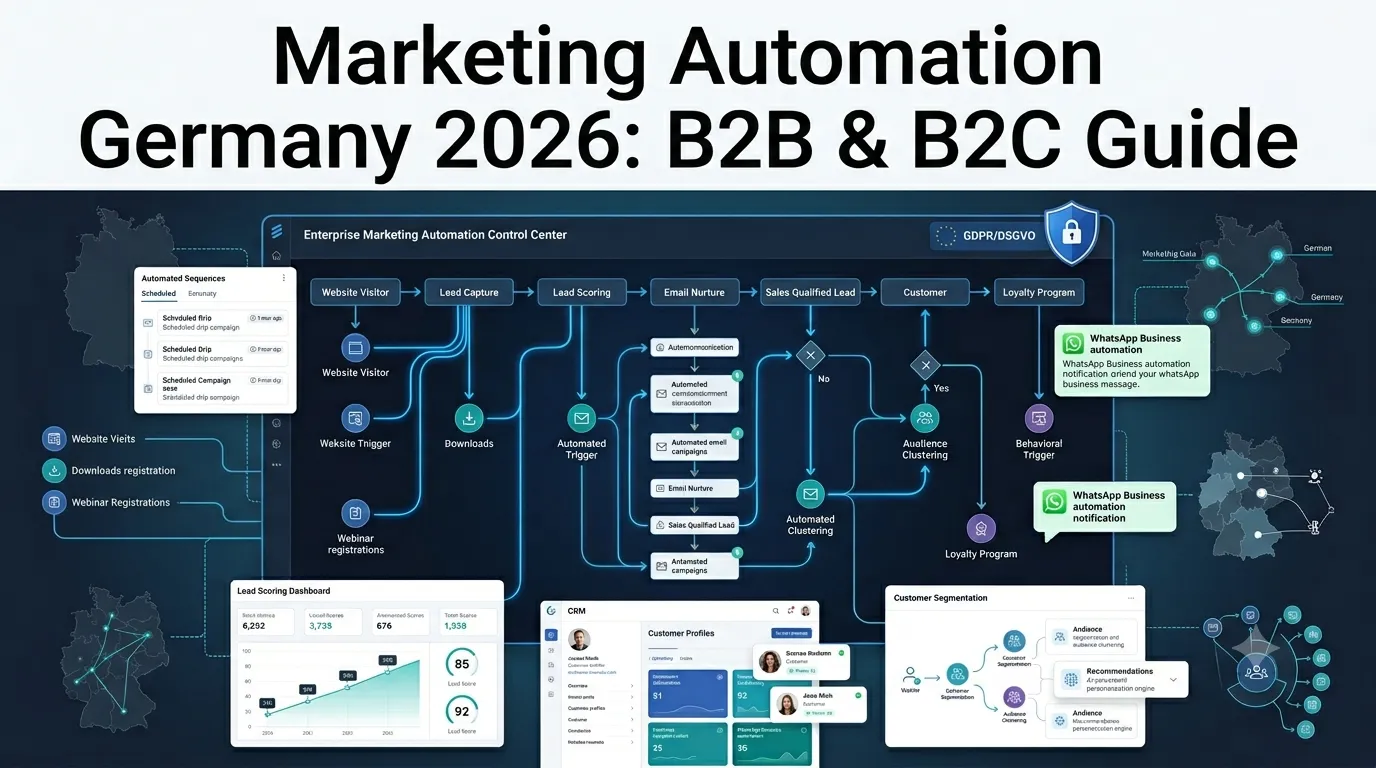
marketing automation Germany is the infrastructure that lets a small marketing team operate like a much larger one. Lead nurture sequences run themselves. Welcome flows onboard new subscribers without manual intervention. Behavioral triggers re-engage cart abandoners while you sleep. Lead scoring routes the hot prospects to sales. Done right, marketing automation multiplies the leverage of every other marketing activity — paid acquisition, content, events, organic.
In Germany 2026, marketing automation has matured significantly. The platforms are more capable, the integrations more reliable, the compliance frameworks better understood. But marketing automation implementations still fail more often than they succeed — usually because companies bought software without designing the strategy first. This guide explains how to think about marketing automation in Germany: what to automate, what platforms work, what DSGVO compliance requires, and how to actually implement programs that deliver returns.
What does marketing automation actually do?
Marketing automation systems perform four core functions:
1. Trigger-based communications:
- Send email/SMS/WhatsApp when user takes action
- Cart abandonment, welcome series, post-purchase
- Behavioral triggers from website, app, CR
2. Scheduled drip sequences:
- Multi-step nurture campaigns over days/weeks/months
- Lead nurture for B2B sales cycles
- Customer onboarding sequences
- Lifecycle programs (renewal, churn prevention)
3. Lead scoring and routing:
- Assign scores based on behavior and demographics
- Identify sales-ready leads
- Route leads to right salesperson automatically
- Trigger notifications and follow-up tasks
4. Segmentation and personalization:
- Dynamic audience segmentation based on attributes and behavior
- Personalized content delivery
- Lifecycle stage management
- Custom journeys per persona
What marketing automation is NOT:
- A replacement for marketing strategy
- A way to send more emails without consent
- A magic solution that works without configuration
- A substitute for understanding your customers
The implementation reality: marketing automation only works as well as the strategy, content, data, and processes behind it. Software is 30% of the project; strategy and content are 70%.
For broader context, see our digital marketing services Germany guide and email marketing Germany DSGVO guide.
What should you automate first?
In rough priority order for German Mittelstand B2B and B2C:
1. Welcome series (new subscribers):
- 3-5 email sequence over 7-14 days
- Introduce brand, share value, build engagement
- Highest-ROI automation; easiest to implement
2. Post-purchase / post-signup onboarding:
- Customer/user activation sequences
- Education and engagement building
- Reduces churn, increases LTV
3. Cart abandonment (e-commerce):
- 2-4 emails over 24-72 hours
- Often 10-20% of abandoned carts recovered
- Critical for e-commerce ROI
4. Lead nurture for B2B sales cycles:
- Multi-month sequences for slow-burn B2B opportunities
- Education + social proof + sales touchpoints
- Critical for high-AOV B2B with long cycles
5. Lifecycle stage transitions:
- Trial → paid conversion sequences
- Customer → repeat customer sequences
- Customer → churn risk sequences
6. Re-engagement campaigns:
- Inactive subscriber win-back sequences
- Sunset sequences for unrecoverable contacts
- Maintains list health
7. Behavioral triggers:
- Page view sequences (visited pricing page 3+ times)
- Content download follow-up
- Webinar registration to attendance to follow-up
8. Birthday / anniversary emails:
- Personal touches that increase loyalty
- Lower priority than functional automation
Start with #1-3. Master those. Then expand. The mistake most companies make: trying to build 20 workflows simultaneously and shipping none of them well.
What B2B lead nurture sequences work in Germany?
B2B nurture sequences should match the buyer’s journey. A typical structure for German B2B SaaS or services:
Top-of-funnel stage: Educational content
- Day 0: Welcome email (thanks for downloading whitepaper / signing up)
- Day 3: Related educational content (blog post, video, podcast)
- Day 7: Industry insight or data point
- Day 14: Customer success story (relevant to subscriber’s segment
Middle-funnel stage: Consideration content
- Day 21: Product/service value proposition (concrete benefits)
- Day 28: Comparison or alternatives content (you vs alternatives)
- Day 35: Live event invitation (webinar, demo, workshop)
- Day 42: Trust signal email (case study, reviews, certifications)
Bottom-funnel stage: Decision-focused content
- Day 50: Direct CTA (book a meeting, request quote, start trial)
- Day 60: Risk reversal (money-back, free pilot, satisfaction guarantee)
- Day 70: Founder/expert personal letter
- Day 90: Final decision support email
Branching logic:
- If subscriber engages strongly (multiple opens, clicks), shorten cadence and route to sales sooner
- If subscriber goes inactive, slow cadence and try re-engagement
- If subscriber unsubscribes, suppress all future marketing
- If subscriber converts to customer, transition to customer lifecycle automation
German B2B specifics:
- Sie-form throughout for traditional Mittelstand
- Substantive content, less marketing-speak
- Clear value proposition in subject lines
- Concrete numbers and proof points
- Easy unsubscribe in every email
- Sales team involvement at right cadence points
What B2C automation sequences work in Germany?
E-commerce automation priorities:
Welcome series (post-signup, pre-purchase):
- Day 0: Welcome + discount code (if applicable)
- Day 3: Bestsellers or curated picks
- Day 7: Brand story / values
- Day 14: User-generated content / reviews
Abandoned cart:
- 1 hour: gentle reminder
- 24 hours: highlight benefits + reviews
- 48 hours: incentive (small discount or free shipping)
- 72 hours: final reminder with urgency
Post-purchase:
- Day 0: Order confirmation
- Day 1: Shipping notification + brand intro
- Day 5-7 (after delivery): How-to or care instructions
- Day 14: Review request
- Day 30: Cross-sell or related products
- Day 60: Loyalty program invitation
Win-back (lapsed customers):
- After 90 days no purchase: “We miss you”
- After 180 days: Incentive offer
- After 270 days: Final win-back attempt
- After 365 days: Sunset (remove from active list)
VIP / repeat customer:
- After 3rd purchase: VIP welcome
- Birthday emails
- Early access to new products
- Higher-value content and offers
What’s lead scoring and how does it work in Germany?
Lead scoring assigns numeric values to lead behavior and attributes, helping prioritize sales follow-up:
Demographic / firmographic scoring:
- Job title (CEO/CMO: +20, Coordinator: +5)
- Company size (Enterprise: +25, SMB: +5)
- Industry (target industries: +15, off-target: +0 or negative)
- Country/region (DACH: +10, other: +0)
Behavioral scoring:
- Email open (+1)
- Email click (+3)
- Page view: pricing page (+10), feature pages (+5), blog (+1)
- Content download (+15)
- Webinar attendance (+20)
- Demo request (+30)
Negative scoring:
- Unsubscribe (-50)
- Spam complaint (-100)
- Visit to careers page (-15, indicates job seeker not buyer)
- Long-period inactivity (-2 per week)
Threshold-based actions:
- 50+: marketing qualified lead (MQL) — automated nurture
- 100+: sales qualified lead (SQL) — route to sales rep
- 150+: hot lead — immediate sales outreach
- Drops below 30: back to nurture
Implementation considerations:
- Start simple (10-15 scoring rules), iterate
- Test scoring threshold against actual conversion outcomes
- Decay scores over time (recency matters)
- Different scoring models for different products / personas
DSGVO consideration:
- Document scoring logic and inform users in privacy policy
- Right to explanation under DSGVO Article 22 for automated decisions
- Don’t use scoring for sensitive automated decisions without human review
What platforms work for German marketing automation?
SMB / Mittelstand:
- ActiveCampaign: strong automation, German support, €30-€500/month
- Brevo (Sendinblue): European, multilingual, €25-€500/month
- HubSpot Starter/Pro: integrated CRM+marketing, €50-€1,200/month
- GetResponse: solid SMB platform, €15-€250/month
Mid-market:
- HubSpot Marketing Hub Professional: most popular German B2B choice, €800-€3,600/month
- ActiveCampaign Enterprise: advanced automation at scale
- Klaviyo: e-commerce specialist for Shopify/WooCommerce
- Salesforce Marketing Cloud (Account Engagement / Pardot): enterprise B2B
Enterprise:
- Salesforce Marketing Cloud: full enterprise stack
- Adobe Experience Cloud / Marketo: enterprise B2B
- Oracle Eloqua: traditional enterprise B2B
- Iterable / Customer.io / Braze: product-led growth and SaaS-native
Selection criteria for German market:
- DSGVO compliance posture and EU/German hosting
- German-language interface and support
- Integration with CRM (Salesforce, HubSpot, Pipedrive)
- Integration with e-commerce platform (Shopify, WooCommerce)
- Automation capability depth
- Pricing model and scalability
For platform comparison detail, see our HubSpot vs ActiveCampaign vs Brevo Germany guide (forthcoming).
What integrations matter for German marketing automation?
Essential integrations:
CRM:
- Salesforce, HubSpot, Pipedrive
- Two-way sync of contact and company data
- Lead status updates and opportunity creation
E-commerce platform (B2C):
- Shopify, WooCommerce, Shopware
- Customer data, order data, product data
- Behavioral triggers (cart abandonment, post-purchase)
Website CMS:
- WordPress, Webflow
- Form submissions, page view tracking
- Dynamic content based on visitor data
Analytics:
- GA4, server-side tracking
- Attribution and revenue tracking
- Audience activation
Sales tools:
- LinkedIn Sales Navigator
- Sales engagement platforms (Outreach, Salesloft)
- Calendar tools (Calendly, Chili Piper)
Communication channels:
- SMS (Twilio integration in many platforms)
- WhatsApp Business API
- Push notifications (mobile and web)
Webinar / events:
- Zoom, GoToWebinar, Demio
- Event registration to email list to follow-up automation
Data and enrichment:
- ZoomInfo, Cognism, Clearbit
- Enrich contact data with firmographic info
- Improve segmentation and scoring
How much does marketing automation cost in Germany?
Software cost:
- SMB tier: €30-€500/month
- Mid-market: €500-€3,600/month
- Enterprise: €3,000-€15,000+/month
Implementation cost (one-time):
- DIY setup with platform support: €0 cash + 40-80 hours team time
- Boutique agency implementation: €5,000-€20,000
- Mid-market agency implementation: €15,000-€60,000
- Enterprise implementation: €50,000-€500,000+
Ongoing management:
- In-house specialist: €60K-€95K base + benefits
- Agency retainer: €2,000-€8,000/month
- Freelancer / part-time: €1,000-€3,500/month
Content production for automation:
- Email templates: €100-€500 per design
- Sequence content (8-12 emails): €1,500-€6,000 per sequence
- Ongoing content refresh: €500-€2,000/month
Total annual marketing automation investment for Mittelstand: typically €30K-€150K/year all-in. ROI typically 5-15x within 12 months for well-implemented programs.
For broader cost context, see our digital marketing cost Germany 2026 guide.
What DSGVO compliance applies to marketing automation?
Marketing automation amplifies DSGVO requirements:
1. Consent basis for every contact:
- Documented consent for marketing communications
- Granular consent for different channels (email, SMS, WhatsApp)
- DOI for email marketing
- Records of consent timestamp, IP, source
2. Data minimization:
- Collect only data needed for marketing purposes
- Document why each data field exists
- Regular review and pruning of unused fields
3. Right to access, correct, delete:
- Self-service preference center for subscribers
- Process for handling DSAR (Data Subject Access Requests)
- 30-day max response window
- Documented deletion workflow
4. Lead scoring transparency:
- Privacy policy explains automated decision-making
- Sensitive automated decisions reviewable by human
- Right to explanation under Article 22
5. Data retention policy:
- Define how long contact data is retained
- Automatic deletion or anonymization after retention period
- Sunset sequences for inactive subscribers
6. AVV with platform:
- Auftragsverarbeitungsvertrag with your marketing automation vendor
- Standard Contractual Clauses for non-EU data transfer
- Documented in Verzeichnis von Verarbeitungstätigkeiten
7. Cross-border data considerations:
- US-hosted platforms (HubSpot, ActiveCampaign): SCCs required, Schrems II considerations
- EU-hosted alternatives where data residency matters
- Document transfer mechanism for compliance audits
The compliance overhead is real but manageable. The platforms have evolved to support DSGVO compliance natively — use their built-in tools rather than building from scratch.
What KPIs matter for marketing automation in Germany?
Top-line:
- Revenue attributed to automation
- Pipeline created through automation flows
- Customer LTV improvement from automation-touched cohorts
Funnel KPIs:
- Lead-to-MQL conversion rate
- MQL-to-SQL conversion rate
- SQL-to-opportunity rate
- Opportunity-to-closed-won rate
Engagement KPIs by automation:
- Open rate per sequence
- Click-through rate per sequence
- Completion rate (% who reach end of sequence)
- Time to conversion
Operational KPIs:
- Active workflows count
- Active subscribers in nurture
- Lead scoring accuracy (predicted vs actual conversion)
- Sales-marketing alignment (lead acceptance rate)
Health KPIs:
- Unsubscribe rate per automation
- Spam complaint rate
- List churn rate
- Compliance violation incidents (target: zero)
Frequently asked questions about marketing automation Germany
3–6 months foundation. Quick wins month 1. Sophisticated workflows 6–12 months.
Under €1M: no. €1M–€10M: part-time/fractional. €10M+: dedicated specialist usually justified.
Behavioral personalization, plain-text variants, human reply-to, founder letters, varied content, right cadence.
Yes but loses value. B2B: CRM foundational. B2C: e-commerce platform substitutes partially.
Rising. Order updates, service, nurture, cart recovery. Separate opt-in + easy opt-out required.
Carefully. Cold outbound is risky in Germany. Opted-in nurture and known-prospect workflows are fine.
UTMs + GA4 + multi-touch attribution + import MQL/SQL/opportunity events. Last-click underestimates nurture.
AI accelerates copy/personalization/next-best-content. Use for execution, keep strategy human.
Ready to build or optimize your marketing automation in Germany?
Marketing automation is the leverage multiplier for every other marketing investment. For German Mittelstand and SaaS, automation done right delivers 5-15x ROI within 12 months. The companies winning are those that invested in strategy first, then infrastructure, then content.
Book a meeting for a free marketing automation audit where we’ll review your current automations, identify gaps, and recommend the top 5 workflows to build first. Or browse our digital marketing services and contact us to discuss a marketing automation engagement.