
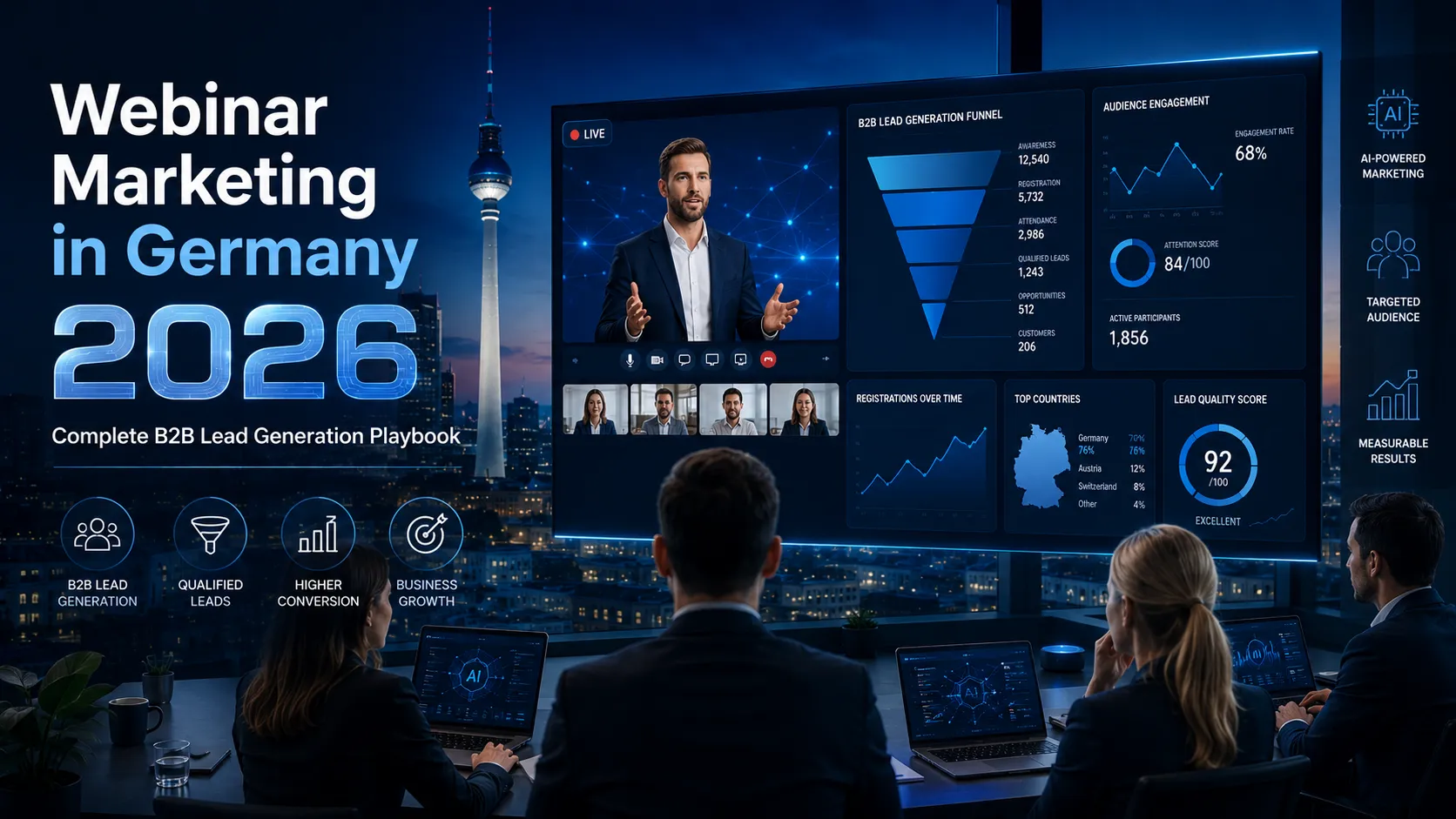
Webinar marketing in Germany is the most consistent B2B lead generation tactic in 2026. They combine three powerful effects: substantive content (which builds authority), genuine engagement (60+ minutes of focused attention from prospects), and direct sales handoff (qualified leads ready for conversation). For German Mittelstand B2B and SaaS, a regular webinar program generates pipeline at lower CAC than most paid channels — and the audience asset compounds over time.
In Germany 2026, webinars have matured beyond the gimmicky lead-magnet “free training” of 2018-2020. Real webinars offer real value, attract real buyers, and convert at meaningful rates. This guide covers what works for German B2B webinar marketing: topic selection, format optimization, registration funnels, attendance maximization, conversion mechanics, and post-event nurture.
Why do webinars work so well for German B2B?
Webinars deliver disproportionate value for German B2B because:
1. Match German B2B buyer behavior:
- German buyers research deeply before engaging sales
- Want substance over sales pitches
- Value learning from experts
- Comfortable with longer-format content
- 60-minute webinar is normal investment
2. Capture high-intent leads:
- People who register are committing time
- Higher commitment = higher quality
- Self-selected for relevant topic
- Often well-defined position and role at company
3. Demonstrate expertise:
- Live presentation builds credibility
- Q&A shows depth of knowledge
- Real customers in attendance create social proof
- Authority compounds across webinars
4. Enable direct sales handoff:
- Live engagement creates relationships
- Q&A reveals prospect needs
- Follow-up calls have warm context
- Faster sales cycles for webinar-attended leads
5. Compound content asset:
- Recording becomes ongoing resource
- Transcript becomes blog content
- Clips become social posts
- Long-tail traffic and leads continue for years
6. Lower CAC than most paid channels:
- Production cost moderate, scale unlimited
- One webinar can generate 100-1,000 leads
- CPL often 30-50% of equivalent paid lead
Typical German B2B webinar performance:
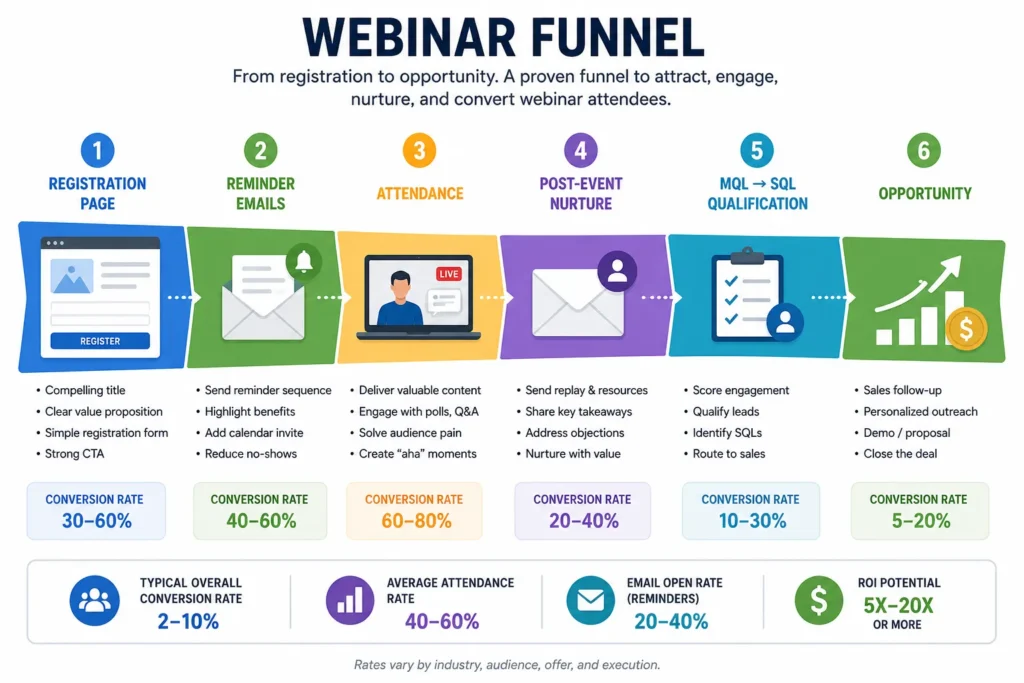
- Registration page conversion: 30-60%
- Registration → attendance: 30-50%
- Attendees → MQLs: 20-50%
- MQLs → SQLs: 25-50%
- SQLs → opportunities: 30-60%
For broader context, see our B2B lead generation Germany guide and content marketing strategy Germany guide.
What webinar marketing topics work for German B2B?
Strong topic patterns:
1. Educational deep-dives:
- “How [Topic] actually works in 2026”
- “[Specific challenge] solved: a complete framework”
- Substantive content, minimal sales
2. Trend analysis:
- “[Industry] trends to watch in [year]”
- “What’s changing in [domain] for [audience]”
- Forward-looking, original analysis
3. Customer success stories:
- “How [Customer] achieved [outcome]”
- Customer + brand co-presented
- Detailed walkthrough with specific metrics
4. Comparison and benchmark:
- “[Approach A] vs [Approach B]: trade-offs and outcomes”
- “[Industry] benchmarks: where you stand”
- Data-driven, useful regardless of vendor choice
5. Case study workshops:
- “Working through a real [topic] challenge live”
- Interactive, problem-solving format
- Demonstrates expertise through application
6. Expert interviews and panels:
- “[Topic] discussed by [3 industry experts]”
- Multiple perspectives
- Often higher attendance than solo presentations
7. Product demos and use cases:
- “[Product] in action: real workflows”
- Use cases relevant to ICP
- Reserved for bottom-of-funnel webinars
Weak topic patterns (avoid):
- Vague “growth hacks” promises
- Overly self-promotional content
- Topics that don’t match ICP pain
- Repetitive content (same topic 6 webinars in a row)
Topic selection process:
- Survey existing customers for common challenges
- Analyze top-performing blog content
- Talk to sales team about objection patterns
- Monitor industry conversations on LinkedIn
- Look at competitor webinar offerings (then differentiate)
Cadence:
- Monthly webinar (12 per year): typical for active B2B program
- Bi-weekly: ambitious but sustainable for full-time webinar team
- Quarterly: minimum to maintain audience momentum
- Less than quarterly: hard to build webinar audience
How do you structure a high-converting webinar marketing in Germany?
60-90 minute optimal length (German B2B comfortable with longer):
Structure for 60-minute webinar:
Minutes 0-5: Introduction
- Welcome and housekeeping
- Speaker introduction (credentials, relevance)
- Webinar overview (what they’ll learn)
- Setting expectations for Q&A and recording
5-15: Minutes Problem definition
- The challenge or topic context
- Why it matters now
- Concrete examples of impact
- Sets up the framework or solution
15-40: Minutes Core content
- Main framework, methodology, or insights
- Specific examples and case studies
- Data and proof points
- Educational, not promotional
40-50: Minutes Application and examples
- How to apply what was covered
- Specific recommendations
- Common pitfalls to avoid
- Real customer outcomes
50-55: Minutes Soft pitch
- Brief overview of how your solution helps
- Clear value proposition
- Specific next-step offer (consultation, trial, demo)
- Not aggressive — earned right to pitch through 50 minutes of value
Minutes 55-60: Q&A
- Live questions from audience
- Demonstrates depth
- Creates engagement
Post-webinar (after end):
- Continue Q&A in chat
- Pin key takeaways
- Clear CTA visible
Key design principles:
- 80% education, 20% promotion (not the other way)
- One key takeaway, not 17
- Slides support but don’t dominate
- Speaker shows on camera (face matters)
- Multiple speakers for variety (host + expert + customer)
- Polls and chat for engagement
- Recording sent to registrants who couldn’t attend
How do you promote webinars to drive registration?
Promotion mix for German B2B webinar:
1. Own audience first:
- Newsletter announcement (typically 30-50% of registrations)
- Customer/CRM list email
- Past webinar attendees email
- Sales team prospect outreach
2. LinkedIn organic:
- Personal post from speaker
- Company page post
- Event creation on LinkedIn
- Founder/team amplification
3. LinkedIn paid (Sponsored Content):
- Promote registration page to ICP audience
- Lead Gen Forms for native LinkedIn registration
- See our LinkedIn Ads B2B Germany guide
4. Google Ads:
- Search ads on relevant topic keywords
- Display retargeting to recent site visitors
5. Industry partnerships:
- Co-host with complementary brands
- Partners promote to their list (mutual)
- Doubles audience reach often
6. Industry communities:
- Slack/Discord communities (with permission)
- LinkedIn groups
- Industry publication community
- Reddit (sparingly, with value-first contributions)
7. Influencer/creator partnerships:
- Industry experts cross-promote
- Podcast guest appearances mentioning webinar
- LinkedIn creator amplification
8. Press and editorial:
- Industry publication mentions
- Press release for significant webinars
- Calendar listings
9. Direct mail (for high-stakes ABM webinars):
- Physical invitation to target accounts
- Premium feel for executive audiences
Timing:
- Announce 3-4 weeks before
- Major push 2 weeks before
- Reminder week before
- Final push 24 hours before
- Same-day reminder morning of
Registration page best practices:
- Clear value proposition (what attendees will learn)
- Speaker bios with credentials
- Specific agenda
- Bullet list of takeaways
- Date and time prominent (with timezone)
- Short form (email + name + company + role typical)
- Social proof (logos of past attendees’ companies if available)
- Reminder of recording availability
Expected costs per webinar registration:
- Owned channels: near-zero marginal cost
- LinkedIn Ads: €15-€60 per registration
- Google Ads: €20-€80 per registration
- Partner cross-promotion: variable
- Blended: €10-€40 per registration typical
How do you maximize webinar attendance?
Registration ≠ attendance. Maximizing show-up rate is critical:
Reminder sequence:
- Confirmation email immediately after registration
- 1 week before: agenda reminder
- 1 day before: tomorrow reminder
- 1 hour before: “starting soon” reminder
- 10 minutes before: “we’re live” reminder
- Add to calendar invite included with first email
Calendar integration:
- ICS calendar attachment in all reminders
- Default calendar add option
- Helps webinar appear in prospect’s day naturally
Multi-channel reminders:
- Email primary
- LinkedIn message from speaker (relationship building)
- SMS opt-in for high-value registrations
- WhatsApp reminder where opt-in obtained
Live engagement tactics that increase attendance:
- Pre-webinar prep email with question to answer
- Exclusive bonus only available live
- Live Q&A only (recording omits some content)
- Limited spots messaging (when genuinely true)
Typical attendance rates:
- B2B webinars in Germany: 30-50% of registrants attend
- Higher (50-70%) for: smaller webinars, near-customer audiences, exclusive content
- Lower (20-35%) for: large webinars, broad topic, low-friction registration
Don’t try to drive 100% attendance — focus on attendees you reach. Send recording to those who couldn’t attend with clear “watch the recording” CTA.
What webinar platforms work for German market?
Major platforms:
Zoom Webinars:
- Most popular, easy to use
- Good German market support
- Pricing: €70-€500+/month
- Best for: most B2B Mittelstand
GoToWebinar:
- Long-time leader in webinar space
- Strong analytics
- Pricing: €100-€500+/month
- Best for: enterprise B2B
Demio:
- Marketing-focused features
- Clean UX
- Pricing: €40-€200+/month
- Best for: marketing-driven webinars
ClickMeeting:
- European company (Polish)
- DSGVO-friendly posture
- Pricing: €30-€150+/month
- Best for: European compliance focus
Microsoft Teams Live Events:
- Free with Microsoft 365 Enterprise
- Less flexible than dedicated platforms
- Good for internal events
Hopin / RingCentral Events:
- Conference and multi-track event platform
- Higher-end pricing
- Best for: larger virtual conferences
WebinarJam / EverWebinar:
- Evergreen webinar capability (recorded as live)
- Marketing-focused
- Less common in DACH B2B
Selection criteria:
- Attendee capacity (50? 500? 5000?)
- Audio/video quality
- Engagement features (polls, chat, Q&A)
- Recording quality
- Analytics depth
- CRM/marketing automation integrations
- DSGVO posture and EU hosting
For most German Mittelstand: Zoom Webinars covers needs. For DSGVO-strict requirements: ClickMeeting or similar EU-hosted options.
How do you convert webinar attendees to pipeline?
The conversion playbook:
During webinar:
- Live Q&A reveals individual needs
- Chat monitoring identifies engaged attendees
- Polls reveal challenges and intent
- Clear CTA in last 5 minutes (consultation, demo, assessment)
- Calendar booking link in chat
Immediately post-webinar (within 24 hours):
- Thank you email with recording link
- Bonus resource related to topic
- Clear next-step CTA
- Sales notification for high-engagement attendees
Days 2-7 post-webinar:
- Follow-up email with extended insights
- Personalized outreach from sales to engaged attendees (those who stayed full length, asked questions, polled relevant)
- LinkedIn connection from speaker to attendees
- Related content distribution
Days 8-30 post-webinar:
- Multi-touch nurture sequence
- Related webinar invitations
- Sales sequences for qualified attendees
- Continued value delivery
Qualification criteria for webinar attendees → MQL:
- Watched 30+ minutes of webinar
- Asked questions or engaged in chat
- ICP fit (company size, industry, role)
- Multiple touchpoints with brand (newsletter, blog, social)
Sales handoff considerations:
- Pre-qualify before passing to sales (avoid wasted time)
- Provide context (which webinar, attendance behavior, asked questions)
- Sales contacts within 48 hours of webinar (warmth fading)
- Personalize outreach with specific reference to webinar content
What does webinar marketing cost in Germany?
Per-webinar costs:
- Platform fees: €70-€500/month (amortized across webinars)
- Speaker time: internal cost or external honorarium
- Production: in-house or €500-€3,000 outsourced
- Promotion: €1,000-€10,000 per webinar typical
- Content creation (slides, materials): €500-€2,500
Total cost per webinar: €2,000-€15,000 depending on production quality and promotion budget
Cost per registration:
- €10-€40 typical via paid channels
- Near-zero for owned audience
Cost per MQL: typically €40-€200
Annual program cost:
- 12-webinar monthly program: €30K-€150K/year all-in
- Includes platform, promotion, production, content
ROI:
- Typical B2B webinar program: 5-20x ROI within 12 months
- Compound benefit of recordings: 2-5x additional value over years
- Best-in-class programs: 30x+ ROI
For broader cost context, see our digital marketing cost Germany 2026 guide.
How do you repurpose webinar content?
A single webinar can generate 10-20 content assets:
Direct repurposing:
- Full recording (gated or public)
- Edited clips (3-5 minute highlights)
- Audio podcast version
- Transcript for SEO content
- Slide deck (gated or public)
Content repurposing:
- Blog post from webinar content (2,000-3,000 words)
- Multiple shorter blog posts (one per section)
- LinkedIn carousel posts
- Twitter/X thread of key insights
- Email newsletter content
- Q&A FAQ blog post from attendee questions
Social content:
- Speaker quote graphics
- Customer testimonial clips
- Polling result visualizations
- Behind-the-scenes content
Sales enablement:
- Webinar recording for sales follow-up
- Specific clips for objection handling
- Customer story segments for case studies
Compounding effect: a single 60-minute webinar can generate 50+ hours of content. Building a content repurposing workflow into webinar production multiplies the return.
Frequently asked questions about webinar marketing in Germany
Still highly effective for B2B. Webinar fatigue is real for low-quality, sales-heavy webinars. Substantive expert-led webinars consistently outperform other content formats for German B2B. Quality matters more than frequency.
60 minutes optimal for German B2B (45 content + 15 Q&A). 90 minutes for deep technical content with an engaged audience. 30 minutes for promotional product-focused webinars (rarely the highest-value format). Avoid pushing past 90 minutes without a compelling reason.
Both have a role. Live webinars: better engagement, fresh content, customer interaction. Evergreen: scalable, always-on lead generation, less production overhead. Most German B2B run primarily live with select evergreen content for “training” topics.
30-50% attendance of registrations is typical for German B2B. Below 25%: registration UX or audience targeting issues. Above 60%: small audience or extremely high-intent topic. Focus on absolute attendance rather than ratio — 100 attendees of 200 registrants is great.
Options: (1) German-only with English subtitles in recording, (2) Separate webinars per language, (3) Live multi-language with simultaneous interpretation (expensive), (4) Predominantly German with English Q&A welcomed. For DACH focus: German primary, English webinars for tech audiences are acceptable.
AI accelerates: transcription, summarization, clip identification, blog post drafting from webinar content, follow-up email personalization, and attendee question routing.
Significant. Custom webinars for top-tier ABM accounts, intimate roundtable webinars with 10-30 target executives, and webinar series specifically promoted to target accounts. Webinars create the depth of relationship that ABM requires.
Ready to launch or optimize webinar marketing in Germany?
Webinar marketing remains one of the highest-ROI tactics for German B2B in 2026. Done with substantive content, targeted promotion, mature conversion mechanics, and disciplined repurposing — webinars compound pipeline contribution for years.
Book a meeting for a free webinar marketing consultation where we’ll review your current program (or recommend one) and identify the highest-leverage improvements. Or browse our digital marketing services and contact us to discuss a webinar program engagement.