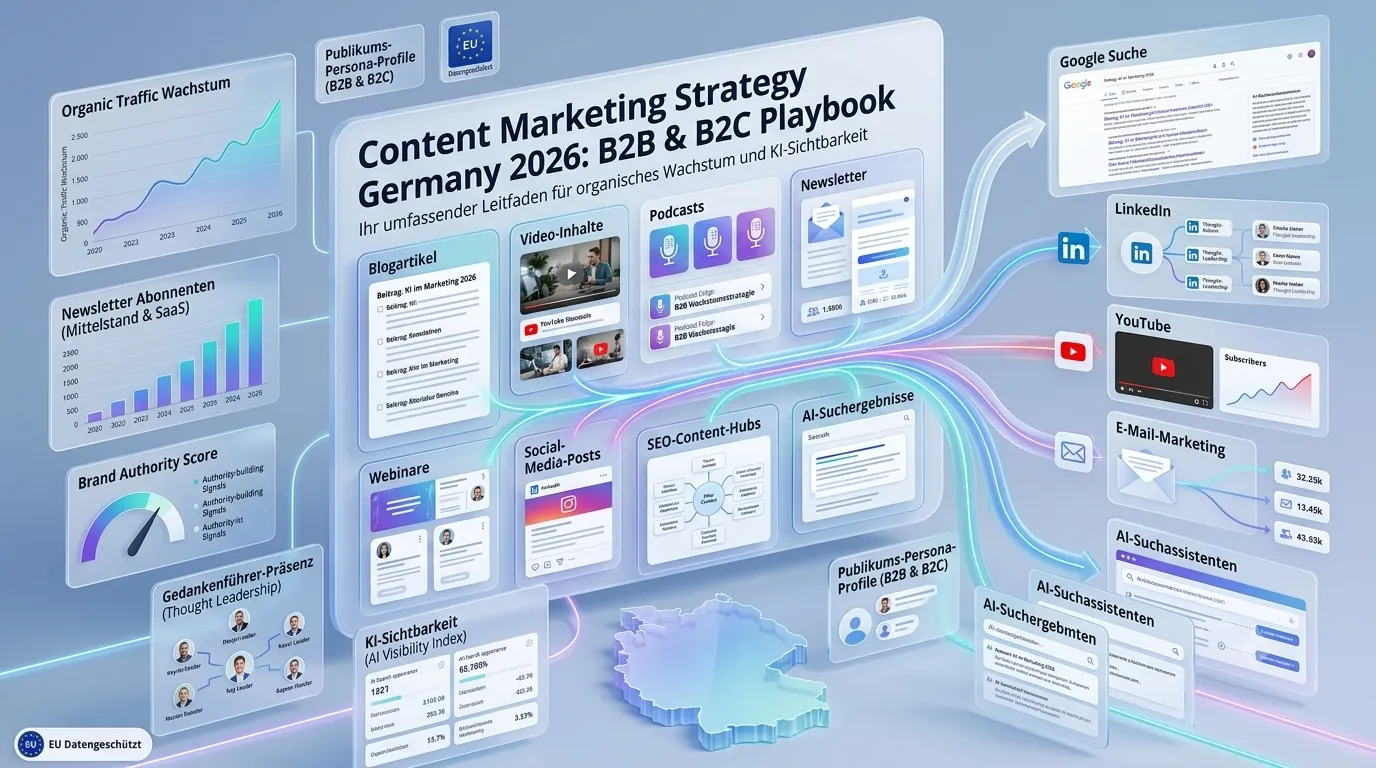
Content marketing is the most undervalued long-term investment for German businesses in 2026. Paid acquisition costs continue to rise. SEO rewards substantive content more than ever. AI search engines (ChatGPT, Perplexity, Claude, Google AI Overviews) cite well-structured authoritative content. Email and social distribution amplify what you publish. The brands building owned audience through consistent high-quality content are compounding advantages that paid-only competitors cannot match.
Yet content marketing in Germany is harder than in the US. The audience expects more substance, more accuracy, more depth. AI-generated mediocre content drowns in the noise. Translation from English rarely works. Building a German-language content engine that produces genuinely valuable work week after week requires strategy, process, and team capacity that most Mittelstand underestimate. This guide explains how to do it right.
What is content marketing in 2026 and why does it matter for German businesses?
Content marketing is the systematic creation and distribution of valuable content — written, visual, audio — to build owned audience, demonstrate expertise, support sales, and compound organic distribution over time.
Why content marketing matters more in 2026 than ever:
1. AI search rewards authority: ChatGPT, Perplexity, Claude, Google AI Overviews surface content from authoritative sources. If you’re not publishing substantive content, you’re invisible to AI-mediated discovery.
2. Paid acquisition costs compound annually: CPCs and CPMs rise 10-20% year-over-year. Content marketing’s marginal cost approaches zero once produced. Long-term economics favor content investment.
3. German trust threshold rewards expertise demonstration: German buyers trust businesses that prove competence through content. A 5,000-word industry guide builds more credibility than 100 paid ads.
4. Compounding distribution: a single great blog post drives traffic for 3-5 years if maintained. A great podcast episode drives audience for years. Compounding effects dominate long-term marketing economics.
5. Sales enablement: content equips sales conversations. Case studies, ROI calculators, comparison guides — content removes friction in B2B sales cycles.
6. Brand differentiation: in commoditized service categories, content quality differentiates more than features. The agency that publishes the best industry analysis wins more than the agency with similar deliverables.
The Mittelstand companies that started serious content marketing in 2020-2022 have built advantages that 2026 startups can’t replicate without years of catch-up investment.
For broader context, see our SEO services Germany guide and digital marketing services Germany guide.
What content types should German businesses produce?
Written content:
- Blog posts (1,500-3,500 words for serious SEO)
- Long-form guides and pillar content (3,500-8,000+ words)
- Whitepapers and ebooks (8-30 pages)
- Case studies (4-12 pages)
- Industry reports with original research
- Newsletter content
- Sales enablement collateral
Video content:
- YouTube long-form (5-30 minutes for tutorials, interviews, deep-dives)
- LinkedIn native video (1-3 minutes)
- Short-form vertical (TikTok, Reels, Shorts — 15-60 seconds)
- Webinar recordings repurposed
- Customer testimonial videos
- Product demos
Audio content:
- Podcast (industry interviews, deep-dives, analysis)
- Audio versions of written content
- Podcast guest appearances on others’ shows
Interactive content:
- Calculators, assessment tools, benchmarks
- Quizzes and self-assessments
- Templates and downloadable resources
- Interactive comparison guides
Visual content:
- Infographics summarizing data
- Process diagrams and frameworks
- Social media visual posts
- Screenshots and product visuals
Live content:
- Webinars (lead-gen and education)
- LinkedIn Live and YouTube Live
- Virtual and in-person events
- AMAs (Ask Me Anything) and Q&A sessions
Content type allocation for German Mittelstand B2B starting content marketing:
- 50% written content (blog, guides, case studies) — foundational SEO and authority
- 20% video content (YouTube + LinkedIn native) — engagement and reach
- 15% audio (podcast or guesting) — depth and brand
- 10% interactive (calculators, tools, templates) — lead capture
- 5% live/events — community building
What’s a content marketing strategy actually look like for German B2B?
A serious content marketing strategy for German B2B SaaS or services contains:
1. ICP and persona definition:
- Who specifically you’re creating for
- What questions they ask, what problems they have, what triggers buying
- Where they consume content (LinkedIn, YouTube, industry publications, etc.)
2. Content pillars (3-5 themes):
- Topic areas where you’ll publish consistently
- Aligned with ICP needs and your business expertise
- Building topical authority around specific subjects
3. Topic clusters and pillar pages:
- One comprehensive pillar page per pillar (5,000+ words)
- Multiple supporting cluster pages linking to pillar
- Internal linking structure for SEO
- See our topic clusters pillar content guide for methodology
4. Content calendar:
- 12-month road map with monthly and weekly publication targets
- Mix of evergreen and timely content
- Seasonality and event-tied content planned
- Content production capacity planned realistically
5. Distribution strategy:
- Owned: blog, newsletter, podcast, YouTube channel
- Earned: PR, guest content, podcast guesting, organic social
- Paid: amplifying high-performing organic with paid budget
6. Production process:
- Who writes, edits, reviews, publishes
- SEO optimization workflow
- Approval and quality control
- Asset library and reuse
7. Measurement framework:
- Traffic and audience metrics
- Engagement and conversion metrics
- Pipeline and revenue attribution
- Brand awareness and authority signals
8. Resourcing plan:
- Internal team capacity
- Freelance / agency support
- Budget for tools, distribution, production
A typical German Mittelstand B2B content program at scale: 4-8 blog posts per month, 1 long-form pillar piece per quarter, 1-2 case studies per month, 2-4 LinkedIn posts per week from leadership team, 1 podcast episode per week, 2-4 newsletter sends per month, 1 webinar per month.
How do you produce great German-language content?
German content production differs from English content production:
Language considerations:
- Native German writers (translation rarely works)
- Sie-form for traditional B2B; Du-form for B2C and creative
- Compound words and German-specific terminology
- Cultural references that resonate (or don’t translate)
- Tone calibration: substantive, not hyped
Quality bar:
- German B2B audiences expect more depth than US audiences
- Factual accuracy critical (errors damage credibility immediately)
- Concrete examples and specific data, not vague claims
- Source attribution for statistics and quotes
- Original analysis where possible
SEO considerations:
- German keyword research (see our keyword research Germany guide)
- Search intent matching
- Question-format headings for AEO/GEO (see our AEO Answer Engine Optimization guide)
- Internal linking strategy
- Schema markup where relevant
AI-assisted content production:
- AI tools accelerate research, drafting, variation
- Heavy human editing required for German market
- AI-generated content without editing often reads as foreign
- Pure AI content rarely ranks well in 2026 (Google AI quality signals)
- Hybrid approach: AI for speed, humans for quality
Production rates realistic for serious programs:
- Blog post (1,500-2,500 words): 4-8 hours per piece (research + writing + editing + SEO)
- Long-form pillar (5,000+ words): 20-40 hours per piece
- Case study: 8-16 hours per piece (interviews + writing + review)
- Whitepaper: 30-60 hours per piece
- Video script + production: highly variable; 8-40 hours per finished video
- Podcast episode: 4-8 hours per episode (prep + recording + editing + promotion)
Outsourced production costs:
- German blog content: €300-€1,200 per article
- Long-form pillar: €1,500-€5,000 per piece
- Case study: €1,000-€3,000 per piece
- Whitepaper: €3,000-€8,000 per piece
- Podcast production: €500-€2,500 per episode (excluding host time)
What content distribution channels work in Germany?
Owned channels (you control fully):
- Your blog/website
- Newsletter
- YouTube channel
- Podcast feed
- Mobile app (if applicable)
- Direct sales conversations
Earned channels (others share/discover):
- Organic search (Google + Bing)
- AI search engines (ChatGPT, Perplexity, Claude, AI Overviews)
- Industry publications republishing your content
- Podcast guest appearances
- Speaking at industry events
- Industry awards and recognition
- Word-of-mouth and organic social shares
Paid channels (amplify what works):
- LinkedIn Sponsored Content (B2B)
- Google Ads to top-performing content
- Meta Ads for B2C content
- TikTok / YouTube Ads for video content
- Native ad networks (Outbrain, Taboola, plista)
- Newsletter sponsorships
Distribution allocation principle:
- Spend 50% of content marketing time on production
- Spend 50% on distribution
- Most German content teams over-produce and under-distribute
- A great post seen by 100 people loses to a good post seen by 10,000
German-specific distribution channels:
- LinkedIn (dominant B2B in DACH)
- Xing (declining but still present for older Mittelstand)
- Industry publications (Heise, t3n, Wirtschaftswoche, Handelsblatt, industry verticals)
- Regional business publications
- Bundesland-specific Mittelstand networks
- Industry associations (BVMW, VDMA, etc.)
For SEO distribution context, see our SEO services Germany guide. For paid amplification context, see our LinkedIn Ads B2B Germany guide.
How long until content marketing pays back in Germany?
Realistic timeline for German B2B content marketing investment:
During months 1–3 (Build the foundation):
- Content strategy and ICP work
- First 10-20 pieces published
- Building publication rhythm
- Limited organic traffic or pipeline impact
- Investment without visible return — manage stakeholder expectations
By months 4–6 (Early ranking signals appear):
- 30-50 pieces published
- First organic traffic to recent content
- Newsletter list growing 20-50/month
- LinkedIn engagement building
- First leads attributed to content
From months 7–12 (SEO momentum compounds):
- 60-100 pieces published
- Organic traffic to 1,000-5,000/month for established programs
- Newsletter list 500-2,000
- Multiple pieces ranking for target keywords
- Marketing-sourced pipeline attributable to content
Year 2 (Strong Compounding):
- 200+ pieces total
- Organic traffic 10K-50K/month
- Newsletter list 2K-10K
- Multiple #1-ranked pieces driving consistent traffic
- Content-sourced pipeline meaningful share of total
Year 3+ (Dominant Channel):
- Continuous publishing with refresh of older content
- Organic traffic 50K-500K/month for top programs
- Newsletter list 10K-50K+
- Industry authority status
- Content drives 30-60% of marketing-sourced revenue
The patience problem: most German Mittelstand abandon content marketing after 6-9 months because they don’t yet see ROI. The companies that persist through year 2 build moats that competitors can’t easily replicate.
What does content marketing cost in Germany?
Internal team approach:
- Content Marketing Manager / Director: €70K-€110K base + benefits = €91K-€143K fully loaded
- Content writer/specialist: €50K-€75K base = €65K-€97K fully loaded
- Designer: €50K-€80K base = €65K-€104K fully loaded
- Total for 3-person internal content team: €220K-€345K/year fully loaded
Hybrid (internal lead + outsourced production):
- Internal Content Lead: €91K-€143K/year
- Outsourced writers/freelancers: €30K-€100K/year
- Outsourced design and video: €20K-€80K/year
- Total: €140K-€320K/year
Fully outsourced (agency or freelancers):
- Content marketing agency: €5,000-€20,000/month = €60K-€240K/year
- Individual freelancers: €30K-€150K/year for consistent program
Distribution and promotion budget:
- Paid amplification: €10K-€80K/year
- Tools (SEO, analytics, project management): €5K-€20K/year
- Production tools (Canva, Figma, Adobe, video editing): €3K-€15K/year
Total realistic annual content marketing investment:
- Starter Mittelstand B2B: €80K-€150K/year
- Serious Mittelstand B2B: €150K-€400K/year
- Mature B2B with strong content investment: €400K-€1.5M+/year
For broader cost context, see our digital marketing cost Germany 2026 guide.
What KPIs matter for content marketing in Germany?
Awareness and audience:
- Organic traffic (Google + Bing + AI search)
- Newsletter subscribers
- LinkedIn followers and engagement
- YouTube subscribers and watch time
- Podcast listens and subscribers
- Branded search volume
Engagement:
- Time on page / scroll depth
- Internal click-through rates
- Email open and click rates
- Video completion rates
- Podcast episode completion
- Comments, shares, replies
Lead generation:
- Content downloads (whitepaper, ebook, calculator)
- Newsletter signups attributable to content
- Demo requests originating from content
- Cost per lead from content (vs paid)
Pipeline and revenue:
- Marketing-sourced pipeline from content
- Marketing-influenced pipeline (multi-touch attribution)
- Content-sourced closed-won revenue
- Customer LTV from content-acquired vs paid-acquired
Authority signals:
- Featured snippets and AI citations
- Backlinks and referring domains
- Industry mentions and shares
- Speaking invitations and awards
- Customer references mentioning your content
Operational:
- Pieces published per month vs plan
- Time per piece (production efficiency)
- Cost per piece
- Refresh cadence on evergreen content
Frequently asked questions about content marketing strategy Germany
Long-form SEO: 2,000–5,000 words. News: 500–1,200. Definitive guides: 5,000–15,000. Match searcher intent.
No. AI accelerates research + drafting. Heavy human editing required for quality and native feel.
Both. Same infrastructure (question headings, structured data, comprehensive coverage) serves both.
Critical. Content equips sales conversations. Tight integration multiplies ROI 2–5x.
Powerful. Customer case studies + interviews + success stories carry trust brand content can’t match.
80% educational, 20% promotional. Lead with audience value. Build authority, not sales pitches.
Germany-focused: German only. DACH: + Austrian/Swiss nuances. Pan-European: + English. Segment by primary market.
Both strong. Podcasts build authority. Webinars convert mid-funnel. Mittelstand: monthly webinar + quarterly podcast.
Ready to build a content marketing engine for the German market?
Content marketing is the highest-leverage long-term investment for German businesses serious about owned audience and organic growth. The companies winning aren’t producing the most content — they’re producing the most useful content, distributing it intelligently, and persisting through the 9-12 month payback period that paid-only competitors can’t see.
Book a meeting for a free content marketing audit where we’ll review your current content, identify gaps in your topical authority, and recommend the highest-leverage content investments for the next 6 months. Or browse our digital marketing services and contact us to discuss a custom engagement.