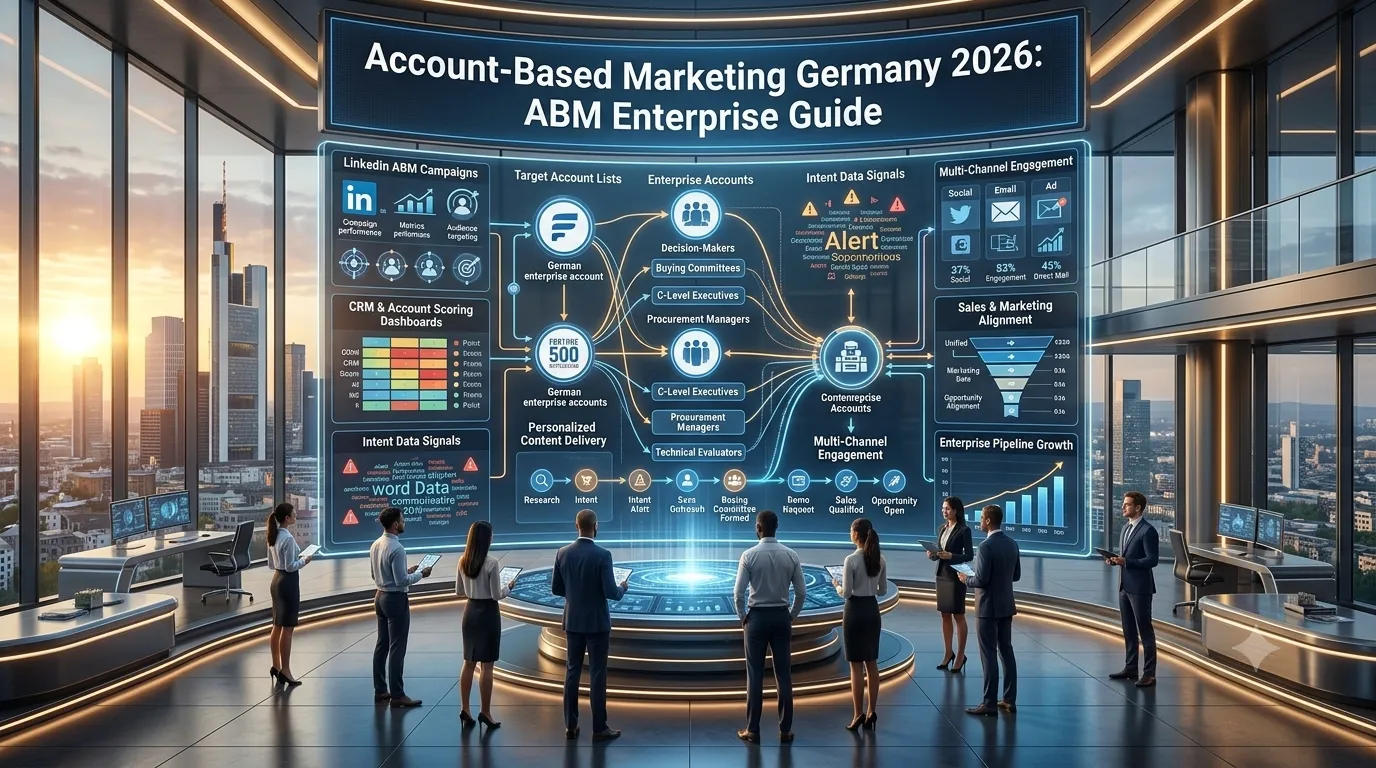
account-based marketing Germany (ABM) flips the traditional B2B lead-gen model. Instead of attracting many leads and qualifying them down, ABM identifies the specific companies you want to sell to and orchestrates personalized marketing-plus-sales campaigns to win them. For German enterprise B2B with high-AOV deals, complex buying committees, and long sales cycles, ABM consistently outperforms generic lead generation on conversion rates and deal size.
In Germany 2026, ABM has matured significantly. The infrastructure is better (intent data platforms, CRM-integrated ABM tools, LinkedIn ABM features). The methodology is more accessible. But ABM still fails more often than it succeeds — usually because companies confuse “expensive paid LinkedIn campaign” with actual account-based strategy. This guide explains how real ABM works in Germany.
What is ABM and how is it different from traditional lead generation?
Traditional B2B lead gen:
- Attract broad audience matching ICP
- Capture leads via content, ads, events
- Qualify down to sales-ready leads
- Hand off to sales
- Sales calls and demos
- Close
Account-based marketing (ABM):
- Identify specific target accounts (named companies)
- Map buying committee at each account (5-10 stakeholders)
- Orchestrate personalized marketing across multiple channels
- Coordinate with sales for synchronized outreach
- Close based on full-committee engagement
Key differences:
- Targeting: ABM targets companies, not individuals
- Personalization: ABM personalizes to specific accounts (account-specific landing pages, content, messaging)
- Multi-channel orchestration: ABM coordinates across email, paid, content, direct mail, events, sales
- Marketing-sales alignment: ABM requires tight marketing-sales integration
- Measurement: ABM measures account engagement and account-level outcomes, not lead counts
ABM is appropriate when:
- High-AOV deals (€25K+ ACV typical floor for ABM economics)
- Identifiable named target accounts (you know who you want to sell to)
- Multi-stakeholder buying decisions
- Long sales cycles (6+ months typical)
- Limited target market size (hundreds to a few thousand accounts max)
- Marketing and sales teams aligned and willing to coordinate
ABM is NOT appropriate when:
- Low-AOV B2B SaaS (<€10K ACV)
- Massive addressable market with mostly transactional sales
- Marketing and sales teams in different silos
- No infrastructure for cross-channel orchestration
- No internal commitment to multi-month investment before measurable returns
For broader B2B strategy, see our B2B lead generation Germany guide and digital marketing services Germany guide.
What are ABM tiers and how do you tier accounts?
Most mature ABM programs operate three tiers:
Strategic accounts (Tier 1: 5–25 accounts)
- Most strategic targets — largest, most aligned, most valuable
- Highly personalized, almost-bespoke campaigns
- Dedicated marketing-sales pod per account or cluster
- Customized content (account-specific landing pages, mini-sites, executive briefings)
- Direct mail and gift programs
- In-person meetings and dinners
- Investment: €5,000-€50,000+ per account per year
- Conversion target: 30-60% to active opportunity within 12 months
Highly programmatic ABM (Tier 2: 50–200 accounts)
- Industry segments or ICP variants
- Semi-personalized campaigns (account name in some content, industry-specific messaging)
- Shared content with account-specific entry points
- Coordinated LinkedIn ABM + sales outreach
- Investment: €500-€3,000 per account per year
- Conversion target: 15-30% to active opportunity within 12 months
Programmatic ABM at scale (Tier 3: 500–2,000 accounts)
- ICP-matching companies at scale
- Audience-targeted campaigns (less personalization)
- LinkedIn account list + Google Ads remarketing
- Email and content nurture
- Investment: €50-€500 per account per year
- Conversion target: 5-15% to active opportunity within 18 months
Selection criteria for target accounts:
- ICP fit (industry, size, geography, business model)
- Buying signals (intent data, technology stack, recent funding, leadership changes)
- Account potential (deal size, expansion potential, strategic value)
- Buying committee accessibility (LinkedIn presence of stakeholders)
- Sales-marketing alignment (sales actually wants these accounts)
How do you map buying committees in German B2B?
German B2B buying committees typically have 5-10 stakeholders for €25K+ ACV deals:
Executive sponsor / economic buyer:
- C-level or VP-level decision maker
- Approves budget
- Cares about business outcomes, ROI, strategic fit
Champion:
- Internal advocate
- Usually mid-level manager who will benefit from the solution
- Drives evaluation forward
- Provides intel and access
Technical evaluator:
- IT, engineering, or technical lead
- Evaluates technical fit, integration, security
- Cares about implementation, maintenance, total cost
End user representatives:
- Daily users of the solution
- Care about UX, productivity, workflow fit
- Often most resistant to change
Procurement / legal:
- Contract review
- Compliance verification
- Negotiation
- Care about terms, pricing, risk
Influencers (varies):
- Internal experts consulted by buyers
- External advisors
- Industry analysts
ABM implication: each stakeholder needs different content and messaging. Executive sponsor sees ROI and strategic content. Technical evaluator sees architecture and security content. End users see workflow and UX content. Generic messaging fails the multi-stakeholder reality.
Mapping process:
- LinkedIn Sales Navigator for org chart visibility
- Sales team intel from conversations
- Public sources (LinkedIn profiles, company website team page, conference speakers)
- Document in CRM with relationships and roles
- Update quarterly as people change roles
What channels and tactics make up an ABM program?
Digital advertising:
- LinkedIn Ads with target account list (CompanyURL upload or company list)
- Google Ads with custom segments based on company match
- Programmatic display via IP targeting or audience match
- Retargeting target account visitors
- See our LinkedIn Ads B2B Germany guide
Content marketing:
- Account-specific landing pages
- Industry-specific case studies
- Executive briefings and whitepapers
- ROI calculators customized to target’s metrics
- Personalized video messages
Email marketing:
- 1:1 emails from sales to specific stakeholders
- Account-specific nurture sequences
- Personalized content delivery
Direct mail and gifts:
- Branded gifts to executive sponsors
- Industry-specific books or relevant items
- Event invitations
- Particularly effective for German Mittelstand culture
Events and experiences:
- Customized executive briefings
- Small-group roundtables for target accounts
- Sponsored attendance at industry events
- Hosted dinners and social events
Sales engagement:
- LinkedIn personal outreach from sales reps
- Cold calling with prepared talking points
- Sales sequences (Outreach, Salesloft)
- Multi-touch coordinated cadences
Intent data activation:
- Bombora, 6sense, Cognism intent signals
- Identify accounts in active research
- Trigger increased outreach intensity
- Time campaigns to buying signals
Customer-led referrals:
- Existing customers refer or introduce
- Partner ecosystem introductions
- Industry connections leveraged
Coordinated cadence (typical Tier 1 ABM):
- Week 1: LinkedIn paid + organic awareness
- Week 2: Direct mail with personalized note
- Week 3: Personalized content delivery via email
- Week 4: Sales rep outreach referencing the journey
- Week 5: Webinar or event invitation
- Week 6: Follow-up sales conversation
- Ongoing: continuous nurture across channels
How do you measure ABM success?
ABM measurement differs from traditional lead-gen:
Account-level metrics:
- Account coverage (% of target accounts engaged)
- Engagement score per account (multi-stakeholder, multi-channel)
- Account-to-opportunity conversion rate
- Opportunity-to-closed-won rate by tier
- Average deal size by tier
- Time from first engagement to closed-won
Pipeline metrics:
- Pipeline created from target accounts (€)
- Pipeline by tier
- Pipeline coverage vs targets
- Sales velocity per account tier
Revenue metrics:
- Closed-won revenue from target accounts
- Average ACV from ABM vs non-ABM
- Customer LTV from ABM-acquired accounts
- ROI by tier (revenue ÷ ABM investment)
Operational metrics:
- Marketing-sales coordination quality (regular cadence meetings, joint planning)
- Content production per account
- Multi-touch attribution showing journey
- Sales rep adoption of ABM workflow
Common ABM measurement mistakes:
- Measuring leads instead of accounts (ABM is about accounts, not lead counts)
- Short measurement windows (ABM payback often 6-18 months)
- Last-click attribution (misses multi-touch contribution)
- Ignoring offline channels (direct mail, events) in attribution
Benchmark expectations for healthy ABM:
- Tier 1: 40-70% target accounts engaged in 12 months
- Tier 2: 20-40% target accounts engaged in 12 months
- Tier 3: 10-25% target accounts engaged in 18 months
- ABM-influenced deal size: 1.5-3x non-ABM average
- ABM win rate: 2-4x non-ABM win rate
What infrastructure does ABM require?
CRM with account-level views:
- Salesforce, HubSpot Enterprise, or equivalent
- Account-centric (not lead-centric) data model
- Custom fields for ABM tier, account scoring, engagement
- Multi-stakeholder tracking
ABM platform:
- Demandbase, 6sense, Terminus, RollWorks, Madison Logic, or HubSpot ABM
- Account scoring and tier management
- Multi-channel orchestration
- Account-level analytics
- Cost: €30K-€200K+/year depending on platform and scale
Intent data:
- Bombora, 6sense, ZoomInfo Intent, Cognism Intent
- Identify accounts in active research
- Trigger outreach timing
- Cost: €20K-€100K/year
Sales engagement platform:
- Outreach, Salesloft, Apollo
- Multi-touch sales cadences
- Cost: €1,000-€5,000/month for team
Direct mail platform (for Tier 1):
- Sendoso, Reachdesk, PFL
- Automated direct mail and gift delivery
- Cost: €500-€5,000/month + gift costs
Marketing automation:
Total ABM tech stack investment for serious program: typically €100K-€500K/year before media spend. For Mittelstand without enterprise budgets, “lite ABM” using HubSpot ABM + LinkedIn ABM + manual coordination can deliver similar outcomes at €30K-€80K/year.
How long does ABM take to show results?
6-18 months to closed-won
- Month 1-3: Account research, content production, campaign setup
- Month 3-6: Initial engagement, intent signals
- Month 6-12: Opportunity creation
- Month 12-18: Closed-won deals
4-12 months to closed-won
- Month 1-2: Account list and content setup
- Month 2-4: Initial engagement
- Month 4-9: Opportunity creation
- Month 9-12: Closed-won deals
3-9 months to closed-won
- Similar to traditional B2B lead gen
- Faster cycle due to lower-touch programmatic approach
The patience problem: ABM programs that get cut at month 4-6 because “no results yet” are giving up just before the curve compounds. The companies that persist through year 1 typically see year 2 produce 60-80% of marketing-sourced revenue from ABM accounts.
What does ABM cost in Germany?
Pilot program (10-25 accounts, single ICP):
- 6-month investment: €50K-€150K
- Includes: account research, content production, campaign management, paid media, software, sales coordination
- Target: 3-8 opportunities created
Established Tier 1 + Tier 2 program (200-300 total accounts):
- Annual investment: €300K-€1.5M
- Includes: dedicated ABM marketer or team, content production, paid media at scale, ABM platform, intent data, direct mail
- Target: 20-50 opportunities created, 5-15 closed-won
Enterprise ABM program (500-2,000 accounts across multiple tiers):
- Annual investment: €1M-€5M+
- Includes: dedicated ABM team (3-10 people), full ABM platform suite, premium intent data, comprehensive content production
- Target: 100+ opportunities, 30-80+ closed-won
For broader cost context, see our digital marketing cost Germany 2026 guide.
How does ABM work in German cultural context?
German B2B buying culture has specific implications for ABM:
Trust and credibility matter more:
- Establish authority before sales outreach
- Industry presence (events, publications, awards)
- References and case studies from similar German companies
- Mittelstand prefers proven over innovative
Slower buying cycles, longer nurture:
- German B2B 6-12 month cycles are normal
- Persistence over time builds credibility
- Don’t expect rapid response to outreach
- Sequenced multi-month touchpoints work
Direct mail still effective:
- German Mittelstand executives appreciate physical mail
- Less cluttered than US executives
- Branded materials and books carry weight
- Coordinated with digital ABM amplifies both
In-person matters:
- Trade shows, conferences, dinners drive German B2B
- Pure digital ABM less effective than hybrid digital + in-person
- Budget for events as part of ABM program
- Regional Mittelstand network events (BVMW, IHK, industry associations)
Sie-form and formality:
- Traditional Mittelstand expects formal communication
- Outreach in German with proper Sie-form
- Founder/expert direct outreach from senior team members carries weight
- US-style casual outreach often fails in DACH
Frequently asked questions about account-based marketing Germany
Yes via lite ABM. 25–100 accounts, more programmatic, €30K–€100K/year.
Complementary. 30–50% ABM, 50–70% lead gen typical. Varies by ACV and TAM.
Weekly launch (90 days), bi-weekly ops, monthly strategy, quarterly tier refresh.
Pilot/setup: yes. Ongoing: hybrid common (agency strategy + content, in-house sales coordination).
Identifies active-research accounts. Prioritize Tier 1, trigger outreach, add net-new. 1.5–3x ROI multiplier.
€15K+ ACV minimum. Under: inbound/PLG. €15–25K: lite. €25K+: full. €50K+: optimal.
LinkedIn ABM robust. Layer non-digital (direct mail, events, sales) to ensure contact regardless of digital reach.
Critical. Customer references close 3–5x normal win rates. Build advocacy program with interviews, case studies, references.
Ready to design or scale ABM for your German B2B?
ABM in Germany 2026 is more accessible than ever — but execution requires strategic clarity, infrastructure investment, marketing-sales coordination, and 12-18 month commitment before fully compounding returns. The companies winning are those with discipline to commit through the J-curve.
Book a meeting for a free ABM consultation where we’ll assess your fit for ABM, review your target account approach, and recommend a pilot program structure. Or browse our digital marketing services and contact us to discuss an ABM engagement.