

German Mittelstand companies — typically 250 to 5,000 employees, family-owned or privately-held, deeply specialized in their industry — represent the backbone of the German economy. They also represent some of the most under-marketed businesses in the developed world. Many Mittelstand companies have world-leading products, decades of customer relationships, and strong technical capabilities, yet operate marketing functions that look like 2010 with budgets to match.
In 2026, this gap is both a problem and an opportunity. Mittelstand companies that develop modern marketing capabilities can win disproportionately against larger competitors stuck in legacy approaches, against startup competitors lacking institutional credibility, and against international competitors who don’t understand the German market. This guide synthesizes everything from our other guides into a strategic framework specifically for Mittelstand marketing in 2026.
What makes Mittelstand marketing different from startup or enterprise marketing?
Mittelstand characteristics:
- Family-owned or founder-led (often 2nd or 3rd generation)
- Decades of customer relationships
- Specialized in a narrow industry vertical
- Conservative culture around change
- Strong technical and operational depth
- Underinvested in marketing historically
- Sales-led growth typical
- Decision authority concentrated in CEO/founder
- Risk-averse on visible spending
Compared to startup marketing:
- Mittelstand has brand history; startup builds from scratch
- Mittelstand has customer base; startup acquires from zero
- Mittelstand has revenue to fund marketing; startup has runway constraints
- Mittelstand decisions slower; startup faster
- Mittelstand customer expectations higher; startup more forgiving
Compared to enterprise marketing:
- Mittelstand has less marketing infrastructure
- Mittelstand decisions less committee-bound
- Mittelstand budget smaller in absolute terms (but often larger as % of revenue)
- Mittelstand culture more personal/relationship-driven
- Mittelstand brand less recognized by media/analysts
Strategic implications for Mittelstand marketing:
- Build on existing strengths (customer relationships, expertise, brand legacy)
- Modernize without losing what works
- Prove ROI to convince traditional leadership
- Move at sustainable pace (not startup speed)
- Build infrastructure for compounding effect over years
For broader marketing context, see our digital marketing services Germany guide and B2B lead generation Germany guide.
What strategic framework should Mittelstand marketing follow?
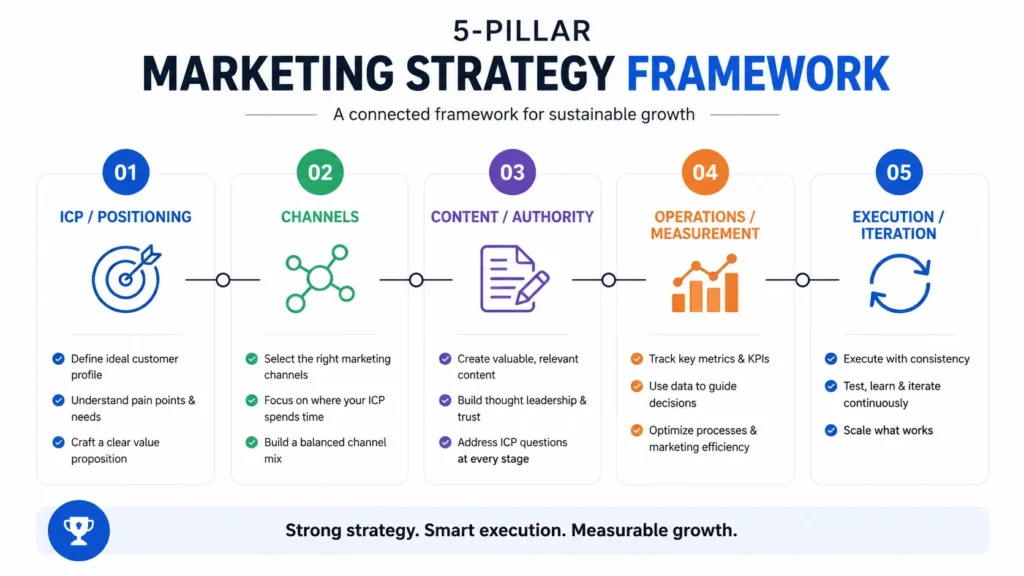
A practical 5-pillar framework for Mittelstand marketing strategy:
Pillar 1: ICP and Positioning
- Who is your actual best customer (industry, size, role, geography)?
- What specific problem do you solve better than alternatives?
- Why does this matter to that customer right now?
- How do you communicate this clearly?
2: Channel Architecture
- Which channels reach your ICP most effectively?
- Which channels match your business model and sales cycle?
- How do channels reinforce each other?
- What’s your channel investment timeline?
3: Content and Authority
- What expertise can you demonstrate that competitors can’t?
- How do you publish that expertise (blog, podcast, video, speaking)?
- How does content support sales conversations?
- What’s your content production capacity?
4: Operations and Measurement
- What CRM and marketing automation infrastructure?
- What tracking and attribution maturity?
- What KPIs and reporting cadence?
- What team structure and outsourced support?
5: Execution and Iteration
- 12-month roadmap with quarterly milestones
- Monthly review and adjustment
- Annual strategic review
- Continuous learning and adaptation
Each pillar feeds the others. Strategy is the integration, not just any single pillar.
How should Mittelstand define ICP and positioning?
ICP development process:
1. Analyze current customers:
- Top 20% by revenue
- Highest LTV cohorts
- Lowest churn
- Strongest references
- Common patterns: industry, size, geography, role, technology stack, business model
2. Identify ideal patterns:
- Where do best customers come from?
- What triggered their purchase?
- What problem were they solving?
- What alternatives did they consider?
- Why did they choose you?
3. Define ICP precisely:
- Industry / sub-industry
- Company size (revenue, employee count)
- Geography (Germany only, DACH, EU, global)
- Buying role (decision maker, influencer, end user)
- Technology / operations characteristics
- Business situation (growth, restructuring, regulation-driven)
4. Document and validate:
- Written ICP profile shared across team
- Sales and customer success input
- Reviewed quarterly as market evolves
Positioning development:
Position vs alternatives:
- Who are the realistic alternatives (vendors, status quo, in-house)?
- What do customers consider when choosing?
- How are you genuinely different?
- Why does that difference matter to the ICP?
Positioning statement template:
“For [ICP description] who [main problem], [brand name] is the [category] that [unique benefit], unlike [primary alternative], because [reason to believe].”
Common Mittelstand positioning strengths:
- Deep industry expertise (decades)
- German-specific compliance and quality
- Long-term partnership orientation
- Engineering and technical depth
- Customer references in same industry
Common Mittelstand positioning gaps:
- Generic value proposition (“quality and service”)
- Unclear differentiation from competitors
- Speaks to wrong audience (engineers vs decision makers)
- Doesn’t reflect modern customer pain points
For positioning context, see our B2B SaaS CRO guide (positioning principles overlap).
What channel architecture works for Mittelstand B2B?
Tier 1 channels (foundational for most Mittelstand):
- SEO and content marketing: long-term authority and demand capture
- Google Ads: high-intent demand capture
- LinkedIn (organic + paid): B2B reach and ABM
- Email marketing and automation: nurture and retention
2 channels (depending on context):
- Industry events and trade shows: critical for established Mittelstand
- Webinars: lead generation and education
- PR and earned media: credibility and authority
- Podcast (own or guesting): thought leadership
3 channels (selective):
- YouTube Ads: where video creative production is feasible
- Programmatic display: for scale beyond walled gardens
- Account-based marketing: for high-AOV enterprise targets
- Influencer / creator partnerships: for consumer-adjacent B2B
- Affiliate marketing: for e-commerce-adjacent B2B
4 channels (rare for Mittelstand):
- TikTok Ads: for B2B targeting young teams or B2C
- Meta Ads (Facebook/Instagram): less essential for B2B Mittelstand
- Traditional TV/radio: rarely cost-effective for B2B
Channel decision framework:
- Where is your ICP active?
- What stage of buyer journey does each channel serve?
- What’s the cost-per-quality-lead by channel?
- What’s the time-to-revenue by channel?
- What’s your capacity to execute on the channel well?
Most Mittelstand B2B should run 4-6 channels seriously, not 10-15 poorly. Channel concentration produces better results than channel diversification beyond a point.
For channel-specific deep dives, see our Google Ads management Germany guide, LinkedIn Ads B2B Germany guide, SEO services Germany guide, and content marketing strategy Germany guide.
How should Mittelstand build content and authority?
Content philosophy for Mittelstand:
Lead with expertise:
- Your domain knowledge IS the product
- Don’t dilute it with generic content
- Customers want depth from specialists
Be substantively useful:
- Real frameworks and methodologies
- Concrete examples and data
- Avoid surface-level content
- “Read it, save it, share it” test
Authentic voice:
- Founder/expert perspective
- German market specifics
- Industry-insider knowledge
- Sie-form for formal Mittelstand audiences
Long-term investment:
- 12-24 month commitment minimum
- Sustainable cadence over heroic launches
- Compound over years
Content pillars for typical Mittelstand:
- Industry expertise (deep guides, frameworks, analysis)
- Customer success (case studies, references, outcomes)
- Trend analysis (what’s changing in industry)
- Practical how-to (specific implementation guidance)
- Founder/leadership perspective (vision, opinions, predictions)
Content production capacity:
Minimum viable:
- 1 substantial blog post per month
- 1 case study per quarter
- 1 webinar per quarter
- LinkedIn presence weekly
- Newsletter monthly
Serious Mittelstand content program:
- 4-8 blog posts per month
- 1-2 case studies per month
- 1 webinar per month
- LinkedIn presence multiple times weekly
- Newsletter bi-weekly
- Podcast monthly or bi-weekly
Compounding effect:
- Year 1: investment without much return
- Year 2: meaningful organic traffic, audience, pipeline contribution
- Year 3+: dominant authority position, owned audience asset
For content strategy detail, see our content marketing strategy Germany guide.
What operations and measurement infrastructure do Mittelstand need?
Foundational infrastructure:
1. CRM:
- HubSpot for most Mittelstand B2B (under 500 employees)
- Salesforce for larger or more complex sales operations
- See our CRM integration for marketing Germany guide
2. Marketing automation:
- HubSpot Marketing Hub for integrated approach
- ActiveCampaign or Brevo as alternatives
- See our marketing automation Germany guide
3. Analytics and attribution:
- GA4 with Consent Mode v2
- Server-side tracking
- Multi-touch attribution
- See our marketing analytics attribution Germany guide and server-side tracking Germany guide
4. Website CMS:
- WordPress most common for Mittelstand
- Headless options for complex needs
- Must support German market requirements (DSGVO, multilingual, etc.)
5. SEO tools:
- Sistrix (German market leader)
- Or Ahrefs/SEMrush
- For keyword research, rank tracking, technical audits
6. Compliance and consent:
- Usercentrics or Cookiebot for CMP
- See our GA4 Consent Mode v2 Germany guide
KPI hierarchy for Mittelstand:
Executive-level:
- Marketing-sourced revenue
- Marketing-influenced revenue
- CAC (blended)
- LTV:CAC ratio
- Payback period
Marketing leadership:
- Channel performance vs target
- Pipeline coverage
- Marketing-sales alignment metrics
- Brand health metrics
Channel-level:
- Channel-specific KPIs (organic traffic, paid CAC, etc.)
- Funnel conversion rates
- Cost per stage
Reporting cadence:
- Daily: campaign performance alerts
- Weekly: channel performance review
- Monthly: comprehensive marketing report to leadership
- Quarterly: strategic review and adjustment
- Annually: strategy refresh
What team structure works for Mittelstand marketing?
Stage-based team evolution:
Stage 1: Marketing emerging (€5M-€20M revenue):
- 1-2 person in-house team
- Marketing Manager covering strategy + execution
- Agency support for paid media and content production
- Founder or executive involvement in strategic decisions
2: Marketing established (€20M-€50M revenue):
- 3-5 person in-house team
- Marketing Director + Performance Marketer + Content/SEO + Operations
- Specialist agencies for specific channels
- Marketing represented in executive team
3: Marketing scaled (€50M-€200M revenue):
- 5-15 person in-house team
- VP/CMO + multiple specialists + analytics
- Multiple agencies for specialized channels
- Full marketing operations function
4: Marketing strategic (€200M+ revenue):
- 15+ person in-house team
- CMO + Directors per channel/function
- Strategic agencies for specific projects
- In-house creative team
- International expansion teams
Key hires in order:
1st hire: Marketing Manager (generalist who can do everything basic)
2nd hire: Performance Marketing Manager (paid acquisition specialist)
3rd hire: Content/SEO Manager (organic and content specialist)
4th hire: Marketing Operations / RevOps (infrastructure and analytics)
5th hire: Designer or Marketing Director (depending on need)
Outsourcing decisions:
- Strategy: usually in-house (better with institutional context)
- Paid media management: often an agency for specialist depth
- Content production: often outsourced or freelanced for volume
- SEO technical work: often an agency for specialist expertise
- Design: usually in-house once the team grows
- Marketing operations: usually in-house for ongoing operations
For agency selection, see our hire digital marketing agency in Germany guide and best digital marketing agency in Germany guide.
What 12-month marketing roadmap looks reasonable for Mittelstand?
Months 1-3: Foundation:
- ICP and positioning refinement
- Marketing analytics audit and setup
- Website CRO audit
- Content audit
- Competitive analysis
- Quick wins on existing channels
- Team and agency alignment
Mon 4-6: Launch:
- New campaign launches across priority channels
- Content production at sustainable cadence
- Marketing automation flows live
- First webinar series launched
- LinkedIn organic and paid building
- First case studies published
Months 7-9: Scale:
- Top-performing channels increased budget
- Content compounding (organic traffic growing)
- LinkedIn audience building momentum
- Webinar attendance growing
- First PR and earned media wins
- Multi-touch attribution functional
Month 10-12: Compound:
- Marketing-sourced pipeline meaningful share of total
- SEO traffic compounding visibly
- LinkedIn audience asset established
- Webinar series with engaged regulars
- Industry presence established
- Year 2 planning informed by data
Year 2 expectations:
- 2-3x year 1 traffic
- 30-50% marketing-sourced revenue
- Established content authority
- Predictable lead generation
- Mature attribution and reporting
Year 3+ expectations:
- Market category awareness established
- 40-60% marketing-sourced revenue
- Brand search dominant
- Content drives compounding traffic
- Mature marketing function operationally
What does serious Mittelstand marketing investment look like?
Realistic annual marketing investment:
Conservative Mittelstand (8-10% of revenue):
- €5M revenue → €400K-€500K marketing
- €25M revenue → €2M-€2.5M marketing
- €100M revenue → €8M-€10M marketing
Growth-focused Mittelstand (12-18% of revenue):
- €5M revenue → €600K-€900K marketing
- €25M revenue → €3M-€4.5M marketing
- €100M revenue → €12M-€18M marketing
Marketing-driven Mittelstand (15-25% of revenue):
- €5M revenue → €750K-€1.25M marketing
- €25M revenue → €3.75M-€6.25M marketing
- €100M revenue → €15M-€25M marketing
Investment allocation typical:
- Team and operations: 30-45%
- Paid media: 25-40%
- Content and SEO: 10-20%
- Tools and technology: 5-10%
- Events and PR: 5-15%
For detailed budgeting, see our digital marketing cost Germany 2026 guide.
What are the biggest Mittelstand marketing mistakes?
1. Treating marketing as cost center, not investment:
- Cuts marketing first in downturns
- Underinvest in operations and analytics
- Don’t measure marketing-sourced revenue
- Result: marketing always justifying existence rather than driving growth
2. Hiring generalists instead of specialists:
- One “Marketing Manager” expected to do everything
- No depth in any channel
- Average results across the board
- Better to have 2 specialists than 4 generalists
3. Continuous tactical pivots without strategy:
- “Let’s try TikTok” without strategic rationale
- Chasing every new channel/tactic
- Never sustained execution long enough to compound
- Strategy provides discipline; tactics deliver execution
4. Underinvesting in infrastructure:
- Bad CRM, no attribution, no marketing operations
- Every channel reports independently
- Decisions based on opinion not data
- Infrastructure investment compounds for years
5. Founder/CEO too involved or not involved enough:
- Too involved: bottleneck, slow decisions, lack of empowerment
- Not involved enough: marketing lacks executive sponsorship
- Right balance: clear delegation with regular strategic review
6. International tactics without German adaptation:
- US-style aggressive marketing tactics fail in Germany
- English-only content for German audience
- Generic templates instead of German-specific copy
- Mittelstand needs German market expertise
7. Treating sales and marketing as opposing:
- Marketing complains sales doesn’t follow up
- Sales complains marketing leads are unqualified
- Both true; both fixable through integration
- Marketing-sales alignment is highest-leverage operational fix
8. Ignoring compliance:
- DSGVO, TTDSG, UWG, Werbekennzeichnung
- Compliance failures create reputational and legal risk
- Better to build compliance in from start than retrofit
9. Lacking patience for compounding:
- Marketing investment needs 12-24 months minimum to compound
- Mittelstand sometimes cuts at month 6 because “not working”
- The companies that persist win; those that pivot constantly don’t
10. Not measuring or learning:
- No clear KPIs
- No retrospectives
- Repeating same mistakes
- Treating each campaign as one-off rather than learning system
Frequently asked questions about Mittelstand marketing strategy
For Mittelstand with no marketing infrastructure: 1) CRM + analytics + tracking (€50K), 2) Website redesign and SEO foundation (€30K-€80K), 3) Google Ads launch (€10K/month), 4) Content production start (€10K/month). After 6-9 months: add LinkedIn, automation, webinars, brand investment.
Digital is now essential, not optional. Traditional channels still valuable (events especially for German Mittelstand) but increasingly inadequate alone. Best Mittelstand programs integrate digital and traditional: events generate leads that digital nurtures, digital amplifies event presence, etc.
12-24 months for compounding effects of integrated program. Quick wins (within 6 months): paid acquisition working, basic analytics in place, content production rhythm. Bigger wins (12-24 months): SEO compounding, brand recognition growing, mature pipeline.
Significantly. AI accelerates execution (content production, ad creative, analysis, personalization). AI search engines (ChatGPT, Perplexity, AI Overviews) reshape discovery. Plan for AI-mediated traffic and AI-assisted operations. Don’t outsource judgment to AI.
Still significant in 2026. Industry trade shows, customer events, and executive roundtables remain core Mittelstand marketing channels. Budget €30K-€200K/year for events. Combine with digital strategy: events generate qualified leads that digital channels alone wouldn’t reach.
B2B Mittelstand: LinkedIn dominant, longer cycles, ABM-relevant, content/expertise critical. B2C Mittelstand: Meta/TikTok dominant, shorter cycles, brand-building important, influencer marketing relevant. Most German Mittelstand are B2B; B2C Mittelstand is rarer.
Counter-intuitive: usually maintain or invest more. Cutting marketing in a downturn loses brand position and SEO, compounding the issue. Companies that maintained marketing through 2022-2023 emerged ahead of competitors.
Ready to develop or refine your Mittelstand marketing strategy?
German Mittelstand marketing in 2026 is one of the highest-leverage opportunities in B2B marketing globally. The companies modernizing marketing capabilities can capture disproportionate share against larger competitors stuck in legacy approaches and smaller competitors lacking institutional resources.
Book a meeting for a free strategic consultation where we’ll review your current marketing maturity, identify highest-leverage opportunities, and outline a 12-month strategic roadmap. Or browse our digital marketing services and contact us to discuss a strategic engagement.