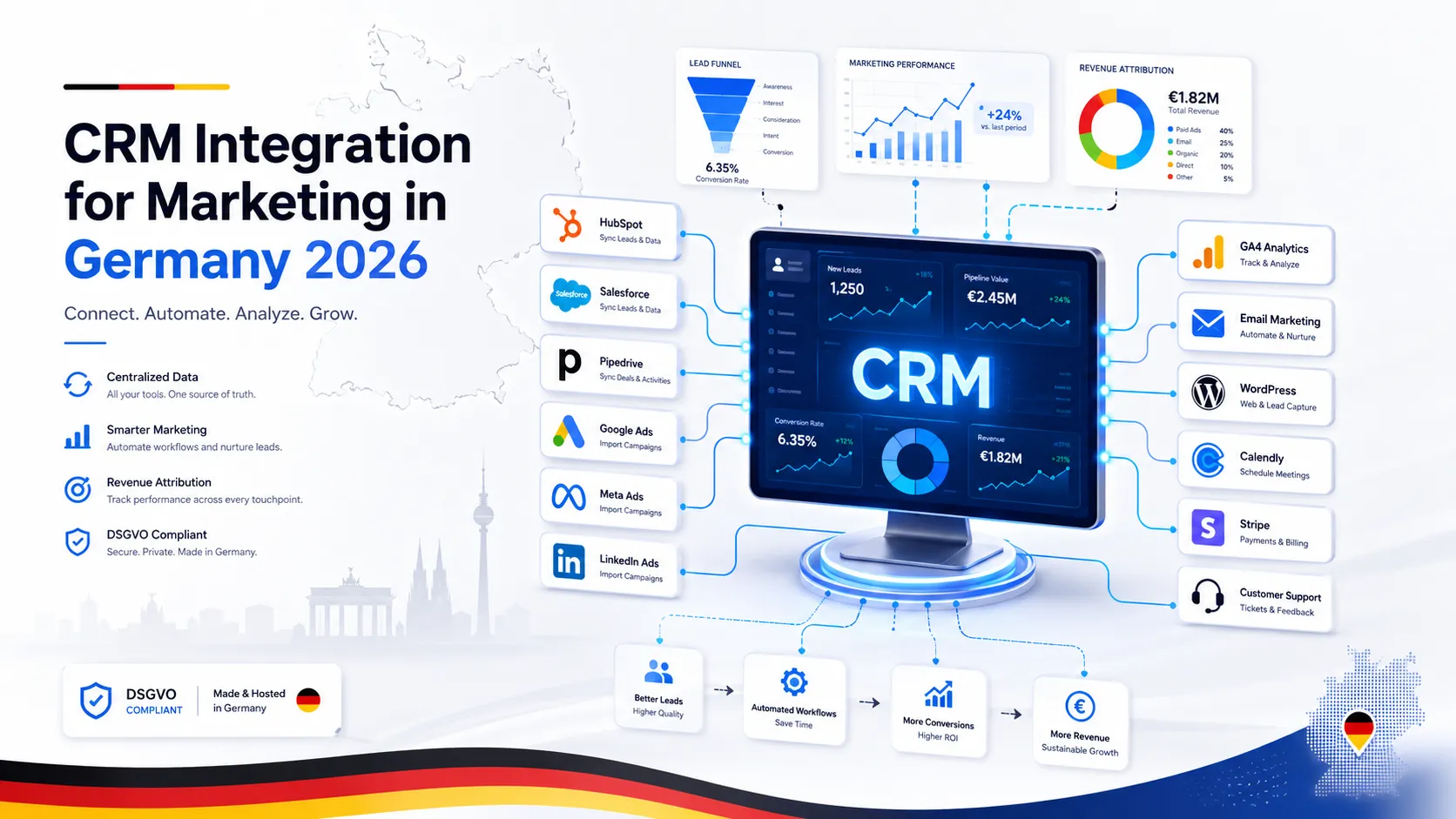
CRM CRM integration marketing Germany (Customer Relationship Management) is the operational backbone of modern B2B marketing — and increasingly important for B2C too. Your CRM holds the truth about your customers: who they are, how they engaged, what they bought, and what stage they’re at in your funnel. Marketing systems without CRM integration operate blindly: campaigns can’t reflect lifecycle stage, lead scoring lacks revenue context, attribution misses the full journey, and sales handoffs break.
In 2026, the German Mittelstand and B2B SaaS that compound marketing ROI year over year are those that integrated CRM with marketing automation, paid platforms, analytics, and operations early. This guide covers what CRM integration actually requires: choosing the right CRM, integrating with marketing tools, handling DSGVO compliance, and using CRM data to drive marketing intelligence.
What CRMs work for the German market?
HubSpot CRM:
- All-in-one CRM + Marketing + Sales + Service
- Free tier available; Professional and Enterprise tiers
- German interface and support
- Native marketing automation
- Most popular for German B2B SaaS and Mittelstand
- Strong inbound marketing methodology
- Pricing: free CRM; €15-€800+/month for Marketing Hub tiers
Salesforce:
- Enterprise-grade CRM
- Strongest sales operations tooling
- Marketing Cloud / Pardot for marketing
- Used by enterprises and larger Mittelstand
- More complex, higher cost
- Pricing: €25-€500+ per user/month + Marketing Cloud separate
Pipedrive:
- Sales-focused CRM
- SMB and growing Mittelstand
- Simpler than HubSpot/Salesforce
- Limited native marketing automation
- Strong sales pipeline focus
- Pricing: €15-€100+ per user/month
Microsoft Dynamics 365:
- Enterprise CRM in the Microsoft ecosystem
- Strong for companies on the Microsoft stack
- More complex to implement
- Pricing: €60-€200+ per user/month
Zoho CRM:
- SMB-focused
- Affordable
- Less common in the German Mittelstand
- Pricing: €15-€60 per user/month
Monday CRM / Monday Sales CRM:
- Visual, easy-to-use
- SMB and growing teams
- Less B2B-deep than HubSpot or Pipedrive
- Pricing: €10-€50 per user/month
Specialty CRMs:
- Close — sales-focused for high-velocity teams
- Copper — Google Workspace integration
- Folk — relationship-focused for agencies/consultants
- Attio — modern Notion-style CRM for SaaS
Selection criteria for the German market:
- B2B vs B2C focus
- Sales team size and process complexity
- Marketing integration depth needed
- Budget
- Technical sophistication of the team
- Integration ecosystem
- DSGVO posture and EU hosting optionsFor
most Mittelstand B2B, HubSpot is the default. For enterprise B2B: Salesforce. sales-led SMB: Pipedrive. For the Microsoft stack: Dynamics 365.
a broader marketing context, see our marketing automation Germany guide and HubSpot vs ActiveCampaign vs Brevo Germany guide.
What CRM integration marketing in Germany matters for marketing?
Essential integrations:
1. Marketing automation platform:
- HubSpot native if using HubSpot CRM
- ActiveCampaign, Brevo, Mailchimp via native integrations
- Bidirectional sync of contact and company data
- Lifecycle stage updates
- Form submissions to CRM
2. Website CMS:
- WordPress, Webflow, Shopify
- Form submissions to CRM
- Page view tracking on contact records
- Dynamic content based on CRM lifecycle stage
3. Email tools:
- Native CRM email integration
- Email open and click tracking
- Reply tracking
- Calendar integration
4. Paid advertising platforms:
- Google Ads (Offline Conversion Import)
- Meta Ads (Offline Conversions via CAPI)
- LinkedIn Ads (Conversions API)
- TikTok Ads (Events API)
- Bidirectional: ad data to CRM (clicks, leads), CRM data to ads (audiences, lifecycle stage)
5. Analytics:
- GA4 with User ID linking to CRM
- HubSpot/Salesforce analytics
- Attribution platforms
- Custom analytics dashboards
6. Customer data platform (CDP):
- Segment, RudderStack, Hightouch
- Unified customer profile
- Multi-tool data activation
7. Sales engagement tools:
- Outreach, Salesloft, Apollo
- Cadence integration
- Activity sync to CRM
8. Calendar and meeting tools:
- Calendly, Chili Piper, HubSpot Meetings
- Meeting bookings create CRM activities
- Calendar sync
9. Webinar and event platforms:
- Zoom, GoToWebinar, Demio
- Registration data to CRM
- Attendance tracking
- Event-driven nurture
10. Data enrichment:
- ZoomInfo, Cognism, Clearbit, Lusha
- Automatically enrich CRM contacts with firmographic data
- DACH-compliance varies by vendor
11. Customer support/success:
- Intercom, Zendesk, Help Scout
- Support ticket history in CRM
- Customer health visibility
12. Billing and revenue:
- Stripe, Chargebee, Recurly
- Subscription status in CRM
- Revenue data for LTV calculation
Most German Mittelstand B2B end up with 8-15 CRM integration marketing in Germany. The compound value of integration depth often exceeds that of any individual tool — CRM as the operational hub matters more than differences in individual features between tools.
How does Offline Conversion Import (OCI) work?
Offline Conversion Import (OCI) is the practice of sending CRM events back to paid ad platforms to optimize algorithms. Critical for B2B with long sales cycles.
Why OCI matters:
- Paid platforms (Google, Meta, LinkedIn) optimize toward conversions they can see
- Without OCI, they only see initial conversions (lead form submission, signup)
- They don’t see whether those leads became customers or revenue
How OCI works:
- Lead progresses through sales process: MQL → SQL → Opportunity → Customer
- At each stagea, CRM sends the event back to the ad platform with the original click ID
- The ad platform algorithm now understands which clicks lead to real outcomes
- The algorithm optimizes for similar patterns going forward
Implementation for Google Ads:
- Capture GCLID on form submission, store in CRM contact record
- When an MQL/SQL/Customer event occurs in CRM, send a conversion event to Google Ads
- Use native HubSpot-Google Ads integration or a custom Zapier/Make workflow
- Configure conversion events in Google Ads as “Imported – Sales.”
for Meta Ads (CAPI):
- Capture FBCLID and FBP cookies
- Send Custom Event via CAPI when CRM stage changes
- Map CRM stages to Meta Custom Conversions
- Use sGTM for server-to-server delivery
Implementation for LinkedIn Ads (Conversions API):
- Map CRM stages to LinkedIn conversion events
- Automatic forwarding as stages change
Native integrations available:
- HubSpot → Google Ads, LinkedIn Ads, Meta Ads (native)
- Salesforce → Google Ads, LinkedIn Ads, Meta Ads (native)
- Pipedrive → Zapier/Make/n8n required for most
- Make/Zapier workflows fill gaps for any CRM-platform combo
Impact:
- Meta Ads B2B: significant improvement
- ROI typically pays back within 2-4 months
For server-side context, see our server-side tracking Germany guide.
How does CRM data drive better marketing?
CRM integration enables marketing intelligence that platform-level data can’t:
Customer LTV analytics:
- LTV by acquisition channel (often surprising — cheapest channel ≠ best customer)
- LTV by industry/segment
- LTV by acquisition campaign
- Inform budget allocation by quality not just CPL
Lifecycle stage targeting:
- Different messaging for prospects vs MQLs vs SQLs vs Customers
- Cross-sell campaigns for existing customers
- Win-back for lapsed customers
- Renewal campaigns for SaaS
Sales-marketing alignment:
- Marketing sees what sales is closing
- Sales sees what marketing is generating
- Shared definitions and metrics
- Closed feedback loop on lead quality
Account-based marketing enablement:
- Target account lists from CRM
- Account engagement scoring
- Multi-stakeholder tracking
- See our account-based marketing ABM Germany guide
Predictive analytics:
- Likelihood-to-convert scoring
- Churn risk prediction
- Expansion opportunity identification
- Custom-trained models on CRM history
Personalization at scale:
- Dynamic website content based on CRM lifecycle stage
- Personalized email content using CRM custom fields
- Targeted paid audiences based on CRM segments
- Customer-specific landing pages
Cohort analysis:
- Performance of customers acquired in Q1 vs Q2
- Channel performance over time
- Campaign quality assessment
How does DSGVO apply to CRM integration marketing in Germany?
CRM holds significant personal data. DSGVO implications:
1. Lawful basis for processing:
- Document basis for each data type (consent, contract, legitimate interest)
- Marketing consent stored as a CRM field with a timestamp
- Lead source captured for consent basis verification
2. AVV with CRM vendor:
- Signed AVV with HubSpot/Salesforce/Pipedrive
- Standard Contractual Clauses for US-hosted CRMs
- Documented in Verzeichnis von Verarbeitungstätigkeiten
3. AVV with each integration:
- Marketing automation, paid platforms, enrichment tools — each needs AVV
- Sub-processor lists documented
- Data flows traced and documented
4. Right to access, correct, delete:
- DSAR (Data Subject Access Request) process via CRM
- Right to deletion implemented across integrated tools
- 30-day max response time
- Documented workflow
5. Data minimization:
- Only collect data needed for marketing purposes
- Regular review of CRM fields and integrations
- Unused integrations disconnected, data deleted
6. Cross-border data flows:
- US-hosted CRMs (HubSpot, Salesforce) require SCCs
- Schrems II considerations documented
- Privacy policy disclosures comprehensive
7. Consent withdrawal:
- Easy unsubscribe from marketing communications
- Granular consent management (different channels)
- Suppression lists maintained across all tools
8. Audit trail:
- Field-level audit logs in CRM
- Integration event logs
- Compliance documentation accessible
CRM is data-rich, making compliance both more important and more achievable when designed correctly from the start.
What does CRM integration cost in Germany?
CRM cost:
- HubSpot CRM (free) + Marketing Hub: €15-€800+/month based on contacts
- Salesforce Sales Cloud: €25-€300+ per user/month
- Pipedrive: €15-€100+ per user/month
Integration setup:
- Native integrations (HubSpot to common tools): often free or low setup time
- Salesforce integrations: vary widely, often €5K-€50K setup costs
- Custom integrations (API development): €10K-€100K+ depending on complexity
- iPaaS platforms (Workato, Tray.io, Make): €5K-€50K/year platform cost + setup
Implementation team:
- Internal marketing operations: €78K-€124K fully loaded annually
- HubSpot Solution Partner agency: €5K-€40K for implementation
- Salesforce implementation partner: €30K-€500K depending on scope
- RevOps consultant: €1,500-€5,000/month
Ongoing maintenance:
- Integration health monitoring
- Workflow optimization
- Data quality management
- Compliance audits
Total annual CRM + integration investment for Mittelstand: typically €60K-€300K/year. Larger B2B: €300K-€2M/year.
ROI: CRM-integrated marketing typically delivers 30-50% better marketing ROI than non-integrated through better targeting, attribution, and personalization.
What KPIs validate that CRM integration is working?
Data quality:
- Field completeness (% of contacts with full data)
- Duplicate rate
- Data freshness (recent activity logged)
- Lead source attribution coverage
Integration health:
- Sync success rate (target: >99%)
- Sync latency (target: <5 minutes for most integrations)
- API error rates
- Failed sync alerts and resolution time
Marketing-Sales alignment:
- MQL acceptance rate by sales (target: 80%+)
- SLA adherence (response time to MQLs)
- Pipeline contribution from marketing
- Marketing-sourced revenue
Operational efficiency:
- Time from form submission to sales notification
- Time to first sales touch
- Lead routing accuracy
- Process automation rate
Compliance:
- DSAR response time (target: <30 days)
- Consent record completeness
- Audit findings
- DSGVO incident count (target: zero)
Frequently asked questions about CRM integration in Germany
HubSpot is the default choice for most German B2B SaaS at <€20M revenue. Salesforce becomes more appropriate at scale (€20M+) or with complex sales operations. Pipedrive works for sales-heavy SMB without significant marketing automation needs.
Basic native integrations: hours to days. Comprehensive integration ecosystem (CRM + marketing automation + paid platforms + analytics + sales tools): 2-6 months for a solid foundation. Enterprise multi-system integrations: 6-18 months.
Technically, yes, but you lose most value. Marketing tools alone can’t track customer LTV, lifecycle stages, or revenue attribution. CRM serves as the system of record that makes other integrations meaningful. Even small Mittelstand should adopt a CRM early.
Several tactics: (1) Mandatory fields in lead capture forms, (2) Automatic enrichment with ZoomInfo/Cognism/Clearbit, (3) Regular data hygiene workflows (duplicate merging, stale data cleanup), (4) Field-level audit logs, (5) Periodic quality scoring with internal team review.
For Mittelstand B2B (€5-20M revenue): 1 dedicated Marketing Operations / RevOps specialist. larger B2B: 2-5 person RevOps team. SMB: hybrid role within marketing or sales operations. RevOps is one of the highest-ROI hires for modern B2B.
Hashed PII via Customer Match (Google) / Custom Audiences (Meta) / Matched Audiences (LinkedIn). Document consent basis for each contact uploaded. Use server-side integration where possible. Suppress contacts who opted out. Regular audit of audience lists.
For most Mittelstand, CRM is sufficient. CDPs add value when: (1) a significant volume of behavioral data beyond CRM, (2) multiple data sources need unification, (3) sophisticated real-time personalization needs, (4) B2C with a high volume of anonymous user data. CRM + good integrations covers 80%+ of needs.
Ready to integrate CRM for marketing in Germany?
CRM is the operational backbone of modern marketing. Without proper CRM integration, marketing in Germany underperforms every other marketing investment. The Mittelstand B2B compounding marketing ROI year-over-year are those with mature CRM operations, deep integrations, and clear marketing-sales alignment.
Book a meeting for a free CRM operations audit where we’ll review your current CRM, identify integration gaps, and recommend a roadmap to mature operations. Or browse our digital marketing services and contact us to discuss a CRM and marketing operations engagement.