
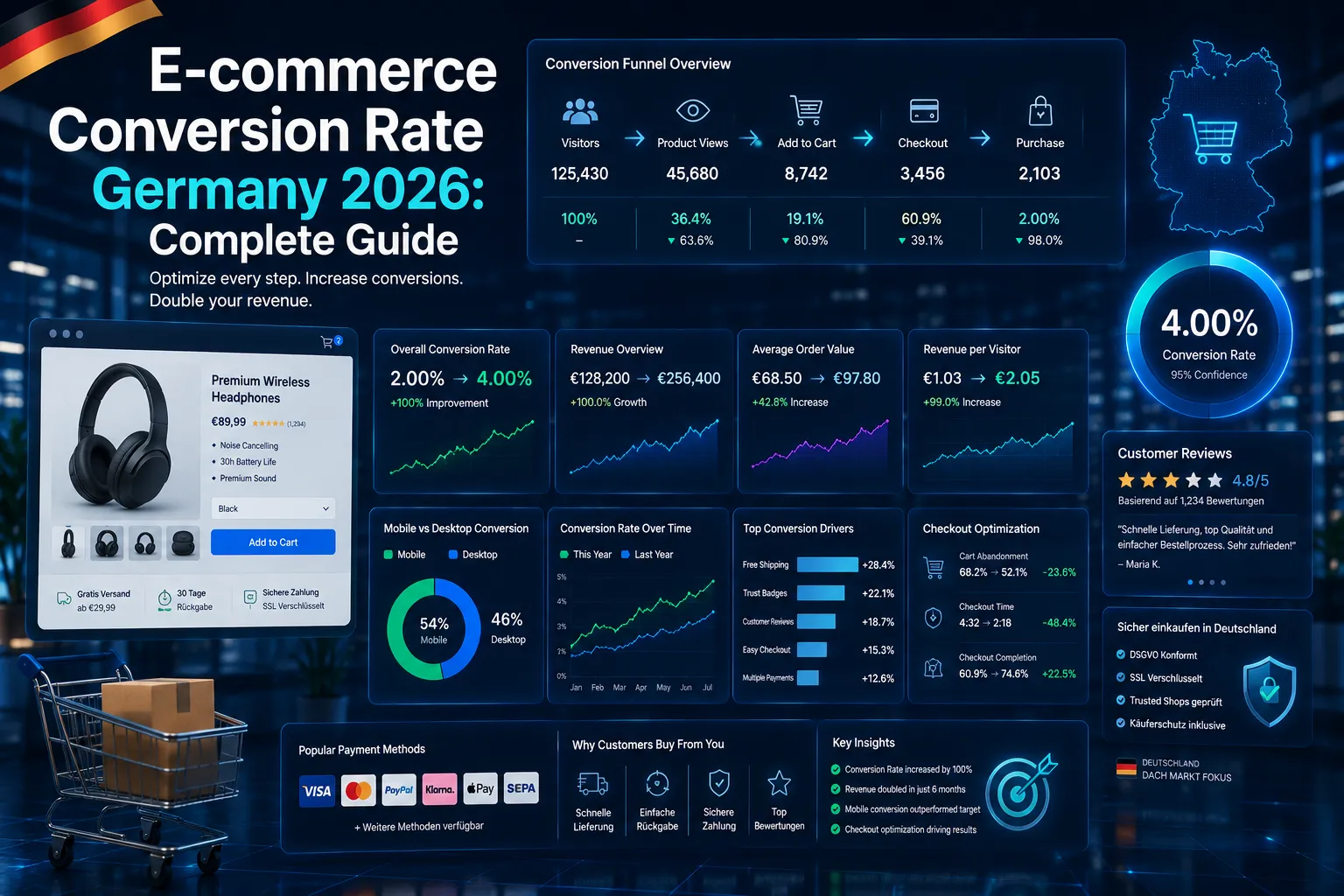
e-commerce conversion rate Germany is the highest-volume, fastest-feedback CRO discipline.Every visitor is visible. Each drop can be measured. Every dollar of revenue is attributableFor German e-commerce in 2026, doubling conversion rate from 2% to 4% literally doubles your revenue without acquiring a single new visitor. The math is so compelling that mature German D2C brands invest 5–15% of revenue in ongoing CRO.
This guide walks through what e-commerce conversion rate Germany optimization actually requires in 2026: product page optimization, cart optimization, checkout optimization, payment method impact, trust signals, mobile UX, and typical lift sizes by tactic.
For broader CRO see our CRO services Germany guide.
What’s the German e-commerce conversion funnel?
Six-step funnel:
- Homepage / landing → 100% visitors
- Category / product browsing → 50–70% drop typical
- Product page view → engagement
- Add to cart → 10–20% of product viewers
- Begin checkout → 60–70% of cart adders
- Complete purchase → 60–80% of checkout starters
Overall conversion: 1.5–4% typical for German B2C e-commerce.
For funnel analysis see our funnel analysis Germany guide.
What does German e-commerce conversion look like?
By store type:
Starter (€0–€500k revenue)
1–2.5% conversion typical.
Growing (€500k–€2M)
2–3.5% typical.
Mature (€2M–€10M)
3–5%+ typical.
Top performers
5%+ achievable with disciplined CRO.
For broader benchmarks see our conversion rate benchmark Germany guide.
What are highest-impact e-commerce CRO wins?
After auditing many German stores:
1. Payment method mix (10–30% conversion lift)
Adding SEPA + Klarna for German stores often delivers biggest single lift. See our Shopify SEPA guide and Shopify Klarna guide.
2. Mobile checkout streamlining (10–25% mobile lift)
Mobile typically converts 30–50% lower than desktop. Closing this gap is high-value.
3. Trust signals above fold (5–15% lift)
Trusted Shops badge, customer logos, reviews. German buyers respond strongly.
4. Product page photography quality (5–20% lift)
Real product photos vs stock. Multiple angles. Lifestyle context.
5. Free shipping threshold display (5–12% lift)
“Noch €X bis zum kostenlosen Versand” progress bar.
6. Returns + Widerrufsrecht clarity (3–10% lift)
Easy returns policy displayed prominently.
7. Customer reviews on product pages (5–15% lift)
Star ratings + written reviews. Verified buyer badges.
What’s the German e-commerce product page checklist?
12 essential elements:
1. Multiple high-quality images
6+ images. Different angles. Lifestyle. Detail shots.
2. Video where applicable
Product in use. 360-degree view.
3. Clear product title
Brand + model + key feature + variant.
4. Comprehensive description
Specific benefits + use cases + materials/specs.
5. Pricing transparency
“inkl. MwSt.” + Versandkosten mention.
6. Stock availability
Clear in/out of stock. Estimated delivery date.
7. Multiple payment method icons
SEPA, Klarna, PayPal, cards visible.
8. Trusted Shops or trust signal
Near purchase button.
9. Customer reviews + ratings
Star rating + count. Sample reviews visible.
10. Shipping + returns info
Versandkosten + Widerrufsbelehrung accessible.
11. FAQ section
Common product questions. FAQ schema markup.
12. Related products
“Häufig zusammen gekauft” or similar.
For Shopify product page specifics see our SEO for ecommerce Germany guide.
What’s the cart optimization checklist?
Eight elements:
1. Persistent cart drawer / icon
Cart visible across site navigation.
2. Quantity adjustment
Easy +/- without leaving cart.
3. Itemized pricing
Product price + shipping + taxes + total clearly shown.
4. Free shipping threshold progress
“Noch €X für kostenlosen Versand.”
5. Discount code field
Available but not prominent (no FOMO).
6. Recommended add-ons
“Häufig zusammen gekauft.”
7. Multiple payment icons preview
SEPA, Klarna, PayPal logos visible in cart already.
8. Clear CTA to checkout
“Jetzt kaufen” or “Zur Kasse.”
9. Continue shopping option
For users still browsing.
What’s the checkout optimization checklist?
Ten elements.
1. Guest checkout option
Don’t force account creation.
2. Single-page checkout (or minimal steps)
Reduce friction. Multi-step okay if streamlined.
3. All payment methods visible
SEPA, Klarna, PayPal, cards, Apple/Google Pay.
4. Address autofill
Both shipping + billing. Browser autofill.
5. Country pre-selected to Germany
For German store. Don’t make users select.
6. Klarna express checkout
For repeat Klarna users. One-click.
7. Trust signals reinforced
Trusted Shops, SSL certificate, money-back guarantee.
8. Order summary visible
Itemized + total shown clearly.
9. Versandkosten transparency
Per §312j BGB.
10. Clear progress indicator (if multi-step)
User knows where they are.
For Shopify checkout depth see our Shopify checkout extensibility guide.
What payment methods does German market need?
Critical mix:
Required for German B2C
- SEPA Lastschrift (30–50% of buyers prefer)
- Klarna (Sofort + Rechnung + Ratenkauf)
- PayPal (still important)
- Credit/debit cards
Mobile additions
- Apple Pa
- Google Pay
Less critical
- Cryptocurrency (rarely used in B2C)
- Sofortüberweisung (legacy)
For payment method depth see our Shopify SEPA Lastschrift guide, Shopify Klarna guide, Shopify PayPal guide.
What mobile e-commerce CRO works?
Mobile-specific tactics:
Sticky add-to-cart on mobile
Floating CTA always visible. Major mobile lift.
Simplified mobile checkout
Fewer fields visible at once. Express options prominent.
Apple Pay / Google Pay prominence
One-tap checkout. Major mobile lift.
Image carousel optimization
Easy swipe. High-quality images sized for mobile.
Mobile-specific trust signals
Star ratings visible. Trusted Shops badge.
Mobile form keyboard optimization
Email keyboard, number pad for phones, etc.
For mobile see our mobile conversion optimization guide (forthcoming, #154).
What about cart abandonment recovery?
Critical e-commerce lever:
Typical recovery rate
3-email Klaviyo flow: 8–14% of abandoned carts recovered.
Plus SMS
Adds 3–5% more recovery.
Plus retargeting
Meta + Google Ads. Adds 2–5%.
For cart abandonment see our Shopify abandoned cart Germany guide.
What German legal compliance affects e-commerce CRO?
Five elements:
Widerrufsbelehrung accessibilit
14-day right of withdrawal visible.
Versandkosten before checkout
Shipping costs clear pre-checkout per §312j BGB.
Grundpreis on product pages
For products sold by weight/volume.
Pflichthinweise per category
Cosmetics ingredients, electronics energy efficiency, etc.
Trust signals (Trusted Shops)
Trust seal + reviews + dispute mediation.
For German legal stack see our Germanized for Shopify guide.
What’s the typical e-commerce CRO investment?
For German e-commerce stores:
Small (€0–€500k revenue)
DIY foundations + freelance support. €500–€2,500/month.
Growing (€500k–€2M
Freelance specialist + tools. €2,500–€8,000/mon
Scale-up (€2M–€10M)
Agency + in-house owner. €8,000–€25,000/month.
Enterprise (€10M+)
Full agency + in-house team. €25,000–€100,000+/month.
For broader CRO cost see our CRO cost Germany guide.
What are common German e-commerce CRO mistakes?
Six patterns:
Card-only checkout
Loses 30–50% of German buyers who prefer SEPA/Klarna.
Hiding shipping costs
Only revealed at checkout. Surprise costs trigger abandonment.
Generic product descriptions
Manufacturer-default text. No conversion lift.
Mobile-as-afterthought
Designing desktop-first. Mobile sub-optimal.
Missing trust signals
No Trusted Shops, weak reviews, no German customer logos.
Aggressive popups + urgency
US-style “Buy in next 5 minutes!” backfires in German market.
What German e-commerce CRO benchmarks?
By tactic, typical lift sizes:
- SEPA + Klarna addition: 10–30% CR lift
- Mobile checkout streamlining: 10–25% mobile CR lift
- Trust signals above fold: 5–15% CR lift
- Customer reviews on products: 5–15% CR lift
- Free shipping threshold display: 5–12% CR lift
- Product photography upgrade: 5–20% CR lift
- Cart abandonment recovery: 8–18% incremental revenue
For ROI math see our CRO cost Germany guide.
Frequently asked questions about e-commerce conversion rate Germany
1.5–4% typical. Top 10%: 5%+. Bottom 25%: under 1.5%.
Payment method mix (SEPA + Klarna): 10–30% lift typical.
Both. Product page captures intent. Checkout converts intent. Address weakest link.
Critical for German buyers. 5–15% conversion lift from prominent reviews.
Mobile typically 60–80% traffic but 30–50% lower conversion. Bigger relative opportunity.
Email flow recovers 8–14%. Plus SMS + retargeting: 13–22% total recovery.
SEPA, Klarna, PayPal, cards minimum. Plus Apple/Google Pay for mobile.
€500–€100,000+/month based on store size. ROI 3–15x typical.
Need help with e-commerce CRO?
If you’re scoping CRO for your German e-commerce store and want a 30-minute scoping conversation about strategy + priorities, book a meeting or send details via our contact page.