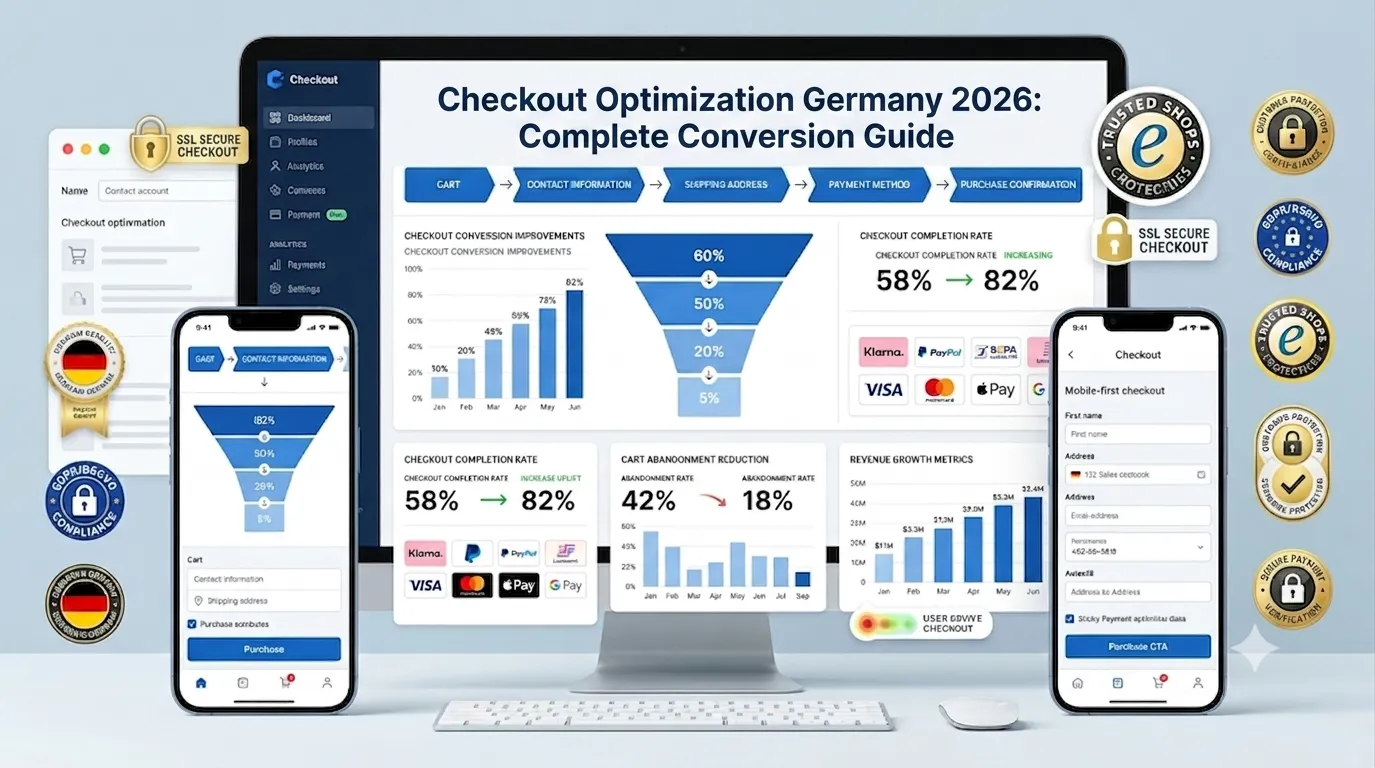
Checkout is the moment of truth in e-commerce. Where 15–30% of users who reached this point abandon. For German e-commerce in 2026, checkout optimization combines technical (fast load, mobile UX), psychological (trust, security), legal (German compliance), and payment-method (SEPA/Klarna/PayPal) considerations. A well-optimized checkout can lift conversion 20–40% over default platform checkouts.
This guide walks through what checkout optimization Germany for e-commerce actually requires in 2026: structural decisions (one-page vs multi-step), guest checkout, payment method mix, trust signals, mobile UX, and common mistakes.
For broader e-commerce see our e-commerce conversion rate Germany guide.
What’s the German checkout structure debate?
Two main approaches:
One-page checkout
All fields on single page. User scrolls + fills.
Pros:
- No transition between steps
- Faster for repeat customers
- Simpler implementation
Cons:
- Can feel overwhelming
- Hard to track step-level abandonment
- Mobile UX challenging
Multi-step checkout
3-4 steps. Each step focused.
Pros:
- Less overwhelming
- Progress indicator psychological reward
- Better step-level analytics
- Better mobile UX
Cons:
- More clicks required
- Transitions can lose users
- Implementation more complex
For German market
Multi-step checkout typically wins. German users prefer structured, clear progression.
What German checkout elements are essential?
12 critical elements:
1. Guest checkout option
Don’t force account creation.
2. Multiple payment methods visible
SEPA, Klarna, PayPal, cards, Apple/Google Pay icons.
3. Order summary
Itemized + visible throughout checkout.
4. Address autofill
Both shipping + billing.
5. Trust signals
Trusted Shops, SSL, secure payment badges.
6. Versandkosten transparency
Per §312j BGB.
7. MwSt display
“inkl. MwSt.” labels.
8. Widerrufsbelehrung accessible
Right of withdrawal visible.
9. AGB acceptance
Pre-checkout checkbox.
10. Mobile-optimized
Touch targets, mobile keyboards.
11. Express checkout options
Apple Pay, Google Pay, Klarna Express.
12. Clear final CTA
“Jetzt kaufen” or “Bestellen.
For German legal compliance see our Germanized for Shopify guide.
What about guest checkout?
Critical for German market:
Why force account creation hurts
20–40% of buyers abandon when forced to create account.
Why offer guest checkout
Captures impulse buyers + first-time visitors. Account can be created after purchase.
Best practice
Default to guest checkout. Optional account creation field at end.
Returning customer convenience
Offer login for known customers but don’t require.
What payment method order matters?
Strategic positioning:
For German B2C
- Klarna (most popular for many buyers)
- SEPA Lastschrift
- PayPal
- Credit/debit cards
- Apple Pay / Google Pay (mobile)
Pre-select default to “most popular”
Reduces friction.
Express options at top
Apple Pay / Google Pay if eligible.
Logo prominence
Payment method icons visible before user clicks payment step.
For payment depth see our Shopify SEPA guide, Shopify Klarna guide, Shopify PayPal guide.
What’s mobile checkout optimization?
Mobile = 60–80% of e-commerce traffic in Germany 2026:
Mobile-specific patterns
- Apple Pay / Google Pay prominent
- Sticky CTA always visible
- Fewer fields visible at once
- Larger touch targets (44px+)
- Numeric keyboards for phone/numbers
- Email keyboards for email fields
Mobile-specific failures
- Tiny tap targets
- Form fields too small for thumb-typing
- Trust signals only visible on scroll
- Payment options buried
For mobile see our mobile conversion optimization guide (forthcoming, #154).
What trust signals work at checkout?
Five essential signals:
Trusted Shops badge
Near payment button. Major German trust signal.
SSL certificate icon
Browser shows by default. Reinforce with badge.
Money-back guarantee
If applicable. Reduces commitment friction.
24/7 customer service
Phone + chat options visible.
Secure payment icons
Visa Secure, Mastercard Identity Check logos.
For trust signal depth see our trust signals conversion guide (forthcoming, #152).
What about address handling?
German address specifics:
Address autocomplete
Use browser autofill (autocomplete attributes) + Google Places API where useful.
PLZ (Postleitzahl) lookup
5-digit ZIP → auto-fill city. Saves time.
Country pre-select
Germany default. Don’t force selection.
Separate house number field
Common German pattern: Straße + Hausnummer. Different from US.
Adressergänzung field
Optional. For c/o or apartment numbers.
What’s the checkout flow optimization?
A 7-step optimization process:
Step 1: Baseline analysis
Where does checkout drop happen step-by-step?
Step 2: User research
Watch session recordings of abandoners. Survey them.n
Step 3: Quick wins implementation
Obvious fixes (broken validation, missing payment options).
Step 4: A/B test major changes
Multi-step vs single-page. Payment method order.
Step 5: Mobile-specific iterations
Focus on mobile separately.
Step 6: Trust signal positioning
Test placements.
Step 7: Continuous monitoring
Watch for regression. Iterate.
For broader CRO process see our CRO services Germany guide.
What are common German checkout mistakes?
Seven patterns:
No SEPA / Klarna option
Loses 30–50% of German buyers who prefer these.
Force account creation
20–40% abandonment from this alone.
Hidden shipping costs
Surprise at checkout step. Triggers abandonment.
No payment method icons preview
Users don’t know payment options until reaching payment step.
Trust signals only at top
Should reinforce near payment button + submit.
Aggressive US-style urgency
“Hurry! Only 2 left!” backfires in German market.
Mobile UX as afterthought
Desktop checkout forced onto mobile. Tiny tap targets.n
What does optimized German checkout look like?
A typical winning structure:
Step 1: Contact info
Email (Guest or login option). Newsletter checkbox optional.
Step 2: Shipping address
Auto-detect country (DE). PLZ lookup for city. Apartment field optional.
Step 3: Shipping method
Options + costs visible. Free shipping threshold messaging.
Step 4: Payment method
All options visible: Klarna, SEPA, PayPal, cards, Apple/Google Pay.
Step 5: Review + submit
Order summary, T&C agreement, final CTA “Jetzt kaufen.”
Throughout
- Trust signals (Trusted Shops, SSL) visible
- Order summary persistent
- Progress indicator
- Easy back navigation
- Mobile-optimized
What does German Shopify checkout look like?
Shopify Plus + checkout extensibility allows extensive customization. See our Shopify checkout extensibility guide.
Standard Shopify allows less customization but covers basics with proper apps.
What about B2B e-commerce checkout?
Different requirements:
Net terms support
Net 14 / Net 30 invoicing for repeat B2B customers.
Purchase order numbers
PO number field at checkout.
Multi-user accounts
Buyer + approver roles.
Tax exemption
For valid USt-ID, reverse charge.
For B2B see our Shopify B2B Germany guide.
What’s the typical checkout conversion?
Industry benchmarks:
Cart-to-checkout conversion
60–80% typical. Below 60% = significant issues.
Checkout-to-purchase conversion
60–80% typical. Below 60% = checkout itself problematic.
Optimized German store
70–85% checkout-to-purchase typical.
For benchmarks see our conversion rate benchmark Germany guide.
Frequently asked questions about checkout optimization Germany
Multi-step typically wins for German market. Better mobile UX, less overwhelming, better analytics.
No. Guest checkout default. Optional account creation post-purchase.
Klarna, SEPA Lastschrift, PayPal, credit cards. Plus Apple Pay + Google Pay for mobile.
Critical at checkout. Trusted Shops, SSL, secure payment icons. Near payment button.
Larger tap targets, sticky CTA, Apple/Google Pay prominent, fewer fields per view, mobile keyboards.
Versandkosten + MwSt visible, Widerrufsbelehrung accessible, AGB acceptance, German address format.
Cart-to-checkout 60–80%. Checkout-to-purchase 60–80%. Optimized: 70–85%.
Shopify Plus + checkout extensibility for most. Custom only for unique needs.
Need help with checkout optimization?
If you’re scoping checkout CRO for your German e-commerce and want a 30-minute scoping conversation about structure + testing, book a meeting or send details via our contact page.
Need expert help? Gem Programmers provides CRO services for businesses in Germany, Austria and Switzerland. Request a free, no-obligation quote and get a clear plan with scope, timeline and price.